Elevating Data Visualization in Apps with Artificial Intelligence

As you develop and refine your applications, you’re likely looking for ways to make complex data more engaging and accessible to your users. Your goal is to create an intuitive and informative experience, and data visualization plays a significant role in achieving this. By integrating artificial intelligence into your data visualization strategies, you can unlock new possibilities for presenting insights and trends, enabling your users to make more informed decisions and driving your app’s overall success.

Key Takeaways:

  • Integrating artificial intelligence (AI) into data visualization in apps can significantly enhance user experience by providing more accurate and personalized insights, thus increasing user engagement and interaction with the application.
  • AI-driven data visualization can automate the process of identifying trends and patterns in complex data sets, allowing for faster and more informed decision-making for both businesses and individuals using the apps.
  • The use of AI in data visualization enables the creation of dynamic and interactive visualizations that adapt to the user’s preferences and behavior, offering a more intuitive and user-friendly interface.
  • AI-powered data visualization tools can handle large volumes of data from various sources, making it easier to integrate multiple data sets and provide a comprehensive view of the information, which is particularly beneficial for applications that rely on real-time data analysis.
  • By leveraging machine learning algorithms, AI can predict user needs and offer suggestions for visualization, thereby streamlining the data analysis process and making data visualization more accessible to a broader range of users, including those without extensive data analysis backgrounds.
Core Principles of AI-Enhanced Data Visualization

For effective data visualization, you need to understand how artificial intelligence enhances your visualizations, making them more informative and engaging. You can leverage AI to analyze large datasets, identify patterns, and create interactive visualizations that help you make data-driven decisions.

Machine Learning Pattern Recognition

On the basis of machine learning algorithms, you can recognize patterns in your data, enabling you to identify trends and correlations that may not be immediately apparent. You can use these insights to create more accurate and informative visualizations.

Automated Visual Optimization

After integrating AI into your data visualization process, you can automate the optimization of your visualizations, ensuring that they are tailored to your specific needs and audience. You can use AI to adjust colors, layouts, and other visual elements to create a more effective and engaging visualization.

Visualization is a key aspect of your data analysis, and automated visual optimization can help you refine your visualizations to better communicate your findings. You can use AI to experiment with different visualization types, such as bar charts, scatter plots, or heat maps, to determine which one best conveys your message, allowing you to focus on interpreting your data and making informed decisions.

Smart Color and Layout Systems

Some of the most effective ways to elevate data visualization in apps involve leveraging artificial intelligence to create more intuitive and engaging user experiences, and you can achieve this by incorporating smart color and layout systems that adapt to your needs.

Dynamic Color Palette Generation

Between the various options available, AI-powered tools can help you generate dynamic color palettes that enhance your data visualization, allowing you to focus on the insights that matter most to your work.

Contextual Space Utilization

Among the key benefits of smart layout systems is their ability to optimize the use of space in your app, ensuring that your data visualizations are clear and easy to understand, and you can use this to your advantage to create more effective dashboards and reports.

Consequently, as you probe deeper into contextual space utilization, you will find that AI can help you create layouts that automatically adjust to the size and complexity of your data, allowing you to make the most of your screen real estate and present your insights in a more compelling and accessible way, which can significantly enhance your ability to extract valuable information from your data and make informed decisions based on your findings.

Predictive Analytics Visualization

Once again, you can leverage AI to enhance your data visualization capabilities, particularly with predictive analytics. You can explore Top 5 AI Tools for Data Visualization to Consider in 2025 to discover the latest trends and tools.

Real-time Data Forecasting

About to make informed decisions, you need real-time data forecasting to analyze current trends and predict future outcomes, enabling you to adjust your strategy accordingly.

Trend Pattern Highlighting

Predictive analytics helps you identify trend patterns in your data, allowing you to make data-driven decisions and stay ahead of the competition.

Realtime trend pattern highlighting enables you to respond quickly to changes in your data, giving you a competitive edge in the market, and you can use this insight to optimize your business strategies and improve your overall performance.

Interactive Intelligence

All aspects of your app’s data visualization can be enhanced with artificial intelligence, enabling you to create a more engaging and personalized experience for your users.

User Behavior Adaptation

Along with AI-driven insights, you can adapt your app’s data visualization to your users’ behavior, providing them with a tailored experience that meets their specific needs and preferences.

Responsive Design Elements

Beside the personalized experience, you can also use AI to optimize your app’s design elements, such as layout and visuals, to ensure a seamless user experience across various devices and platforms.

The responsive design elements in your app can be further enhanced by using AI to analyze user interactions and adjust the layout, color scheme, and other visual elements to create a more intuitive and engaging experience, allowing you to make data-driven decisions to improve your app’s overall performance and user satisfaction.

Performance Optimization

Not all data visualization apps are created equal, and you’ll need to consider performance optimization to ensure your app runs smoothly, especially when dealing with large datasets.

Data Processing Efficiency

The effectiveness of your app’s data processing capabilities will directly impact user experience, and you should focus on streamlining your data pipelines to minimize latency and maximize throughput, allowing your app to handle complex data with ease, so you can provide your users with a seamless experience.

Rendering Techniques

With the right rendering techniques, you can significantly improve your app’s performance, and you should explore various options, such as hardware acceleration and caching, to optimize the visualization process, enabling your app to render complex visualizations quickly and efficiently, so you can deliver high-quality results to your users.

Hence, as you probe deeper into rendering techniques, you’ll discover that leveraging AI-powered rendering engines can help you achieve even better performance, allowing your app to adapt to different hardware configurations and user preferences, so you can provide a personalized experience that meets your users’ unique needs, and you can focus on creating engaging and informative visualizations that drive insights and decision-making.

Accessibility and Inclusivity

To create an inclusive app, you need to consider the diverse needs of your users. This involves incorporating features that cater to different abilities and preferences, ensuring that everyone can effectively engage with your data visualizations.

AI-Driven Accessibility Features

Among the various tools at your disposal, AI-driven accessibility features can significantly enhance the user experience. You can leverage AI to generate alt-text for images, provide audio descriptions, and offer personalized font sizes and colors, making your app more accessible to a broader audience.

Multi-format Presentation

Inclusivity is key when presenting data, and offering multiple formats is an effective way to achieve this. You can use AI to generate different formats, such as text, images, and audio, allowing users to choose the format that best suits their needs.

But as you explore deeper into multi-format presentation, you’ll find that it’s not just about providing alternative formats, but also about ensuring that each format is optimized for the user’s device and preferences. You can use AI to analyze user behavior and adapt the presentation format accordingly, creating a more personalized and engaging experience for your users.

To wrap up

Now that you’ve explored the potential of artificial intelligence in elevating data visualization in apps, you can enhance your user experience by leveraging AI-driven insights. You will be able to create more engaging and informative visualizations, allowing your users to make data-driven decisions. With AI, your apps will provide more accurate and personalized experiences, setting you apart from the competition and driving your business forward. You can now unlock new possibilities for your apps with AI-powered data visualization.

FAQ

Q: What role does Artificial Intelligence play in elevating data visualization in apps?

A: Artificial Intelligence (AI) plays a significant role in elevating data visualization in apps by enabling the automatic generation of insights and patterns from complex data sets. AI-powered algorithms can analyze large volumes of data, identify trends, and create interactive and dynamic visualizations that help users understand the data more effectively. This leads to better decision-making and improved user experience. Additionally, AI-driven data visualization can adapt to user behavior and preferences, providing personalized insights and recommendations.

Q: How can developers integrate Artificial Intelligence into their data visualization tools to enhance user engagement?

A: Developers can integrate Artificial Intelligence into their data visualization tools by utilizing machine learning libraries and frameworks that provide pre-built functions for data analysis and visualization. They can also use natural language processing (NLP) to enable users to interact with data visualizations using voice or text commands. Furthermore, developers can leverage AI-powered analytics platforms that offer automated data storytelling and insights generation, allowing users to explore data in a more intuitive and engaging way. By integrating AI, developers can create data visualizations that are not only informative but also interactive and immersive.

Q: What are the potential benefits of using Artificial Intelligence in data visualization for business intelligence and decision-making?

A: The potential benefits of using Artificial Intelligence in data visualization for business intelligence and decision-making are numerous. AI-powered data visualization can help businesses identify new opportunities, predict market trends, and optimize operations by uncovering hidden patterns and correlations in data. Additionally, AI-driven data visualization can facilitate faster decision-making by providing real-time insights and recommendations, enabling businesses to respond quickly to changing market conditions. Moreover, AI can help reduce the risk of human error in data analysis, providing more accurate and reliable insights that inform strategic business decisions. Overall, the integration of AI in data visualization can lead to improved business outcomes, increased competitiveness, and enhanced innovation.

Creating Intelligent Game Apps with Machine Learning

As you investigate into the world of game development, you’re likely exploring ways to make your apps more engaging and interactive. You can leverage machine learning to create intelligent game apps that adapt to your users’ behavior, offering a personalized experience. With machine learning, you can develop games that learn from user interactions, making them more challenging and enjoyable. Your goal is to craft an immersive experience, and machine learning can help you achieve that.

Key Takeaways:

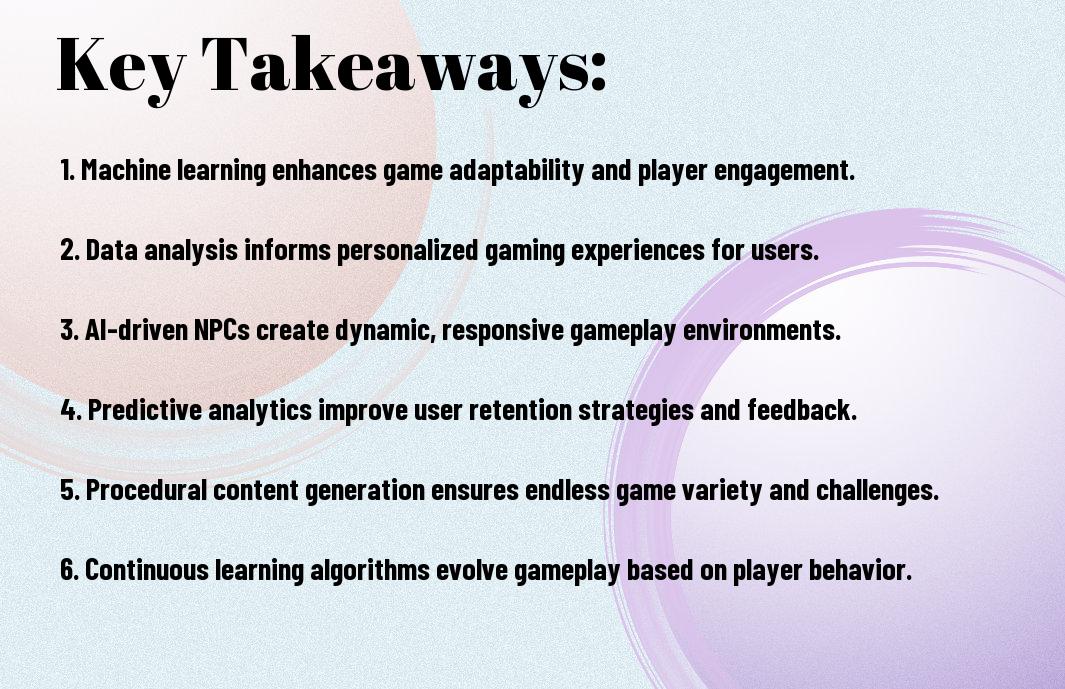
  • Machine learning can be used to create personalized gaming experiences by analyzing player behavior and adapting the game difficulty and content accordingly, leading to increased player engagement and retention.
  • Integrating machine learning into game development enables the creation of more realistic non-player characters (NPCs) that can learn from player interactions and make decisions based on that data, enhancing the overall gaming experience.
  • Machine learning algorithms can be applied to game data to predict player churn, allowing developers to proactively address issues and improve player satisfaction, ultimately reducing the risk of losing players to competing games.
  • The use of machine learning in game development can also facilitate the automation of tasks such as content generation, testing, and optimization, freeing up resources for more creative and high-level tasks.
  • By leveraging machine learning, game developers can gain valuable insights into player preferences and behavior, enabling them to make data-driven decisions and create more successful and profitable games.

Machine Learning Foundations for Game Development

For your game app to be intelligent, you need to understand the basics of machine learning and how it can be applied to game development, enabling you to create more engaging and dynamic experiences for your users.

Core ML Algorithms for Games

Games that incorporate machine learning rely on algorithms such as decision trees and neural networks to make predictions and decisions, allowing you to create more realistic and responsive game environments that adapt to your players’ behaviors.

Data Collection and Processing

To develop effective machine learning models for your game, you will need to collect and process large amounts of data, which can include player behavior, game metrics, and user feedback, enabling you to train your models and improve your game’s performance.

And as you examine deeper into data collection and processing, you will discover that it involves not only gathering data but also cleaning, transforming, and preparing it for use in your machine learning models, which can be a time-consuming task, but ultimately allows you to create more personalized and engaging experiences for your players.

Neural Networks in Game Design

Now that you’re exploring machine learning in game development, you’ll discover how neural networks can enhance your game design, enabling you to create more realistic and engaging experiences for your players.

Deep Learning Architecture

Beneath the surface of neural networks lies a complex deep learning architecture that you can leverage to build sophisticated game models, allowing you to analyze and improve your game’s performance and overall player satisfaction.

Pattern Recognition Systems

Towards the goal of creating intelligent game apps, you’ll utilize pattern recognition systems to identify and analyze player behavior, enabling you to make data-driven decisions and optimize your game for better user engagement and retention.

Architecture of pattern recognition systems involves designing and training models that can learn from your players’ actions and adapt to their behavior, enabling you to create a more personalized and immersive experience, and as you probe deeper into this technology, you’ll find that your game becomes increasingly responsive to your players’ needs and preferences.

Player Behavior Analysis

Not surprisingly, analyzing player behavior is key to creating engaging game apps. You can learn more about how to make a machine learning game that adapts to your players’ needs. By leveraging machine learning, you can gain valuable insights into your players’ behavior and preferences.

Predictive Analytics

Among the various techniques used in player behavior analysis, predictive analytics stands out. You can use predictive models to forecast player behavior, identifying patterns and trends that inform your game development decisions.

Adaptive Difficulty Systems

Any game app can benefit from adaptive difficulty systems, which adjust the level of challenge based on your players’ skills and performance. You can use machine learning algorithms to create adaptive systems that keep your players engaged and motivated.

It is worth noting that adaptive difficulty systems can be particularly effective in enhancing the overall gaming experience. You can use data and analytics to adjust the difficulty level in real-time, ensuring that your players are always challenged but not overwhelmed. By doing so, you can increase player retention and encourage players to continue playing your game.

Game AI Implementation

Unlike traditional game development, implementing game AI with machine learning requires a deep understanding of algorithms and data analysis, allowing you to create more realistic and engaging gameplay experiences, as you research into the world of intelligent game apps.

Decision-Making Algorithms

Beneath the surface of game AI lies the complexity of decision-making algorithms, which enable you to create characters that can think and act like humans, making your game more immersive and interactive, as you explore the possibilities of machine learning in game development.

Real-time Learning Models

Alongside the development process, you’ll find that real-time learning models are necessary for creating adaptive gameplay, allowing you to adjust difficulty levels and gameplay mechanics on the fly, making your game more dynamic and responsive to your players’ actions.

But as you implement real-time learning models, you’ll need to consider the trade-offs between complexity and performance, ensuring that your game runs smoothly and efficiently, while still providing an engaging and challenging experience for your players, and you’ll need to balance these factors to create a truly intelligent game app that sets your game apart from others in the market.

Performance Optimization

Once again, you’ll need to focus on optimizing your game app’s performance to ensure a seamless user experience, as machine learning integration can be resource-intensive, affecting your app’s speed and overall performance.

Resource Management

Beneath the surface of your game app, you’ll find that efficient resource management is key to preventing performance issues, and you can achieve this by allocating resources wisely and minimizing waste.

Scaling Solutions

Between the demands of machine learning and the growth of your user base, you’ll need to find scaling solutions that can handle increased traffic and computational requirements, ensuring your app remains stable and responsive.

Even with the right scaling solutions in place, you’ll still need to monitor your app’s performance closely, as you’ll be able to identify areas for improvement and make data-driven decisions to further optimize your app’s performance, ultimately enhancing the overall user experience and driving engagement.

Testing and Deployment

To ensure your game app functions as intended, thorough testing and deployment strategies are necessary. You will need to consider various factors, including user experience and performance, to guarantee a smooth launch.

Quality Assurance Methods

Around this stage, you should be focusing on identifying and fixing bugs, as well as optimizing your app’s overall quality. You can utilize methods such as user testing and feedback to refine your app.

Continuous Integration

Above all, automating your testing process is key to efficient deployment. You can use tools to streamline your workflow, ensuring that your app is always up-to-date and functioning correctly.

It is vital to note that continuous integration involves regularly integrating your code changes into a central repository, allowing you to catch and fix errors early on. You can then use this process to automate testing, ensuring that your app meets the required standards before each release, and you can confidently deploy your game app to your users.

To wrap up

So, as you initiate on creating intelligent game apps with machine learning, you will discover the vast potential it holds. You can develop apps that adapt to your users’ behavior, offering a unique experience. With your skills and knowledge, you can craft engaging games that set your app apart from others, enhancing your users’ overall experience and driving your success in the gaming industry. You will be able to create innovative apps that captivate your audience.

FAQ

Q: What are the key benefits of using machine learning in game app development?

A: The integration of machine learning in game app development offers several benefits, including enhanced user experience through personalized gameplay, adaptive difficulty levels, and dynamic content generation. Machine learning algorithms can analyze player behavior, preferences, and performance, enabling the game to adjust its challenges and rewards accordingly. This leads to increased player engagement, retention, and overall satisfaction. Furthermore, machine learning can help in predictive analytics, allowing developers to forecast player behavior, identify potential issues, and make data-driven decisions to improve the game.

Q: How can machine learning be used to create more realistic and engaging game characters and environments?

A: Machine learning can be utilized to create more realistic and engaging game characters and environments through various techniques such as procedural content generation, physics engines, and character animation. For instance, generative models like Generative Adversarial Networks (GANs) can generate realistic textures, terrains, and objects, while reinforcement learning can be used to create more realistic character movements and behaviors. Additionally, machine learning-based physics engines can simulate complex interactions between objects, characters, and environments, resulting in a more immersive and realistic gaming experience.

Q: What are the challenges and limitations of implementing machine learning in game app development, and how can they be addressed?

A: Implementing machine learning in game app development poses several challenges and limitations, including data quality and availability, computational resources, and interpretability of machine learning models. To address these challenges, developers can focus on collecting and preprocessing high-quality data, optimizing machine learning models for mobile devices, and using techniques like model pruning and knowledge distillation to reduce computational requirements. Moreover, developers can use techniques like feature attribution and model interpretability to understand how machine learning models are making decisions, ensuring that the game behaves as intended and providing a fair and enjoyable experience for players.

The Essential Toolkit for Building AI-Enhanced Applications

As you launch on building AI-enhanced applications, you’ll need a solid foundation to ensure success. Your goal is to create intelligent, efficient, and scalable solutions that meet your users’ needs. To achieve this, you require a well-rounded toolkit that includes the right technologies, frameworks, and techniques. You will learn about the must-have tools and technologies that will help you develop innovative AI-enhanced applications, and how to leverage them to drive your project forward, in this post.

Key Takeaways:

  • Building AI-enhanced applications requires a solid understanding of machine learning fundamentals, including data preparation, model training, and deployment.
  • A well-designed toolkit for AI-enhanced applications should include a range of technologies, such as natural language processing, computer vision, and predictive analytics.
  • Effective integration of AI capabilities into applications depends on the ability to collect, process, and analyze large datasets, as well as to deploy models in a scalable and secure manner.
  • A key aspect of building successful AI-enhanced applications is the ability to balance technical complexity with user-centered design, ensuring that AI-driven features are intuitive and accessible to end-users.
  • Continuous monitoring and evaluation of AI-enhanced applications is necessary to ensure they are functioning as intended, and to identify areas for improvement and further development.

Core AI Development Components

A solid foundation in AI development is important for building effective AI-enhanced applications, and you will need to familiarize yourself with the key components that drive this technology, including machine learning frameworks and neural network libraries, to create your own AI-enhanced applications.

Machine Learning Frameworks

Between the various tools and technologies available, you will find that machine learning frameworks such as TensorFlow and PyTorch are among the most popular choices for building and deploying AI models, allowing you to focus on developing your application’s logic.

Neural Network Libraries

Behind the scenes, neural network libraries like Keras and Caffe provide the necessary functionality for building and training neural networks, enabling you to create complex AI models that can be integrated into your applications, and you can leverage these libraries to simplify your development process.

Indeed, as you explore deeper into the world of neural network libraries, you will discover a wide range of tools and resources that can help you optimize your AI models, from data preprocessing to model deployment, and by utilizing these libraries effectively, you can significantly improve the performance and accuracy of your AI-enhanced applications, allowing you to create more sophisticated and intelligent systems that can drive business value and innovation.

Data Processing Infrastructure

While building AI-enhanced applications, you need a robust data processing infrastructure to handle large volumes of data. Your infrastructure should be scalable, secure, and efficient to support your application’s growth.

Data Collection Tools

Alongside other tools, you will need data collection tools to gather relevant data for your application. You can utilize web scraping, APIs, or data warehouses to collect data, depending on your specific needs.

Data Cleaning Solutions

Beneath the surface of your data processing infrastructure, you will need data cleaning solutions to ensure your data is accurate and reliable. You can use data validation, data normalization, and data transformation to clean your data.

But as you research deeper into data cleaning, you will find that it involves handling missing values, removing duplicates, and dealing with outliers. You can use machine learning algorithms or statistical methods to identify and correct errors in your data, ensuring that your AI-enhanced application makes informed decisions based on high-quality data.

Integration Essentials

Your application’s success relies on seamless integration with various tools and services, and having the right integration vitals in your toolkit is vital for building AI-enhanced applications that meet your needs.

API Development Tools

For developing robust APIs, you will need tools that support your API development lifecycle, from design to deployment, and allow you to create scalable and secure APIs that integrate with your AI-enhanced applications.

Cloud Service Connectors

Above all, cloud service connectors play a significant role in integrating your application with cloud services, enabling you to leverage the power of cloud computing and artificial intelligence to enhance your application’s capabilities.

For instance, when you use cloud service connectors, you can easily integrate your application with popular cloud services such as AWS or Google Cloud, and access a wide range of AI and machine learning services, such as natural language processing, computer vision, and predictive analytics, to build more intelligent and interactive applications that meet your specific needs.

Security and Privacy Tools

Keep your AI-enhanced applications secure with the right tools, you can protect your users’ data and prevent potential threats, ensuring the integrity of your system and maintaining your users’ trust in your application.

Data Protection Frameworks

The foundation of a secure application lies in a robust data protection framework, you will need to implement policies and procedures that ensure the confidentiality, integrity, and availability of your users’ data, and you can use established frameworks to guide your efforts.

Authentication Systems

By implementing robust authentication systems, you can ensure that only authorized users have access to your application and its data, and you can use various authentication methods to verify user identities and prevent unauthorized access.

Indeed, authentication systems are a key component of your application’s security, and you should consider using multi-factor authentication, biometric authentication, or other advanced methods to provide an additional layer of security, and you can also use machine learning algorithms to detect and prevent authentication attempts that may be malicious or unauthorized.

Performance Optimization

Now that you have developed your AI-enhanced application, it’s time to focus on performance optimization to ensure seamless user experience and efficient resource utilization.

Model Compression Tools

Condensing your AI models is necessary to reduce computational overhead, and you can achieve this using various model compression tools that help simplify your models without compromising their accuracy.

Runtime Optimization Solutions

After deploying your application, you’ll need to monitor its performance and optimize it at runtime to adapt to changing usage patterns and hardware configurations, which can be achieved using specialized runtime optimization solutions.

In fact, these solutions enable you to fine-tune your application’s performance in real-time, allowing you to identify and address bottlenecks, and make data-driven decisions to improve your application’s overall efficiency and scalability, ensuring your users have a responsive and engaging experience with your AI-enhanced application.

Testing and Monitoring

For building AI-enhanced applications, you need to ensure that your models are functioning as expected, and your system is performing optimally, which is where testing and monitoring come in, allowing you to identify and fix issues before they affect your users.

AI Model Testing Suites

One of the key components of testing is utilizing AI model testing suites, which provide you with a comprehensive set of tools to evaluate your models’ performance, accuracy, and reliability, enabling you to refine and improve them.

Performance Monitoring Tools

After deploying your application, you will need performance monitoring tools to track its performance, identify bottlenecks, and optimize its efficiency, which is important for delivering a seamless user experience and maintaining your application’s overall health.

Monitoring your application’s performance in real-time allows you to quickly respond to issues, make data-driven decisions, and continuously improve your system, ensuring that your users receive the best possible experience, and your application operates at its full potential, which is important for your business’s success, and you can achieve this by leveraging the right performance monitoring tools.

Conclusion

Hence, as you begin on building AI-enhanced applications, you will find that having the right toolkit is vital to your success. You will be able to develop innovative solutions that meet your needs, leveraging the power of AI to drive your projects forward. With your newfound knowledge, you can create applications that transform your business and stay ahead of the curve, making the most of your investment in AI technology and maximizing your returns.

FAQ

Q: What is The Essential Toolkit for Building AI-Enhanced Applications and how does it support developers?

A: The Essential Toolkit for Building AI-Enhanced Applications is a comprehensive suite of tools designed to help developers create, deploy, and manage artificial intelligence (AI) and machine learning (ML) models within their applications. This toolkit provides a wide range of functionalities, including data preparation, model training, and model deployment, along with integration capabilities that allow developers to seamlessly embed AI-enhanced features into their software products. By leveraging this toolkit, developers can accelerate the development process, improve the accuracy of AI models, and enhance the overall user experience of their applications.

Q: What kind of support and resources are available for developers using The Essential Toolkit for Building AI-Enhanced Applications?

A: Developers using The Essential Toolkit for Building AI-Enhanced Applications have access to a variety of support resources and tools. These include extensive documentation, tutorials, and guides that cover every aspect of the toolkit, from initial setup to advanced model tuning. Additionally, a community forum and dedicated support team are available to address any questions or issues that may arise during the development process. Regular updates and new feature releases ensure that developers have the latest technologies and methodologies at their disposal, allowing them to stay at the forefront of AI-enhanced application development.

Q: How does The Essential Toolkit for Building AI-Enhanced Applications ensure the security and privacy of data used in AI model training and deployment?

A: The Essential Toolkit for Building AI-Enhanced Applications prioritizes the security and privacy of data used in AI model training and deployment through several robust measures. It incorporates advanced encryption technologies to protect data both in transit and at rest. Additionally, the toolkit is designed with privacy by design principles, ensuring that data collection, storage, and processing adhere to stringent privacy standards. Developers can also leverage the toolkit’s built-in access controls and auditing capabilities to manage who has access to sensitive data and monitor all interactions with the data. This comprehensive approach to security and privacy enables developers to build trust with their users and comply with regulatory requirements.

From AI Models to Market – Developing Innovative App Solutions

As you investigate into the world of artificial intelligence, you’re likely exploring ways to transform your ideas into reality. You’re looking to develop innovative app solutions that integrate AI models, driving your business forward. Your goal is to create applications that not only meet but exceed user expectations, leveraging the power of AI to enhance functionality and user experience. You’re on the verge of discovering how to successfully transition from AI models to market, and this journey begins with understanding the development process.

Key Takeaways:

  • Developing innovative app solutions with AI models requires a deep understanding of the target market and user needs to create effective and engaging applications.
  • Successful AI-powered apps rely on high-quality data and robust model training to deliver accurate and reliable results, enhancing user experience and trust.
  • Effective integration of AI models into app development involves balancing complexity with simplicity, ensuring that the technology enhances the user interface without overwhelming it.
  • Continuous testing and iteration are important for refining AI-driven app solutions, addressing potential biases, and adapting to evolving user expectations and technological advancements.
  • Collaboration between data scientists, developers, and designers is vital for creating seamless and intuitive AI-powered apps that meet market demands and provide a competitive edge.

AI Model Foundation

To develop innovative app solutions, you need a solid AI model foundation. This foundation is the backbone of your app, enabling it to learn, adapt, and improve over time. You will build upon this foundation, integrating various technologies and frameworks to create a robust and efficient app.

Core Technologies and Frameworks

Besides the AI model itself, you will need to consider the core technologies and frameworks that support it. You will have to choose from a range of options, including machine learning libraries, deep learning frameworks, and natural language processing tools, to name a few.

Model Selection and Integration

Before selecting an AI model, you need to consider your app’s specific requirements and goals. You should evaluate different models, considering factors such as accuracy, scalability, and compatibility, to ensure you choose the best fit for your app.

Even as you select and integrate your AI model, you should consider how it will interact with other components of your app. You will need to ensure seamless integration, optimizing performance and user experience, and continually monitor and refine your model to ensure it meets your app’s evolving needs.

Market Research and Validation

You need to conduct thorough market research to validate your app idea, ensuring it meets the needs of your target audience and stands out in a competitive landscape. This involves gathering data and insights to inform your development process.

Target Audience Analysis

Among the key considerations is understanding your target audience’s demographics, preferences, and behaviors, which will help you tailor your app to their needs and create a user-centric experience that drives engagement and adoption.

Competitive Landscape Assessment

About your competitors, you should analyze their strengths, weaknesses, and market strategies to identify gaps and opportunities for differentiation, allowing you to position your app uniquely and effectively.

Further analysis of the competitive landscape will help you stay ahead of the curve, as you’ll be able to anticipate and respond to market trends, customer needs, and emerging technologies, ultimately giving your app a competitive edge and increasing its chances of success in the market.

Development Strategy

Your development strategy is key to transforming AI models into successful app solutions, and it involves several steps that you need to follow to ensure the project’s success.

Technical Architecture Planning

Strategically, you will need to plan your technical architecture to support the integration of AI models into your app, considering factors such as scalability and security.

Resource Allocation

Across various stages of development, you will need to allocate resources effectively, including personnel, infrastructure, and budget, to ensure that your project stays on track.

Due to the complexity of AI-powered app development, you will need to carefully manage your resources to avoid delays and cost overruns, and to ensure that your app meets the required standards of quality and performance, you should prioritize your resources based on the specific needs of your project.

App Design and User Experience

Despite the complexity of AI models, your app’s design and user experience play a significant role in its success. You need to create an intuitive and engaging interface that simplifies the interaction between users and your AI-powered app.

Interface Design Principles

One key aspect of app design is adhering to established interface design principles, which you can use to create a consistent and user-friendly experience, making it easier for your users to navigate and utilize your app’s features.

User Journey Mapping

Journey through your app from your users’ perspective, and you will identify areas that need improvement, allowing you to refine your design and create a seamless experience that meets their needs and expectations.

Consequently, as you examine deeper into user journey mapping, you will uncover opportunities to streamline processes, reduce friction points, and ultimately increase user satisfaction, which is crucial for the long-term success of your app, and you will be able to make data-driven decisions to inform your design and development process.

Implementation Process

Many factors contribute to a successful implementation process, and you will need to consider several key elements when developing your app solution. You must ensure that your development team is well-versed in the latest technologies and trends to bring your innovative idea to life.

Development Phases

Against the backdrop of rapid technological advancements, you will need to break down your development process into manageable phases, allowing you to focus on specific aspects of your app, such as design, functionality, and user experience.

Quality Assurance Methods

Phasing out errors and bugs is an important part of the development process, and you will need to implement robust quality assurance methods to ensure your app meets the highest standards, providing your users with a seamless and enjoyable experience.

Due to the complexity of AI-powered apps, you will need to invest time and resources into thorough testing and debugging, leveraging techniques such as alpha and beta testing to identify and fix issues before launch, ultimately ensuring that your app is stable, secure, and functions as intended, meeting your users’ expectations and solidifying your reputation as a developer of high-quality app solutions.

Market Launch Strategy

All aspects of your app’s development are complete, and now it’s time to bring it to the market. You need a solid plan to ensure a successful launch, considering factors like target audience, marketing channels, and budget.

Go-to-Market Planning

Any successful launch begins with a well-thought-out plan, and you should define your goals, identify your target audience, and outline your marketing strategy to achieve a strong market presence.

Distribution Channels

Across various platforms, you can distribute your app, and selecting the right channels is vital for your app’s visibility and accessibility, allowing you to reach a broader audience.

Strategy for distribution channels involves evaluating the most suitable options for your app, such as app stores, websites, or social media, and you should consider factors like fees, target audience, and competition to maximize your app’s reach and downloads.

To wrap up

With this in mind, you now have a comprehensive understanding of developing innovative app solutions from AI models to market. You can leverage your knowledge to create cutting-edge apps that transform your business. To stay ahead, explore the Top AI Tools Revolutionizing App Development in 2025 and discover how you can utilize them to enhance your app development process, driving your business forward with your innovative solutions.

FAQ

Q: What are the key steps involved in developing innovative app solutions from AI models?

A: The key steps involved in developing innovative app solutions from AI models include identifying a specific problem or opportunity, selecting a suitable AI model, designing a user-friendly interface, integrating the AI model with the app, testing and refining the app, and deploying it to the market. This process requires collaboration between data scientists, software developers, and business stakeholders to ensure that the app meets the needs of its target audience and provides a seamless user experience.

Q: How can businesses ensure that their AI-powered app solutions are scalable and secure?

A: To ensure that AI-powered app solutions are scalable and secure, businesses should implement robust infrastructure, use cloud-based services, and follow best practices for data protection and encryption. Additionally, they should conduct thorough testing and validation to identify potential vulnerabilities and address them before the app is deployed. It is also important to have a plan in place for monitoring and updating the app regularly to prevent security breaches and ensure that it continues to meet the evolving needs of its users.

Q: What role does user experience play in the development of successful AI-powered app solutions?

A: User experience plays a vital role in the development of successful AI-powered app solutions. A well-designed user interface can make the app more intuitive and engaging, while a poorly designed interface can lead to user frustration and abandonment. Businesses should conduct user testing and gather feedback to ensure that the app is easy to use, provides relevant and timely information, and meets the needs and expectations of its target audience. By prioritizing user experience, businesses can increase user adoption and retention, drive engagement, and ultimately achieve their business goals.

Building Smart Assistant Apps with Voice AI Integration

As you consider developing innovative applications, you’re likely exploring the potential of voice AI integration. You can enhance your app’s user experience by incorporating smart assistant capabilities. To get started, you’ll want to learn about the process of creating such apps. For a comprehensive guide, you can check out How to Develop a Voice Assistant App with AI and ML for 2024, which outlines the necessary steps and technologies involved in building a successful voice assistant app.

Key Takeaways:

  • Developing smart assistant apps with voice AI integration enhances user experience by providing hands-free control and voice-activated commands, making it easier for users to interact with devices and access information.
  • Voice AI integration enables businesses to create personalized experiences for their customers, offering tailored responses and recommendations based on individual preferences and behaviors.
  • Building smart assistant apps requires a deep understanding of natural language processing (NLP) and machine learning algorithms to ensure accurate speech recognition and intent identification.
  • Effective voice AI integration involves designing intuitive voice user interfaces (VUIs) that simplify complex tasks and provide clear, concise feedback to users, reducing frustration and improving overall satisfaction.
  • As voice AI technology continues to evolve, developers must prioritize security and data protection to ensure the safe handling of sensitive user information and maintain trust in smart assistant apps.

Voice AI Fundamentals

To build effective smart assistant apps, you need to understand the basics of voice AI integration, which involves combining speech recognition, natural language processing, and machine learning to create a seamless user experience.

Speech Recognition Architecture

The foundation of voice AI lies in speech recognition, which enables your app to transcribe spoken words into text, allowing you to process and respond to user requests accurately.

Natural Language Processing Components

Against the backdrop of speech recognition, natural language processing components play a vital role in interpreting the meaning and context of user input, enabling your app to provide relevant and personalized responses.

Another key aspect of natural language processing components is their ability to analyze user intent, sentiment, and preferences, which you can leverage to create a more engaging and intuitive user experience, tailored to your users’ specific needs and behaviors.

Smart Assistant Core Elements

Now that you’re building a smart assistant app, you need to understand its core elements, which enable your app to understand and respond to user inputs, making it a powerful tool for your users.

Intent Recognition Systems

Beneath the surface of your smart assistant app, intent recognition systems play a significant role in identifying the purpose behind your users’ requests, allowing you to provide relevant responses and enhance their experience.

Response Generation Framework

The foundation of a smart assistant app lies in its response generation framework, which you can use to create human-like responses to your users’ queries, making interactions more engaging and personalized.

Generation of responses is a complex process that involves understanding the context, intent, and preferences of your users, and you can achieve this by integrating machine learning algorithms and natural language processing techniques into your response generation framework, enabling your smart assistant app to provide accurate and helpful responses.

Development Environment Setup

Not having the right development environment can hinder your progress in building smart assistant apps with voice AI integration. You will need to set up your environment with the necessary tools and configurations to get started.

Required Tools and SDKs

The tools and SDKs you choose will depend on the specific requirements of your project, and you will need to select the ones that best fit your needs, ensuring they are compatible with your development environment.

Platform Configuration

After setting up your development environment, you will need to configure your platform to work seamlessly with voice AI integration, ensuring that all components are properly connected and functioning as expected, allowing you to focus on building your app.

Further, when configuring your platform, you will need to consider factors such as speech recognition, natural language processing, and machine learning, as these will be crucial in enabling your smart assistant app to understand and respond to voice commands, and you will need to fine-tune these settings to optimize your app’s performance and user experience.

Voice Integration Implementation

Despite the complexity of voice AI integration, you can achieve seamless implementation with the right approach. You’ll need to consider various factors, including speech recognition, natural language processing, and text-to-speech synthesis, to create a robust voice integration system.

API Integration Methods

Beneath the surface of voice integration lies a range of API integration methods, which you can leverage to connect your app with voice AI services, enabling you to build a sophisticated smart assistant app with voice capabilities.

Voice Command Mapping

Alongside the technical aspects, you’ll need to define voice command mappings that allow users to interact with your app using natural language, enabling you to create an intuitive user experience.

Plus, as you research deeper into voice command mapping, you’ll discover that it involves creating a comprehensive set of voice commands that correspond to specific actions within your app, allowing you to tailor the experience to your users’ needs and preferences, and enabling you to refine your app’s voice integration to provide a more personalized and engaging experience for your users.

User Experience Design

All aspects of your smart assistant app’s user experience design should be carefully considered to ensure a seamless interaction between the user and the voice AI. You need to think about how your app will respond to user queries, and how it will handle errors or unclear inputs.

Conversation Flow Design

Across various user interactions, you should design a conversation flow that is natural and intuitive, allowing users to easily navigate through your app and access the information they need. You can achieve this by using clear and concise language, and by providing users with relevant feedback and guidance throughout the conversation.

Error Handling Protocols

Protocols for handling errors and exceptions should be established to ensure that your app can recover from unexpected user inputs or technical issues. You should consider implementing features such as retry mechanisms, error messages, and fallback options to minimize the impact of errors on the user experience.

In addition, you should also consider implementing analytics and logging mechanisms to track and analyze errors, allowing you to identify and fix issues quickly, and improve your app’s overall performance and reliability, which will help you to provide a better experience for your users.

Performance Optimization

Once again, you’ll need to focus on refining your smart assistant app’s performance to ensure a seamless user experience, and this involves fine-tuning various aspects of the voice AI integration.

Response Time Enhancement

Optimizing your app’s response time is vital, and you can achieve this by streamlining the communication between your app and the voice AI server, thereby reducing latency and enabling faster responses to user queries.

Accuracy Improvement Techniques

Along with response time, you’ll also want to implement techniques to improve the accuracy of your voice AI, such as using high-quality audio inputs and advanced speech recognition algorithms to better understand user requests.

It is imperative to note that implementing these techniques can significantly enhance your app’s overall performance, and you can achieve this by continually testing and refining your voice AI integration, allowing you to provide your users with a more accurate and efficient experience.

Final Words

So, as you conclude your journey of building smart assistant apps with voice AI integration, you now possess the knowledge to create innovative and user-friendly applications. You can leverage your skills to develop apps that make your users’ lives easier, and your expertise will enable you to stay ahead in the competitive market. With your newfound understanding, you will be able to design and implement voice AI integrated apps that meet your users’ evolving needs.

FAQ

Q: What are the key benefits of building smart assistant apps with voice AI integration?

A: Building smart assistant apps with voice AI integration offers several benefits, including enhanced user experience, increased efficiency, and improved accessibility. Voice AI integration enables users to interact with the app using natural language, making it more intuitive and user-friendly. Additionally, voice AI can help automate tasks, provide personalized recommendations, and offer real-time feedback, making the app more engaging and useful. By leveraging voice AI, developers can create more sophisticated and interactive apps that can understand and respond to user needs more effectively.

Q: What are the technical requirements for building smart assistant apps with voice AI integration?

A: To build smart assistant apps with voice AI integration, developers need to have a solid understanding of natural language processing (NLP), machine learning, and software development. They should be familiar with voice AI platforms such as Amazon Alexa, Google Assistant, or Microsoft Cortana, and have experience with programming languages like Java, Python, or C++. Additionally, developers should have access to a robust development environment, including tools like speech recognition software, text-to-speech engines, and dialogue management systems. They should also consider factors like data storage, security, and scalability to ensure a seamless user experience.

Q: How can developers ensure the security and privacy of user data when building smart assistant apps with voice AI integration?

A: Ensuring the security and privacy of user data is a top priority when building smart assistant apps with voice AI integration. Developers should implement robust security measures, such as encryption, secure authentication, and access controls, to protect user data from unauthorized access. They should also comply with relevant data protection regulations, like GDPR or CCPA, and provide transparent privacy policies that inform users about data collection and usage. Furthermore, developers should use secure communication protocols, like HTTPS, and regularly update their apps to patch vulnerabilities and prevent data breaches. By prioritizing user data security and privacy, developers can build trust with their users and create a safe and reliable smart assistant app experience.

Skip to content