As you strive to enhance your app’s user experience, you’re likely considering ways to personalize interactions and increase engagement. You can achieve this by integrating recommendation engines into your app ecosystem, allowing you to offer tailored suggestions and content to your users. By doing so, you can boost user satisfaction, drive conversions, and ultimately, grow your business. You will learn how to leverage recommendation engines to create a more intuitive and responsive app environment that meets your users’ evolving needs and expectations.

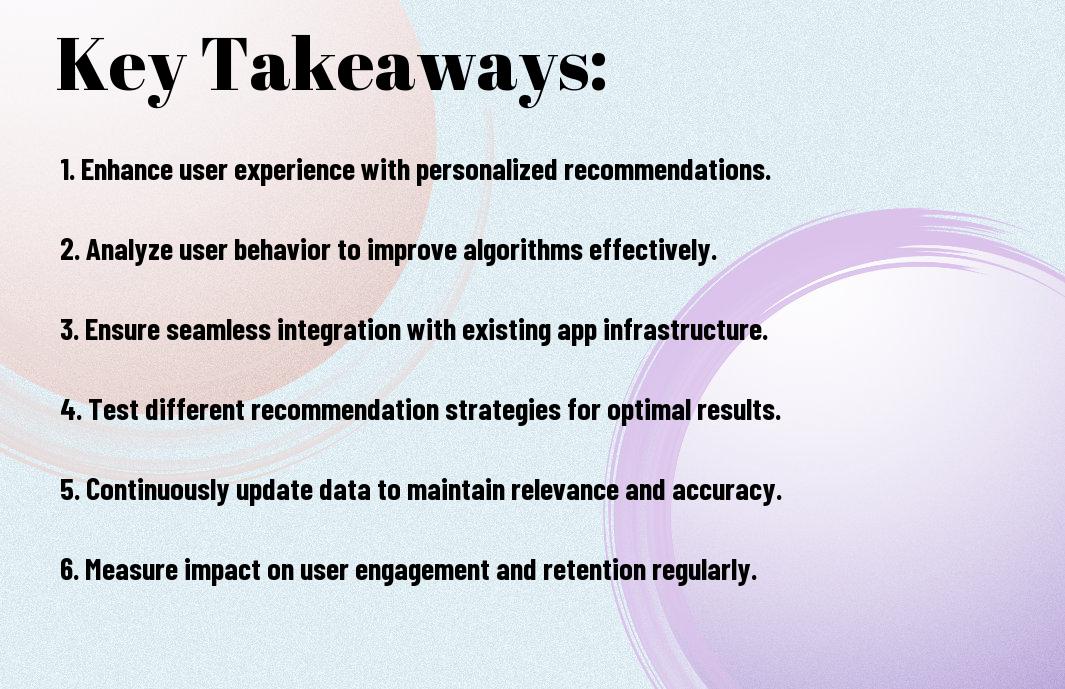
Key Takeaways:
- Personalization is key: Integrating recommendation engines into your app ecosystem allows you to provide users with tailored content and product suggestions, enhancing their overall experience and increasing engagement.
- Improved user retention: By offering relevant recommendations, you can encourage users to spend more time within your app, reducing the likelihood of them switching to competitors and ultimately driving long-term retention.
- Increased conversions: Recommendation engines can help users discover new products or services they may not have found otherwise, leading to increased sales, revenue, and overall business growth.
- Data-driven decision making: Recommendation engines rely on data and analytics to generate suggestions, providing valuable insights into user behavior and preferences that can inform future development and marketing strategies.
- Enhanced competitiveness: Incorporating recommendation engines into your app ecosystem can be a key differentiator, setting your business apart from competitors and establishing a leadership position in your market.
Core Components of Recommendation Systems
While developing a recommendation engine, you’ll encounter various components that work together to provide personalized suggestions. Your system will rely on data collection, processing, and analysis to generate recommendations.
Collaborative Filtering Methods
Around the concept of collaborative filtering, you’ll find that it involves analyzing user behavior and preferences to identify patterns and make recommendations. Your approach will depend on the type of data you collect and the algorithms you implement.
Content-Based Filtering Approaches
Often, you’ll find that content-based filtering is an effective method for recommending items with similar attributes. Your system will analyze the features of items and user preferences to provide personalized suggestions.
Components of content-based filtering approaches include attribute extraction, weighting, and scoring. You’ll need to consider the types of attributes to extract, how to weigh their importance, and how to score items based on user preferences. This will enable your system to provide accurate and relevant recommendations, enhancing your users’ experience and engagement with your app ecosystem.
Data Pipeline Architecture
Some of the most effective recommendation engines rely on a well-designed data pipeline architecture, which you can learn more about in a Step-by-Step Guide to Developing a Recommendation System Application. This will help you understand how to integrate your data pipeline with your app ecosystem.
Data Collection and Processing
With a solid data pipeline in place, you can focus on collecting and processing the data that will power your recommendation engine, allowing you to provide personalized recommendations to your users.
Feature Engineering for Recommendations
Beside the data collection, feature engineering is a key aspect of building a recommendation engine, as it enables you to extract relevant features from your data that will inform your recommendations.
Considering the complexity of feature engineering, you will need to carefully evaluate your data and select the most relevant features to include in your recommendation model, ensuring that your engine provides accurate and personalized recommendations to your users.
Integration Strategies
Unlike other components, integrating a recommendation engine into your app ecosystem requires careful planning and execution. You need to consider factors such as data flow, scalability, and user experience to ensure seamless integration.
API Design and Endpoints
Around the time you start designing your API, you should consider the endpoints that will interact with your recommendation engine, allowing you to fetch and update recommendations in real-time, enabling your app to provide personalized experiences for your users.
Service Layer Implementation
Implementation of the service layer is where you define how your app will interact with the recommendation engine, handling requests and responses, and ensuring that your app’s functionality is not compromised.
Plus, as you implement the service layer, you will need to consider factors such as data processing, caching, and error handling, to ensure that your recommendation engine is robust and efficient, providing your users with accurate and relevant recommendations, and enhancing their overall experience with your app.
Performance Optimization
Now that you have integrated a recommendation engine into your app ecosystem, you need to focus on optimizing its performance to ensure seamless user experience. You can achieve this by identifying bottlenecks and implementing strategies to mitigate them, thereby improving the overall efficiency of your app.
Caching Mechanisms
Optimally, you will want to implement caching mechanisms to store frequently accessed data, reducing the load on your servers and improving response times. You can use caching to store pre-computed recommendations, allowing your app to retrieve them quickly and efficiently.
Load Balancing Considerations
To ensure your app can handle a large volume of requests, you need to consider load balancing strategies that distribute the workload across multiple servers. You can use load balancing algorithms to route requests to the most available server, preventing any single server from becoming overwhelmed.
Further, when implementing load balancing, you should consider factors such as server capacity, network latency, and user geography to ensure that your app provides a consistent and responsive experience for all users, regardless of their location or the volume of requests being processed. You can use techniques like geo-load balancing to direct users to the nearest server, minimizing latency and improving overall performance.
Testing and Monitoring
Once again, you’ll need to evaluate your recommendation engine’s performance to ensure it’s meeting your app’s goals. This involves assessing its impact on user engagement, conversion rates, and overall satisfaction.
A/B Testing Framework
Trialing different approaches will help you refine your recommendation engine. You can test various algorithms, user interfaces, and content types to determine what works best for your users.
Performance Metrics
The key to optimizing your recommendation engine lies in tracking the right metrics. You should monitor click-through rates, conversion rates, and user retention to gauge the engine’s effectiveness.
Another aspect of performance metrics is analyzing user behavior and feedback. You can collect data on user interactions, such as likes, dislikes, and ratings, to identify areas for improvement and refine your recommendation engine to better meet your users’ needs, ultimately enhancing their overall experience with your app.
Security and Privacy
Despite the benefits of recommendation engines, you must prioritize security and privacy to maintain user trust in your app ecosystem.
Data Protection Measures
Betwixt the lines of code, you’ll need to implement robust data protection measures to safeguard user data and prevent unauthorized access.
User Consent Management
Around the issue of user consent, you should establish clear policies and procedures to ensure transparency and compliance with regulations.
And as you examine deeper into user consent management, you’ll need to consider implementing features that allow users to opt-out of data collection, provide explicit consent for specific uses, and access their personal data, giving you a clear understanding of your responsibilities in handling their information, and enabling you to make informed decisions about your app’s recommendation engine.
Conclusion
With these considerations, you can effectively integrate recommendation engines into your app ecosystem, enhancing your users’ experience. You will be able to provide personalized content, increasing user engagement and driving business growth. By leveraging recommendation engines, you can stay ahead of the competition and establish your app as a leader in its category, ultimately benefiting your business and your users.
FAQ
Q: What are the benefits of integrating a recommendation engine into my app ecosystem?
A: Integrating a recommendation engine into your app ecosystem can significantly enhance user engagement and conversion rates. By providing personalized suggestions, you can help users discover new content, products, or services that align with their interests, leading to increased satisfaction and loyalty. Additionally, recommendation engines can help you to upsell and cross-sell, resulting in increased revenue and a competitive edge in the market. With a well-implemented recommendation engine, you can also gain valuable insights into user behavior and preferences, allowing you to refine your app and improve the overall user experience.
Q: How do I choose the right recommendation engine for my app, considering factors such as data quality, scalability, and integration complexity?
A: Choosing the right recommendation engine for your app depends on several factors, including the type and quality of your data, the scalability requirements of your app, and the complexity of integration. You should consider the following: the algorithm used by the engine, the type of data it can handle (e.g., user behavior, ratings, metadata), and its ability to scale with your growing user base. It’s also important to evaluate the integration process, including the level of technical expertise required, the availability of APIs and SDKs, and the support provided by the engine’s developers. Furthermore, you should assess the engine’s flexibility and customizability to ensure it can be tailored to your app’s specific needs and goals.
Q: What are some best practices for implementing and optimizing a recommendation engine in my app to ensure maximum effectiveness and user adoption?
A: To ensure maximum effectiveness and user adoption of your recommendation engine, follow these best practices: start by collecting and preprocessing high-quality data, including user behavior, preferences, and feedback. Implement A/B testing to compare the performance of different algorithms and models, and continuously monitor and analyze user interactions with the recommendations. It’s also important to provide transparency and control to users, allowing them to understand and influence the recommendations they receive. Regularly update and refine your recommendation engine to adapt to changing user behavior and preferences, and ensure that the recommendations are contextually relevant and timely. Finally, consider using hybrid approaches that combine multiple algorithms and data sources to provide a more comprehensive and accurate recommendation experience.