Integration

8 Proven Strategies For Integrating AI Agents Into Your Business Model

As you consider enhancing your business operations, you’re likely exploring the potential of artificial intelligence (AI) to drive growth and efficiency. You’re not alone in this pursuit, as many organizations are now leveraging AI agents to streamline processes and improve customer experiences. By integrating AI into your business model, you can unlock new opportunities and stay competitive in a rapidly evolving market. This post will guide you through the process, providing you with actionable strategies to successfully incorporate AI agents into your operations.

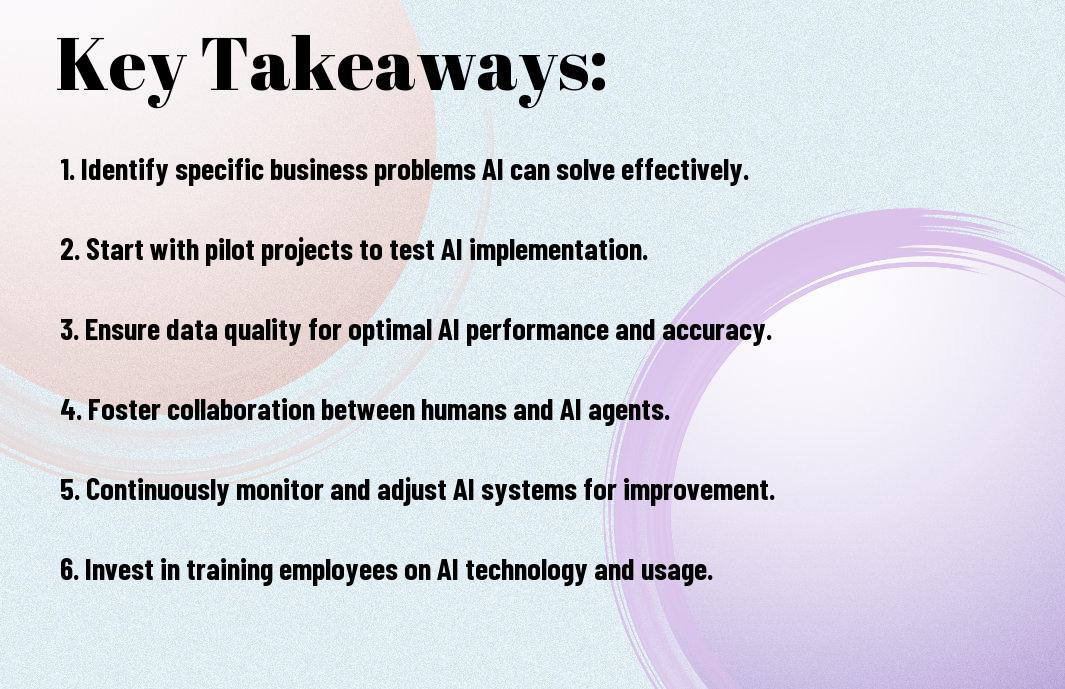
Key Takeaways:

  • Identifying the right business processes to automate with AI agents is imperative to maximize efficiency and productivity, allowing companies to focus on high-value tasks that drive growth and innovation.
  • Developing a clear understanding of AI agent capabilities and limitations is vital to successful integration, ensuring that businesses can design effective workflows and workflows that complement human skills.
  • Continuous monitoring and evaluation of AI agent performance is necessary to refine and improve their effectiveness, enabling businesses to adapt to changing market conditions and customer needs.
The AI Integration Landscape

While navigating the complex world of AI, you’ll need to consider various factors to successfully integrate AI agents into your business model, including the current state of AI technology and its applications, as well as your own business needs and goals.

Current Business AI Applications

Above all, you should be aware of the existing AI applications in your industry, such as chatbots, predictive analytics, and automation, to determine how you can leverage them to enhance your business operations and improve customer experience.

Market Readiness Assessment

Integrating AI into your business requires a thorough assessment of your market readiness, including evaluating your infrastructure, data quality, and employee skills to ensure a smooth transition and maximize the benefits of AI adoption.

And as you conduct your market readiness assessment, you will need to consider factors such as your competitors’ AI adoption, customer expectations, and regulatory requirements to determine the best approach for your business, allowing you to make informed decisions and create a tailored AI integration strategy that meets your unique needs and goals.

Strategic Implementation Framework

You will need to develop a comprehensive strategy for integrating AI agents into your business model, considering factors such as operational efficiency and customer experience.

Technical Infrastructure Requirements

Around the time you start planning, about the technical aspects, you should assess your current infrastructure to determine what upgrades or modifications are necessary to support AI agents.

Resource Allocation Planning

Besides identifying the necessary resources, you should allocate them effectively to ensure a smooth integration process, considering factors such as budget, talent, and timelines.

Also, as you plan your resource allocation, you will need to consider the skills and training required for your team to work effectively with AI agents, as well as the potential need for additional personnel or external partners to support the integration process, and how you will measure the success of your AI integration efforts to inform future decisions and adjustments to your business model.

Employee Integration Protocol

Keep your employees informed about the integration of AI agents into your business model. You can learn more about implementing AI to improve customer service by visiting 8 Ways You Can Implement AI to Improve Customer Service to enhance your understanding.

Training and Skill Development

Teaching your staff about AI agents and their applications is imperative for successful integration. You will need to develop training programs that focus on the skills required to work with AI systems, ensuring your employees are comfortable and confident in their new roles.

Change Management Processes

Across your organization, you will need to establish clear guidelines and protocols for managing change when introducing AI agents. You should communicate the benefits and expectations to your employees, addressing any concerns they may have about the integration process.

The key to successful change management is to be transparent and open with your employees, providing them with the necessary support and resources to adapt to the new technology. You should also establish a feedback mechanism to monitor the progress of the integration and make adjustments as needed, ensuring a smooth transition for your employees and your business.

Risk Management and Compliance

Despite the benefits of AI, you must consider the risks involved, and for that, you can follow 8 steps to successful AI integration to ensure a smooth transition. This will help you identify potential pitfalls and develop strategies to mitigate them, ultimately protecting your business from potential threats.

Security Protocols

Betwixt the various aspects of AI integration, you should prioritize security protocols to safeguard your data and systems from cyber threats, ensuring the integrity of your business operations.

Regulatory Considerations

By understanding the regulatory landscape, you can navigate the complexities of AI integration, ensuring your business remains compliant with relevant laws and regulations, and avoiding potential fines or penalties.

Hence, as you investigate into regulatory considerations, you will need to assess the specific requirements for your industry, such as data protection and privacy laws, and implement measures to ensure your AI systems adhere to these standards, allowing you to maintain trust with your customers and stakeholders, and ultimately, drive business success.

Performance Metrics

Once again, you’ll need to establish a set of performance metrics to evaluate the effectiveness of your AI agents, ensuring they align with your business objectives and contribute to your overall success.

ROI Measurement Systems

Behind every successful AI integration is a robust ROI measurement system, allowing you to track the financial impact of your AI agents and make data-driven decisions to optimize their performance and maximize your return on investment.

Success Indicators

For your AI agents to be considered successful, you’ll need to define key success indicators, such as increased efficiency, enhanced customer experience, or improved decision-making capabilities, which will serve as benchmarks to measure their performance and guide your future investments.

And as you monitor these success indicators, you’ll be able to refine your AI strategy, identifying areas where your agents are excelling and areas where they may need additional training or support, ultimately enabling you to unlock the full potential of your AI-powered business model and drive long-term growth and profitability.

Operational Workflow Design

Not all businesses are ready to integrate AI agents into their workflow, but you can start by assessing your current operations and identifying areas where AI can enhance efficiency. You will need to evaluate your business processes and determine how AI can be incorporated to improve productivity and decision-making.

Process Automation Mapping

Designing an effective automation strategy is key to successful AI integration, and you should begin by mapping out your current processes and identifying areas where automation can add value. You will need to analyze your workflows and determine which tasks can be automated, and how AI can support your business goals.

Human-AI Collaboration Models

Automating tasks is just the first step, and you will also need to consider how your employees will work alongside AI agents. You should design collaboration models that take into account the strengths and weaknesses of both humans and AI, and establish clear guidelines for how they will interact and share tasks.

Indeed, as you develop your human-AI collaboration models, you will need to consider the skills and training your employees will need to effectively work with AI agents. You should provide your staff with the necessary tools and training to ensure they can work efficiently and effectively with AI, and establish a framework for monitoring and evaluating the performance of your human-AI teams. This will enable you to identify areas for improvement and make adjustments as needed to optimize your business operations.

Scaling and Optimization

Now that you have integrated AI agents into your business model, it’s time to focus on scaling and optimization to maximize their potential. You will need to assess your current infrastructure and make adjustments to support the growth of your AI-powered operations.

Growth Strategies

Against the backdrop of increasing competition, you must develop effective growth strategies to stay ahead. You can achieve this by identifying areas where AI can enhance your existing processes and expanding your AI capabilities to new areas of your business.

Continuous Improvement Cycles

Beside the initial implementation, you should prioritize ongoing evaluation and refinement of your AI agents. You will need to monitor their performance, gather feedback, and make data-driven decisions to optimize their impact on your business.

Continuous monitoring and analysis of your AI agents’ performance will help you identify areas for improvement and implement changes to increase their efficiency and effectiveness. You can use this information to adjust your strategies, update your AI models, and ensure that your AI agents continue to drive value for your business, helping you to achieve your goals and stay competitive in the market.

To wrap up

To wrap up, you now have the tools to successfully integrate AI agents into your business model. You can leverage these 8 proven strategies to streamline your operations, enhance customer experience, and drive growth. By implementing these strategies, you will be able to stay ahead of the competition and achieve your business goals. Your business will become more efficient, agile, and innovative, ultimately leading to increased success and profitability.

FAQ

Q: What are the benefits of integrating AI agents into my business model?

A: Integrating AI agents into your business model can bring numerous benefits, including increased efficiency, enhanced customer experience, and improved decision-making. AI agents can automate repetitive tasks, provide 24/7 customer support, and analyze large amounts of data to provide valuable insights. By leveraging AI, businesses can stay competitive, drive innovation, and achieve their goals more effectively.

Q: How can I determine which areas of my business can benefit from AI agents?

A: To determine which areas of your business can benefit from AI agents, start by identifying processes that are repetitive, time-consuming, or prone to errors. Consider areas such as customer service, data analysis, and marketing automation. Assess your business operations and look for opportunities where AI can augment human capabilities, improve accuracy, and enhance productivity. You can also consult with AI experts or conduct a thorough analysis of your business needs to determine the best applications for AI agents.

Q: What are some common challenges businesses face when integrating AI agents into their operations?

A: Common challenges businesses face when integrating AI agents include data quality issues, lack of skilled personnel, and integration with existing systems. Additionally, businesses may struggle with explaining AI-driven decisions, addressing bias in AI algorithms, and ensuring transparency and accountability. To overcome these challenges, it’s crucial to develop a comprehensive AI strategy, invest in employee training, and establish clear guidelines for AI development and deployment.

Q: How can I ensure that my AI agents are transparent and explainable?

A: To ensure that your AI agents are transparent and explainable, prioritize model interpretability and develop techniques to provide insights into AI-driven decisions. This can be achieved by using techniques such as feature attribution, model-agnostic explanations, and transparent model design. Additionally, establish clear guidelines and standards for AI development, and provide training for employees to understand AI-driven decision-making processes. By prioritizing transparency and explainability, businesses can build trust with customers, stakeholders, and regulatory bodies.

Q: What are the key considerations for measuring the success of AI agents in my business?

A: To measure the success of AI agents in your business, establish clear key performance indicators (KPIs) and metrics that align with your business objectives. Monitor metrics such as productivity gains, customer satisfaction, and revenue growth. Regularly assess the performance of AI agents, identify areas for improvement, and adjust your AI strategy accordingly. It’s also crucial to evaluate the return on investment (ROI) of AI initiatives and compare them to traditional methods to ensure that AI agents are delivering expected benefits and driving business value.


How to Integrate AI Models into Your Mobile Application

You’re looking to enhance your mobile application with artificial intelligence, and you want to know where to start. Integrating AI models can seem complex, but with the right approach, you can unlock new capabilities and improve user experience. As you begin on this journey, you’ll need to consider your application’s specific needs and choose the right AI models to achieve your goals, and this post will guide you through the process, helping you make informed decisions about your AI integration strategy.

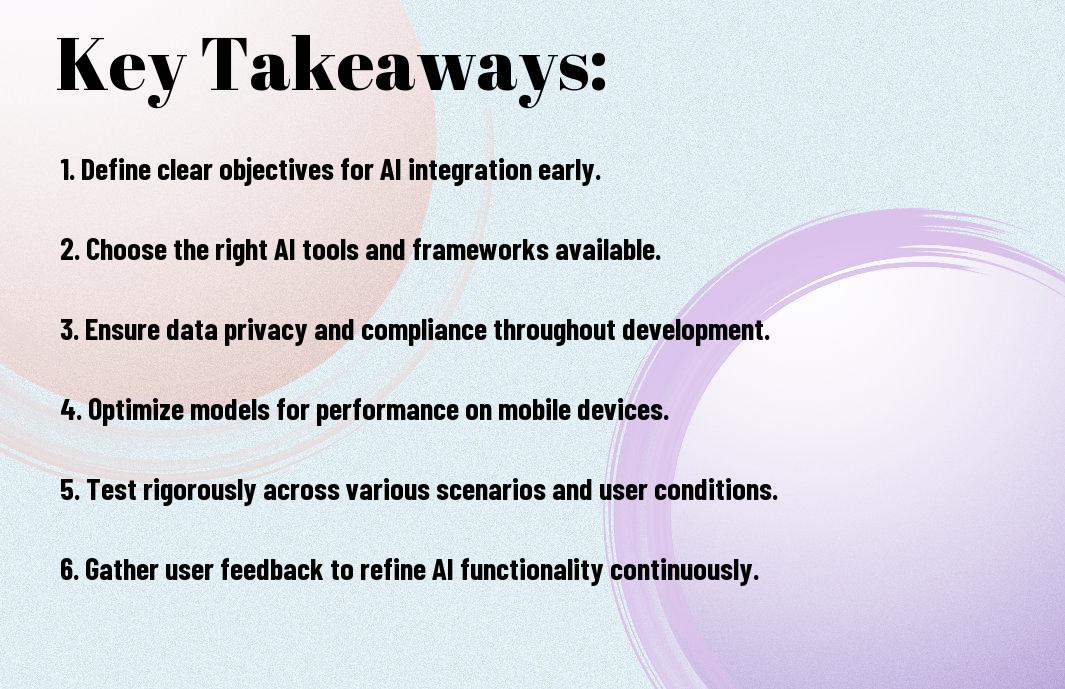
Key Takeaways:

  • Define the purpose and scope of AI integration in your mobile application to determine the type of AI model needed and ensure alignment with your app’s goals and functionality.
  • Choose the right AI framework and tools, such as TensorFlow or Core ML, to develop and deploy AI models that are compatible with your mobile platform and meet performance requirements.
  • Design a user-friendly interface to interact with AI models, providing clear instructions and feedback to users, and ensuring a seamless experience that enhances the overall app usability.
  • Address data privacy and security concerns by implementing robust data protection measures, such as encryption and access controls, to safeguard user data used for AI model training and inference.
  • Continuously monitor and update AI models to improve their accuracy and performance, using techniques such as model retraining and updates, to ensure the AI-powered features remain effective and relevant over time.

AI Model Selection

To integrate AI into your mobile application, you need to select the right model. You can learn more about this process in our article How to Integrate AI into Your App: 7 Steps Guide, which provides a comprehensive overview of the integration process.

Popular Mobile AI Frameworks

The most popular frameworks for mobile AI development are TensorFlow, Core ML, and ML Kit, which offer a range of tools and resources to help you build and deploy AI models in your app.

Model Size and Performance Trade-offs

Mobile app developers often face trade-offs between model size and performance, as larger models can provide more accurate results but may slow down your app.

A key consideration when selecting an AI model is the balance between model size and performance, as you want your app to be responsive and efficient while still providing accurate results, so you need to evaluate your options carefully to choose the best model for your specific use case.

Technical Requirements

While integrating AI models into your mobile application, you’ll need to consider various factors, as outlined in A Complete Guide to How to Integrate AI Into Your App, to ensure seamless execution.

Hardware Specifications

Above all, your device should have sufficient processing power and memory to handle AI-driven tasks, enabling you to run complex models efficiently on your mobile application.

Software Dependencies

For successful integration, you’ll need to install specific software libraries and frameworks that support AI model development, such as TensorFlow or Core ML, to power your mobile application.

Even with the right hardware and software in place, you’ll still need to ensure that your development environment is properly configured to handle the unique demands of AI model integration, which may involve installing additional tools and plugins to support tasks like model training and testing, allowing you to effectively integrate AI into your mobile application.

Implementation Process

After selecting the AI model, you can proceed with integrating it into your mobile application, which involves several steps that you need to follow carefully to ensure seamless functionality.

Model Preparation

Beneath the surface of your application, you need to prepare your AI model by training and testing it with relevant data to ensure it provides accurate results and integrates well with your app’s existing infrastructure.

API Integration

Meanwhile, you will need to integrate your AI model with your application’s API, which allows you to access the model’s functionality and retrieve results, enabling you to leverage the power of AI in your mobile app.

Another important aspect of API integration is handling requests and responses, as you will need to send input data to the AI model and receive output data, which you can then use to update your application’s UI and provide a seamless user experience, and you should consider using established APIs and frameworks to simplify this process and ensure your application is scalable and maintainable.

Performance Optimization

Not all AI models are created equal, and optimizing their performance is key to a seamless user experience in your mobile application.

Model Compression Techniques

Betwixt the various methods available, you’ll find that model pruning and quantization can significantly reduce the size of your AI models, making them more efficient for mobile use.

Memory Management

Modeled after the principles of efficient data handling, you’ll want to ensure that your application’s memory usage is optimized to prevent crashes and slow performance.

Plus, by implementing strategies such as caching and lazy loading, you can further improve your application’s memory management, allowing your users to enjoy a smoother experience when interacting with your AI-powered mobile application, and you can achieve this by carefully monitoring your app’s memory usage and adjusting your strategies accordingly to get the best results for your users.

User Experience Design

All aspects of user experience design must be considered when integrating AI models into your mobile application, as it directly impacts your users’ overall satisfaction and engagement with your app.

Response Time Management

Between the time a user interacts with your app and the time they receive a response, you must optimize the AI model’s processing speed to ensure a seamless experience, as slow response times can lead to frustration and app abandonment.

Interface Adaptation

Around the AI model’s capabilities, you should design an interface that is intuitive and easy to use, allowing your users to easily interact with the AI-powered features and understand the results.

With a well-designed interface, you can enhance your users’ experience and encourage them to explore the AI-driven features of your app, which can lead to increased user engagement and loyalty, as you provide them with a personalized and dynamic experience that meets their needs and expectations.

Security Measures

Once again, as you integrate AI models into your mobile application, you must prioritize security to protect your users’ data and prevent potential threats.

Data Protection

With the increasing use of AI models, you need to ensure that your users’ data is encrypted and stored securely, adhering to strict data protection policies to maintain their trust.

Model Access Control

Driven by the need for security, you should implement access controls to restrict unauthorized access to your AI models, ensuring that only authorized personnel can modify or update them.

Consequently, as you implement model access control, you will be able to monitor and track all changes made to your AI models, allowing you to identify and address any potential security vulnerabilities, and thereby protecting your application and users from potential threats.

Conclusion

As a reminder, you now have the knowledge to integrate AI models into your mobile application. You can leverage AI to enhance your app’s functionality, improving your users’ experience. By following the steps outlined, you will be able to successfully incorporate AI models, making your application more efficient and intelligent, and ultimately, taking your business to the next level with your newly acquired skills.

FAQ

Q: What are the initial steps to integrate AI models into my mobile application?

A: To integrate AI models into your mobile application, start by defining the specific AI functionality you want to implement, such as image recognition, natural language processing, or predictive analytics. Next, choose a suitable AI framework or library that supports your mobile platform, like Core ML for iOS or TensorFlow Lite for Android. Ensure your development team has the necessary skills and expertise in AI and mobile app development. Finally, plan the integration process, considering factors like data privacy, security, and user experience.

Q: How do I select the most appropriate AI model for my mobile application?

A: Selecting the right AI model for your mobile application involves several considerations. First, identify the specific task or problem you want the AI to solve. Then, evaluate different AI models based on their accuracy, complexity, and compatibility with your mobile platform. Consider factors like model size, computational requirements, and power consumption, as these can impact your app’s performance and user experience. You may also need to compare models from different providers or develop your own custom model using machine learning frameworks like TensorFlow or PyTorch. Additionally, ensure the chosen model aligns with your app’s goals and enhances its functionality without compromising security or privacy.

Q: What are the key challenges and considerations when deploying AI models in a mobile application?

A: When deploying AI models in a mobile application, several challenges and considerations arise. One key challenge is ensuring the model’s accuracy and reliability in real-world scenarios, which may involve continuous model training and updates. Another consideration is data privacy and security, as AI models often process sensitive user data. You must implement robust security measures to protect this data and comply with relevant regulations like GDPR or CCPA. Furthermore, optimizing the model for mobile devices is crucial to prevent increased battery consumption, heat generation, or slower performance. Regular testing and user feedback are also vital to identify and address any issues that may arise after the deployment of the AI-powered features.

Integrating Natural Language Processing into Your App

As you consider enhancing your app’s capabilities, you’re likely exploring ways to improve user experience. You can leverage Natural Language Processing (NLP) to enable your app to understand and interact with users in a more human-like way. By integrating NLP, you can unlock features like voice commands, sentiment analysis, and text classification, allowing your app to better serve your users’ needs and preferences. You will be able to create a more intuitive and engaging experience for your users.

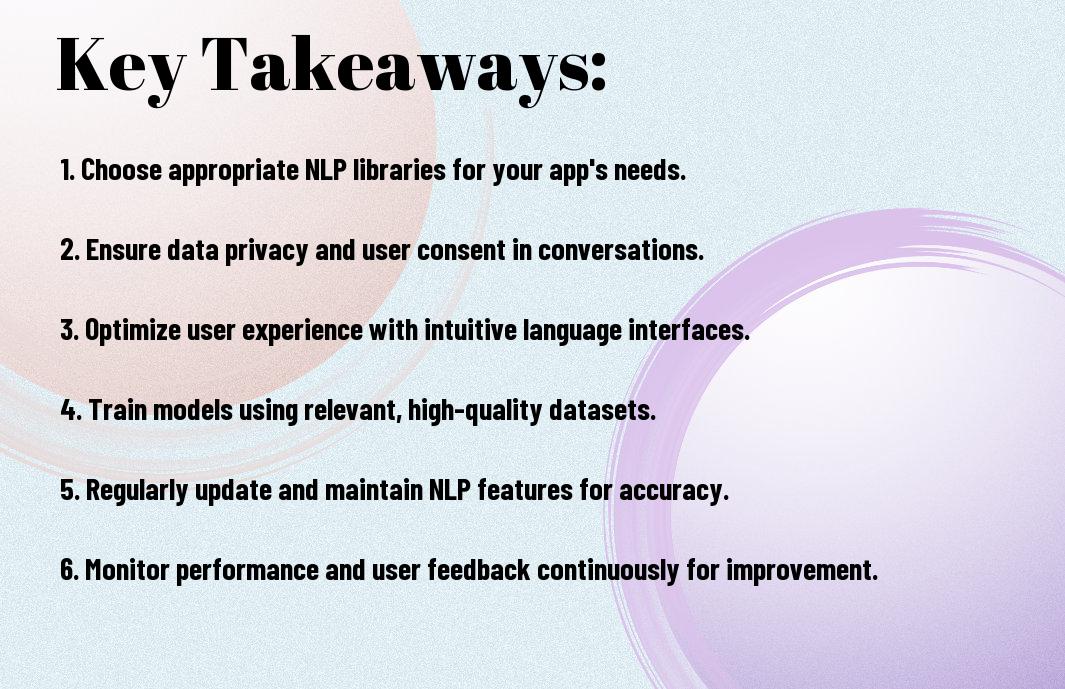
Key Takeaways:

  • Integrating Natural Language Processing (NLP) into your app can significantly enhance user experience by enabling more intuitive and human-like interactions, allowing users to communicate with your app in a more natural way.
  • NLP can be used to analyze and understand user input, such as text or speech, and generate relevant responses, making it a powerful tool for building conversational interfaces, chatbots, and virtual assistants.
  • To successfully integrate NLP into your app, you’ll need to choose the right NLP library or framework, such as NLTK, spaCy, or Stanford CoreNLP, and consider factors like language support, accuracy, and scalability.
  • NLP can also be used to improve app functionality, such as sentiment analysis, entity recognition, and topic modeling, which can help you better understand user behavior and preferences, and make data-driven decisions.
  • As NLP technology continues to evolve, it’s imperative to stay up-to-date with the latest developments and advancements, and consider how you can leverage NLP to drive innovation and differentiation in your app, and stay ahead of the competition.

Fundamentals of NLP Integration

For a successful NLP integration, you need to understand the basics of natural language processing and its applications in your app. You will learn how to leverage NLP to enhance your app’s functionality and user experience.

Core NLP Components

Beneath the surface of NLP integration lies a complex system of algorithms and techniques. You will discover the key components that enable your app to process and understand human language, allowing you to make informed decisions about your NLP strategy.

API Selection and Setup

For your NLP integration to be effective, you need to choose the right API and set it up correctly. You will explore the various options available and learn how to select the one that best fits your app’s needs, ensuring seamless integration and optimal performance.

And as you probe deeper into API selection and setup, you will consider factors such as scalability, security, and compatibility, ensuring that your NLP integration is robust and reliable, and that you can easily maintain and update it as your app evolves, allowing you to focus on providing the best possible experience for your users.

Text Processing Architecture

If you’re looking to integrate natural language processing into your app, you’ll need to design a robust text processing architecture. This involves several components working together to analyze and understand human language, enabling your app to make informed decisions and take appropriate actions.

Data Preprocessing Pipeline

Piping in raw text data, you’ll need to clean and normalize it to prepare for analysis, removing unnecessary characters, correcting spelling errors, and transforming it into a format suitable for your language models.

Language Models and Tokenization

Across various natural language processing tasks, you’ll utilize language models and tokenization techniques to break down text into individual words or tokens, analyzing their context and meaning to extract insights and make predictions.

Architecture of your language models and tokenization techniques will play a significant role in determining the accuracy and efficiency of your text processing pipeline, as you’ll need to select the most suitable models and techniques for your specific use case, considering factors such as performance, scalability, and interpretability, to ensure your app provides accurate and reliable results.

Implementation Strategies

Unlike other technologies, integrating Natural Language Processing (NLP) into your app can be straightforward. You can find guidance on How to integrate Natural Language processing (NLP) techniques into AI prompt engineering to inform your approach.

RESTful API Integration

Around the time you start designing your NLP integration, you’ll need to consider RESTful API integration, which allows your app to communicate with NLP services seamlessly, enabling efficient data exchange and processing.

Local Processing Solutions

The choice between local and cloud-based NLP solutions depends on your specific needs. You can opt for local processing solutions, which provide more control over data and processing, but may require more resources and maintenance.

Plus, when you choose local processing solutions, you’ll have the flexibility to customize and optimize NLP models for your specific use case, allowing for more accurate and relevant results, and you can ensure the security and privacy of your users’ data by keeping it on your own servers.

Performance Optimization

Despite the complexity of NLP tasks, you can optimize your app’s performance by implementing efficient algorithms and data structures, allowing your users to enjoy a seamless experience.

Memory Management

Beneath the surface of your app’s performance lies the importance of managing memory usage, and you can achieve this by using techniques such as caching and reducing data redundancy, ultimately enhancing your app’s overall efficiency.

Response Time Enhancement

Underneath the hood of your app’s performance optimization lies the need to enhance response times, and you can accomplish this by leveraging parallel processing and optimizing database queries, resulting in faster processing of NLP tasks.

Management of response times is vital to ensuring your users have a positive experience with your app, and you can further improve this by analyzing user behavior and optimizing your NLP models to handle common queries more efficiently, allowing you to provide a more responsive and engaging experience for your users.

Security Considerations

Many security concerns arise when integrating Natural Language Processing into your app, and you must address them to protect your users’ data and maintain their trust.

Data Privacy Protocols

Around the clock, you should ensure that your app adheres to strict data privacy protocols, safeguarding sensitive information and preventing unauthorized access.

Authentication Methods

Along with data privacy, you need to implement robust authentication methods to verify user identities and prevent malicious activities within your app.

Further, when implementing authentication methods, you should consider multi-factor authentication, such as biometric verification or one-time passwords, to add an extra layer of security and protect your users’ accounts from unauthorized access, allowing you to provide a secure and reliable experience for your users.

Testing and Validation

Keep in mind that testing and validation are necessary steps in integrating NLP into your app, ensuring your system functions as expected and provides accurate results.

Accuracy Metrics

Around the evaluation of your NLP system, you will need to consider various metrics, such as precision, recall, and F1 score, to assess its performance and identify areas for improvement.

Load Testing Procedures

Towards optimizing your NLP system’s performance, you should conduct load testing to determine how it handles a large volume of user requests and data, helping you identify potential bottlenecks.

The load testing procedures you implement will help you understand how your system scales and performs under real-world conditions, allowing you to make adjustments and improvements to ensure a seamless user experience, and you can use various tools and techniques to simulate a large number of users and test your system’s limits, giving you valuable insights into its performance and reliability.

Conclusion

Ultimately, you can enhance your app’s user experience by integrating Natural Language Processing into your app. You will be able to provide more personalized and interactive experiences for your users. To learn more about how to implement this technology, visit Natural Language Processing (NLP) for Smarter Mobile Apps to discover new ways to improve your app’s functionality and stay ahead of the competition with your innovative approach.

FAQ

Q: What are the benefits of integrating Natural Language Processing (NLP) into my app?

A: Integrating NLP into your app can significantly enhance user experience by enabling more intuitive and natural interactions. NLP allows your app to understand and process human language, making it possible to implement features such as voice commands, text analysis, and sentiment analysis. This can lead to increased user engagement, improved customer satisfaction, and a competitive edge in the market. Additionally, NLP can help automate tasks, provide personalized recommendations, and offer multilingual support, further expanding your app’s capabilities and reach.

Q: How do I choose the right NLP technology for my app, considering the variety of tools and services available?

A: Choosing the right NLP technology for your app depends on several factors, including the specific use case, the size and complexity of your project, and your development team’s expertise. You should consider the type of NLP tasks you want to perform, such as text classification, entity recognition, or language translation. Evaluate the accuracy, scalability, and customization options of different NLP tools and services, such as cloud-based APIs or open-source libraries. It’s also important to assess the integration complexity, cost, and support offered by the provider. Conducting thorough research, reading reviews, and testing demos or free versions can help you make an informed decision that aligns with your app’s requirements and goals.

Q: What are the common challenges faced during the integration of NLP into an app, and how can they be addressed?

A: Common challenges during NLP integration include data quality issues, model accuracy, and scalability. Poor data quality can significantly impact NLP model performance, so ensuring that your training data is relevant, diverse, and well-annotated is imperative. Model accuracy can be improved by selecting the appropriate algorithm, fine-tuning hyperparameters, and continuously updating the model with new data. Scalability issues can be addressed by using cloud-based services that offer automatic scaling, optimizing resource allocation, and implementing efficient processing pipelines. Additionally, challenges related to user privacy and security, such as data encryption and access control, must be carefully considered and mitigated to maintain user trust and comply with regulations. Collaborating with NLP experts, monitoring performance metrics, and staying updated with the latest advancements in the field can also help overcome these challenges and achieve successful NLP integration.

Maximizing Efficiency – Integrating AI in Your App

As you develop your app, you’re likely looking for ways to streamline processes and improve user experience. You can achieve this by integrating Artificial Intelligence (AI) into your app, enabling you to automate tasks, enhance decision-making, and drive business growth. By leveraging AI, you can optimize your app’s performance, making it more efficient and responsive to your users’ needs, ultimately giving you a competitive edge in the market.

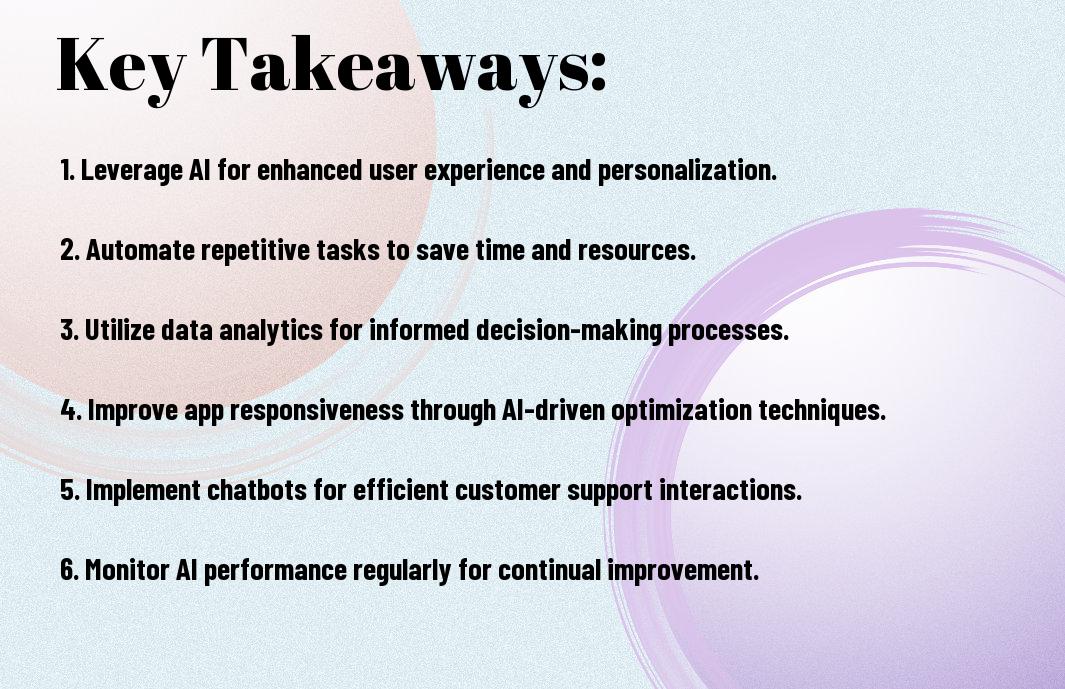
Key Takeaways:

  • Integrating AI into your app can significantly enhance user experience by providing personalized recommendations, automating tasks, and improving overall performance, leading to increased user engagement and retention.
  • A well-designed AI system can help streamline processes, reduce manual errors, and optimize resource allocation, resulting in improved efficiency and productivity for businesses and organizations.
  • AI-powered analytics can provide valuable insights into user behavior, preferences, and trends, enabling developers to make data-driven decisions and drive informed product development and marketing strategies.
  • Effective integration of AI requires a thorough understanding of the technology, as well as careful consideration of factors such as data quality, security, and user privacy to ensure seamless and secure implementation.
  • By leveraging AI capabilities, developers can create innovative and competitive apps that stay ahead of the curve, drive growth, and deliver exceptional value to users, ultimately leading to long-term success and profitability.

Essential AI Components for Modern Apps

A key aspect of integrating AI into your app is understanding the various components that make it efficient, as you can learn more about in Maximizing Efficiency: Harnessing AI in Project Management. This knowledge will help you make informed decisions about your app’s development.

Machine Learning Integration Points

About the integration of machine learning, you’ll need to identify the points in your app where it can add the most value, streamlining your development process and enhancing user experience.

Natural Language Processing Elements

Any app can benefit from natural language processing elements, enabling you to provide a more intuitive and user-friendly interface, which you can leverage to improve your app’s overall performance.

In fact, natural language processing allows your app to understand and generate human-like text, enabling features like chatbots, voice assistants, and text analysis, which can significantly enhance your users’ interaction with your app, making it more engaging and efficient for them to use.

Performance Optimization

There’s no denying that integrating AI in your app can significantly enhance its performance, but it’s necessary to ensure that your system can handle the increased demands. You need to consider the potential impact on your app’s speed, scalability, and overall efficiency.

Resource Management

Around the clock, your app’s resources are being utilized, and it’s your responsibility to manage them effectively. You must allocate resources wisely to prevent bottlenecks and ensure seamless performance, allowing your users to have a smooth experience.

Load Balancing Strategies

One of the key aspects of performance optimization is implementing effective load balancing strategies. You should distribute the workload evenly across your system to prevent overload and ensure that your app can handle a large number of users simultaneously.

The load balancing strategies you implement will have a significant impact on your app’s performance. You should consider using algorithms that can detect changes in traffic and adjust the workload accordingly, ensuring that your system is always running at optimal levels. By doing so, you can provide your users with a fast and responsive experience, even during peak usage periods, which will ultimately lead to increased user satisfaction and loyalty to your app.

Data Management and Processing

After integrating AI into your app, you’ll need to focus on efficient data management and processing to ensure seamless functionality. This involves handling large amounts of data, which can be a challenging task, but with the right strategies, you can optimize your app’s performance.

Real-time Data Handling

Prior to implementing AI, you need to consider real-time data handling, which enables your app to process and analyze data instantly, allowing for swift decision-making and improved user experience, as you will be able to provide your users with up-to-date information and insights.

Storage Optimization Methods

Along with data handling, you should also explore storage optimization methods, which help reduce data storage costs and improve data retrieval efficiency, enabling your app to function smoothly and efficiently, as you will be able to store and manage large amounts of data effectively.

Consequently, as you research deeper into storage optimization methods, you will discover various techniques such as data compression, caching, and cloud storage, which can be tailored to your app’s specific needs, allowing you to strike a balance between storage costs and data accessibility, and ultimately enhancing your app’s overall performance and user satisfaction.

User Experience Enhancement

Despite the numerous benefits of AI, its integration into your app should prioritize user experience. You can enhance your app’s usability and engagement by leveraging AI-driven features that simplify interactions and provide valuable insights.

Predictive Features

On the other hand, predictive features enabled by AI can help you anticipate user needs, offering proactive solutions and streamlining their experience within your app.

Personalization Systems

To take your app to the next level, you can implement AI-powered personalization systems that tailor content and recommendations to individual users, increasing their satisfaction and loyalty.

User personalization is key to creating an engaging experience, as it allows you to cater to specific preferences and behaviors, making your app more intuitive and enjoyable for your users. You can achieve this by analyzing user data and adapting your app’s interface and functionality accordingly, resulting in a more seamless and effective interaction.

Security and Privacy

For your app to be successful, you need to prioritize security and privacy when integrating AI, ensuring that your users’ data is protected and your app complies with regulations.

Data Protection Protocols

Above all, you should implement robust data protection protocols to safeguard your users’ sensitive information, using encryption and secure storage to prevent unauthorized access.

Compliance Requirements

Alongside regulatory standards, you must ensure your app meets compliance requirements, adhering to laws and guidelines that govern data collection, storage, and usage, to avoid potential penalties and maintain user trust.

This compliance involves understanding and implementing specific regulations, such as GDPR or CCPA, which dictate how you handle user data, and taking steps to ensure your app is transparent about data collection and usage, allowing you to build trust with your users and maintain a strong reputation.

Implementation Roadmap

Now that you have decided to integrate AI in your app, it’s time to create a plan. You need to outline the steps required to implement AI, including data collection, model training, and deployment.

Integration Timeline

Integrating AI into your app requires a well-structured timeline. You should set realistic milestones and deadlines to ensure a smooth integration process, avoiding delays and potential pitfalls.

Testing Procedures

Proceeding with testing is an important step in AI integration. You should develop a comprehensive testing strategy to validate your AI model’s performance, ensuring it meets your app’s requirements and functions as expected.

In fact, your testing procedures should include multiple stages, such as unit testing, integration testing, and user acceptance testing, to guarantee your AI-powered app is reliable, efficient, and provides a seamless user experience.

Final Words

Summing up, you now have the knowledge to maximize efficiency in your app by integrating AI. You can take your business to the next level by leveraging AI’s capabilities. For a more in-depth guide on implementation, visit Integrating AI into Existing Business Applications to learn how you can streamline your operations and enhance your app’s performance, ultimately benefiting your business.

FAQ

Q: What are the benefits of integrating AI in my app to maximize efficiency?

A: Integrating AI in your app can bring numerous benefits, including enhanced user experience, improved decision-making, and increased productivity. AI-powered features such as predictive analytics, natural language processing, and machine learning can help automate tasks, provide personalized recommendations, and optimize app performance. By leveraging AI, you can streamline processes, reduce manual errors, and gain valuable insights into user behavior, ultimately leading to increased efficiency and competitiveness in the market.

Q: How can I determine which AI-powered features to integrate into my app to maximize efficiency?

A: To determine which AI-powered features to integrate into your app, start by identifying areas where manual processes are time-consuming, prone to errors, or can be automated. Analyze your app’s functionality, user feedback, and market trends to pinpoint opportunities for AI-driven improvement. Consider features such as chatbots for customer support, image recognition for content moderation, or predictive maintenance for proactive issue resolution. Evaluate the potential impact of each feature on your app’s efficiency, user engagement, and overall value proposition, and prioritize integration based on the expected return on investment and alignment with your business goals.

Q: What are the key considerations for ensuring successful integration of AI in my app to maximize efficiency?

A: To ensure successful integration of AI in your app, consider several key factors. First, define clear goals and objectives for AI integration, and establish a robust data management strategy to support AI-driven decision-making. Next, select the right AI technologies and tools that align with your app’s architecture and scalability requirements. Additionally, prioritize transparency, explainability, and accountability in AI-driven processes to maintain user trust and compliance with regulatory requirements. Finally, continuously monitor and evaluate the performance of AI-powered features, and be prepared to iterate and refine their implementation based on user feedback, emerging trends, and evolving business needs.

Integrating Recommendation Engines into Your App Ecosystem

As you strive to enhance your app’s user experience, you’re likely considering ways to personalize interactions and increase engagement. You can achieve this by integrating recommendation engines into your app ecosystem, allowing you to offer tailored suggestions and content to your users. By doing so, you can boost user satisfaction, drive conversions, and ultimately, grow your business. You will learn how to leverage recommendation engines to create a more intuitive and responsive app environment that meets your users’ evolving needs and expectations.

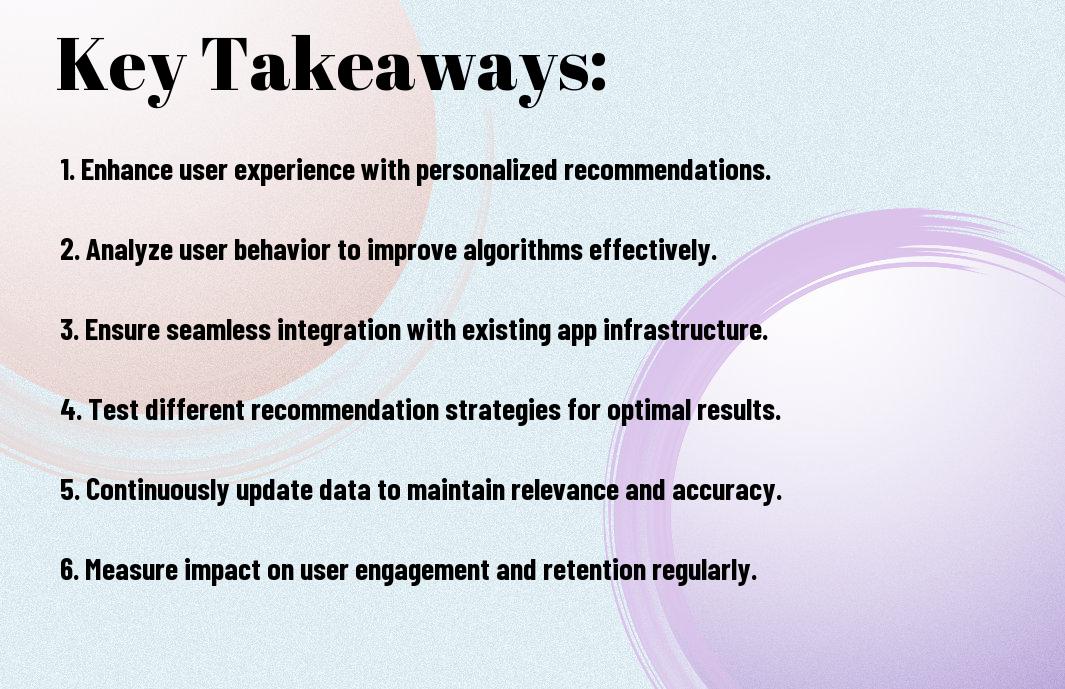
Key Takeaways:

  • Personalization is key: Integrating recommendation engines into your app ecosystem allows you to provide users with tailored content and product suggestions, enhancing their overall experience and increasing engagement.
  • Improved user retention: By offering relevant recommendations, you can encourage users to spend more time within your app, reducing the likelihood of them switching to competitors and ultimately driving long-term retention.
  • Increased conversions: Recommendation engines can help users discover new products or services they may not have found otherwise, leading to increased sales, revenue, and overall business growth.
  • Data-driven decision making: Recommendation engines rely on data and analytics to generate suggestions, providing valuable insights into user behavior and preferences that can inform future development and marketing strategies.
  • Enhanced competitiveness: Incorporating recommendation engines into your app ecosystem can be a key differentiator, setting your business apart from competitors and establishing a leadership position in your market.

    Core Components of Recommendation Systems

    While developing a recommendation engine, you’ll encounter various components that work together to provide personalized suggestions. Your system will rely on data collection, processing, and analysis to generate recommendations.

    Collaborative Filtering Methods

    Around the concept of collaborative filtering, you’ll find that it involves analyzing user behavior and preferences to identify patterns and make recommendations. Your approach will depend on the type of data you collect and the algorithms you implement.

    Content-Based Filtering Approaches

    Often, you’ll find that content-based filtering is an effective method for recommending items with similar attributes. Your system will analyze the features of items and user preferences to provide personalized suggestions.

    Components of content-based filtering approaches include attribute extraction, weighting, and scoring. You’ll need to consider the types of attributes to extract, how to weigh their importance, and how to score items based on user preferences. This will enable your system to provide accurate and relevant recommendations, enhancing your users’ experience and engagement with your app ecosystem.

    Data Pipeline Architecture

    Some of the most effective recommendation engines rely on a well-designed data pipeline architecture, which you can learn more about in a Step-by-Step Guide to Developing a Recommendation System Application. This will help you understand how to integrate your data pipeline with your app ecosystem.

    Data Collection and Processing

    With a solid data pipeline in place, you can focus on collecting and processing the data that will power your recommendation engine, allowing you to provide personalized recommendations to your users.

    Feature Engineering for Recommendations

    Beside the data collection, feature engineering is a key aspect of building a recommendation engine, as it enables you to extract relevant features from your data that will inform your recommendations.

    Considering the complexity of feature engineering, you will need to carefully evaluate your data and select the most relevant features to include in your recommendation model, ensuring that your engine provides accurate and personalized recommendations to your users.

    Integration Strategies

    Unlike other components, integrating a recommendation engine into your app ecosystem requires careful planning and execution. You need to consider factors such as data flow, scalability, and user experience to ensure seamless integration.

    API Design and Endpoints

    Around the time you start designing your API, you should consider the endpoints that will interact with your recommendation engine, allowing you to fetch and update recommendations in real-time, enabling your app to provide personalized experiences for your users.

    Service Layer Implementation

    Implementation of the service layer is where you define how your app will interact with the recommendation engine, handling requests and responses, and ensuring that your app’s functionality is not compromised.

    Plus, as you implement the service layer, you will need to consider factors such as data processing, caching, and error handling, to ensure that your recommendation engine is robust and efficient, providing your users with accurate and relevant recommendations, and enhancing their overall experience with your app.

    Performance Optimization

    Now that you have integrated a recommendation engine into your app ecosystem, you need to focus on optimizing its performance to ensure seamless user experience. You can achieve this by identifying bottlenecks and implementing strategies to mitigate them, thereby improving the overall efficiency of your app.

    Caching Mechanisms

    Optimally, you will want to implement caching mechanisms to store frequently accessed data, reducing the load on your servers and improving response times. You can use caching to store pre-computed recommendations, allowing your app to retrieve them quickly and efficiently.

    Load Balancing Considerations

    To ensure your app can handle a large volume of requests, you need to consider load balancing strategies that distribute the workload across multiple servers. You can use load balancing algorithms to route requests to the most available server, preventing any single server from becoming overwhelmed.

    Further, when implementing load balancing, you should consider factors such as server capacity, network latency, and user geography to ensure that your app provides a consistent and responsive experience for all users, regardless of their location or the volume of requests being processed. You can use techniques like geo-load balancing to direct users to the nearest server, minimizing latency and improving overall performance.

    Testing and Monitoring

    Once again, you’ll need to evaluate your recommendation engine’s performance to ensure it’s meeting your app’s goals. This involves assessing its impact on user engagement, conversion rates, and overall satisfaction.

    A/B Testing Framework

    Trialing different approaches will help you refine your recommendation engine. You can test various algorithms, user interfaces, and content types to determine what works best for your users.

    Performance Metrics

    The key to optimizing your recommendation engine lies in tracking the right metrics. You should monitor click-through rates, conversion rates, and user retention to gauge the engine’s effectiveness.

    Another aspect of performance metrics is analyzing user behavior and feedback. You can collect data on user interactions, such as likes, dislikes, and ratings, to identify areas for improvement and refine your recommendation engine to better meet your users’ needs, ultimately enhancing their overall experience with your app.

    Security and Privacy

    Despite the benefits of recommendation engines, you must prioritize security and privacy to maintain user trust in your app ecosystem.

    Data Protection Measures

    Betwixt the lines of code, you’ll need to implement robust data protection measures to safeguard user data and prevent unauthorized access.

    User Consent Management

    Around the issue of user consent, you should establish clear policies and procedures to ensure transparency and compliance with regulations.

    And as you examine deeper into user consent management, you’ll need to consider implementing features that allow users to opt-out of data collection, provide explicit consent for specific uses, and access their personal data, giving you a clear understanding of your responsibilities in handling their information, and enabling you to make informed decisions about your app’s recommendation engine.

    Conclusion

    With these considerations, you can effectively integrate recommendation engines into your app ecosystem, enhancing your users’ experience. You will be able to provide personalized content, increasing user engagement and driving business growth. By leveraging recommendation engines, you can stay ahead of the competition and establish your app as a leader in its category, ultimately benefiting your business and your users.

    FAQ

    Q: What are the benefits of integrating a recommendation engine into my app ecosystem?

    A: Integrating a recommendation engine into your app ecosystem can significantly enhance user engagement and conversion rates. By providing personalized suggestions, you can help users discover new content, products, or services that align with their interests, leading to increased satisfaction and loyalty. Additionally, recommendation engines can help you to upsell and cross-sell, resulting in increased revenue and a competitive edge in the market. With a well-implemented recommendation engine, you can also gain valuable insights into user behavior and preferences, allowing you to refine your app and improve the overall user experience.

    Q: How do I choose the right recommendation engine for my app, considering factors such as data quality, scalability, and integration complexity?

    A: Choosing the right recommendation engine for your app depends on several factors, including the type and quality of your data, the scalability requirements of your app, and the complexity of integration. You should consider the following: the algorithm used by the engine, the type of data it can handle (e.g., user behavior, ratings, metadata), and its ability to scale with your growing user base. It’s also important to evaluate the integration process, including the level of technical expertise required, the availability of APIs and SDKs, and the support provided by the engine’s developers. Furthermore, you should assess the engine’s flexibility and customizability to ensure it can be tailored to your app’s specific needs and goals.

    Q: What are some best practices for implementing and optimizing a recommendation engine in my app to ensure maximum effectiveness and user adoption?

    A: To ensure maximum effectiveness and user adoption of your recommendation engine, follow these best practices: start by collecting and preprocessing high-quality data, including user behavior, preferences, and feedback. Implement A/B testing to compare the performance of different algorithms and models, and continuously monitor and analyze user interactions with the recommendations. It’s also important to provide transparency and control to users, allowing them to understand and influence the recommendations they receive. Regularly update and refine your recommendation engine to adapt to changing user behavior and preferences, and ensure that the recommendations are contextually relevant and timely. Finally, consider using hybrid approaches that combine multiple algorithms and data sources to provide a more comprehensive and accurate recommendation experience.

Skip to content