Apps

Tips and Strategies for Building AI-First Apps

As you launch on developing your next application, you’re likely considering the role of artificial intelligence in enhancing user experience. You want your app to be intelligent, intuitive, and innovative. Your goal is to create an app that not only leverages AI capabilities but also provides a seamless and personalized experience for your users. You will learn how to harness the power of AI to drive your app’s development and success, and this post will guide you through the process with expert tips and strategies.

Key Takeaways:

  • Define a clear AI strategy that aligns with your business goals and objectives, ensuring that AI is integrated into the core of your application from the outset.
  • Focus on developing a robust data infrastructure to support AI capabilities, including data collection, processing, and analysis.
  • Design intuitive user interfaces that seamlessly integrate AI-driven features, providing a seamless and engaging user experience.
  • Leverage cloud-based services and platforms to streamline AI development, deployment, and maintenance, reducing costs and increasing scalability.
  • Continuously monitor and evaluate AI performance, using metrics and feedback to refine and improve AI-driven features and capabilities over time.
Core AI Components for Modern Applications

To build AI-first apps, you need to understand the core components that drive their functionality. Your application’s success relies on the effective integration of these components, which include machine learning, natural language processing, and computer vision.

Machine Learning Integration Points

Points to consider when integrating machine learning into your app include data quality, model selection, and training methods. You should carefully evaluate your data and choose the most suitable model to achieve your desired outcomes, ensuring your app provides accurate and reliable results.

Natural Language Processing Elements

Around the concept of natural language processing, you’ll find various elements that enable your app to understand and generate human-like language. You can leverage these elements to create chatbots, sentiment analysis tools, and language translation features that enhance your app’s user experience.

Modern natural language processing techniques allow you to analyze and generate text, speech, and dialogue, enabling your app to interact with users in a more intuitive and personalized way. You can use these techniques to build conversational interfaces, such as voice assistants or chatbots, that understand and respond to user input, making your app more engaging and user-friendly.

Data Architecture Fundamentals

There’s no denying that a well-designed data architecture is important for building AI-first apps, as it enables you to efficiently process and analyze large amounts of data, which is necessary for training AI models.

Data Collection and Processing

Gathering data from various sources is key to building a robust AI model, and you should consider how to integrate and process your data in a way that supports your app’s functionality.

Model Training Infrastructure

At the heart of your AI-first app is the model training infrastructure, which you will use to train and deploy your AI models, and you should design it to be scalable and flexible.

Considering your model training infrastructure, you will want to ensure that it can handle large amounts of data and scale to meet the needs of your app, and you should also consider using cloud-based services to reduce costs and improve efficiency, allowing you to focus on developing and improving your AI models.

AI Development Best Practices

After laying the foundation for your AI-first app, you’ll want to focus on best practices that ensure its success. You’ll need to consider several factors, including model selection, optimization, and scalability, to create a robust and efficient application.

Model Selection and Optimization

Alongside your development process, you should evaluate various models to determine which one best suits your app’s requirements, considering factors such as accuracy, complexity, and computational resources, to optimize your AI’s performance.

Scalability Considerations

Before deploying your app, you should think about scalability, ensuring your AI system can handle increased traffic and data, and that your infrastructure can adapt to growing demands without compromising performance or user experience.

With scalability in mind, you can design your app to handle large volumes of data and user requests, allowing you to expand your user base without worrying about your AI’s ability to keep up, and you should plan for potential bottlenecks and develop strategies to mitigate them, ensuring your app’s continued success.

User Experience in AI Applications

Keep in mind that a well-designed user experience is imperative for AI-first apps, as it directly impacts user engagement and adoption. You need to consider how your users will interact with your AI-powered app and ensure that it is intuitive and easy to use.

Intuitive AI Interfaces

Interacting with AI systems requires careful consideration of the interface design, as you want your users to be able to easily understand and navigate your app. You should focus on creating simple and consistent interfaces that make it easy for users to access the AI-powered features.

Feedback Loop Implementation

One key aspect of AI-first apps is the implementation of a feedback loop, which allows your app to learn and improve over time based on user interactions. You should design your app to collect and incorporate user feedback, enabling your AI system to refine its performance and provide better results.

A well-implemented feedback loop can significantly enhance the user experience, as it enables your app to adapt to the user’s needs and preferences. As you design your feedback loop, you should consider how you will collect, process, and incorporate user feedback, and ensure that it is seamless and transparent to the user.

Performance Optimization

All AI-first apps require careful performance optimization to ensure seamless user experience. You need to consider factors like latency, throughput, and resource utilization to build a high-performing app.

Resource Management

The key to efficient resource management is allocating resources effectively, allowing your app to scale as needed. You should monitor your app’s resource usage and adjust accordingly to prevent bottlenecks.

Response Time Enhancement

Above all, optimizing response time is vital for your app’s success. You can achieve this by minimizing latency, optimizing database queries, and leveraging caching mechanisms to reduce load times.

Understanding how your app’s architecture impacts response time is necessary for making informed optimization decisions. You should analyze your app’s workflow, identify bottlenecks, and apply techniques like parallel processing, content delivery networks, and edge computing to enhance response times, ultimately improving your users’ experience.

Security and Ethics

Now that you’re building AI-first apps, considering security and ethics is vital to protect your users’ trust and maintain a positive reputation. You must prioritize these aspects to ensure the long-term success of your application.

Data Privacy Measures

To safeguard your users’ sensitive information, you should implement robust data privacy measures, such as encryption and secure data storage, to prevent unauthorized access and potential data breaches.

Ethical AI Implementation

Between developing and deploying AI models, you need to ensure that your implementation is fair, transparent, and unbiased, avoiding any potential harm to your users or society as a whole.

Privacy is a fundamental right, and as you implement ethical AI, you should consider the potential impact of your app on your users’ personal lives, taking steps to mitigate any negative consequences and maintain their trust in your application, which is important for your success in the long run, and you should be aware of the potential risks and take proactive measures to address them.

Summing up

Conclusively, you now have the knowledge to build AI-first apps that transform your business. You can leverage these tips and strategies to create innovative solutions, enhancing your users’ experience. By prioritizing AI in your development process, you will unlock new opportunities, driving growth and success for your organization. Your ability to adapt and innovate will set you apart, allowing you to stay ahead in a competitive market.

FAQ

Q: What are the key considerations when designing an AI-first app, and how can I ensure a seamless user experience?

A: When designing an AI-first app, it’s imperative to prioritize a user-centered approach, focusing on simplicity, intuitiveness, and transparency. To achieve a seamless user experience, consider the following strategies: implement intuitive navigation, provide clear explanations of AI-driven decisions, and offer personalized feedback mechanisms. Additionally, ensure that your app’s AI components are explainable, fair, and unbiased, and that you have a robust testing and validation process in place to identify and address potential issues.

Q: How can I effectively integrate machine learning models into my AI-first app, and what are some best practices for model training and deployment?

A: To integrate machine learning models into your AI-first app, start by selecting the most suitable model for your specific use case, considering factors such as data quality, complexity, and scalability. Best practices for model training include using high-quality, diverse datasets, monitoring performance metrics, and continuously updating and refining your models. When deploying models, ensure that you have a robust infrastructure in place, leveraging cloud-based services or containerization to enable efficient scaling and management. Furthermore, implement model interpretability techniques, such as feature attribution or model explainability, to provide insights into AI-driven decisions.

Q: What are some strategies for ensuring the security and reliability of AI-first apps, and how can I mitigate potential risks associated with AI-driven decision-making?

A: To ensure the security and reliability of AI-first apps, implement robust data validation and sanitization mechanisms, encrypt sensitive data, and use secure communication protocols. Additionally, consider implementing techniques such as adversarial training, anomaly detection, and redundancy to mitigate potential risks associated with AI-driven decision-making. Regularly monitor your app’s performance, and have a plan in place for addressing potential errors or biases. It’s also imperative to establish clear guidelines and regulations for AI development, deployment, and maintenance, and to invest in ongoing education and training for your development team to stay up-to-date with the latest AI security best practices and standards.

Harnessing AI for Dynamic Content Generation in Apps

As you explore ways to enhance your app’s content, you’re likely considering the potential of AI. You can leverage AI to generate dynamic content that engages your users and sets your app apart. To learn more about the benefits of AI in content creation, you can visit Harnessing AI to Streamline Content Creation and Boost Productivity, which provides valuable insights into this innovative technology and its applications. You’ll discover how AI can revolutionize your app’s content strategy.

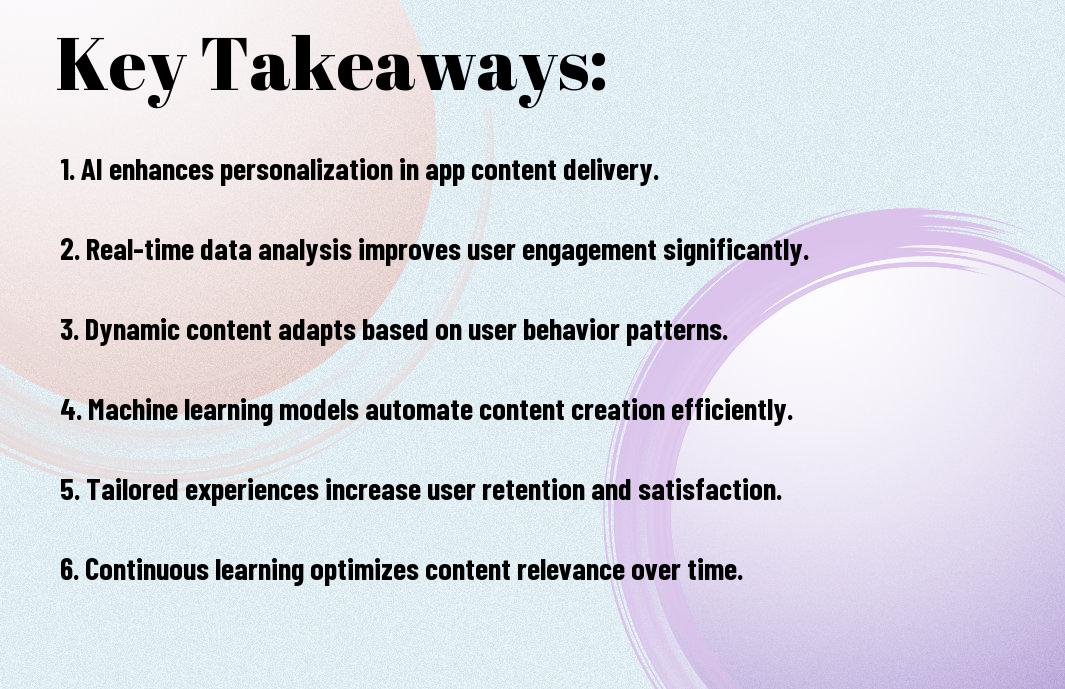
Key Takeaways:

  • AI-powered content generation can significantly enhance user engagement in apps by providing personalized and dynamic content that adapts to individual user preferences and behaviors.
  • Integrating AI-driven content generation can help reduce the workload of human content creators, allowing them to focus on higher-level tasks such as strategy and creative direction.
  • AI algorithms can analyze user data and generate content in real-time, enabling apps to respond quickly to changing user needs and trends.
  • Dynamic content generation can also help apps to stay updated with fresh and relevant content, reducing the risk of user fatigue and increasing the overall user experience.
  • Effective implementation of AI-powered content generation requires careful consideration of factors such as data quality, algorithmic bias, and content relevance to ensure that the generated content meets user needs and expectations.

    Core AI Technologies in Content Generation

    The core AI technologies in content generation are the foundation of dynamic content creation in apps, enabling you to produce high-quality, personalized content for your users. You can leverage these technologies to enhance your app’s content generation capabilities.

    Machine Learning Frameworks

    Content creation is facilitated by machine learning frameworks that allow you to develop and train models tailored to your specific needs, enabling you to generate content that resonates with your audience, as you explore the possibilities of AI-driven content generation.

    Natural Language Processing Systems

    For instance, natural language processing systems enable you to analyze and understand the nuances of language, allowing you to generate content that is contextually relevant and engaging for your users, as you examine into the world of AI-powered content creation.

    Language is at the heart of natural language processing systems, and as you work with these systems, you will discover how they can be used to generate human-like language, enabling you to create content that is both informative and engaging, and helping you to take your content generation to the next level, with your apps producing high-quality content that meets the evolving needs of your users.

    Dynamic Content Architecture

    If you’re looking to harness AI for dynamic content generation in your apps, you’ll need to design a robust architecture that can support this functionality. Your architecture should be able to handle large amounts of data and scale to meet the needs of your users.

    Data Pipeline Integration

    Behind the scenes, you’ll need to integrate your data pipeline with your AI algorithms to ensure seamless data flow. You’ll want to consider how your data is collected, processed, and stored to ensure it’s readily available for your AI models.

    Real-time Processing Components

    Dynamically, your app will need to process and generate content in real-time, which requires specialized components that can handle this task. You’ll need to consider how your app will handle high volumes of data and generate content quickly and efficiently.

    Data from various sources will flow into your real-time processing components, where it will be analyzed and used to generate dynamic content. You’ll need to consider how your components will handle this data, including how it’s processed, stored, and retrieved, to ensure your app can generate high-quality content quickly and efficiently, meeting your users’ expectations and keeping them engaged with your app.

    Content Personalization Mechanics

    For effective content generation, you need to understand the mechanics behind personalization, which enables your app to deliver tailored experiences to your users, increasing engagement and retention.

    User Behavior Analysis

    Personalizing content involves analyzing your users’ behavior, allowing you to identify patterns and preferences, and create profiles that inform your content generation strategy, helping you to better serve your audience.

    Adaptive Response Systems

    At the heart of dynamic content generation lies the ability to respond to user interactions, adapting your content in real-time to meet their evolving needs and interests, enabling you to create a more immersive experience.

    With adaptive response systems, you can take personalization to the next level, using machine learning algorithms to analyze user behavior and generate content that is not only relevant but also predictive, anticipating your users’ needs and delivering a seamless experience that sets your app apart from the competition, allowing you to build a loyal user base and drive business growth.

    Implementation Strategies

    After planning your dynamic content generation approach, you can begin implementing AI-powered solutions in your app, enabling you to create personalized experiences for your users, and you will need to consider several factors to ensure seamless integration.

    API Integration Methods

    With various API options available, you can choose the one that best fits your app’s architecture, allowing you to leverage AI capabilities and generate dynamic content that enhances your users’ engagement and overall experience.

    Content Delivery Optimization

    Delivering content efficiently is vital to your app’s performance, and you should optimize your content delivery to ensure that your users receive the dynamic content quickly and reliably, which will help you to improve user satisfaction.

    In addition, to optimize content delivery, you will need to consider factors such as content caching, compression, and routing, as these will help you to reduce latency and improve the overall performance of your app, allowing you to provide your users with a better experience.

    Performance Metrics

    Now that you have integrated AI for dynamic content generation in your app, it’s vital to evaluate its performance. You need to track metrics that measure the effectiveness of your AI-powered content generation system.

    Content Quality Assessment

    Evaluation of your AI-generated content is vital to ensure it meets your standards. You will need to assess the relevance, accuracy, and engagement level of the content to determine its quality and make necessary adjustments.

    System Efficiency Indicators

    About the system’s performance, you should monitor indicators such as processing time, memory usage, and scalability. You can use these metrics to optimize your system and improve its overall efficiency.

    The system efficiency indicators you track will help you identify bottlenecks and areas for improvement in your AI-powered content generation system. You can then use this information to make data-driven decisions and fine-tune your system to achieve better performance, ensuring that your app provides a seamless user experience and delivers high-quality content efficiently.

    Security and Ethics

    All developers must consider the security and ethics implications when harnessing AI for dynamic content generation in apps, as you will be handling sensitive user data and generating content that may impact your users.

    Data Protection Protocols

    Across the development process, you should implement robust data protection protocols to safeguard user information and prevent unauthorized access, ensuring your app’s integrity and your users’ trust in your brand.

    Ethical Content Generation Guidelines

    Before generating content, you should establish clear guidelines to ensure that the AI system produces content that is respectful, unbiased, and aligned with your values and principles, avoiding any potential harm to your users.

    And as you probe deeper into ethical content generation, you will need to consider factors such as transparency, accountability, and fairness, ensuring that your AI system is designed to produce content that is not only engaging but also responsible and respectful of your users’ diverse backgrounds and perspectives.

    Final Words

    Hence, as you explore the potential of AI in dynamic content generation, you’ll discover new ways to enhance your apps. You can learn more about Harnessing Generative AI for Cutting-Edge Mobile App Development to stay ahead in the industry. By leveraging AI, you can create innovative and engaging experiences for your users, setting your apps apart from the rest.

    FAQ

    Q: What is dynamic content generation in apps and how can AI be used to enhance it?

    A: Dynamic content generation in apps refers to the process of creating and updating content in real-time, based on user interactions, preferences, and behaviors. AI can be used to enhance dynamic content generation by analyzing user data, identifying patterns, and generating personalized content recommendations. For instance, AI-powered algorithms can analyze user engagement metrics, such as click-through rates and time spent on specific pages, to generate content that is more likely to resonate with individual users. Additionally, AI can help automate content creation, reducing the need for manual intervention and enabling apps to scale their content offerings more efficiently.

    Q: How can AI-powered dynamic content generation improve user experience in apps?

    A: AI-powered dynamic content generation can significantly improve user experience in apps by providing users with relevant, timely, and engaging content. By analyzing user behavior and preferences, AI algorithms can generate content that is tailored to individual users’ interests, increasing the likelihood of user engagement and conversion. Furthermore, AI-powered dynamic content generation can help apps to stay up-to-date with the latest trends and topics, ensuring that users have access to fresh and relevant content. This can lead to increased user satisfaction, loyalty, and retention, ultimately driving business growth and revenue for app developers.

    Q: What are some potential challenges and limitations of harnessing AI for dynamic content generation in apps, and how can they be addressed?

    A: Some potential challenges and limitations of harnessing AI for dynamic content generation in apps include data quality and availability, algorithmic bias, and the need for ongoing training and maintenance. To address these challenges, app developers can ensure that they have access to high-quality, diverse, and relevant data, and implement robust testing and validation protocols to detect and mitigate algorithmic bias. Additionally, developers can invest in ongoing training and maintenance of their AI models, incorporating user feedback and updating their algorithms to ensure that they continue to generate high-quality, relevant content. By acknowledging and addressing these challenges, app developers can unlock the full potential of AI-powered dynamic content generation and create more engaging, personalized, and effective user experiences.

Developing Cross-Platform Apps with AI Integration

As you research into the world of mobile app development, you’re likely considering how to create seamless experiences across multiple platforms. You want your app to be accessible and functional on various devices, and integrating Artificial Intelligence (AI) can enhance its capabilities. Your goal is to develop an app that not only runs smoothly on different platforms but also leverages AI to provide personalized user experiences, and this post will guide you through the process of achieving that.

Key Takeaways:

  • Developing cross-platform apps with AI integration enables businesses to reach a wider audience and provide a seamless user experience across different devices and operating systems.
  • AI-powered cross-platform apps can automate tasks, improve performance, and offer personalized experiences, leading to increased user engagement and loyalty.
  • Popular frameworks such as React Native, Flutter, and Xamarin allow developers to build cross-platform apps with AI integration, using a single codebase and reducing development time and costs.
  • Integrating AI and machine learning models into cross-platform apps requires careful consideration of data privacy, security, and ethics to ensure compliance with regulations and maintain user trust.
  • Continuous testing, iteration, and updating of AI-powered cross-platform apps are necessary to ensure they remain relevant, efficient, and effective in meeting evolving user needs and market demands.

Foundations of Cross-Platform Development

A solid understanding of the underlying principles is imperative for developing cross-platform apps with AI integration, and you will need to consider various factors, including your target audience, desired features, and technical requirements.

Native vs. Cross-Platform Architecture

Anyway, when deciding between native and cross-platform architecture, you should weigh the pros and cons of each approach, considering factors such as performance, development time, and maintenance costs, to determine which one best suits your needs.

Modern Development Frameworks

Above all, you will need to choose a suitable framework for your cross-platform app development, and you can select from a range of options, including React Native, Flutter, and Xamarin, each with its own strengths and weaknesses.

Frameworks like React Native and Flutter provide you with the tools and resources you need to build cross-platform apps with AI integration, allowing you to share code across platforms and streamline your development process, which can help you to reduce development time and costs, and you can focus on creating a seamless user experience for your audience.

AI Integration Components

Now, as you examine into the world of cross-platform app development, you’ll need to explore AI integration components. You can learn more about App development with AI to enhance your skills.

Machine Learning Libraries

Libraries such as TensorFlow and Core ML enable you to build intelligent apps, allowing you to focus on your development process.

Neural Network Implementation

Learning from data, you can implement neural networks to improve your app’s performance and user experience.

With neural network implementation, you can enable your app to make predictions, classify data, and make decisions, taking your app to the next level, and as you explore this further, you’ll discover how to optimize your neural network for better performance, making your app more efficient and effective for your users.

Data Management Across Platforms

To effectively manage data across platforms, you’ll need to consider a unified approach. You can explore tools like Free AI-Powered Mobile App Development – Build Cross-Platform Apps to streamline your data management process.

Unified Data Architecture

On the path to developing a cross-platform app, you’ll need to design a unified data architecture that integrates your AI components seamlessly, allowing you to access and manage data efficiently across different platforms.

Cross-Platform Storage Solutions

Against the backdrop of diverse platform requirements, you’ll need to select cross-platform storage solutions that can accommodate your app’s unique needs, ensuring data consistency and security.

Unified storage solutions enable you to manage data across platforms, allowing you to focus on your app’s core functionality. You can leverage cloud-based storage services to store and retrieve data, ensuring that your app’s data is accessible and up-to-date across all platforms, making it easier for you to maintain and update your app.

AI Model Deployment

After developing your AI model, you need to deploy it to your cross-platform app. You’ll have to choose between cloud-based services or on-device processing, each with its own advantages and disadvantages.

Cloud-Based AI Services

Above all, cloud-based AI services provide scalability and cost-effectiveness, allowing you to deploy your model quickly and efficiently, and you can leverage the expertise of cloud providers to manage your AI infrastructure.

On-Device AI Processing

Between these options, on-device processing offers real-time processing and enhanced security, as your data is processed locally on the user’s device, and you can optimize your app’s performance by leveraging the device’s hardware capabilities.

This approach also enables you to provide a seamless user experience, even with limited internet connectivity, and you can ensure that your app’s AI functionality is always available, regardless of network conditions, which is especially important for applications that require real-time processing, such as image recognition or natural language processing.

Performance Optimization

For developing cross-platform apps with AI integration, you need to focus on optimizing performance to ensure a seamless user experience. Your app’s performance is directly related to its success, and you should prioritize it to retain users.

Resource Management

Besides optimizing code, you should manage resources efficiently to prevent memory leaks and reduce battery consumption. You can use various tools to monitor your app’s resource usage and identify areas for improvement.

Response Time Enhancement

Beside other factors, response time plays a significant role in your app’s performance. You can enhance it by optimizing database queries, reducing network latency, and using caching mechanisms to fetch data quickly.

Indeed, enhancing response time requires a thorough analysis of your app’s architecture and workflow. You can use various techniques such as parallel processing, asynchronous programming, and content delivery networks to reduce latency and improve your app’s overall performance, allowing you to provide a better experience for your users.

Security and Privacy

Many cross-platform apps with AI integration face security and privacy concerns, and as you develop your app, you must prioritize these aspects to protect your users’ data and maintain their trust.

Data Protection Protocols

The most effective way to ensure data protection is by implementing robust protocols, such as encryption and secure authentication, to safeguard your users’ sensitive information and prevent unauthorized access.

AI Model Security

Securely designing and testing your AI models is vital to prevent potential vulnerabilities, and you should ensure that your models are trained on secure data and are resistant to attacks, so you can trust your AI-powered app.

Hence, as you focus on AI model security, you will need to consider various factors, including data quality, model interpretability, and explainability, to ensure that your AI-powered app is not only secure but also transparent and fair, allowing you to build a trustworthy relationship with your users.

Final Words

Upon reflecting on your journey to develop cross-platform apps with AI integration, you now possess the knowledge to create innovative solutions. You can leverage AI to enhance your app’s functionality, making it more engaging for users. As you move forward, your expertise will enable you to design and develop cutting-edge apps, streamlining your workflow and expanding your reach across various platforms, ultimately taking your app development to the next level.

FAQ

Q: What are the benefits of developing cross-platform apps with AI integration?

A: Developing cross-platform apps with AI integration offers several benefits, including increased reach and accessibility across different platforms, enhanced user experience through personalized and intelligent features, and improved development efficiency by leveraging a single codebase. Additionally, AI-powered cross-platform apps can provide real-time insights and analytics, enabling data-driven decision-making and driving business growth.

Q: What are the key technologies and tools used for developing cross-platform apps with AI integration?

A: The key technologies and tools used for developing cross-platform apps with AI integration include frameworks such as React Native, Flutter, and Xamarin, which enable cross-platform development. For AI integration, popular tools and technologies include machine learning frameworks like TensorFlow and Core ML, natural language processing (NLP) libraries like NLTK and spaCy, and computer vision libraries like OpenCV. Furthermore, cloud-based services like Google Cloud AI Platform, Microsoft Azure Machine Learning, and Amazon SageMaker provide scalable and secure infrastructure for deploying and managing AI models.

Q: How do developers ensure the security and privacy of user data in cross-platform apps with AI integration?

A: To ensure the security and privacy of user data in cross-platform apps with AI integration, developers should implement robust security measures, such as encryption, secure authentication and authorization, and access controls. Additionally, developers should comply with relevant data protection regulations, like GDPR and CCPA, and implement data anonymization and pseudonymization techniques to protect sensitive user information. Regular security audits, penetration testing, and vulnerability assessments can also help identify and address potential security risks associated with AI-powered cross-platform apps.

Real-Time Personalization in Apps Using AI Models

As you navigate through your favorite apps, you expect a tailored experience that caters to your unique preferences. Your interactions with these apps generate vast amounts of data, which can be leveraged to create personalized experiences. With the integration of AI models, you can now enjoy real-time personalization in apps, enhancing your overall user experience. You will discover how AI-driven personalization can help you get the most out of your apps, making your interactions more engaging and relevant to your needs.

Key Takeaways:

  • Real-time personalization in apps using AI models enables businesses to deliver tailored experiences to users based on their behavior, preferences, and interests, leading to increased user engagement and conversion rates.
  • AI-powered personalization allows for the analysis of vast amounts of user data, enabling apps to provide users with relevant content, recommendations, and offers that meet their individual needs.
  • Integrating AI models into apps enables real-time processing and decision-making, allowing for instantaneous adjustments to the user experience based on changing user behavior and preferences.
  • Effective implementation of real-time personalization using AI models requires a robust data infrastructure, advanced analytics capabilities, and a deep understanding of user behavior and psychology.
  • By leveraging AI-driven personalization, businesses can gain a competitive edge in the market, drive user loyalty, and ultimately, increase revenue through targeted and effective marketing strategies.

    Core AI Technologies for Real-Time Personalization

    While developing your app, you can leverage AI models to enhance user experience, and for more information on this, you can visit Real-time mobile app personalization with Generative AI to learn more about strategies for implementation.

    Machine Learning Models in Mobile Environments

    Mechanisms like machine learning enable your app to learn from user behavior, allowing for a more tailored experience as you use it, and you can apply this to improve your app’s overall performance.

    Neural Networks for User Behavior Analysis

    Around the concept of neural networks, you can analyze user behavior and preferences, enabling your app to make informed decisions about the content to display, and you will find this useful for creating a personalized experience.

    Consequently, as you probe deeper into neural networks for user behavior analysis, you will discover that these networks can be trained on vast amounts of data, allowing your app to recognize patterns and make predictions about user behavior, thereby enabling you to create a highly personalized experience that meets your users’ needs and expectations, and you can use this to drive engagement and increase user satisfaction.

    Data Processing Architecture

    Any effective real-time personalization system relies on a robust data processing architecture, which enables you to handle large volumes of user data and generate insights that inform your app’s behavior, allowing you to create a tailored experience for your users.

    Edge Computing Implementation

    For instance, when implementing edge computing, you can process user data closer to its source, reducing latency and enabling faster decision-making, which is imperative for delivering seamless, personalized experiences in your app.

    Cloud-AI Integration Points

    Around the integration of cloud and AI technologies, you will find numerous opportunities to enhance your app’s personalization capabilities, such as leveraging cloud-based machine learning models to analyze user behavior and preferences.

    Indeed, as you research deeper into cloud-AI integration, you will discover that it allows you to tap into a vast array of data sources, from social media to IoT devices, and use this information to create highly targeted, personalized experiences that meet your users’ unique needs and preferences, ultimately driving engagement and loyalty in your app.

    User Interaction Patterns

    All your interactions with an app, from taps to swipes, provide valuable insights into your behavior and preferences, enabling personalized experiences.

    Behavioral Data Collection

    Around the clock, your app usage generates data that can be collected and analyzed to understand your habits and interests, helping to create a tailored experience.

    Response Time Optimization

    Against the backdrop of increasing user expectations, optimizing response times is vital to ensure seamless interactions, allowing you to engage with your apps more efficiently.

    In addition, when you optimize response times, you can significantly enhance your overall app experience, as faster load times and swift feedback loops keep you engaged and interested in the content, ultimately leading to increased satisfaction and loyalty to the app.

    Implementation Framework

    Not every implementation framework is created equal, and you will need to choose the one that best fits your needs when it comes to real-time personalization in apps using AI models.

    Model Deployment Strategies

    Around the time you start thinking about deploying your AI model, you should consider the various strategies available to you, and how they will impact your app’s performance and user experience.

    API Integration Methods

    Along with choosing the right model deployment strategy, you will also need to decide on the API integration method that will work best for your app, taking into account factors such as scalability and security.

    Consequently, as you probe deeper into API integration methods, you will find that there are several options available, including RESTful APIs, GraphQL, and gRPC, each with its own strengths and weaknesses, and you will need to carefully evaluate which one is the best fit for your specific use case, considering factors such as data complexity, latency, and development ease, to ensure seamless integration and optimal performance of your app.

    Performance Optimization

    Despite the benefits of real-time personalization, you must ensure that your app’s performance is not compromised. You need to strike a balance between providing a personalized experience and maintaining a smooth user interface.

    Resource Management

    At this stage, you should assess your app’s resource usage to prevent overload. You can allocate resources efficiently to support AI models and ensure seamless performance.

    Battery Impact Considerations

    The battery life of your users’ devices is a significant concern when implementing AI-powered personalization. You should consider the energy consumption of your app to avoid draining batteries quickly.

    In fact, you can take several steps to minimize the battery impact, such as optimizing data processing, reducing network requests, and using power-efficient algorithms. By doing so, you can provide a personalized experience without compromising your users’ device performance, and they will appreciate your consideration for their device’s battery life.

    Privacy and Security Measures

    After implementing AI models in your app, you need to consider the privacy and security of your users’ data, as it is sensitive and vulnerable to breaches, and you must take measures to protect it.

    Data Protection Protocols

    At this stage, you should establish robust data protection protocols to safeguard your users’ information, ensuring that you handle their data responsibly and securely, and you must be transparent about your data collection and usage practices.

    Compliance Requirements

    For your app to be compliant with regulations, you must adhere to relevant laws and guidelines, such as GDPR or CCPA, and you should regularly review and update your policies to ensure you meet the necessary standards, and you need to be aware of the specific requirements that apply to your app and users.

    Even as you strive to comply with these requirements, you should also prioritize your users’ trust and confidence in your app, by being open about your data practices and providing them with controls over their personal information, and you can achieve this by implementing intuitive settings and clear policies that your users can easily understand and manage.

    Conclusion

    As a reminder, you can leverage real-time personalization in apps using AI models to enhance your user experience. You can learn more about this topic by visiting What is real time personalization? [+examples] to discover how your business can benefit from tailored interactions, increasing your engagement and conversion rates with your target audience.

    FAQ

    Q: What is Real-Time Personalization in Apps Using AI Models?

    A: Real-Time Personalization in apps using AI models refers to the ability of an application to tailor its content, recommendations, and user experience in real-time, based on individual user behavior, preferences, and interests. This is achieved by leveraging advanced AI and machine learning algorithms that analyze user data and adapt the app’s responses accordingly, providing a unique and personalized experience for each user. By utilizing AI models, apps can process vast amounts of data quickly and accurately, enabling real-time personalization that enhances user engagement, satisfaction, and loyalty.

    Q: How Do AI Models Enable Real-Time Personalization in Apps?

    A: AI models enable real-time personalization in apps by analyzing large datasets of user behavior, such as search history, clicks, purchases, and other interactions. These models use complex algorithms to identify patterns, preferences, and interests, and then generate personalized recommendations, content, and offers in real-time. Additionally, AI models can incorporate external data sources, such as social media, location, and device information, to further refine the personalization. The use of AI models allows apps to process and respond to user data quickly, ensuring that the personalized experience is delivered in a timely and relevant manner, thereby increasing user engagement and conversion rates.

    Q: What Are the Benefits of Implementing Real-Time Personalization in Apps Using AI Models?

    A: The benefits of implementing real-time personalization in apps using AI models are numerous. Some of the key advantages include increased user engagement and retention, improved conversion rates, enhanced customer satisfaction, and increased revenue. Real-time personalization also enables apps to stay competitive in a crowded market, by providing a unique and differentiated user experience. Furthermore, AI-powered personalization can help apps to better understand their users, identify new opportunities, and optimize their marketing strategies, ultimately leading to improved business outcomes and a stronger competitive edge. By leveraging AI models, apps can unlock the full potential of personalization and deliver exceptional user experiences that drive long-term success.

Developing Fintech Apps with AI – Trends and Techniques

As you probe into the world of fintech, you’ll discover the significant impact of artificial intelligence on your app development process. You’ll learn how AI enhances your fintech apps, making them more efficient and secure. Your goal is to stay ahead of the curve, and understanding the latest trends and techniques in AI-powered fintech app development will help you achieve that. You’ll explore the innovative solutions that AI brings to your fintech apps, transforming the way you approach development and user experience.

Key Takeaways:

  • Integrating AI into fintech apps can significantly enhance user experience, improve security, and increase efficiency by automating tasks and providing personalized services.
  • Machine learning algorithms can be used to detect and prevent fraudulent transactions, reducing the risk of financial losses and protecting sensitive user data.
  • Natural Language Processing (NLP) and chatbots can be leveraged to provide 24/7 customer support, helping users navigate fintech apps and resolving queries in a timely manner.
  • AI-powered predictive analytics can help fintech companies make data-driven decisions, identify market trends, and develop targeted marketing strategies to acquire new customers.
  • Developing fintech apps with AI requires a deep understanding of data privacy and security regulations, as well as the ability to ensure transparency and explainability in AI-driven decision-making processes.

The AI-Fintech Integration Landscape

A growing number of fintech companies are leveraging AI to enhance their services, and you can expect this trend to continue in the coming years. As you explore the AI-fintech integration landscape, you’ll find that AI is being used to improve customer experience, detect fraud, and optimize operations.

Current Market Dynamics

AIFintech innovations are transforming the financial sector, and you are likely to see more collaborations between fintech companies and AI providers. As you navigate this landscape, you’ll notice that AI is being used to develop more personalized and efficient financial services.

Key Technology Drivers

Among the key factors driving AI adoption in fintech, you’ll find technologies like machine learning, natural language processing, and computer vision. As you consider these drivers, you’ll see how they enable fintech companies to develop more sophisticated and user-friendly applications.

Consequently, you can expect to see significant advancements in AI-fintech integration, driven by the increasing availability of data, advances in computing power, and the development of more sophisticated AI algorithms. As you develop your own fintech apps with AI, you’ll need to stay up-to-date with these trends and technologies to remain competitive in the market.

Essential AI Components for Fintech

Assuming you want to develop a competitive fintech app, you’ll need to incorporate AI components. Your app will require a combination of machine learning, natural language processing, and data analytics to provide personalized user experiences and stay ahead of the competition.

Machine Learning Algorithms

Prior to implementing AI, you should consider machine learning algorithms that enable your app to learn from user data and make predictions. You can use these algorithms to detect fraud, predict market trends, and offer personalized recommendations to your users.

Natural Language Processing Solutions

Before exploring into NLP, you should understand its potential to enhance user interactions. You can use NLP to build chatbots, sentiment analysis tools, and text analysis systems that help you better understand your users’ needs and preferences.

And as you explore NLP solutions, you’ll discover that they can be used to automate customer support, improve user engagement, and even help with risk assessment and compliance. You can use NLP to analyze large amounts of text data, such as financial news and reports, to gain valuable insights and make informed decisions.

Security and Risk Management

After developing a fintech app with AI, you need to prioritize security and risk management to protect your users’ sensitive data and maintain trust in your platform.

AI-Powered Fraud Detection

At this stage, you can leverage AI-powered fraud detection systems to identify and prevent fraudulent activities, ensuring the integrity of your app and safeguarding your users’ financial information.

Regulatory Compliance Systems

After implementing AI-powered fraud detection, you should focus on regulatory compliance systems to ensure your app adheres to relevant laws and regulations, avoiding potential legal and financial repercussions.

Even as you navigate the complex landscape of regulatory requirements, you can utilize AI-driven tools to streamline compliance processes, reducing the risk of non-compliance and enabling your app to operate smoothly and securely, allowing you to focus on providing a seamless user experience and driving business growth.

User Experience Design

All fintech apps require a well-designed user interface to engage your customers and provide a seamless experience, which is why you should focus on creating an intuitive and user-friendly design for your app.

Personalization Engines

Alongside other features, a similar approach to personalization can be applied to your fintech app, allowing you to offer tailored services and improve your overall customer satisfaction, as you cater to individual needs and preferences.

Behavioral Analytics

Analytically, you can leverage data to understand your customers’ behavior and make informed decisions about your app’s development, which enables you to identify trends and patterns in user behavior, helping you refine your app.

At the heart of behavioral analytics is the ability to track and analyze user interactions, allowing you to gain valuable insights into how your customers are using your app, and make data-driven decisions to enhance their experience and drive business growth, as you continually monitor and improve your app’s performance to meet your customers’ evolving needs.

Development Best Practices

Despite the complexity of fintech apps, you can ensure a smooth development process by following established guidelines. You should prioritize scalability, security, and user experience when building your app, and consider leveraging agile methodologies to facilitate iterative development and testing.

Architecture Considerations

Practically, you will need to design a robust architecture that can handle large volumes of data and transactions. You should consider a microservices-based approach, which allows for greater flexibility and scalability, enabling you to build a more resilient and adaptable fintech app.

Testing and Deployment Strategies

At this stage, you will need to develop a comprehensive testing plan, including unit testing, integration testing, and user acceptance testing. You should also consider implementing continuous integration and continuous deployment (CI/CD) pipelines to streamline your testing and deployment process.

Development of a well-planned testing and deployment strategy is vital for ensuring the quality and reliability of your fintech app. You will need to identify potential bottlenecks and develop strategies to mitigate them, such as implementing automated testing and monitoring tools to ensure your app meets the required standards and is deployed efficiently.

Performance Optimization

Many fintech apps require optimization to ensure seamless user experience. You need to focus on improving your app’s performance to stay competitive in the market.

Scalability Solutions

Besides developing a robust architecture, you should consider scalability solutions to handle increased traffic and user demand, ensuring your app’s stability and efficiency.

Real-time Processing Methods

Performing real-time processing is vital for fintech apps, enabling you to provide instant updates and transactions, which is vital for your users’ trust and satisfaction.

In fact, implementing real-time processing methods allows you to analyze user behavior, detect potential issues, and make data-driven decisions to enhance your app’s overall performance, giving you a competitive edge in the fintech industry, and enabling you to better serve your users’ needs.

Summing up

From above, you can see that developing fintech apps with AI is a rapidly evolving field. As you explore this space, you’ll find that AI is transforming your financial services experience. To learn more about the latest trends and techniques, you can visit AI in Fintech: Top Use Cases and Applications with Examples to discover how you can leverage AI to enhance your fintech apps and stay ahead in the industry.

FAQ

Q: What are the current trends in developing fintech apps with AI, and how are they transforming the financial industry?

A: The current trends in developing fintech apps with AI include the use of machine learning algorithms for predictive analytics, natural language processing for chatbots and virtual assistants, and deep learning for fraud detection and risk assessment. These trends are transforming the financial industry by enabling faster and more accurate transactions, improving customer experience, and reducing operational costs. Additionally, AI-powered fintech apps are also enabling new business models, such as mobile payments, digital wallets, and robo-advisory services, which are changing the way people manage their finances.

Q: What techniques are used to develop secure and reliable fintech apps with AI, and how do they ensure data protection and compliance with regulations?

A: To develop secure and reliable fintech apps with AI, techniques such as encryption, tokenization, and secure authentication are used to protect sensitive data. Additionally, AI-powered security systems are used to detect and prevent cyber threats, such as phishing and malware attacks. To ensure compliance with regulations, fintech apps with AI must adhere to standards such as GDPR, PCI-DSS, and AML/KYC, which require robust data protection and privacy measures. Furthermore, techniques such as explainable AI and model interpretability are used to ensure transparency and accountability in AI decision-making, which is crucial for regulatory compliance.

Q: How can developers and businesses leverage AI and machine learning to create innovative fintech apps that meet the evolving needs of consumers and businesses, and what are the future prospects of AI in fintech?

A: Developers and businesses can leverage AI and machine learning to create innovative fintech apps by using techniques such as data analytics, predictive modeling, and natural language processing to develop personalized and intuitive user experiences. Additionally, AI-powered APIs and software development kits (SDKs) can be used to integrate AI capabilities into existing fintech apps, enabling new features and functionalities. The future prospects of AI in fintech are vast, with potential applications in areas such as digital payments, lending, and investment management. As AI technology continues to evolve, we can expect to see more sophisticated and automated fintech apps that can learn and adapt to changing consumer behaviors and market conditions, driving greater efficiency, innovation, and growth in the financial industry.

Skip to content