
As you research into the world of mobile app development, you’re likely considering how to create seamless experiences across multiple platforms. You want your app to be accessible and functional on various devices, and integrating Artificial Intelligence (AI) can enhance its capabilities. Your goal is to develop an app that not only runs smoothly on different platforms but also leverages AI to provide personalized user experiences, and this post will guide you through the process of achieving that.
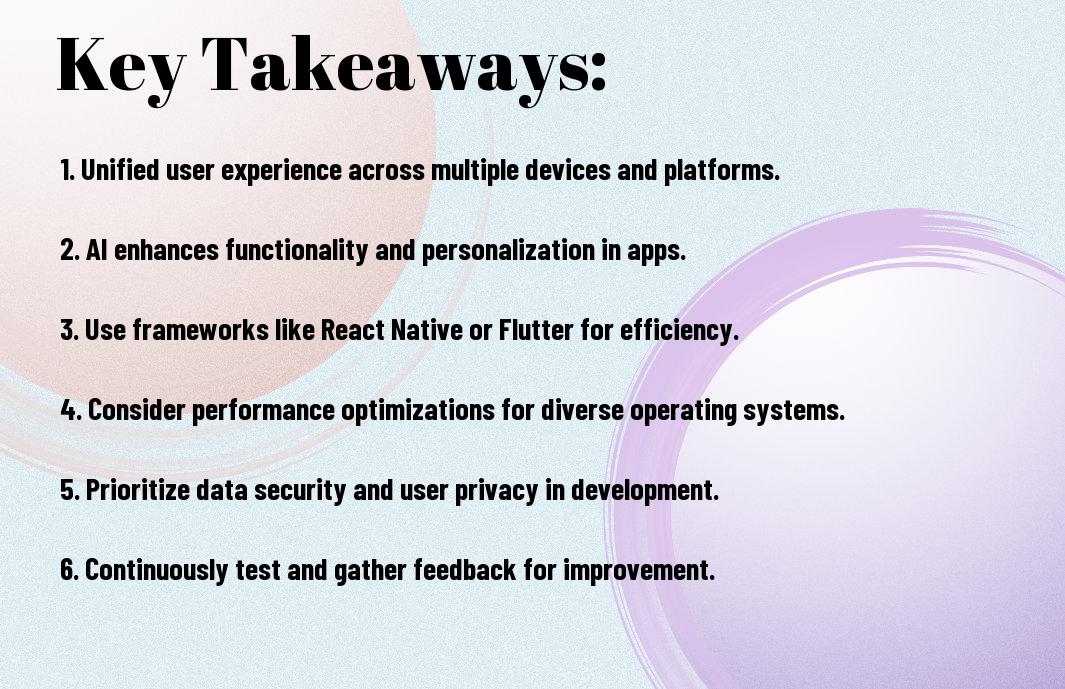
Key Takeaways:
- Developing cross-platform apps with AI integration enables businesses to reach a wider audience and provide a seamless user experience across different devices and operating systems.
- AI-powered cross-platform apps can automate tasks, improve performance, and offer personalized experiences, leading to increased user engagement and loyalty.
- Popular frameworks such as React Native, Flutter, and Xamarin allow developers to build cross-platform apps with AI integration, using a single codebase and reducing development time and costs.
- Integrating AI and machine learning models into cross-platform apps requires careful consideration of data privacy, security, and ethics to ensure compliance with regulations and maintain user trust.
- Continuous testing, iteration, and updating of AI-powered cross-platform apps are necessary to ensure they remain relevant, efficient, and effective in meeting evolving user needs and market demands.
Foundations of Cross-Platform Development
A solid understanding of the underlying principles is imperative for developing cross-platform apps with AI integration, and you will need to consider various factors, including your target audience, desired features, and technical requirements.
Native vs. Cross-Platform Architecture
Anyway, when deciding between native and cross-platform architecture, you should weigh the pros and cons of each approach, considering factors such as performance, development time, and maintenance costs, to determine which one best suits your needs.
Modern Development Frameworks
Above all, you will need to choose a suitable framework for your cross-platform app development, and you can select from a range of options, including React Native, Flutter, and Xamarin, each with its own strengths and weaknesses.
Frameworks like React Native and Flutter provide you with the tools and resources you need to build cross-platform apps with AI integration, allowing you to share code across platforms and streamline your development process, which can help you to reduce development time and costs, and you can focus on creating a seamless user experience for your audience.

AI Integration Components
Now, as you examine into the world of cross-platform app development, you’ll need to explore AI integration components. You can learn more about App development with AI to enhance your skills.
Machine Learning Libraries
Libraries such as TensorFlow and Core ML enable you to build intelligent apps, allowing you to focus on your development process.
Neural Network Implementation
Learning from data, you can implement neural networks to improve your app’s performance and user experience.
With neural network implementation, you can enable your app to make predictions, classify data, and make decisions, taking your app to the next level, and as you explore this further, you’ll discover how to optimize your neural network for better performance, making your app more efficient and effective for your users.
Data Management Across Platforms
To effectively manage data across platforms, you’ll need to consider a unified approach. You can explore tools like Free AI-Powered Mobile App Development – Build Cross-Platform Apps to streamline your data management process.
Unified Data Architecture
On the path to developing a cross-platform app, you’ll need to design a unified data architecture that integrates your AI components seamlessly, allowing you to access and manage data efficiently across different platforms.
Cross-Platform Storage Solutions
Against the backdrop of diverse platform requirements, you’ll need to select cross-platform storage solutions that can accommodate your app’s unique needs, ensuring data consistency and security.
Unified storage solutions enable you to manage data across platforms, allowing you to focus on your app’s core functionality. You can leverage cloud-based storage services to store and retrieve data, ensuring that your app’s data is accessible and up-to-date across all platforms, making it easier for you to maintain and update your app.
AI Model Deployment
After developing your AI model, you need to deploy it to your cross-platform app. You’ll have to choose between cloud-based services or on-device processing, each with its own advantages and disadvantages.
Cloud-Based AI Services
Above all, cloud-based AI services provide scalability and cost-effectiveness, allowing you to deploy your model quickly and efficiently, and you can leverage the expertise of cloud providers to manage your AI infrastructure.
On-Device AI Processing
Between these options, on-device processing offers real-time processing and enhanced security, as your data is processed locally on the user’s device, and you can optimize your app’s performance by leveraging the device’s hardware capabilities.
This approach also enables you to provide a seamless user experience, even with limited internet connectivity, and you can ensure that your app’s AI functionality is always available, regardless of network conditions, which is especially important for applications that require real-time processing, such as image recognition or natural language processing.
Performance Optimization
For developing cross-platform apps with AI integration, you need to focus on optimizing performance to ensure a seamless user experience. Your app’s performance is directly related to its success, and you should prioritize it to retain users.
Resource Management
Besides optimizing code, you should manage resources efficiently to prevent memory leaks and reduce battery consumption. You can use various tools to monitor your app’s resource usage and identify areas for improvement.
Response Time Enhancement
Beside other factors, response time plays a significant role in your app’s performance. You can enhance it by optimizing database queries, reducing network latency, and using caching mechanisms to fetch data quickly.
Indeed, enhancing response time requires a thorough analysis of your app’s architecture and workflow. You can use various techniques such as parallel processing, asynchronous programming, and content delivery networks to reduce latency and improve your app’s overall performance, allowing you to provide a better experience for your users.
Security and Privacy
Many cross-platform apps with AI integration face security and privacy concerns, and as you develop your app, you must prioritize these aspects to protect your users’ data and maintain their trust.
Data Protection Protocols
The most effective way to ensure data protection is by implementing robust protocols, such as encryption and secure authentication, to safeguard your users’ sensitive information and prevent unauthorized access.
AI Model Security
Securely designing and testing your AI models is vital to prevent potential vulnerabilities, and you should ensure that your models are trained on secure data and are resistant to attacks, so you can trust your AI-powered app.
Hence, as you focus on AI model security, you will need to consider various factors, including data quality, model interpretability, and explainability, to ensure that your AI-powered app is not only secure but also transparent and fair, allowing you to build a trustworthy relationship with your users.
Final Words
Upon reflecting on your journey to develop cross-platform apps with AI integration, you now possess the knowledge to create innovative solutions. You can leverage AI to enhance your app’s functionality, making it more engaging for users. As you move forward, your expertise will enable you to design and develop cutting-edge apps, streamlining your workflow and expanding your reach across various platforms, ultimately taking your app development to the next level.
FAQ
Q: What are the benefits of developing cross-platform apps with AI integration?
A: Developing cross-platform apps with AI integration offers several benefits, including increased reach and accessibility across different platforms, enhanced user experience through personalized and intelligent features, and improved development efficiency by leveraging a single codebase. Additionally, AI-powered cross-platform apps can provide real-time insights and analytics, enabling data-driven decision-making and driving business growth.
Q: What are the key technologies and tools used for developing cross-platform apps with AI integration?
A: The key technologies and tools used for developing cross-platform apps with AI integration include frameworks such as React Native, Flutter, and Xamarin, which enable cross-platform development. For AI integration, popular tools and technologies include machine learning frameworks like TensorFlow and Core ML, natural language processing (NLP) libraries like NLTK and spaCy, and computer vision libraries like OpenCV. Furthermore, cloud-based services like Google Cloud AI Platform, Microsoft Azure Machine Learning, and Amazon SageMaker provide scalable and secure infrastructure for deploying and managing AI models.
Q: How do developers ensure the security and privacy of user data in cross-platform apps with AI integration?
A: To ensure the security and privacy of user data in cross-platform apps with AI integration, developers should implement robust security measures, such as encryption, secure authentication and authorization, and access controls. Additionally, developers should comply with relevant data protection regulations, like GDPR and CCPA, and implement data anonymization and pseudonymization techniques to protect sensitive user information. Regular security audits, penetration testing, and vulnerability assessments can also help identify and address potential security risks associated with AI-powered cross-platform apps.


