Apps

The Role of Machine Learning in Building Intelligent Apps

As you probe into the world of app development, you’ll discover that machine learning plays a significant role in creating intelligent apps. You’ll learn how your apps can leverage machine learning algorithms to analyze data, make predictions, and provide personalized experiences. Your understanding of machine learning will enable you to build apps that adapt to user behavior, making them more engaging and effective. By exploring the intersection of machine learning and app development, you’ll unlock new possibilities for your projects.

Key Takeaways:

  • Machine learning enables apps to learn from user behavior and adapt to their preferences, creating a more personalized experience and increasing user engagement.
  • Intelligent apps powered by machine learning can automate tasks, such as data analysis and processing, freeing up resources for more strategic and creative work.
  • Machine learning algorithms can be used to develop predictive models that forecast user behavior, allowing apps to proactively offer relevant content, services, or recommendations.
  • The integration of machine learning in app development facilitates the creation of chatbots and virtual assistants that can understand and respond to user queries in a more human-like way.
  • By leveraging machine learning, developers can build apps that continuously improve over time, as the algorithms learn from user interactions and refine their performance to deliver better outcomes.
    Evolution of Machine Learning in App Development

    A significant transformation has taken place in the field of app development with the integration of machine learning, enabling you to create more intelligent and interactive applications.

    Traditional App Development vs ML-Powered Apps

    Alongside the rise of machine learning, you are now able to compare the limitations of traditional app development with the capabilities of ML-powered apps, allowing you to make informed decisions about your app development strategy.

    Core ML Technologies Driving Modern Apps

    Between the various technologies available, you will find that some are more relevant to your app development needs, such as natural language processing and computer vision, which can enhance your app’s user experience.

    With the help of these core ML technologies, you can develop apps that learn from user behavior, adapt to their preferences, and provide personalized experiences, ultimately setting your app apart from others in the market and driving user engagement, as you explore the possibilities of machine learning in app development, you will discover new ways to innovate and improve your applications.

    Data Processing and Pattern Recognition

    Some of the most significant advantages of machine learning in building intelligent apps lie in its ability to process vast amounts of data and recognize patterns, as you can learn more about The Role of AI and Machine Learning in Mobile App Development, enabling you to make informed decisions.

    Training Data Requirements

    Between the various stages of data processing, you will need to consider the requirements for training data, ensuring that your dataset is diverse, relevant, and sufficient to support your app’s intelligent features.

    Algorithm Selection and Optimization

    With the right data in place, you can focus on selecting and optimizing the algorithms that will drive your app’s pattern recognition capabilities, allowing you to refine your approach and improve performance.

    Training your algorithms effectively is key to unlocking the full potential of your intelligent app, and as you explore different techniques, you will find that the right combination of data and algorithms can significantly enhance your app’s ability to learn and adapt to user behavior, enabling you to deliver a more personalized and engaging experience for your users.

    Personalization Through ML

    Many apps now leverage machine learning to offer personalized experiences, enhancing user engagement and satisfaction. You can use ML algorithms to analyze your users’ behavior and preferences, tailoring your app’s content and features to meet their individual needs.

    User Behavior Analysis

    Beneath the surface of personalization lies a complex analysis of user behavior, where you can use ML to identify patterns and trends in how your users interact with your app, allowing you to refine your personalization strategies and improve your app’s overall user experience.

    Adaptive Interface Design

    Following the analysis of user behavior, you can design adaptive interfaces that adjust to your users’ preferences, making your app more intuitive and user-friendly, and as you research deeper into adaptive interface design, you’ll find that it enables your app to learn from user interactions and adapt accordingly.

    Adaptive interface design allows you to create a unique experience for each user, as your app learns and adapts to their behavior, preferences, and habits, enabling you to provide a more personalized and engaging experience, and by leveraging ML in this way, you can increase user satisfaction, retention, and ultimately, drive business success.

    Predictive Features Implementation

    After implementing machine learning algorithms, you can develop predictive features that enable your app to forecast user behavior and preferences, allowing you to provide personalized experiences and improve engagement.

    Real-time Decision Making

    Beneath the surface of intelligent apps lies the ability to make decisions in real-time, enabling you to respond quickly to changing user needs and market conditions, giving you a competitive edge.

    Automated Response Systems

    Prior to interacting with your app, you may wonder how automated response systems work, but with machine learning, you can create systems that automatically respond to user queries, freeing up your time and resources.

    Response systems powered by machine learning enable you to automate tasks, such as answering frequent user questions, sending notifications, and even offering personalized recommendations, allowing you to focus on more complex and high-value tasks, and ultimately enhancing your overall user experience.

    Performance Optimization

    Your application’s performance is directly tied to its ability to learn and adapt, making machine learning a key component in optimizing its efficiency and effectiveness.

    Resource Management

    Around the clock, your app is collecting and processing data, and you need to ensure that your resources are being utilized in the most efficient way possible to support this process.

    Scalability Solutions

    Solutions to scalability issues often involve implementing flexible infrastructure that can grow with your app’s user base, allowing you to handle increased traffic and data processing demands.

    A key aspect of scalability solutions is the ability to automatically adjust to changing conditions, such as increased user activity or unexpected spikes in data volume, ensuring that your app remains responsive and performs well under pressure, and you can achieve this by leveraging machine learning algorithms that detect anomalies and adjust resources accordingly.

    Security and Privacy Considerations

    Keep in mind that as you build intelligent apps with machine learning, security and privacy are of utmost importance. You must ensure that your app protects user data and maintains confidentiality, integrity, and availability.

    Data Protection Frameworks

    Between the various regulations and standards, you need to establish a robust data protection framework to safeguard your users’ sensitive information. You should consider implementing frameworks that ensure compliance with relevant laws and regulations.

    Ethical AI Implementation

    One of the key aspects of building intelligent apps is ensuring that your AI implementation is ethical. You should consider the potential impact of your app on users and society, and strive to develop AI that is fair, transparent, and accountable.

    Implementation of ethical AI in your app requires careful consideration of various factors, including data bias, algorithmic transparency, and user consent. You should prioritize fairness and transparency in your AI decision-making processes, and ensure that your app is designed to promote user well-being and safety. As you develop your app, you should also consider establishing an ethics review process to ensure that your AI implementation aligns with your values and principles.

    Conclusion

    Taking this into account, you can leverage machine learning to build intelligent apps that enhance your user experience. As you develop your apps, you’ll find that machine learning enables your systems to learn from data, making predictions and improving performance. With your apps becoming more intuitive, you’ll be able to provide personalized experiences, driving engagement and loyalty. By harnessing the power of machine learning, you can stay ahead in the competitive app market, delivering innovative solutions that meet your users’ evolving needs.

    FAQ

    Q: What is the primary role of machine learning in building intelligent apps?

    A: The primary role of machine learning in building intelligent apps is to enable them to learn from data, make predictions, and improve their performance over time. Machine learning algorithms can be trained on large datasets to recognize patterns, classify objects, and make decisions, allowing apps to provide personalized experiences, automate tasks, and solve complex problems. By integrating machine learning, developers can create apps that adapt to user behavior, preferences, and needs, resulting in a more engaging and effective user experience.

    Q: How does machine learning enhance the functionality of intelligent apps?

    A: Machine learning enhances the functionality of intelligent apps in several ways. It enables apps to analyze user data, such as usage patterns, location, and behavior, to provide personalized recommendations, content, and offers. Additionally, machine learning-powered apps can detect anomalies, predict user intent, and prevent errors, resulting in a more seamless and intuitive user experience. Furthermore, machine learning can be used to develop chatbots, virtual assistants, and other conversational interfaces that can understand natural language, respond to user queries, and provide support. By leveraging machine learning, developers can create apps that are more responsive, interactive, and user-friendly.

    Q: What are the key benefits of using machine learning in building intelligent apps?

    A: The key benefits of using machine learning in building intelligent apps include improved user experience, increased efficiency, and enhanced decision-making capabilities. Machine learning-powered apps can analyze large amounts of data, identify trends, and provide insights that can inform business decisions. Additionally, machine learning can help apps to detect and prevent security threats, such as fraud and malware, by identifying patterns and anomalies in user behavior. Overall, the use of machine learning in building intelligent apps can lead to increased customer satisfaction, loyalty, and retention, as well as improved operational efficiency and competitiveness in the market.

Building Apps that Learn – Machine Learning in Action

As you probe into the world of mobile app development, you’re likely to encounter the concept of machine learning. You can create apps that learn and adapt to user behavior, making them more engaging and effective. To get started, you’ll need to understand the fundamentals of machine learning and how to integrate it into your app. For a comprehensive guide, visit How to Build Machine Learning Apps to discover the possibilities and potential of machine learning in your development projects.

Key Takeaways:

  • Building apps that learn from user interactions and adapt to their behavior can significantly enhance the user experience and provide personalized services, making them more engaging and effective.
  • Machine learning algorithms can be integrated into apps to analyze user data, identify patterns, and make predictions, enabling the app to learn and improve over time.
  • Apps that learn can automate tasks, such as data processing and content recommendation, freeing up users from mundane activities and allowing them to focus on more important tasks.
  • Machine learning-powered apps can also improve their performance and accuracy by learning from user feedback, enabling them to refine their decision-making processes and provide more accurate results.
  • Developing apps that learn requires a combination of technical expertise, data analysis, and user-centered design, making it imperative to involve cross-functional teams in the development process to ensure successful implementation.

Machine Learning Fundamentals

The foundation of machine learning lies in its ability to enable apps to learn from data. As you investigate into this field, you’ll discover various aspects that contribute to its functionality.

Types of Learning Algorithms

One key aspect is the type of learning algorithm used, which can be:

  • Supervised learning
  • Unsupervised learning
  • Reinforcement learning
  • Deep learning
  • Neural networks

This understanding will help you choose the right algorithm for your app.

Algorithm Description
Supervised learning Learning from labeled data
Unsupervised learning Learning from unlabeled data
Reinforcement learning Learning through trial and error
Deep learning Learning through neural networks
Neural networks Mimicking human brain function

Data Processing Pipeline

Beneath the surface of machine learning lies the data processing pipeline, which you will need to understand to build effective apps.

Understanding the data processing pipeline is crucial for you, as it involves collecting, processing, and preparing data for your machine learning model, allowing you to make informed decisions about your app’s development.

Essential Tools and Frameworks

Some of the most effective machine learning tools and frameworks are available to help you build intelligent apps. You can leverage these to streamline your development process and create more accurate models.

Popular ML Libraries

Prior to starting your project, you’ll want to explore popular ML libraries like TensorFlow and PyTorch, which offer a wide range of features and functionalities to support your machine learning endeavors, allowing you to focus on building your app.

Development Environments

For your development needs, you’ll need a suitable environment that supports your machine learning workflow, providing you with the necessary tools and features to design, test, and deploy your app efficiently.

Another key aspect of development environments is the ability to collaborate with others and track changes to your code, you can use platforms like Jupyter Notebook or Google Colab to work on your projects and share your findings with your team, making it easier to iterate and improve your app.

Model Development Process

Unlike traditional app development, machine learning app development involves a unique set of processes. You can learn more about it in this comprehensive guide to machine learning app development, which will walk you through the entire process.

Training Data Preparation

On the path to developing a machine learning model, you’ll need to prepare your training data. You’ll need to collect, clean, and preprocess your data to ensure it’s ready for your model.

Model Selection and Training

Before selecting a model, you’ll need to consider your app’s specific needs and goals. You’ll need to choose a model that aligns with your objectives and train it using your prepared data.

Data quality plays a significant role in model selection and training. You’ll need to ensure that your data is diverse, well-annotated, and relevant to your app’s use case. By doing so, you’ll be able to train a model that learns effectively and makes accurate predictions, ultimately enhancing your app’s overall performance and user experience.

App Integration Strategies

All successful apps that learn from user behavior rely on effective integration strategies, enabling you to leverage machine learning capabilities and enhance your app’s performance, which ultimately benefits your users.

API Implementation

Strategically, you will need to implement APIs that seamlessly connect your app to machine learning services, allowing you to access and utilize the data and insights you need to improve your app, and you can then use this data to inform your development decisions.

Real-time Processing

Processively, you will want to focus on real-time processing, enabling your app to analyze and respond to user behavior as it happens, which allows you to provide a more personalized and dynamic experience for your users, and you can achieve this by integrating machine learning models into your app’s backend.

Hence, as you probe deeper into real-time processing, you will discover that it requires a robust infrastructure and efficient algorithms to handle the vast amounts of data being generated by your users, and you will need to ensure that your app can scale to meet the demands of real-time processing, which can be a challenging but worthwhile endeavor for you.

Performance Optimization

After developing a machine learning model, you need to optimize its performance to ensure it runs efficiently. You will need to evaluate your model’s performance and identify areas for improvement.

Resource Management

Following the initial development, you’ll need to manage resources effectively to optimize performance. You should monitor your model’s resource usage and adjust accordingly to prevent bottlenecks.

Scaling Solutions

At this stage, you’ll need to consider scaling solutions to handle increased traffic or data. You can explore distributed computing or cloud services to support your growing application.

To implement effective scaling solutions, you will need to assess your application’s specific needs and choose the most suitable approach. You can consider horizontal scaling, vertical scaling, or a combination of both, depending on your requirements, and you should also plan for potential future growth to ensure your application remains efficient and effective.

Testing and Validation

Once again, you’ll need to assess your app’s performance, this time focusing on its ability to learn and adapt, ensuring it meets your requirements and functions as expected.

Model Evaluation Metrics

Modelling your app’s performance involves selecting the right metrics to evaluate its success, allowing you to identify areas for improvement and optimize its learning capabilities, helping you refine your app to better serve your users.

Quality Assurance Methods

At this stage, you’ll implement various methods to ensure your app’s quality, such as testing and validation techniques, to guarantee it functions as intended and provides accurate results, giving you confidence in your app’s abilities.

Validation of your app’s quality assurance methods is an ongoing process, as you continue to test and refine your app, you’ll be able to identify potential issues and make necessary adjustments, ensuring your app maintains a high level of performance and provides value to your users, and as you move forward, you’ll be able to trust that your app is functioning as expected, learning and adapting to user interactions, and providing the best possible experience.

To wrap up

On the whole, you now have a solid foundation in building apps that learn, leveraging machine learning to enhance your user experience. You’ve explored the concepts and techniques to integrate machine learning into your apps, enabling them to learn from your users’ behavior and adapt to their needs. With this knowledge, you can develop innovative apps that provide personalized experiences, making your users’ interactions more engaging and effective, and ultimately, driving the success of your app.

FAQ

Q: What is the main goal of building apps that learn using machine learning, and how does it enhance user experience?

A: The primary objective of building apps that learn is to create applications that can adapt and improve over time based on user interactions and data. By integrating machine learning algorithms, these apps can analyze user behavior, preferences, and patterns, enabling them to provide personalized experiences, make predictions, and automate tasks. This leads to increased user engagement, improved satisfaction, and a more intuitive interface, ultimately driving business success and competitiveness in the market.
Q: How do machine learning models learn and improve in apps, and what types of data do they require to function effectively?

A: Machine learning models in apps learn through a process of training and testing on large datasets, which can include user-generated content, behavioral data, and other relevant information. These models use algorithms to identify patterns and relationships within the data, making predictions or taking actions based on that analysis. To function effectively, machine learning models require high-quality, diverse, and sufficiently large datasets that are relevant to the task at hand. This can include text, images, audio, or other types of data, depending on the app’s purpose and functionality. By continuously updating and refining their models with new data, apps can improve their accuracy and performance over time.

Q: What are some of the key challenges and considerations when implementing machine learning in app development, and how can developers overcome them?

A: Implementing machine learning in app development poses several challenges, including data quality and availability, model complexity, and integration with existing infrastructure. Additionally, ensuring transparency, explainability, and fairness in machine learning decision-making processes is crucial. To overcome these challenges, developers should focus on collecting and preprocessing high-quality data, selecting appropriate algorithms, and continuously monitoring and updating their models. Furthermore, they should prioritize model interpretability, consider ethical implications, and ensure that their machine learning solutions align with the app’s overall goals and user needs. By addressing these challenges and considerations, developers can successfully leverage machine learning to create innovative, effective, and user-centric apps.

Building Multilingual Apps with Natural Language AI

As you expand your app’s reach to a global audience, you’ll need to cater to diverse language preferences. You can leverage Natural Language AI to develop multilingual apps, enabling your users to interact in their native languages. With this technology, you can enhance your app’s user experience, increase engagement, and tap into new markets. By integrating Natural Language AI, you can efficiently manage language support and provide personalized experiences for your users worldwide.

Key Takeaways:

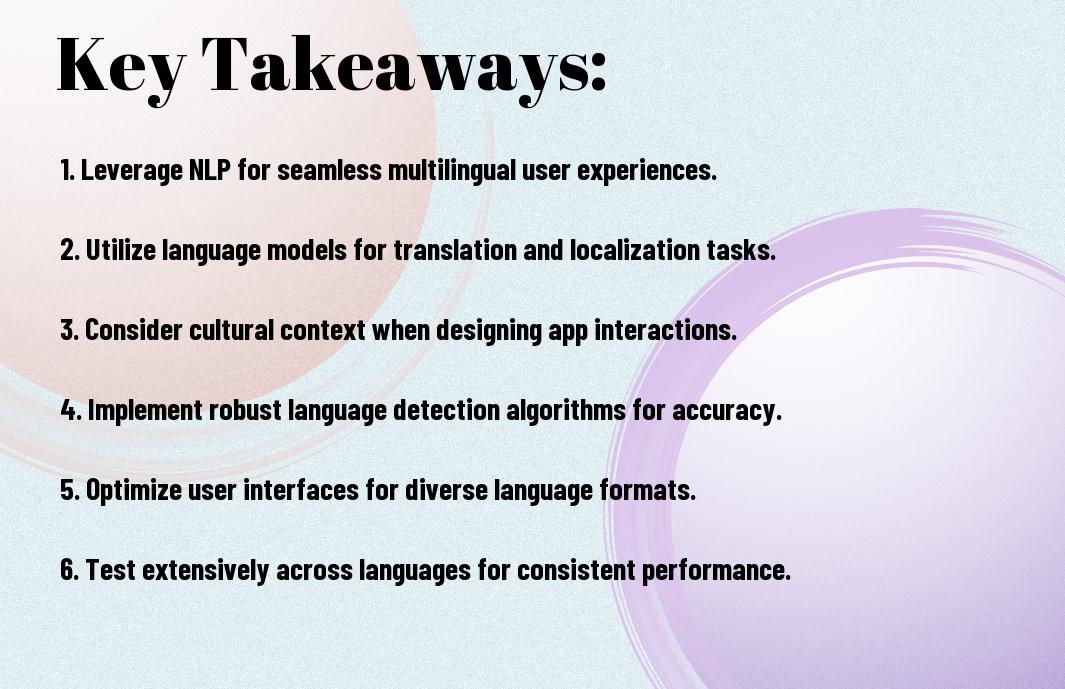
  • Developing multilingual apps with natural language AI enables businesses to expand their reach and cater to diverse user bases, improving overall user experience and engagement.
  • Natural language processing (NLP) and machine learning algorithms can be leveraged to build apps that understand and respond to user input in multiple languages, facilitating seamless communication.
  • Integrating language translation and localization capabilities into apps can help companies tap into new markets and increase their global presence, driving revenue growth and competitiveness.
  • Building multilingual apps with natural language AI requires careful consideration of cultural and linguistic nuances to ensure accurate and context-specific translations, avoiding potential miscommunications or misinterpretations.
  • By incorporating natural language AI into multilingual app development, developers can create more intuitive and user-friendly interfaces, enhancing customer satisfaction and loyalty across different languages and regions.

Natural Language AI Fundamentals

Before venturing into building multilingual apps, you need to understand the basics of natural language AI, which enables computers to process and generate human-like language, allowing your app to communicate effectively with users worldwide.

Core Language Processing Components

Among the key elements of natural language AI, you will find tokenization, syntax analysis, and semantics, which are imperative for your app to comprehend and generate text, facilitating interaction with users in their native languages.

Language Model Architecture

Language is at the heart of natural language AI, and you will need to design an architecture that can handle various languages, taking into account their unique characteristics, such as grammar and syntax, to ensure your app provides accurate and context-specific responses.

Components of a language model architecture include encoders, decoders, and attention mechanisms, which you can use to build a robust and flexible system, allowing your app to learn from data and improve its language understanding and generation capabilities over time, enabling you to support multiple languages and dialects in your app.

Multilingual Framework Setup

Now that you have decided to build a multilingual app, setting up a framework is important. You need to consider the languages you want to support and the resources you have available. Your framework should be scalable and flexible to accommodate different languages and regions.

Language Detection Systems

With language detection systems, you can automatically identify the language of your users and provide them with a personalized experience. You can use various libraries and APIs to detect languages and integrate them into your app.

Translation Pipeline Integration

Pipeline integration is a key step in building a multilingual app. You need to integrate your translation pipeline with your development workflow to ensure that your app is translated efficiently and accurately. Your translation pipeline should be able to handle different file formats and languages.

Indeed, integrating a translation pipeline into your development workflow can be complex, but it is worth the effort. You can use various tools and services to automate the translation process, such as machine translation APIs and translation management platforms. By integrating a translation pipeline, you can ensure that your app is translated quickly and accurately, and that you can reach a global audience with your product.

Language Data Management

For building multilingual apps, you need to manage language data effectively. This involves several steps, from collecting and storing data to retrieving and using it in your app.

Data Collection Strategies

Deriving data from various sources is imperative for your multilingual app. You will collect text, speech, and other forms of language data to train your AI models, enabling them to understand and generate human-like language.

Storage and Retrieval Methods

Collecting and organizing your language data is just the first step. You will need to store it securely and retrieve it efficiently to use in your app, ensuring that your AI models can access the data they need to function effectively.

Understanding how to implement effective storage and retrieval methods is vital for your app’s performance. You will want to consider factors such as data format, storage solutions, and retrieval algorithms to ensure that your language data is handled correctly, allowing your app to provide accurate and helpful responses to your users.

Cultural Context Integration

All aspects of your app’s development should consider the cultural context, and for more information on this topic, you can visit Multilingual natural language processing | Fast Data Science to learn more about integrating cultural context into your multilingual app.

Regional Language Adaptations

Adapting your app to regional languages is imperative, as you will need to consider the nuances of each language to ensure your app is effective in different regions, and you should take the time to understand the specific needs of your target audience.

Localization Parameters

Localization is key when developing a multilingual app, and you will need to consider various parameters such as date and time formats, currency, and units of measurement to ensure your app is user-friendly and accessible to a global audience.

At this stage, you will need to conduct thorough research to determine the specific localization parameters that apply to your target regions, and you should consider factors such as language, culture, and regulations to ensure your app meets the needs of your users and complies with local laws and regulations.

Performance Optimization

Once again, you’ll need to focus on optimizing your app’s performance to ensure a seamless user experience, especially when dealing with multiple languages and AI-powered features.

Response Time Enhancement

Across various platforms and devices, you can enhance your app’s response time by leveraging caching, content delivery networks, and optimizing database queries to reduce latency.

Resource Management

After implementing your multilingual app, you’ll need to monitor and manage your resources efficiently to prevent performance degradation, ensuring your app can handle increased traffic and user engagement.

Performance of your app is directly tied to how well you manage your resources, and you can achieve this by setting up alerts, tracking memory usage, and optimizing your code to minimize unnecessary computations, allowing you to identify and address potential bottlenecks before they impact your users.

Security and Privacy

Keep your users’ trust by prioritizing security and privacy in your multilingual app, ensuring their data is protected and their interactions are secure.

Data Protection Protocols

Following the development of your app, adhere to strict data protection protocols, implementing robust encryption and secure storage to safeguard your users’ information.

User Privacy Controls

Privately, you must consider the user’s perspective, providing them with controls to manage their personal data and opt-out of data collection, giving them autonomy over their privacy settings.

Security measures should be implemented to support user privacy controls, allowing you to ensure that your users’ data is handled responsibly, and you can maintain transparency about how their information is being used, giving you the ability to build trust with your users and establish a strong reputation for your app.

Conclusion

The development of multilingual apps with natural language AI enables you to expand your reach globally. You can now create apps that understand and respond to your users’ queries in their native languages, enhancing their experience. By leveraging natural language AI, you can break language barriers and make your app more accessible, increasing your user base and ultimately, your revenue. Your ability to cater to diverse linguistic needs sets you apart in the competitive app market.

FAQ

Q: What are the benefits of using Natural Language AI in building multilingual apps?

A: Building multilingual apps with Natural Language AI offers several benefits, including enhanced user experience, increased accessibility, and broader market reach. Natural Language AI enables apps to understand and respond to user input in multiple languages, making them more inclusive and user-friendly. This technology also allows for more accurate language translation, sentiment analysis, and intent detection, which can improve customer engagement and loyalty. Furthermore, by supporting multiple languages, businesses can expand their customer base and enter new markets, potentially leading to increased revenue and growth.

Q: How does Natural Language AI handle language nuances and cultural differences in multilingual apps?

A: Natural Language AI is designed to handle language nuances and cultural differences by leveraging advanced machine learning algorithms and large datasets. These algorithms can learn to recognize and adapt to the unique characteristics of each language, including idioms, colloquialisms, and cultural references. Additionally, Natural Language AI can be trained on region-specific data to ensure that the app is sensitive to local customs and preferences. This enables multilingual apps to provide more accurate and contextually relevant responses, improving the overall user experience and reducing the risk of cultural or linguistic misinterpretation.

Q: What are the key considerations for integrating Natural Language AI into a multilingual app development project?

A: When integrating Natural Language AI into a multilingual app development project, several key considerations must be taken into account. These include selecting the right Natural Language AI platform and tools, ensuring high-quality training data, and designing an intuitive user interface that can accommodate multiple languages. It is also important to consider factors such as language support, character encoding, and font compatibility to ensure seamless integration and optimal performance. Moreover, developers should prioritize ongoing testing and evaluation to ensure that the Natural Language AI component is functioning correctly and providing accurate results across all supported languages.

Personalizing App Experiences with AI Models

As you navigate the digital landscape, you expect tailored experiences from the apps you use. Your interactions, preferences, and behaviors hold valuable insights that can be leveraged to create unique experiences. With AI models, you can now analyze and act on this data to deliver personalized app experiences, enhancing user engagement and loyalty. By integrating AI, you can unlock new levels of customization, making your app stand out in a crowded market and driving long-term success.

Key Takeaways:

  • Personalizing app experiences with AI models can significantly enhance user engagement and retention by providing tailored content and recommendations based on individual preferences and behaviors.
  • AI-powered personalization can be achieved through various techniques, including natural language processing, machine learning algorithms, and collaborative filtering, to create unique experiences for each user.
  • Integrating AI models into app development enables real-time data analysis, allowing for prompt adjustments to the user interface, features, and content to optimize the overall user experience.
  • AI-driven personalization can also help app developers to identify and address user pain points, improving the app’s overall usability and driving long-term user loyalty.
  • By leveraging AI models, app developers can create dynamic and adaptive experiences that evolve with the user over time, leading to increased satisfaction and a competitive edge in the market.

AI Models in App Personalization

The use of AI models in app personalization enables you to create tailored experiences for your users. You can learn more about AI Personalization and its applications in enhancing user engagement.

Machine Learning Foundations

Between the various techniques used in AI models, machine learning is a fundamental aspect that helps you understand your users’ behavior and preferences, allowing you to make data-driven decisions.

Neural Networks for User Behavior

Foundations of neural networks enable you to analyze complex user behavior patterns, providing valuable insights to inform your personalization strategies and improve your app’s overall user experience.

Behavior analysis is a key component of neural networks for user behavior, as it allows you to identify trends and patterns in how users interact with your app, enabling you to create personalized experiences that meet their unique needs and preferences, ultimately enhancing your app’s engagement and retention rates.

Data Collection and Analysis

You begin by collecting data from various sources, including user interactions, behavior, and feedback, to create a comprehensive understanding of your users’ needs and preferences.

User Interaction Metrics

At this stage, you focus on gathering metrics such as click-through rates, session duration, and bounce rates to understand how users interact with your app.

Behavioral Pattern Recognition

Analysis of user behavior helps you identify patterns and trends, enabling you to create personalized experiences that cater to individual preferences and needs.

Recognition of behavioral patterns allows you to group users into segments based on their behavior, enabling you to tailor your app’s features, content, and recommendations to meet the unique needs of each segment, thereby enhancing your users’ overall experience and increasing engagement with your app.

Personalization Strategies

Once again, you’ll find that personalization is key to creating an engaging app experience, and there are several strategies you can employ to achieve this, including dynamic content adaptation and predictive user preferences, which can be used to tailor your app to individual users’ needs and preferences.

Dynamic Content Adaptation

The ability to adapt content in real-time is a powerful tool, allowing you to adjust your app’s layout, tone, and style to suit your users’ behaviors and preferences, creating a more personalized experience that keeps them coming back for more.

Predictive User Preferences

With predictive analytics, you can anticipate your users’ needs and preferences, enabling you to provide them with relevant content and recommendations that enhance their overall app experience, and increase the likelihood of them achieving their goals.

A key aspect of predictive user preferences is the ability to analyze user behavior and identify patterns, allowing you to make informed decisions about the content and features you present to your users, and continually refine your approach to meet their evolving needs and preferences, ultimately leading to a more satisfying and engaging experience for your users.

Implementation Framework

After designing your AI model, you can proceed to implement it within your app, leveraging its capabilities to enhance user experience. You will need to consider various factors, including data integration, scalability, and security, to ensure seamless model deployment.

Integration Architecture

Architecturally, you should design a system that allows for efficient data flow between your app and the AI model, enabling personalized experiences for your users. This involves setting up a robust infrastructure that supports real-time data processing and analysis.

Model Deployment Steps

Framework-wise, you will need to follow a structured approach to deploy your AI model, starting with data preparation, model training, and testing, before integrating it with your app. You should also consider using cloud-based services to streamline the deployment process.

Also, as you deploy your model, you will need to continuously monitor its performance, gathering feedback from users and making adjustments as necessary to ensure that your app provides the best possible experience, tailored to individual user preferences and behaviors, which will help you to refine your model over time and improve its accuracy.

Privacy and Security

For any app developer, ensuring the privacy and security of user data is paramount when implementing AI models to personalize app experiences, as you will be handling sensitive user information.

Data Protection Measures

Any measures you take to protect user data will be necessary in maintaining trust with your users, and you should consider implementing robust data protection measures to safeguard against potential breaches.

Ethical Considerations

Along with the benefits of personalized app experiences, you must also consider the ethical implications of using AI models, as you will be making decisions that affect your users’ experiences and privacy.

At the heart of ethical considerations is the need to be transparent with your users about the data you collect and how you use it, and you should ensure that your AI models are fair, unbiased, and respectful of user privacy, allowing you to build trust with your users and create a positive app experience.

Performance Optimization

To ensure seamless user experiences, you need to optimize your app’s performance, leveraging AI models to streamline processes and enhance overall efficiency, which in turn boosts your app’s reputation and user retention.

Response Time Management

Prior to implementing AI models, you likely faced challenges in managing response times, but with AI, you can now predict and optimize your app’s response times, ensuring that your users enjoy a smooth and responsive experience.

Resource Efficiency

Alongside response time management, you will find that an efficient allocation of resources is vital, as AI models help you identify areas of waste and optimize your app’s performance, allowing you to make the most of your resources.

Consequently, as you focus on optimizing resource efficiency, you will notice significant improvements in your app’s overall performance, and you will be able to allocate resources more effectively, leading to better user experiences and increased customer satisfaction, which ultimately benefits your business and helps you achieve your goals.

Summing up

So, as you integrate AI models into your app, you can create personalized experiences that cater to your users’ unique needs. You can leverage AI-driven insights to tailor your content, recommendations, and interactions, thereby enhancing user engagement and loyalty. By doing so, you can stay ahead of the competition and drive your business forward with data-driven decision making, ultimately leading to increased customer satisfaction and retention.

FAQ

Q: What are the benefits of using AI models to personalize app experiences?

A: Using AI models to personalize app experiences offers several benefits, including enhanced user engagement, increased conversion rates, and improved customer satisfaction. By leveraging machine learning algorithms, apps can analyze user behavior, preferences, and interests to deliver tailored content, recommendations, and interactions. This personalized approach enables apps to build stronger relationships with their users, driving loyalty and retention. Furthermore, AI-powered personalization can help apps to stay competitive in a crowded market, differentiate themselves from rivals, and ultimately, drive business growth.

Q: How do AI models collect and process data to personalize app experiences?

A: AI models collect and process data through various methods, including user feedback, behavior tracking, and integration with other data sources. This data is then analyzed using machine learning algorithms to identify patterns, preferences, and trends. The models can process large amounts of data, including user interactions, search queries, and demographic information, to create detailed user profiles. These profiles are used to deliver personalized content, such as product recommendations, customized notifications, and tailored advertising. Additionally, AI models can continuously learn and adapt to user behavior, ensuring that the personalized experiences evolve and improve over time.

Q: What are the key considerations for implementing AI models to personalize app experiences?

A: When implementing AI models to personalize app experiences, there are several key considerations to keep in mind. First, it is necessary to ensure that the AI model is transparent, explainable, and fair, to maintain user trust and avoid potential biases. Second, apps must comply with data protection regulations, such as GDPR and CCPA, to safeguard user privacy and security. Third, the AI model should be integrated seamlessly into the app’s existing infrastructure, without compromising performance or user experience. Finally, apps should continuously monitor and evaluate the effectiveness of their AI-powered personalization, making adjustments and improvements as needed to optimize user engagement and business outcomes.

Designing Adaptive Apps with Self-Learning AI Systems

As you research into the world of app development, you’re likely aware of the growing need for personalized user experiences. You can create apps that adapt to individual preferences by leveraging self-learning AI systems. Your goal is to craft an interface that learns and evolves with your users, providing a unique experience tailored to their needs. By integrating AI, you can enhance your app’s functionality and boost user engagement, setting your product apart in a crowded market.

Key Takeaways:

  • Designing adaptive apps with self-learning AI systems requires a deep understanding of user behavior and preferences to create personalized experiences that evolve over time.
  • Self-learning AI systems can analyze vast amounts of data to identify patterns and make predictions, enabling apps to adapt and improve their performance automatically.
  • Adaptive apps with self-learning AI systems can enhance user engagement by providing tailored content, recommendations, and interactions that cater to individual needs and interests.
  • Developers must consider factors such as data quality, algorithmic transparency, and user trust when designing adaptive apps with self-learning AI systems to ensure reliable and unbiased decision-making.
  • Continuous monitoring and evaluation of self-learning AI systems are necessary to ensure they remain effective and aligned with user needs, and to identify areas for improvement and optimization.

Core Components of Adaptive Apps

For designing adaptive apps, you need to understand the core components that make them work, including self-learning AI systems, which can be explored further in Adaptive UI Design Powered by AI and Machine Learning to create personalized user experiences.

Self-Learning Mechanisms

For instance, you will need to implement self-learning mechanisms that allow your app to adapt to user behavior and preferences over time, enabling it to make predictions and decisions autonomously.

Data Processing Architecture

Mechanisms like data processing architecture are crucial for handling the vast amounts of user data that your adaptive app will collect, and you should design it to be scalable and efficient.

To develop an effective data processing architecture, you will need to consider factors such as data storage, processing power, and security, ensuring that your app can handle the demands of real-time data processing and analysis, and provide your users with a seamless and personalized experience.

AI System Integration

Any effective adaptive app relies on seamless AI system integration, allowing your application to learn and adapt to user behavior, ensuring a personalized experience. You will need to consider the type of AI system that best suits your app’s requirements, taking into account factors such as data processing and user interaction.

Neural Network Implementation

Around the concept of neural networks, you can implement a system that mimics the human brain, enabling your app to make predictions and decisions based on user data, and you will be able to analyze complex patterns and make informed decisions.

Machine Learning Frameworks

Integrating machine learning frameworks into your app allows you to leverage pre-built tools and libraries, streamlining the development process and enabling your app to learn from user interactions, and you can focus on refining your app’s performance and user experience.

Even with the right machine learning frameworks in place, you will still need to fine-tune your app’s algorithms and models to ensure they are optimized for your specific use case, and you can continually monitor and update your app to ensure it remains effective and efficient, providing the best possible experience for your users.

Behavioral Pattern Recognition

Now, as you design adaptive apps with self-learning AI systems, you need to understand how users interact with your application, and this is where behavioral pattern recognition comes into play, enabling your system to learn from user behavior and adapt accordingly.

User Interaction Analysis

Between each user interaction, you can gather valuable data that helps your AI system to identify patterns and preferences, allowing you to tailor your app’s response to meet the unique needs of your users.

Response Optimization

Recognizing the importance of personalized experiences, you can use machine learning algorithms to optimize your app’s response, ensuring that it is tailored to the individual user’s behavior and preferences, thereby enhancing their overall experience.

Even as you probe deeper into response optimization, you will find that your AI system can analyze user feedback and adjust its responses in real-time, enabling your app to evolve and improve continuously, and as you monitor user engagement, you can refine your app’s adaptive capabilities to deliver a more intuitive and engaging experience for your users.

Real-Time Adaptation Systems

Keep in mind that real-time adaptation systems are vital for designing adaptive apps, and you can learn more about self-learning AI systems by visiting Self-Learning AI — Building Future-Proof Machine Learning Applications to improve your understanding of the topic.

Dynamic Content Adjustment

Along with real-time adaptation, you will need to adjust your content dynamically to cater to the changing needs of your users, ensuring that your app remains engaging and relevant.

Performance Monitoring

Between designing and deploying your adaptive app, you will need to monitor its performance to identify areas that require improvement, allowing you to make data-driven decisions.

For instance, you can use performance monitoring tools to track user behavior, identify bottlenecks, and optimize your app’s performance in real-time, enabling you to provide a seamless user experience and increase user satisfaction with your adaptive app.

Personalization Engines

Once again, you’ll find that personalization is key to creating an adaptive app, and personalization engines are the driving force behind this capability, enabling your app to learn and adjust to user behavior over time.

User Profile Management

Personally, you will need to implement effective user profile management to store and analyze user data, allowing your app to make informed decisions about the content and features to display to each individual user.

Preference Learning Algorithms

Besides the user interface, you will also need to integrate preference learning algorithms that can analyze user behavior and adapt your app’s functionality accordingly, providing a more tailored experience for each user.

Considering the complexity of human preferences, you will need to carefully design and train your preference learning algorithms to accurately capture and respond to user behavior, taking into account various factors such as usage patterns, search history, and feedback, to create a truly personalized experience that meets your users’ unique needs and expectations.

Security and Privacy

After designing an adaptive app with self-learning AI systems, you must consider the security and privacy implications to protect your users’ data and maintain their trust.

Data Protection Protocols

Driven by the need for secure data handling, you should implement robust data protection protocols to safeguard your users’ sensitive information and ensure compliance with regulatory requirements.

Ethical AI Implementation

Implementing AI in an ethical manner is vital to avoid biases and ensure fairness in your app’s decision-making processes, allowing you to build a trustworthy relationship with your users.

Indeed, as you examine deeper into ethical AI implementation, you will need to consider factors such as transparency, accountability, and explainability, enabling you to develop an AI system that not only learns from data but also respects your users’ rights and privacy, ultimately enhancing your app’s overall performance and user experience.

Final Words

Drawing together the concepts explored, you now have a solid foundation for designing adaptive apps with self-learning AI systems. You can leverage this knowledge to create innovative solutions that enhance your users’ experiences. As you launch on your project, consider your goals and how your app will learn and adapt to meet the evolving needs of your audience, ultimately leading to increased user satisfaction and engagement with your product.

FAQ

Q: What are the benefits of designing adaptive apps with self-learning AI systems?

A: Designing adaptive apps with self-learning AI systems provides several benefits, including enhanced user experience, improved performance, and increased efficiency. These systems can learn from user behavior and adapt to their needs, offering personalized experiences that increase user engagement and satisfaction. Additionally, self-learning AI systems can automate tasks, reduce errors, and optimize resource allocation, leading to improved performance and efficiency.

Q: How do self-learning AI systems integrate with existing app infrastructure to enable adaptive design?

A: Self-learning AI systems can integrate with existing app infrastructure through various methods, including APIs, SDKs, and data analytics platforms. These systems can collect and analyze user data, such as usage patterns, preferences, and behavior, to inform adaptive design decisions. By leveraging machine learning algorithms and natural language processing, self-learning AI systems can identify areas for improvement and optimize the app’s UI/UX, content, and functionality to deliver a more adaptive and responsive user experience.

Q: What are the key considerations for developers when designing adaptive apps with self-learning AI systems?

A: When designing adaptive apps with self-learning AI systems, developers should consider several key factors, including data quality, user privacy, and transparency. Ensuring high-quality and diverse data is necessary for training accurate self-learning AI models. Developers must also prioritize user privacy and security, implementing robust data protection measures to prevent unauthorized access or misuse. Furthermore, providing transparent explanations of how the self-learning AI system works and makes decisions can help build trust with users and foster a positive app experience.

Skip to content