As you navigate the complexities of development workflows, you’re likely seeking ways to optimize efficiency and productivity. Your goal is to deliver high-quality results quickly, and AI integration can help you achieve this. By leveraging AI, you can automate repetitive tasks, enhance collaboration, and gain valuable insights to inform your decision-making. This enables you to focus on high-level strategy and creative problem-solving, ultimately driving your projects forward with greater speed and accuracy.

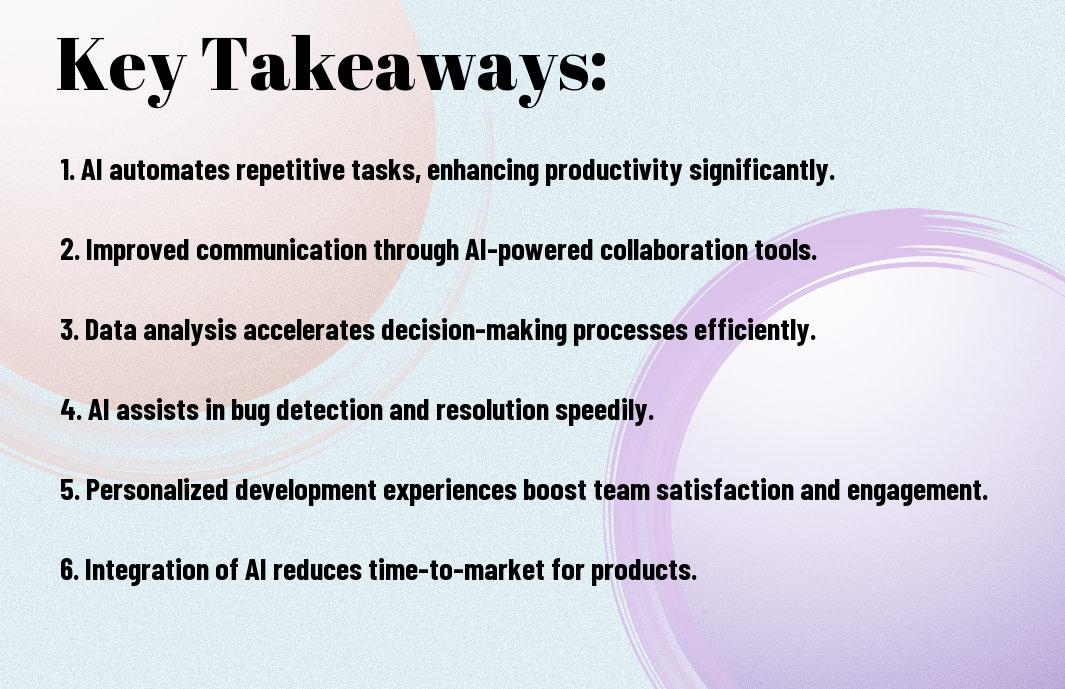
Key Takeaways:
- Automating repetitive tasks through AI integration can significantly reduce development time and increase productivity, allowing teams to focus on more complex and high-value tasks.
- AI-powered tools can help improve code quality by detecting errors, suggesting improvements, and optimizing code performance, resulting in faster and more reliable software development.
- AI-driven project management can enhance collaboration and communication among team members by providing real-time updates, predicting potential roadblocks, and identifying areas for improvement.
- Integrating AI into development workflows can facilitate data-driven decision making by providing insights and analytics on development processes, enabling teams to make informed decisions and optimize their workflows.
- AI integration can also enable developers to build more intelligent and adaptive software systems, such as chatbots, virtual assistants, and predictive maintenance systems, that can learn and improve over time.
AI Development Tools Integration
A key aspect of streamlining development workflows is integrating AI development tools, which can significantly enhance your productivity. You can explore more about AI Workflow optimization to discover how AI can transform your development process.
Code Generation Assistants
One of the most significant benefits of AI integration is the ability to automate repetitive coding tasks, allowing you to focus on more complex aspects of your project, thereby increasing your overall efficiency.
Automated Testing Frameworks
Across various development stages, you can leverage AI-powered testing frameworks to identify and fix errors, ensuring your application is stable and functions as intended, which ultimately saves you time and resources.
Assistants like automated testing frameworks can help you identify potential issues before they become major problems, enabling you to proactively address them and maintain the quality of your application, allowing you to deliver a better user experience.
Machine Learning Pipeline Optimization
If you’re looking to streamline your development workflows, integrating AI can be a game-changer, allowing you to automate repetitive tasks and focus on high-level strategy.
Data Processing Automation
Following the implementation of AI, you’ll find that data processing becomes much more efficient, allowing you to allocate your resources more effectively and make data-driven decisions to drive your business forward.
Model Training Workflows
By leveraging AI, you can optimize your model training workflows, enabling you to develop and deploy models more quickly and accurately, which in turn allows you to respond to changing market conditions and stay ahead of the competition.
Consequently, as you refine your model training workflows, you’ll be able to identify areas for improvement and make targeted adjustments, allowing you to continually refine and improve your models, and ultimately drive better outcomes for your business, enabling you to make more informed decisions and achieve your goals more effectively.
DevOps Enhancement with AI
Once again, you can leverage AI to enhance your DevOps practices, leading to more efficient and streamlined workflows. By integrating AI into your DevOps pipeline, you can automate tasks, improve code quality, and predict potential issues before they arise.
Predictive Maintenance
With advanced analytics and machine learning algorithms, you can identify potential problems in your system, allowing you to take proactive measures to prevent downtime and ensure continuous delivery of your services.
Resource Allocation Systems
Beneath the surface of your development workflow, you can optimize your resource allocation with AI-powered systems, enabling you to assign tasks and manage resources more effectively, leading to increased productivity and reduced waste.
Also, as you examine deeper into resource allocation systems, you’ll find that AI can help you analyze your workflow, identify bottlenecks, and provide recommendations for improvement, allowing you to make data-driven decisions and optimize your development process for maximum efficiency and output, ultimately benefiting your overall workflow and project delivery.
Collaborative AI Systems
Keep in mind that collaborative AI systems can significantly enhance your development workflows by facilitating seamless communication and task management among team members, allowing you to focus on high-priority tasks.
Team Coordination Tools
Among the various benefits of collaborative AI systems, you will find that team coordination tools enable you to streamline your workflow, making it easier for you to manage tasks and collaborate with your team more efficiently.
Code Review Automation
Across the board, code review automation is a key feature of collaborative AI systems, allowing you to automate tedious tasks and focus on more complex aspects of your project, thereby increasing your productivity.
Review your code review process and consider implementing AI-powered tools to automate the task, enabling you to identify errors and bugs more quickly, and ultimately, you will be able to deliver high-quality products faster and more reliably, which will enhance your overall development workflow.
Quality Assurance Through AI
To ensure the delivery of high-quality software, you can leverage AI-powered tools that automate testing and validation processes, freeing up your team to focus on more complex tasks.
Bug Detection Algorithms
Toward achieving this goal, you can utilize bug detection algorithms that use machine learning to identify and classify defects, allowing you to address issues before they reach production.
Performance Optimization
Around the clock, your application’s performance can be monitored and optimized using AI-driven tools that analyze usage patterns and provide recommendations for improvement, enabling you to deliver a seamless user experience.
This performance optimization not only enhances your application’s speed and reliability but also helps you to identify areas where resources are being underutilized, allowing you to allocate them more efficiently and reduce costs, ultimately leading to better decision-making and increased customer satisfaction, as you are able to provide your users with a high-quality experience that meets their expectations.
Security and Compliance
Many development teams face challenges in ensuring the security and compliance of their workflows, but AI integration can help alleviate these concerns by automating various security and compliance tasks, allowing you to focus on your core development work.
Automated Security Scanning
Above all, automated security scanning is a key benefit of AI integration, enabling you to identify and address potential security vulnerabilities in your codebase, thereby protecting your applications and data from potential threats.
Regulatory Compliance Checks
Compliant with regulatory requirements, AI-powered tools can help you ensure that your development workflows adhere to relevant standards and regulations, such as data protection and privacy laws, allowing you to avoid potential fines and reputational damage.
Consequently, as you implement regulatory compliance checks, you will be able to demonstrate your commitment to protecting sensitive data and maintaining the trust of your customers, which is necessary for building a strong reputation and maintaining a competitive edge in your industry.
Conclusion
As a reminder, you can significantly enhance your development workflows by integrating AI. You will experience improved efficiency and productivity, allowing your team to focus on high-priority tasks. By automating repetitive tasks, you can optimize your workflow, leading to faster project completion and increased accuracy. Your development process will become more streamlined, enabling you to deliver high-quality results and stay ahead in the competitive market.
FAQ
Q: What are the benefits of integrating AI into development workflows?
A: Integrating AI into development workflows can significantly enhance productivity, efficiency, and accuracy. AI-powered tools can automate repetitive tasks, such as code reviews and testing, allowing developers to focus on more complex and creative tasks. Additionally, AI can help identify potential bugs and errors, reducing the likelihood of downstream problems and improving overall code quality. By streamlining development workflows through AI integration, teams can deliver high-quality software faster and more reliably, ultimately driving business success.
Q: How can AI be used to improve collaboration and communication among development teams?
A: AI can be used to improve collaboration and communication among development teams in several ways. For example, AI-powered chatbots can facilitate communication between team members, provide real-time updates on project status, and even help with task assignment and prioritization. AI can also analyze team dynamics and provide insights on how to improve collaboration, such as identifying potential bottlenecks and suggesting ways to improve knowledge sharing. Furthermore, AI-powered project management tools can help teams track progress, set deadlines, and allocate resources more effectively, ensuring that everyone is on the same page and working towards common goals.
Q: What are some potential challenges and limitations of integrating AI into development workflows, and how can they be addressed?
A: While integrating AI into development workflows can bring numerous benefits, there are also potential challenges and limitations to consider. For example, AI systems may require significant training data and computational resources, which can be time-consuming and costly to implement. Additionally, AI may not always understand the nuances of human decision-making, which can lead to errors or unexpected outcomes. To address these challenges, teams should carefully evaluate their AI solutions, ensure that they are properly trained and validated, and establish clear guidelines and protocols for AI use. Moreover, teams should also prioritize transparency, accountability, and human oversight to ensure that AI is used in a way that complements and augments human capabilities, rather than replacing them.