As you develop your application, you’re likely considering how to ensure its longevity and adaptability in an ever-evolving technological landscape. You want your application to stay relevant and competitive, and integrating AI models can be a key factor in achieving this goal. By incorporating AI, you can enhance your application’s capabilities, improve user experience, and position your business for long-term success. You’ll be able to leverage AI-driven insights and automation to drive innovation and growth.
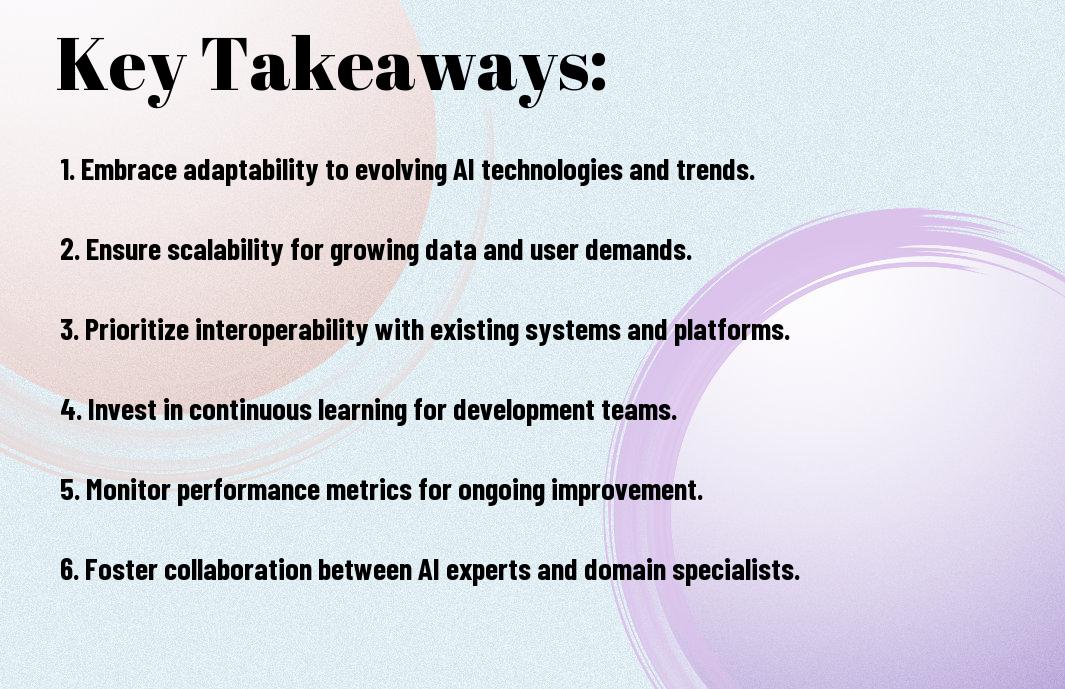
Key Takeaways:
- Integrating AI models into your application can significantly enhance its ability to adapt to changing user needs and market conditions, ensuring long-term success and relevance.
- AI-driven applications can automate routine tasks, freeing up resources for more strategic and creative endeavors, and leading to increased efficiency and productivity.
- By leveraging AI, applications can provide personalized experiences for users, leading to higher engagement and satisfaction rates, as well as improved customer retention and loyalty.
- Future-proofing an application with AI requires ongoing monitoring and evaluation of emerging trends and technologies, allowing for timely updates and adjustments to stay ahead of the competition.
- Effective integration of AI models also involves addressing potential ethical and regulatory considerations, such as data privacy and bias, to maintain trust and compliance in the application’s operation.

AI Integration Fundamentals
Before integrating AI models into your application, you need to understand the basics of AI and its potential applications. You should assess your current infrastructure and identify areas where AI can bring the most value to your business.
Model Selection Criteria
Integrating the right AI model is imperative for your application’s success. You will need to evaluate different models based on factors such as accuracy, complexity, and compatibility with your existing infrastructure to ensure seamless integration.
Scalability Requirements
For your AI-powered application to be successful, you need to consider scalability from the outset. You should design your infrastructure to handle increased traffic and data processing demands as your application grows.
Fundamentals of scalability requirements involve planning for potential growth and ensuring that your AI model can handle increased loads without compromising performance. You should consider factors such as data storage, processing power, and network bandwidth to ensure that your application can scale efficiently and effectively, meeting your growing needs and expectations.
Technical Architecture Design
The technical architecture design of your application plays a significant role in future-proofing it with AI models. You need to consider a design that allows for flexibility and scalability to accommodate evolving AI technologies.
Modular AI Components
Modifying your application to incorporate modular AI components enables you to update and replace individual components without affecting the entire system, allowing you to adapt to changing AI landscapes.
API Integration Points
Componentizing your application’s architecture enables you to create well-defined API integration points, making it easier to integrate AI models and ensuring seamless communication between different components of your application.
Points of integration are important when designing your application’s architecture, as you will be working with various AI models and technologies. You should consider how these points will be used to connect your application with external AI services, allowing you to leverage the latest advancements in AI and machine learning, and ensuring your application stays up-to-date and competitive in the market.
Data Pipeline Strategy
Unlike traditional approaches, a well-planned data pipeline strategy is important for integrating AI models into your application, enabling you to make data-driven decisions and drive long-term success.
Data Collection Framework
About the data you collect, it’s important to establish a framework that ensures quality, relevance, and consistency, allowing you to build a robust foundation for your AI models and inform your application’s development.
Processing Infrastructure
Driven by the need for efficient data processing, you’ll need to design an infrastructure that can handle large volumes of data, providing you with the scalability and flexibility required to support your application’s growth.
Consequently, as you develop your processing infrastructure, you’ll want to consider factors such as data storage, computational power, and network bandwidth, ensuring that your system can handle the demands of your AI models and provide you with the insights you need to drive your application forward.
Model Lifecycle Management
Your application’s AI models require ongoing management to ensure their effectiveness and adaptability, this involves monitoring, updating, and refining them over time to maintain their performance and accuracy.
Version Control Systems
Among the crucial tools for model lifecycle management are version control systems, which allow you to track changes and collaborate with your team, enabling you to manage different versions of your models and maintain a record of updates and modifications.
Update Mechanisms
Behind every successful AI model is a well-planned update mechanism, which enables you to modify and refine your models as new data becomes available, ensuring they continue to perform optimally and adapt to changing conditions.
Also, when implementing update mechanisms, you should consider factors such as data drift, model degradation, and concept drift, which can impact your model’s performance over time, and develop strategies to address these challenges and ensure your models continue to deliver accurate results.
Performance Optimization
All applications require ongoing performance optimization to ensure they continue to meet your needs. You will need to monitor and adjust your application regularly to maintain its performance and efficiency.
Resource Allocation
One key aspect of performance optimization is allocating your resources effectively. You should prioritize tasks and allocate resources accordingly to maximize your application’s performance and efficiency.
Load Balancing
Any imbalance in your application’s load can significantly impact its performance. You can use load balancing techniques to distribute the workload evenly and ensure your application runs smoothly.
Optimization of load balancing is vital to ensure your application can handle increased traffic or demand. You can achieve this by continuously monitoring your application’s performance and making adjustments as needed to ensure optimal load balancing, which will help you to improve your application’s overall performance and user experience.
Security and Compliance
Now that you’re integrating AI models into your application, you should consider visiting Three Key Concepts to Build Future-Proof AI Applications to ensure long-term success.
Data Protection Measures
After implementing AI, you need to prioritize data protection to safeguard your users’ information and maintain their trust in your application.
Regulatory Adherence
Among the various aspects of security and compliance, adhering to regulations is vital to avoid legal repercussions and reputational damage, so you must ensure your application meets all necessary standards.
This involves staying up-to-date with the latest regulatory requirements and adapting your application accordingly, which you can achieve by regularly monitoring updates and consulting with experts to guarantee your application’s compliance and security, thereby protecting your users and your business.
Final Words
Drawing together the insights from integrating AI models, you now have a solid foundation to future-proof your application. You can leverage AI to drive long-term success, enhancing your product’s capabilities and staying ahead of the competition. By incorporating AI, you ensure your application remains relevant, efficient, and adaptable to evolving user needs, ultimately securing your position in the market and driving your business forward.
FAQ
Q: What are the benefits of integrating AI models into my application for future-proofing?
A: Integrating AI models into your application can provide numerous benefits for long-term success, including enhanced user experience, improved decision-making capabilities, and increased efficiency. AI models can help analyze large amounts of data, identify patterns, and make predictions, allowing your application to adapt to changing user needs and market trends. Additionally, AI-powered applications can automate routine tasks, freeing up resources for more strategic and creative endeavors. By incorporating AI models, you can stay ahead of the competition and ensure your application remains relevant and effective in the ever-evolving digital landscape.
Q: How can I ensure the AI models I integrate into my application are scalable and flexible for long-term success?
A: To ensure the AI models you integrate into your application are scalable and flexible, it’s crucial to consider several factors. First, choose AI models that are cloud-based and can handle increased traffic and data volumes. Second, select models that are modular and can be easily updated or replaced as new technologies emerge. Third, implement a microservices architecture that allows for seamless integration and deployment of new AI models. Finally, establish a robust testing and validation framework to ensure the AI models continue to perform optimally as your application evolves. By taking these steps, you can create a scalable and flexible AI-powered application that can adapt to changing user needs and technological advancements.
Q: What are the key considerations for maintaining and updating AI models in my application to ensure long-term success?
A: Maintaining and updating AI models in your application is vital to ensure long-term success. Key considerations include regularly monitoring model performance, updating models with new data and algorithms, and retraining models as needed. It’s also crucial to establish a data management strategy that ensures the quality, accuracy, and relevance of the data used to train and update AI models. Additionally, consider implementing a human-in-the-loop approach, where human feedback and oversight are used to validate AI model outputs and identify areas for improvement. By prioritizing model maintenance and updates, you can ensure your AI-powered application continues to deliver value to users and drive business success over time.