
As you develop your mobile application, you aim to create an engaging experience that meets your users’ unique needs. You understand that a one-size-fits-all approach no longer works, and your goal is to deliver personalized interactions that drive loyalty and retention. With AI-driven personalization, you can analyze user behavior, preferences, and patterns to tailor your app’s content, features, and interface, ultimately enhancing your users’ overall experience and setting your app apart from the competition.
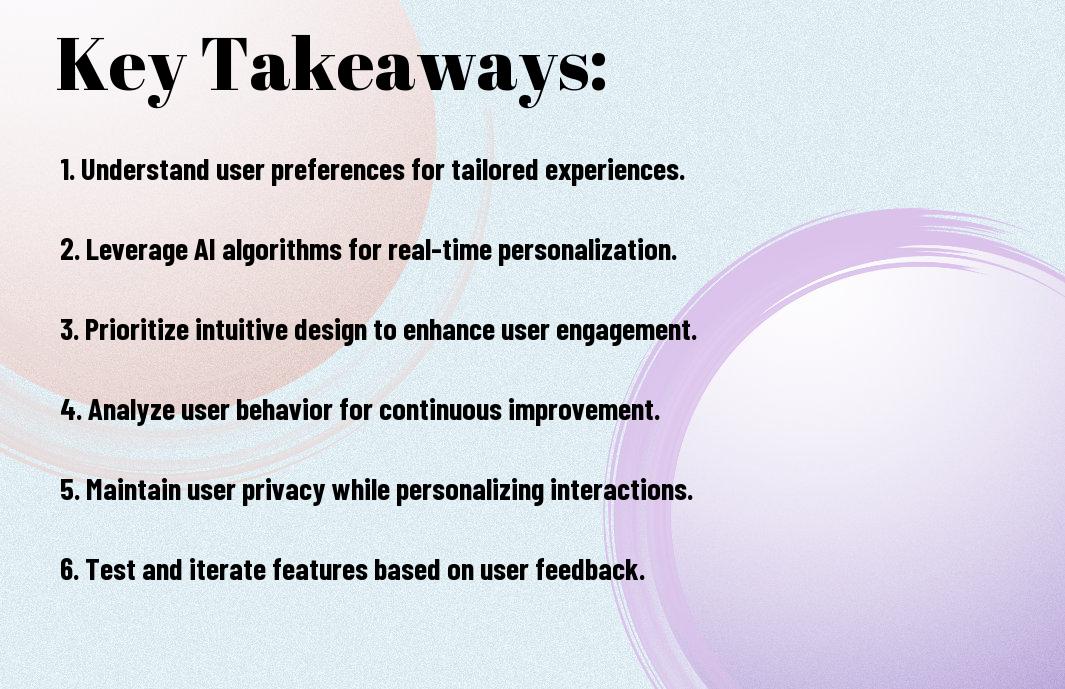
Key Takeaways:
- Effective use of AI-driven personalization in app development enables businesses to deliver tailored experiences that meet individual user preferences, leading to increased engagement and loyalty.
- By leveraging machine learning algorithms and user data, developers can create apps that adapt to user behavior, offering relevant content and features that enhance the overall user experience.
- A well-implemented AI-driven personalization strategy can drive business growth by improving conversion rates, reducing churn, and increasing average revenue per user.
- To achieve successful AI-driven personalization, it’s important to balance personalization with user privacy and data protection, ensuring that users feel comfortable sharing their data and are aware of how it’s being used.
- Continuous testing and iteration are vital to refining AI-driven personalization, allowing developers to refine their approach based on user feedback and emerging trends in the market.
The Psychology of Digital Personalization
Before stepping into the world of AI-driven personalization, you need to understand the underlying psychology that drives user behavior and decision-making. This involves analyzing how your users interact with your app and what motivates them to engage with your content.
Human Behavior Patterns in App Usage
Behaving in predictable patterns, your users exhibit unique characteristics that can be leveraged to create personalized experiences. You can analyze their usage patterns, preferences, and interests to tailor your app’s features and content to meet their needs.
Creating Emotional Connections Through AI
The key to successful personalization lies in creating emotional connections with your users. You can use AI to analyze user data and create personalized experiences that resonate with them on an emotional level, fostering loyalty and engagement.
At the heart of creating emotional connections is understanding your users’ motivations, desires, and pain points. You can use AI-driven insights to craft personalized messages, offers, and content that speak directly to your users, making them feel valued and understood. By doing so, you can build strong emotional bonds with your users, driving long-term engagement and loyalty to your app.
Core AI Technologies in App Personalization
Even the most basic apps can benefit from AI-driven personalization, and you can achieve this by leveraging various core AI technologies, which enable your app to learn and adapt to user behavior, providing a unique experience for each user.
Machine Learning Algorithms
To develop an app that truly understands your users, you will need to implement machine learning algorithms that can analyze user data and make predictions about their preferences and behavior, allowing your app to provide personalized recommendations and content.
Natural Language Processing Integration
Integrating natural language processing into your app enables you to analyze and understand user feedback, allowing you to make data-driven decisions and improve your app’s personalization capabilities, making it more intuitive and user-friendly for your users.
Understanding how natural language processing integration works is key to creating an app that can effectively communicate with your users, and you can achieve this by using NLP to analyze user input, such as text or voice commands, and respond accordingly, providing a more personalized and engaging experience for your users, and helping you to build a loyal user base.
Data Collection and User Insights
Not surprisingly, collecting user data is the foundation of AI-driven personalization, and you will need to gather information about your users’ behavior, preferences, and interests to create effective personalized experiences.
Behavioral Analytics
About the ways users interact with your app, you can gain valuable insights by analyzing their behavior, such as click-through rates, session duration, and conversion rates, which will help you understand their needs and preferences.
Preference Mapping Systems
To create a personalized experience, you will need to develop preference mapping systems that can accurately capture your users’ preferences and interests, allowing you to tailor your content and recommendations to their unique needs.
A key aspect of preference mapping systems is their ability to learn and adapt to your users’ changing preferences over time, enabling you to deliver highly personalized and dynamic experiences that meet their evolving needs and interests, and as you implement these systems, you will be able to gain a deeper understanding of your users and create more effective personalized experiences.
Real-Time Adaptation Mechanisms
Keep your users engaged with real-time adaptation mechanisms that adjust to their behavior and preferences, enabling a more personalized experience in your app.
Dynamic Content Delivery
Against the backdrop of static content, you can leverage dynamic content delivery to serve users with relevant information, tailored to their interests and needs, thereby enhancing their overall experience.
Contextual Response Systems
Towards creating a more intuitive interface, you can implement contextual response systems that anticipate and respond to user interactions, providing a seamless and personalized experience.
RealTime analytics and machine learning algorithms enable you to refine your contextual response systems, allowing you to better understand your users’ behavior and preferences, and adjust your app’s response accordingly, resulting in a more engaging and user-centric experience for your audience.

Privacy and Ethical Considerations
Unlike other aspects of app development, privacy and ethical considerations require careful attention when implementing AI-driven personalization, as you navigate the fine line between user experience and data protection, you can learn more about The Role of AI in Crafting User-Centric Experiences.
Data Protection Frameworks
Between the lines of code and user interactions, you must establish robust data protection frameworks to safeguard user information and maintain trust in your app, ensuring that your AI-driven personalization efforts do not compromise user privacy.
Transparent AI Practices
With the increasing use of AI in app development, you should prioritize transparent AI practices, providing users with clear information about how their data is being used and protected, and allowing them to make informed decisions about their experience.
Further, as you implement transparent AI practices, you will find that it not only helps to build trust with your users but also enables you to identify and address potential biases in your AI algorithms, ultimately leading to a more fair and personalized experience for your users, and allowing you to maintain a competitive edge in the market by demonstrating your commitment to ethical AI development.
Implementation Strategies
After developing a solid plan, you can begin implementing AI-driven personalization in your app, focusing on seamless integration and minimal disruption to your users’ experience. You’ll need to consider factors like data collection, algorithm selection, and user interface design to create a cohesive and effective strategy.
Technical Integration Steps
Following the planning phase, you will begin on the technical integration of AI-driven personalization, which involves incorporating the necessary tools and frameworks into your app’s infrastructure, ensuring that your development team is well-versed in the technologies used.
Performance Monitoring Methods
On the path to optimizing your app’s performance, you will need to establish a set of metrics to measure the effectiveness of your AI-driven personalization, allowing you to identify areas for improvement and make data-driven decisions to enhance your users’ experience.
It is necessary to track key performance indicators such as user engagement, retention rates, and conversion rates to gauge the success of your personalization strategy, and you can use tools like analytics platforms and A/B testing to gain valuable insights into your users’ behavior and preferences, enabling you to refine your approach and deliver a more tailored experience that meets their evolving needs.
Conclusion
Conclusively, you can revolutionize your mobile experience by incorporating AI-driven personalization into your apps. You will be able to offer tailored experiences that cater to your users’ unique needs and preferences, enhancing their overall engagement and satisfaction. By leveraging AI, you can make informed decisions to optimize your app’s performance and deliver targeted content, ultimately driving your business forward and setting you apart from the competition. Your users will appreciate the personalized touch, leading to increased loyalty and retention.
FAQ
Q: What is the main goal of crafting user-centric apps with AI-driven personalization?
A: The primary objective of developing user-centric apps with AI-driven personalization is to create applications that provide tailored experiences for each user, leveraging artificial intelligence to analyze user behavior, preferences, and needs. This approach enables apps to adapt and evolve over time, offering relevant content, features, and recommendations that enhance user engagement, satisfaction, and loyalty.
Q: How does AI-driven personalization contribute to improving user experience in apps?
A: AI-driven personalization significantly enhances the user experience by enabling apps to learn from user interactions and adjust their behavior accordingly. This can include personalized content feeds, tailored notifications, and adaptive user interfaces. By utilizing machine learning algorithms and data analytics, apps can identify patterns and preferences, making predictions about what users are likely to need or want next, and delivering it to them in a seamless and intuitive manner.
Q: What are the key benefits of integrating AI-driven personalization into app development?
A: The integration of AI-driven personalization into app development offers several key benefits, including increased user retention, improved conversion rates, and enhanced overall user satisfaction. Personalized experiences lead to more engaging interactions, which in turn can drive business growth through increased sales, better customer loyalty, and positive word-of-mouth. Furthermore, AI-driven personalization allows developers to gather valuable insights into user behavior, helping to inform future development decisions and optimize the app’s performance and relevance in the market.


