As you explore the world of e-commerce, you’re likely to notice a significant shift towards personalized experiences. Your customers expect tailored product recommendations, seamless navigation, and efficient checkout processes. You can achieve this by leveraging artificial intelligence (AI) to enhance your e-commerce app, enabling you to analyze user behavior, optimize operations, and drive sales. By integrating AI, you can revolutionize your online store and stay ahead of the competition, providing your customers with a unique and engaging shopping experience that sets your brand apart.
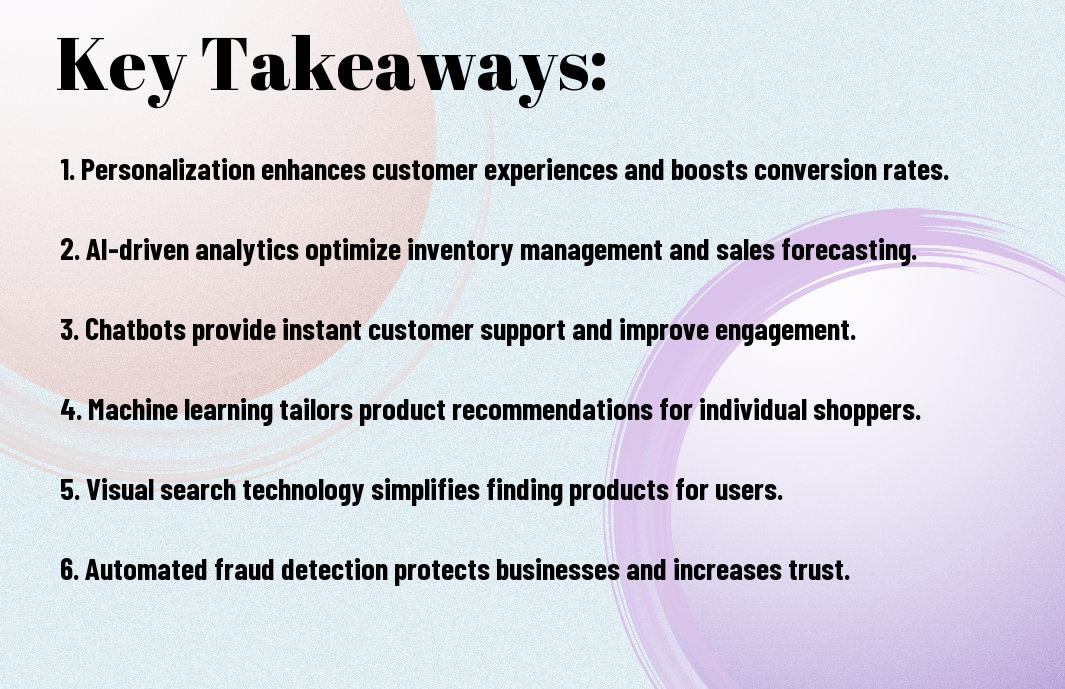
Key Takeaways:
- Integrating Artificial Intelligence (AI) into e-commerce apps can significantly enhance the user experience by offering personalized product recommendations, streamlining navigation, and improving search functionality.
- AI-powered chatbots can provide 24/7 customer support, helping to increase customer satisfaction and reduce support queries, thus making the overall shopping experience more efficient.
- AI-driven analytics can help e-commerce businesses gain valuable insights into customer behavior, preferences, and shopping patterns, enabling data-driven decisions to optimize marketing strategies and improve sales.
- Implementing AI in e-commerce apps can also help to detect and prevent fraudulent activities, such as fake accounts and suspicious transactions, ensuring a safer and more secure online shopping environment.
- By leveraging AI, e-commerce businesses can automate various tasks, such as inventory management and order processing, allowing them to focus on core activities and improve overall operational efficiency.
AI Revolution in Digital Commerce
While the rise of artificial intelligence is transforming various industries, you are likely to witness significant changes in e-commerce. AI is revolutionizing the way you interact with digital commerce platforms, making them more personalized and efficient.
Evolution of E-Commerce Platforms
With the advancement of technology, your online shopping experience has become more streamlined. E-commerce platforms have evolved to incorporate innovative features, enhancing your overall experience and encouraging you to make more informed purchasing decisions.
Modern AI Integration Points
Commercially, you can leverage AI to optimize your e-commerce app’s performance. Modern AI integration points enable you to analyze customer behavior, providing valuable insights to improve your business strategies and increase customer satisfaction.
To further integrate AI into your e-commerce app, you can focus on implementing chatbots, product recommendations, and personalized content. By doing so, you can create a more engaging and tailored experience for your customers, driving sales and boosting your revenue. As you explore the possibilities of AI in e-commerce, you will discover new opportunities to enhance your business and stay ahead of the competition.
Smart Product Recommendations
You can enhance your e-commerce app with AI-powered recommendations, increasing user engagement and sales. By analyzing user behavior and preferences, your app can suggest relevant products, improving the overall shopping experience.
Personalization Algorithms
Recommendations based on personalization algorithms help you tailor the shopping experience to individual users. Your app can learn from user interactions, adapting to their unique preferences and interests.
Customer Behavior Analysis
About the behavior of your customers, understanding their shopping habits and patterns is key to creating effective recommendations. Your app can analyze user data, identifying trends and preferences to inform product suggestions.
For instance, by analyzing customer behavior, you can identify high-value customers, track purchase history, and offer personalized promotions, leading to increased loyalty and retention, and ultimately, driving business growth and revenue for your e-commerce app.

AI-Powered Search Optimization
To enhance your e-commerce app’s search functionality, AI-powered search optimization is necessary. You can leverage machine learning algorithms to improve search results, making it easier for your customers to find what they’re looking for.
Natural Language Processing
Similarly, to improve your search functionality, natural language processing enables your app to understand your customers’ search queries more effectively, allowing for more accurate results and a better user experience.
Visual Search Capabilities
On the other hand, visual search capabilities allow your customers to search for products using images, making it easier for them to find what they want. You can integrate visual search into your app to enhance the user experience.
Further, with visual search capabilities, you can enable your customers to upload images or take photos of products they like, and your app will suggest similar products, making it a powerful tool for driving sales and increasing customer engagement.
Chatbots and Customer Service
After integrating chatbots into your e-commerce app, you can expect a significant improvement in customer service. Chatbots can help answer frequent questions, provide order updates, and offer personalized recommendations, making your customers’ experience more enjoyable and efficient.
Conversational AI Systems
Systems like these enable your e-commerce app to understand and respond to customer inquiries in a more human-like way, allowing you to provide better support and build trust with your customers.
24/7 Customer Support Solutions
Any time of day or night, your customers can receive assistance from your chatbot, which can help resolve issues and answer questions, ensuring that your customers are always satisfied with your service.
Service is at the forefront of your e-commerce app when you implement 24/7 customer support solutions. You can ensure that your customers’ needs are met promptly, and their issues are resolved quickly, which can lead to increased customer loyalty and retention, ultimately benefiting your business and helping you stay competitive in the market.
Predictive Analytics
Despite the complexity of e-commerce, predictive analytics can help you make informed decisions. You can analyze customer behavior, preferences, and purchase history to anticipate future trends and optimize your app accordingly.
Inventory Management
The key to efficient inventory management is understanding your customers’ needs. You can use predictive analytics to determine which products to stock up on, reducing waste and overstocking, and ensuring that your customers find what they’re looking for.
Sales Forecasting
Across various industries, sales forecasting is a powerful tool for driving business growth. You can leverage predictive analytics to forecast sales, identifying opportunities to increase revenue and optimize your marketing strategies.
In fact, by analyzing historical sales data, seasonal trends, and external factors, you can create accurate sales forecasts that inform your business decisions, helping you to stay ahead of the competition and drive your e-commerce app’s success. You can use this insight to adjust your pricing, inventory, and marketing campaigns, ultimately enhancing your customers’ experience and boosting your bottom line.
Security and Fraud Detection
Not only does AI enhance your e-commerce app’s user experience, but it also plays a significant role in securing your platform. You can leverage AI to detect and prevent fraudulent activities, protecting your business and customers from potential threats.
AI-Based Threat Detection
Alongside traditional security measures, AI-based threat detection helps you identify and mitigate potential risks. You can use machine learning algorithms to analyze patterns and anomalies in user behavior, enabling you to take proactive measures to secure your app.
Transaction Safety Measures
Following the implementation of AI-based threat detection, you can focus on transaction safety measures. You will be able to monitor and analyze transactions in real-time, detecting and preventing fraudulent activities, and ensuring a safe and secure experience for your customers.
Further, by implementing robust transaction safety measures, you can reduce the risk of chargebacks and financial losses. You will be able to analyze customer behavior, identify suspicious patterns, and take proactive measures to prevent fraudulent transactions, ultimately protecting your business and maintaining customer trust.
Conclusion
Upon reflecting on the potential of artificial intelligence in e-commerce, you can see how it transforms your online shopping experience. You will notice enhanced personalization, streamlined processes, and improved customer service. As you integrate AI into your e-commerce apps, your business will likely experience increased efficiency and competitiveness. You can expect to drive growth and innovation, staying ahead in the market with AI-driven solutions.
FAQ
Q: How can Artificial Intelligence enhance the user experience in E-Commerce Apps?
A: Artificial Intelligence (AI) can significantly enhance the user experience in E-Commerce Apps by providing personalized product recommendations, streamlining the search process, and offering chatbot-based customer support. AI-powered algorithms can analyze user behavior, purchase history, and browsing patterns to suggest relevant products, increasing the likelihood of sales and customer satisfaction. Additionally, AI-driven chatbots can help resolve customer queries and issues in real-time, reducing the need for human intervention and improving response times.
Q: What role does Machine Learning play in transforming E-Commerce Apps with Artificial Intelligence?
A: Machine Learning (ML) plays a vital role in transforming E-Commerce Apps with Artificial Intelligence by enabling the development of predictive models that can analyze large datasets and make accurate predictions about user behavior. ML algorithms can be trained on historical data to identify patterns and trends, allowing E-Commerce Apps to anticipate and respond to user needs in real-time. For instance, ML-powered predictive analytics can help E-Commerce Apps to forecast demand, optimize pricing, and improve inventory management, leading to increased efficiency and profitability.
Q: How can E-Commerce businesses measure the effectiveness of Artificial Intelligence-powered transformations in their Apps?
A: E-Commerce businesses can measure the effectiveness of Artificial Intelligence-powered transformations in their Apps by tracking key performance indicators (KPIs) such as conversion rates, customer engagement, and sales revenue. AI-powered analytics tools can provide insights into user behavior, helping businesses to identify areas of improvement and optimize their AI-driven strategies. Additionally, businesses can conduct A/B testing and experiments to evaluate the impact of AI-powered features on user experience and business outcomes, making data-driven decisions to refine and improve their AI-powered transformations over time.