Development

The Future of App Development – AI Models in Focus

As you explore the latest trends in app development, you’re likely to notice the growing impact of AI models on the industry. Your apps will soon be powered by intelligent systems that can learn and adapt to user behavior, revolutionizing the way you interact with them. You can expect significant changes in the way apps are designed, developed, and deployed, and it’s necessary to understand how AI models will shape your app development strategy to stay ahead of the curve.

Key Takeaways:

  • The integration of AI models in app development is expected to significantly enhance user experience, with personalized interfaces and predictive analytics becoming more prevalent.
  • AI-powered chatbots and virtual assistants will play a major role in shaping the future of app development, enabling more efficient customer support and feedback mechanisms.
  • Machine learning algorithms will be used to improve app security, detect potential threats, and prevent data breaches, making apps more reliable and trustworthy.
  • The use of AI models will also enable developers to create more intelligent and adaptive apps, capable of learning from user behavior and adjusting their functionality accordingly.
  • As AI technology continues to evolve, app developers will need to stay up-to-date with the latest advancements and trends to create innovative and competitive apps that meet the changing needs of users.
Evolution of App Development

The app development landscape has undergone significant transformations over the years, and you are now witnessing a new era of innovation. As you explore the latest trends, you’ll notice a shift towards more efficient and intelligent solutions.

Traditional Development Methods

Beneath the surface of modern app development, you’ll find traditional methods that have been used for years, and you can see how they have shaped the industry into what it is today, with your own projects likely having started from these foundations.

AI Integration Turning Point

Alongside the rise of new technologies, you’re approaching a significant turning point where AI integration is becoming a key factor in app development, and you will need to adapt to these changes to stay ahead.

According to your goals and objectives, AI-powered tools can help you streamline your development process, making it more efficient and cost-effective, and you can leverage these benefits to enhance your overall app development strategy and take your projects to the next level.

Core AI Models in Modern Apps

Some of the most significant AI models in modern apps include machine learning, deep learning, and neural networks, which enable your apps to learn from data and make predictions or decisions, allowing you to create more personalized and engaging user experiences.

Natural Language Processing Systems

Prior to delving into the details, you’ll find that natural language processing systems are a key component of many modern apps, enabling your users to interact with your app using voice or text commands, and allowing you to analyze and understand their feedback and preferences.

Computer Vision Integration

Around the topic of computer vision, you’ll discover that it enables your apps to interpret and understand visual data from images and videos, allowing you to create more immersive and interactive experiences, such as augmented reality and object detection, which can enhance your app’s functionality and user engagement.

Hence, as you explore computer vision integration in your app development, you’ll find that it opens up a wide range of possibilities, from enhancing user experience to creating new and innovative features, such as facial recognition, image classification, and object tracking, which can help you to stay ahead of the competition and provide your users with a unique and engaging experience.

Machine Learning Frameworks

Keep in mind that machine learning frameworks are necessary for your app development process, and you can learn more about The Future of AI in Mobile App Development in 2025 to stay ahead in the game.

Automated Code Generation

Around the same time, you’ll notice that automated code generation is becoming increasingly popular, allowing you to focus on more complex tasks and improving your overall development efficiency.

Predictive Development Tools

After implementing machine learning frameworks, you’ll find that predictive development tools can help you anticipate and fix issues before they arise, streamlining your development process.

For instance, with predictive development tools, you can analyze user behavior, identify potential bottlenecks, and make data-driven decisions to optimize your app’s performance, ultimately enhancing your users’ experience and increasing your app’s success.

AI-Powered User Experience

Your app’s user experience is about to get a significant boost with AI models, enabling you to create more intuitive and engaging interfaces that meet your users’ evolving needs.

Personalization Engines

Users expect tailored experiences, and AI-powered personalization engines can help you deliver just that, allowing you to offer customized content and recommendations that cater to your users’ preferences and behaviors.

Adaptive Interfaces

Behind the scenes, AI-driven adaptive interfaces are being designed to adjust and optimize your app’s layout, navigation, and overall user flow in real-time, ensuring a seamless and efficient experience for your users.

Due to the capabilities of machine learning algorithms, you can now create adaptive interfaces that learn and adapt to your users’ habits and preferences, providing a unique experience that enhances their overall interaction with your app, and ultimately driving engagement and loyalty.

Security and AI Implementation

Once again, you’ll need to consider the security implications of integrating AI models into your app development process, as this can introduce new vulnerabilities and Vectors for attack, you should be aware of the potential risks and take steps to mitigate them.

Threat Detection Systems

Beneath the surface of your app’s code, you’ll find that AI-powered threat detection systems can help identify and respond to potential security threats, allowing you to stay one step ahead of malicious actors and protect your users’ data.

Privacy Protection Measures

Securely, you’ll want to implement robust privacy protection measures to safeguard your users’ personal information, as AI models can potentially compromise data privacy if not properly designed and implemented, you should prioritize transparency and control.

Hence, as you research deeper into the world of AI-powered app development, you’ll need to carefully consider the privacy implications of your design choices, and implement measures such as data anonymization, encryption, and access controls to ensure that your users’ data is protected, and that you’re complying with relevant regulations and laws, this will help you build trust with your users and maintain a strong reputation.

Development Workflow Revolution

Now, as AI models become more prevalent in app development, you can expect a significant shift in your workflow. Your development process will become more efficient, with AI handling repetitive tasks and freeing up your time to focus on more complex issues.

AI-Assisted Testing

Beneath the surface of traditional testing methods, AI-assisted testing is emerging as a game-changer. You will be able to identify and fix bugs more quickly, ensuring your app is stable and functions as intended.

Automated Optimization

Among the many benefits of AI in app development, automated optimization is one that will have a significant impact on your workflow. You will be able to automate tasks such as code review and optimization, allowing you to focus on higher-level tasks.

At the heart of automated optimization is the ability to analyze your code and identify areas for improvement. You will be able to use AI-powered tools to optimize your app’s performance, ensuring it runs smoothly and efficiently on a variety of devices, and as you explore deeper into the capabilities of automated optimization, you will find that it can also help you to improve your app’s security and user experience.

Summing up

Following this exploration of AI models in app development, you now have a clearer understanding of what the future holds. As you consider your own app development journey, you will see how AI can enhance your user experience and streamline your processes. Your ability to leverage these models will be key to staying competitive, and you can expect significant advancements in the field to continue shaping your approach to app development.

FAQ

Q: What role will AI models play in the future of app development, and how will they impact the industry?

A: AI models are expected to revolutionize the app development process by automating tasks, improving user experience, and enabling the creation of more intelligent and personalized applications. With the integration of AI, apps will be able to learn from user behavior, adapt to their needs, and provide more accurate and relevant results. This will lead to increased efficiency, productivity, and innovation in the industry, as developers will be able to focus on higher-level tasks and create more sophisticated applications.

Q: How will AI models change the way developers design and build apps, and what new skills will be required?

A: AI models will significantly change the app development process, as developers will need to design and build apps that can integrate with AI systems, process large amounts of data, and learn from user interactions. To work effectively with AI models, developers will need to acquire new skills, such as machine learning, natural language processing, and data analysis. They will also need to understand how to design user interfaces that can effectively interact with AI systems and provide a seamless user experience. Additionally, developers will need to consider issues related to data privacy, security, and ethics when building AI-powered apps.

Q: What are the potential benefits and challenges of using AI models in app development, and how can developers mitigate potential risks?

A: The potential benefits of using AI models in app development include improved user experience, increased efficiency, and enhanced decision-making capabilities. However, there are also potential challenges, such as data quality issues, bias in AI decision-making, and the need for significant computational resources. To mitigate these risks, developers can use techniques such as data validation, testing, and validation, as well as implementing robust security measures to protect user data. Additionally, developers can use explainable AI techniques to provide transparency into AI decision-making processes and ensure that AI models are fair, reliable, and trustworthy. By understanding the benefits and challenges of AI models, developers can harness their potential to create innovative and effective apps that meet the needs of users.

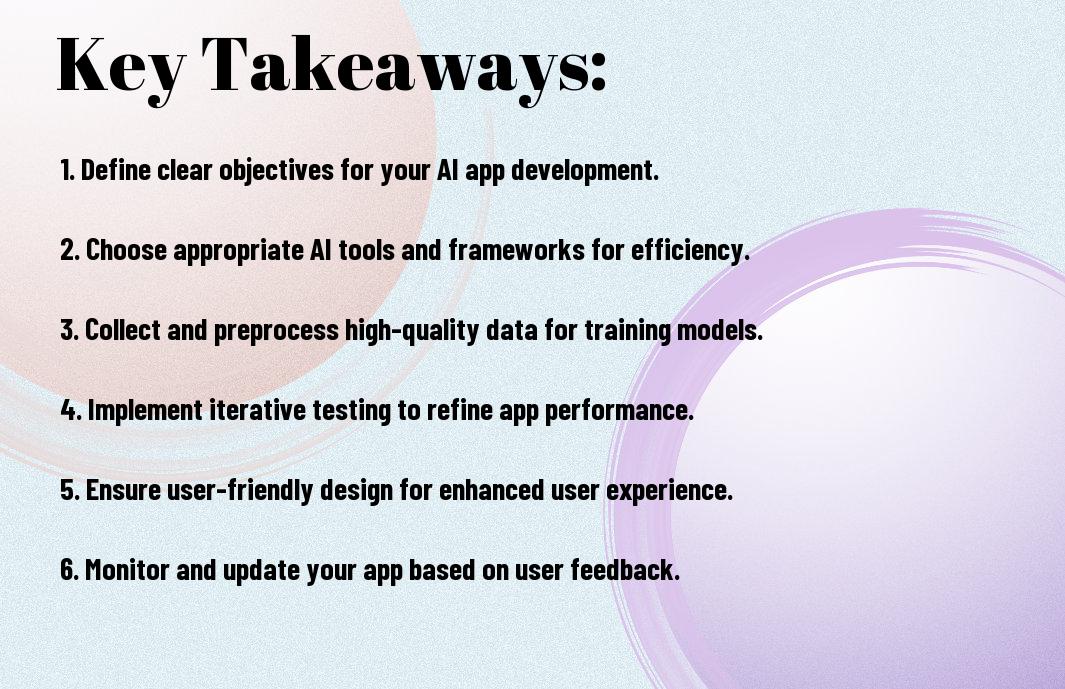
Step-by-Step – Developing Apps with AI Technology

As you initiate on creating innovative mobile applications, you’ll discover the vast potential of Artificial Intelligence (AI) technology. You can leverage AI to streamline your development process, enhance user experience, and drive business growth. Your journey to developing cutting-edge apps with AI technology begins here, where you’ll learn the fundamentals and gain insights into the latest trends and tools, empowering you to bring your vision to life.

Key Takeaways:

  • Developing apps with AI technology involves integrating machine learning algorithms and natural language processing to create intelligent and interactive user experiences.
  • A thorough understanding of AI fundamentals, such as data analysis and model training, is necessary for building effective AI-powered apps.
  • AI technology can be used to automate tasks, provide personalized recommendations, and enhance user engagement in various app categories, including entertainment, education, and healthcare.
  • When developing AI-driven apps, it’s imperative to consider factors like data privacy, security, and ethics to ensure responsible AI implementation.
  • Continuous testing, iteration, and refinement are necessary to optimize AI app performance, improve accuracy, and adapt to evolving user needs and preferences.

Foundations of AI Development

While developing apps with AI technology, you need to understand the basics of AI and its applications. You will learn about the key concepts and technologies that power AI systems, enabling you to create intelligent and innovative apps.

Essential AI Technologies

Around the core of AI development, you will find machine learning, natural language processing, and computer vision, which are imperative for building intelligent apps that can learn, understand, and interact with users in a more human-like way, allowing you to create personalized experiences for your users.

Development Environment Setup

Along with learning AI concepts, you need to set up a suitable development environment, which includes choosing the right programming languages, frameworks, and tools that will help you build, test, and deploy your AI-powered apps efficiently, enabling you to focus on your app’s development.

In fact, setting up your development environment is an ongoing process that will evolve as you progress with your app development, and you will need to stay up-to-date with the latest technologies and trends to ensure your app stays competitive and meets your users’ expectations, so you should be prepared to continuously learn and adapt your environment as needed.

Planning Your AI Application

The first step in developing an app with AI technology is planning. You can learn more about the process by visiting How to create an app with AI: The undisputed guide to get started.

Project Scope Definition

Your project’s scope is defined by identifying the key features and functionalities you want to include in your app, helping you stay focused on your goals.

Resource Requirements

On the other hand, determining the resources you need is necessary for a successful project, including personnel, equipment, and budget.

This includes considering the cost of AI tools, infrastructure, and personnel with expertise in AI development, which you will need to allocate to ensure your project’s success, and you should plan accordingly to meet your app’s requirements.

Data Management

For effective app development with AI technology, you need to manage your data efficiently. This involves collecting, preprocessing, and analyzing data to train your AI models.

Data Collection Methods

Beneath the surface of AI technology lies the foundation of data collection. You will use various methods to gather data, such as surveys, sensors, and social media platforms, to fuel your app’s development.

Data Preprocessing Techniques

Any inconsistencies in your data can affect your AI model’s performance. You will need to clean and preprocess your data to ensure it is accurate and reliable, using techniques such as data normalization and feature scaling.

Even with a solid understanding of data preprocessing techniques, you will still need to consider the specific requirements of your app. You should explore different methods to handle missing values, outliers, and noisy data, and select the ones that best fit your project’s needs, allowing you to develop a robust and efficient AI-powered app.

AI Model Selection

Despite the numerous AI models available, selecting the right one for your app development is vital. You need to consider factors such as data type, complexity, and performance requirements to make an informed decision.

Machine Learning Algorithms

Along with the development of AI, you will encounter various machine learning algorithms that can be used to train your model, including decision trees, random forests, and support vector machines, which you can choose from based on your specific needs.

Neural Network Architectures

Behind the success of many AI-powered apps are neural network architectures, which you can utilize to build complex models that can learn and improve over time, allowing you to create more sophisticated and accurate AI systems.

Neural network architectures are designed to mimic the human brain, and as you examine deeper into developing your app, you will discover that they can be customized and fine-tuned to suit your specific requirements, enabling you to create highly efficient and effective AI models that can drive your app’s success.

Implementation Process

All aspects of your app development process will be influenced by the integration of AI technology. You will need to consider how AI will impact your design, functionality, and overall user experience.

Code Structure

Around the organization of your code, you will need to consider how AI components will be integrated into your existing architecture. You should consider creating a modular structure to facilitate easy integration and maintenance of AI-powered features.

Integration Guidelines

Before you begin integrating AI technology into your app, you should establish clear guidelines for how AI will be used and how it will impact your development process. You will need to consider factors such as data privacy and security.

Process of integrating AI technology into your app requires careful planning and execution. You will need to consider how AI will impact your app’s performance, scalability, and user experience, and make adjustments accordingly to ensure a seamless integration that meets your goals and expectations.

Testing and Optimization

Keep in mind that testing and optimization are imperative steps in developing apps with AI technology. You need to ensure that your app functions as intended and provides a seamless user experience.

Performance Metrics

With the help of various tools, you can measure your app’s performance and identify areas for improvement, allowing you to make data-driven decisions to optimize your app’s functionality and user experience.

Quality Assurance

With a thorough testing process, you can ensure that your app meets the required standards and is free from bugs and errors, giving you confidence in your app’s quality and reliability.

This quality assurance process involves testing your app on various devices and platforms, and you should also conduct user testing to gather feedback and make necessary improvements to your app, ensuring that it meets your users’ needs and expectations, and ultimately enhancing your app’s overall quality and user satisfaction.

Final Words

With this in mind, you now have a comprehensive understanding of developing apps with AI technology. You can apply your knowledge to create innovative solutions, enhancing your skills and productivity. As you move forward, your ability to integrate AI will elevate your app development, allowing you to deliver cutting-edge products that meet your users’ evolving needs, and stay ahead in the competitive market with your advanced skills.

FAQ

Q: What is the first step in developing apps with AI technology?

A: The first step in developing apps with AI technology is to define the problem you want to solve and identify the type of AI technology that can be applied to solve it. This involves conducting market research, analyzing user needs, and determining the feasibility of integrating AI into your app. You should also consider the type of data you will need to collect and process, as well as the computational resources required to support AI-driven functionality.

Q: How do I choose the right AI framework and tools for my app development project?

A: Choosing the right AI framework and tools for your app development project depends on several factors, including the type of AI technology you want to use, the programming languages you are working with, and the level of complexity you are comfortable with. Popular AI frameworks include TensorFlow, PyTorch, and Core ML, each with its own strengths and weaknesses. You should also consider factors such as scalability, compatibility, and community support when selecting an AI framework and tools for your project. Additionally, you may want to experiment with different frameworks and tools to determine which ones work best for your specific use case.

Q: What are some best practices for integrating AI technology into my app to ensure a seamless user experience?

A: To ensure a seamless user experience when integrating AI technology into your app, it’s imperative to prioritize transparency, explainability, and user control. This means providing clear and concise explanations of how AI-driven features work, as well as offering users the ability to opt-out or customize AI-driven functionality. You should also focus on optimizing app performance, minimizing latency, and ensuring that AI-driven features are intuitive and easy to use. Furthermore, you should continuously collect user feedback and iterate on your AI-driven features to ensure they meet user needs and expectations, and align with your app’s overall goals and objectives.

Harnessing Deep Learning for Smart App Development

As you probe into the world of app development, you’re likely to encounter the concept of deep learning, a subset of machine learning that’s revolutionizing the way your apps interact with users. You can leverage deep learning to create smarter, more intuitive apps that learn from user behavior and adapt to their needs. By harnessing the power of deep learning, you can take your app development to the next level, enabling your apps to make predictions, classify data, and drive innovation in unprecedented ways, transforming your user experience.

Key Takeaways:

  • Deep learning can significantly enhance the user experience in smart app development by enabling features such as image and speech recognition, natural language processing, and predictive analytics.
  • Integrating deep learning models into mobile apps can improve their performance, security, and functionality, leading to increased user engagement and retention.
  • Developers can leverage pre-trained deep learning models and frameworks, such as TensorFlow and PyTorch, to streamline the development process and reduce the need for extensive machine learning expertise.
  • Deep learning-powered apps can provide personalized experiences for users by analyzing their behavior, preferences, and usage patterns, enabling targeted recommendations and advertisements.
  • As deep learning technology continues to evolve, it is likely to play an increasingly important role in the development of smart apps, enabling new use cases and applications across various industries, including healthcare, finance, and education.

Deep Learning Fundamentals in App Development

A key aspect of developing smart apps is understanding deep learning fundamentals, which you can explore further by visiting Can you explain the process of creating a simple application using neural networks to gain insights into the process.

Neural Networks Architecture for Apps

Applications relying on neural networks are designed to mimic human brain functions, allowing you to create complex models that can learn and adapt to your users’ behavior, making your app more intuitive and user-friendly.

Training Models for Mobile Environments

To develop efficient models, you need to consider the limitations and capabilities of mobile devices, ensuring that your app’s performance is optimized for various platforms and hardware configurations, which will help you to create a seamless user experience.

Learning from data is crucial in training models for mobile environments, and as you research deeper into this process, you will discover that your app’s ability to learn from user interactions and adapt to new data will significantly enhance its overall performance and user engagement, allowing you to refine your app and make it more responsive to your users’ needs.

Smart Features Integration

If you’re looking to create a cutting-edge app, integrating smart features is necessary. You can leverage deep learning to enhance your app’s functionality and user experience. By incorporating advanced technologies, you can set your app apart from the competition and provide your users with a unique experience.

Natural Language Processing Components

For instance, you can utilize natural language processing (NLP) components to enable voice commands, sentiment analysis, and text classification in your app. You can use NLP to improve your app’s user interface and make it more interactive, allowing your users to engage with your app in a more natural way.

Computer Vision Elements

At the forefront of smart feature integration is computer vision, which enables your app to interpret and understand visual data from images and videos. You can use computer vision to develop features such as facial recognition, object detection, and image classification, making your app more intuitive and engaging.

Due to the advancements in computer vision, you can now develop apps that can analyze and understand visual data in real-time, enabling features such as augmented reality, gesture recognition, and more. You can use these features to create immersive experiences for your users, setting your app apart from others in the market.

Performance Optimization

Your application’s performance is directly tied to its success, and deep learning models can be computationally intensive, making optimization important for smart app development.

Model Compression Techniques

Against the backdrop of increasing model complexity, you can leverage techniques like pruning and quantization to reduce model size and improve inference speed.

Resource Management Strategies

Condensing your resources effectively is key to optimizing performance, and you can achieve this by allocating resources dynamically and utilizing cloud services to scale your application.

Hence, as you implement resource management strategies, you will be able to monitor and control resource utilization, ensuring that your application runs smoothly and efficiently, which is vital for providing a seamless user experience, and you can achieve this by setting up monitoring tools and alerts to notify you of potential issues before they impact your users.

User Experience Enhancement

Despite the complexity of deep learning, you can leverage it to enhance your app’s user experience, making it more intuitive and engaging for your users.

Predictive Interface Adaptation

By utilizing predictive models, you can adapt your app’s interface to anticipate your users’ needs, providing a more seamless experience and increasing user satisfaction.

Personalization Algorithms

One key aspect of user experience enhancement is the use of personalization algorithms, which allow you to tailor your app’s content and features to individual users’ preferences and behaviors.

Personalization enables you to create a unique experience for each user, increasing engagement and loyalty, and you can achieve this by analyzing user data and incorporating machine learning models into your app development process, allowing you to make data-driven decisions and continuously improve your app’s user experience.

Data Management and Privacy

Keep in mind that managing data is a significant aspect of deep learning in smart app development, as you handle sensitive user information and ensure its security.

Secure Data Handling

Handling sensitive data requires robust security measures, as you protect your users’ information from unauthorized access and potential breaches.

Local Processing Methods

Across various platforms, you can utilize local processing methods to enhance data security, allowing your app to process data on-device, thereby minimizing the risk of data exposure.

Privacy is a major concern when implementing local processing methods, as you need to ensure that your app adheres to strict data protection regulations, giving you greater control over your users’ data and maintaining their trust in your app.

Implementation Framework

Now that you have a solid understanding of deep learning, you can begin implementing it in your app development. For more information on integrating AI, visit Harnessing Artificial Intelligence in Mobile Apps to explore key applications.

Development Workflow

Beneath the surface of your app’s development lies a complex workflow. You will need to design, develop, and train your deep learning models to ensure seamless integration with your app’s existing infrastructure.

Testing and Deployment

Any issues that arise during testing can be ironed out through rigorous quality assurance processes. You should test your app thoroughly to ensure that the deep learning components are functioning as intended.

To ensure a smooth deployment, you will need to monitor your app’s performance and make any necessary adjustments to the deep learning models. You can then deploy your app, confident that the deep learning components will enhance your users’ experience.

Conclusion

Hence, as you explore into the world of smart app development, you will find that harnessing deep learning can significantly enhance your projects. You can leverage its capabilities to create more intuitive and responsive applications, ultimately elevating your users’ experience. By integrating deep learning into your development process, you can unlock new possibilities and stay ahead in the competitive tech landscape, making your apps more innovative and effective.

FAQ

Q: What is deep learning and how can it be applied to smart app development?

A: Deep learning is a subset of machine learning that involves the use of artificial neural networks to analyze and interpret data. In the context of smart app development, deep learning can be used to enable apps to learn from user behavior, make predictions, and improve performance over time. For example, deep learning can be used to develop image and speech recognition systems, natural language processing, and predictive analytics. By leveraging deep learning, developers can create more intelligent and personalized apps that provide a better user experience.

Q: What are the benefits of using deep learning in smart app development, and how can it improve the user experience?

A: The benefits of using deep learning in smart app development include improved accuracy, enhanced personalization, and increased efficiency. Deep learning algorithms can analyze large amounts of data and learn from user behavior, allowing apps to provide more accurate and relevant recommendations, predictions, and responses. Additionally, deep learning can enable apps to automate tasks, reduce latency, and improve overall performance. By leveraging deep learning, developers can create apps that are more intuitive, responsive, and engaging, leading to a better user experience and increased user satisfaction.

Q: What are the challenges and limitations of harnessing deep learning for smart app development, and how can developers overcome them?

A: The challenges and limitations of harnessing deep learning for smart app development include the need for large amounts of high-quality training data, significant computational resources, and expertise in deep learning algorithms and techniques. Additionally, deep learning models can be complex and difficult to interpret, making it challenging to identify and address errors or biases. To overcome these challenges, developers can use techniques such as data augmentation, transfer learning, and model pruning to reduce the need for large amounts of training data and computational resources. They can also use tools and frameworks such as TensorFlow, PyTorch, and Keras to simplify the development and deployment of deep learning models. Furthermore, developers can collaborate with data scientists and machine learning experts to ensure that deep learning models are accurate, reliable, and fair.

Developing Chatbots and Virtual Assistants for Your App

As you consider enhancing your app’s user experience, you’re likely thinking about how to provide instant support and personalized interactions. You can achieve this by developing chatbots and virtual assistants, which can help you automate tasks, answer frequent questions, and offer tailored guidance. By integrating these technologies, you can streamline your app’s functionality and improve user engagement, making your app more intuitive and user-friendly, and ultimately, driving business success. You will learn how to do this in this post.

Key Takeaways:

  • Defining the purpose and functionality of a chatbot or virtual assistant is crucial to determine its role within an app and how it will interact with users to provide a seamless experience.
  • Understanding the target audience and their needs is vital to design a conversational interface that is intuitive and user-friendly, allowing for effective communication and problem-solving.
  • Choosing the right technology and development tools, such as natural language processing (NLP) and machine learning algorithms, is necessary to build a sophisticated chatbot or virtual assistant that can accurately interpret and respond to user inputs.
  • Integrating chatbots and virtual assistants with existing systems and data sources can enhance their capabilities and provide users with personalized and relevant information, improving the overall user experience.
  • Continuously testing and refining chatbots and virtual assistants is necessary to ensure they are functioning as intended, and to identify areas for improvement to optimize their performance and user engagement.

    Core Components of Chatbot Development

    Your chatbot’s development relies on several key elements, including natural language processing and machine learning, which enable your app to understand and respond to user input effectively.

    Natural Language Processing Integration

    Components such as intent recognition and sentiment analysis are vital for your chatbot to comprehend the nuances of human language, allowing you to create a more engaging user experience.

    Machine Learning Foundations

    Along with a solid understanding of machine learning algorithms, you can develop a chatbot that learns from user interactions and improves over time, enabling your app to provide more accurate and personalized responses.

    Another key aspect of machine learning foundations is the ability to integrate with various data sources, allowing you to train your chatbot on a wide range of datasets and improve its performance, which in turn enables you to offer a more sophisticated and effective virtual assistant to your users.

    Design Architecture

    While designing your chatbot or virtual assistant, you’ll need to consider the overall architecture, including the conversational flow and response generation systems, which can be informed by exploring Chatbots and Virtual Assistant Use Cases – Generative AI to create a more engaging experience for your users.

    Conversational Flow Mapping

    Alike other design processes, you start by mapping out the conversational flow, which involves identifying the possible user inputs and the corresponding responses, allowing you to create a more intuitive and user-friendly interface for your chatbot or virtual assistant.

    Response Generation Systems

    Once you have mapped out the conversational flow, you can start designing the response generation systems, which will enable your chatbot or virtual assistant to provide accurate and helpful responses to user queries, making it vital to consider the tone and language used in your responses.

    Conversational systems like these rely on complex algorithms and natural language processing techniques to generate human-like responses, and as you design your response generation systems, you’ll need to consider factors such as context, intent, and user preferences to create a more personalized experience for your users, allowing you to build a more effective and engaging chatbot or virtual assistant for your app.

    Implementation Strategies

    Once again, you’ll need to consider the specifics of your app and its users when developing chatbots and virtual assistants. You can learn more about the process in How to Create AI Virtual Assistant: Product Owner’s Guide and Technology Overview to make informed decisions.

    Platform Selection

    The choice of platform for your chatbot or virtual assistant will depend on your app’s existing infrastructure and the level of customization you need, so you should evaluate your options carefully to find the best fit for your project.

    API Integration Methods

    Methods of integrating APIs will vary depending on the platforms and tools you’re using, so you’ll need to assess your needs and choose the approach that works best for your app and its users.

    A key aspect of API integration is ensuring seamless communication between different systems, so you’ll want to consider factors like data formats, security protocols, and error handling to ensure a smooth and reliable experience for your users, and you should also consider scalability and flexibility to accommodate future updates and changes to your app.

    User Experience Elements

    To create an effective chatbot or virtual assistant, you need to consider several user experience elements that will make your app engaging and user-friendly. You should focus on designing an interface that is intuitive and easy to navigate, allowing your users to interact with your chatbot or virtual assistant seamlessly.

    Personality Development

    Along with a well-designed interface, you should also develop a personality for your chatbot or virtual assistant that aligns with your brand and resonates with your target audience. You can achieve this by defining the tone, language, and behavior of your chatbot or virtual assistant, making it more relatable and engaging to your users.

    Conversation Design Patterns

    Similarly, you should design conversation patterns that are natural and intuitive, allowing your users to interact with your chatbot or virtual assistant in a way that feels like a normal conversation. You can use various techniques such as intent recognition, entity extraction, and context management to create a conversational flow that is smooth and efficient.

    Conversation design patterns are an crucial aspect of creating a chatbot or virtual assistant that can engage your users in a meaningful way. You can use different conversation patterns such as question-answering, dialogue-based, or menu-based conversations to create a flow that is tailored to your users’ needs and preferences. By designing effective conversation patterns, you can improve the overall user experience of your app and increase user satisfaction.

    Security and Privacy

    After developing your chatbot or virtual assistant, you need to consider the security and privacy of your users’ data. You must ensure that your app is secure and protects user information.

    Data Protection Protocols

    Driven by the need to safeguard sensitive information, you should implement robust data protection protocols to prevent unauthorized access to your users’ data.

    User Authentication Systems

    Authenticated access is imperative to prevent unauthorized users from interacting with your chatbot or virtual assistant, so you should implement secure user authentication systems to verify the identity of your users.

    At the heart of your user authentication systems, you will need to use a combination of passwords, biometric authentication, and other security measures to ensure that only authorized users can access your app and interact with your chatbot or virtual assistant, giving you confidence in the security of your users’ data and interactions.

    Testing and Optimization

    Many factors contribute to a successful chatbot or virtual assistant, and testing is vital to ensure your app meets user expectations. You need to evaluate your chatbot’s performance, identify areas for improvement, and make data-driven decisions to optimize its functionality.

    Performance Metrics

    Against a backdrop of evolving user behavior, you will measure your chatbot’s performance using key metrics such as response accuracy, conversation completion rates, and user satisfaction. You will use these metrics to assess your chatbot’s effectiveness and identify areas that require improvement.

    Iterative Improvements

    Testing your chatbot is an ongoing process, and you will continually refine its performance based on user feedback and testing results. You will analyze user interactions, identify patterns, and make adjustments to improve your chatbot’s responses and overall user experience.

    Indeed, as you implement iterative improvements, you will see significant enhancements in your chatbot’s performance and user engagement. You will be able to refine its personality, tone, and language to better align with your brand and user expectations, ultimately leading to increased user satisfaction and loyalty. By continually testing and optimizing your chatbot, you will ensure it remains a valuable and integral part of your app, providing users with a seamless and intuitive experience.

    To wrap up

    Summing up, you now have a solid foundation to develop chatbots and virtual assistants for your app. You can enhance your users’ experience by integrating conversational interfaces, making your app more engaging and user-friendly. By following the right strategies, you can create effective chatbots and virtual assistants that meet your users’ needs, ultimately driving the success of your app. You are equipped to make informed decisions about your chatbot development, and your users will appreciate the personalized experience you provide.

    FAQ

    Q: What are the benefits of integrating chatbots and virtual assistants into my app?

    A: Integrating chatbots and virtual assistants into your app can significantly enhance user experience by providing 24/7 support, automating tasks, and offering personalized interactions. This can lead to increased user engagement, improved customer satisfaction, and ultimately, a competitive edge in the market. Moreover, chatbots can help reduce the workload of human customer support agents by handling routine inquiries, allowing them to focus on more complex issues that require a human touch.

    Q: How do I determine the type of chatbot or virtual assistant that is best suited for my app?

    A: To determine the type of chatbot or virtual assistant best suited for your app, you should consider several factors including your app’s purpose, target audience, and the specific tasks you want the chatbot to perform. For instance, if your app is an e-commerce platform, you might want a chatbot that can assist with product inquiries, order tracking, and customer support. On the other hand, if your app is focused on entertainment, you might opt for a chatbot that can engage users in conversations or games. Understanding your users’ needs and preferences is key to designing an effective chatbot or virtual assistant.

    Q: What technologies and tools are available for developing chatbots and virtual assistants, and how do I choose the right ones for my project?

    A: There are numerous technologies and tools available for developing chatbots and virtual assistants, including natural language processing (NLP) platforms, machine learning frameworks, and development kits provided by major tech companies. The choice of technology depends on your project’s requirements, your team’s expertise, and the scalability you anticipate. For example, if you’re building a simple chatbot for a small app, you might use a cloud-based NLP service. For more complex projects, you might need to integrate multiple technologies to achieve advanced functionalities such as voice recognition, emotional intelligence, and seamless integration with other services. Evaluating the ease of integration, cost, and the community support of these technologies can help you make an informed decision.

Overcoming Development Hurdles with AI Solutions

As you navigate the complexities of development, you often encounter hurdles that slow your progress. Your projects can be delayed or derailed by inefficiencies, errors, and limitations. However, with the integration of AI solutions, you can overcome these challenges and streamline your development process. You can leverage AI to automate tasks, enhance decision-making, and improve overall productivity, ultimately driving your projects forward with greater ease and efficiency.

Key Takeaways:

  • Implementing AI solutions can significantly accelerate development processes by automating repetitive tasks and enhancing productivity, allowing teams to focus on more complex and creative aspects of their work.
  • AI-powered tools can help identify and mitigate potential development hurdles, such as bugs and compatibility issues, early on, reducing the risk of project delays and cost overruns.
  • AI-driven analytics can provide valuable insights into user behavior and preferences, enabling developers to create more user-centric and effective solutions that meet the needs of their target audience.
  • AI solutions can facilitate collaboration and communication among development teams, stakeholders, and clients, ensuring that all parties are aligned and working towards a common goal.
  • By leveraging AI solutions, organizations can stay ahead of the competition and drive innovation, unlocking new opportunities for growth and expansion in an increasingly complex and rapidly evolving development landscape.

Current Development Challenges

A major obstacle you face in your development journey is the presence of various hurdles that can slow down your progress and hinder your success.

Technical Bottlenecks

Besides the complexity of your project, you also encounter technical difficulties that can be overwhelming, such as outdated tools and inefficient coding practices.

Resource Limitations

Barriers to your development process often arise from limited resources, including insufficient funding, inadequate personnel, and restricted access to necessary tools and technology.

Hence, as you navigate these resource limitations, you will need to prioritize your needs, allocate your resources efficiently, and explore alternative solutions to ensure the successful completion of your project, which is where AI solutions can offer significant benefits to you.

AI Integration Fundamentals

There’s no denying that AI integration is a key aspect of overcoming development hurdles, and you will need to understand the basics of AI to implement it effectively in your projects. You can start by learning about the different types of AI technologies and how they can be applied to your specific use case.

Machine Learning Applications

Following your initial research, you’ll find that machine learning is a subset of AI that enables systems to learn from data without being explicitly programmed, and you can leverage this technology to automate tasks and improve your development process. You will be able to identify areas where machine learning can add value to your project.

Neural Network Solutions

Above all, neural networks are a type of machine learning model that can be used to solve complex problems, and you can utilize them to improve your development workflow. You will be able to design and implement neural networks that can learn from your data and make predictions or decisions.

The neural network solutions you implement will depend on your specific needs and goals, and you will need to consider factors such as data quality, model complexity, and computational resources when designing your neural network architecture. You can use neural networks to analyze large datasets, identify patterns, and make predictions, which can help you to overcome development hurdles and improve your overall productivity.

Smart Development Tools

Your development process can be significantly enhanced with the integration of AI-powered tools, designed to streamline tasks and improve overall efficiency, allowing you to focus on high-level decision making.

Automated Code Generation

Bridging the gap between manual coding and automation, AI-driven solutions can generate high-quality code, saving you time and reducing the likelihood of human error, enabling you to meet deadlines and deliver projects more effectively.

Predictive Testing Systems

Around the concept of predictive testing, you can leverage AI to identify potential issues before they arise, ensuring your applications are more stable and reliable, which in turn enhances user experience and satisfaction.

Considering the capabilities of predictive testing systems, you can analyze user behavior, detect anomalies, and forecast potential problems, allowing you to proactively address them and maintain a high level of quality in your development projects, ultimately leading to better outcomes and increased customer loyalty.

Performance Optimization

Not only can AI solutions help you overcome development hurdles, but they can also enhance your overall performance. You can learn more about the challenges of implementing AI by visiting 3 Hurdles to AI Adoption and How to Overcome Them to improve your development process.

AI-Driven Analytics

About the benefits of AI-driven analytics, you’ll find that they provide valuable insights to inform your decision-making, enabling you to make data-driven choices that drive your development forward.

Resource Management

Among the key aspects of performance optimization, you’ll need to focus on effective resource management to ensure your development process runs smoothly and efficiently.

Optimization of your resources is key to achieving your development goals, and with AI solutions, you can streamline your workflow, allocate tasks more efficiently, and make the most of your resources, allowing you to deliver high-quality results and stay ahead of the competition, as you work to overcome development hurdles and achieve success in your projects.

Development Workflow Enhancement

To streamline your development process, you can leverage AI solutions to enhance your workflow, making it more efficient and productive. By implementing AI-powered tools, you can automate repetitive tasks, improve collaboration, and reduce errors, ultimately leading to faster time-to-market and increased customer satisfaction.

Automated Decision Making

Besides manual decision-making, AI-driven systems can analyze vast amounts of data, providing you with insights to make informed decisions. This enables you to optimize your development process, allocate resources effectively, and predict potential roadblocks, ensuring your project stays on track.

Quality Assurance Systems

Beneath the surface of your development process, AI-powered quality assurance systems can help you identify and fix defects early on. By integrating these systems, you can ensure your product meets the highest standards, reducing the likelihood of post-launch issues and improving overall customer experience.

With quality assurance systems in place, you can focus on developing innovative features and functionalities, while AI takes care of testing and validation. This not only saves you time and resources but also enables you to deliver high-quality products that meet your customers’ expectations, ultimately enhancing your brand reputation and loyalty.

Risk Mitigation Strategies

Keep your development project on track by implementing effective risk mitigation strategies, leveraging AI solutions to identify and address potential issues before they become major problems, allowing you to navigate challenges with confidence and ensure your project’s success.

AI-Based Security Measures

Relying on AI-powered security tools, you can enhance your project’s defenses, protecting your data and systems from cyber threats, and enabling you to focus on development, knowing your assets are secure and your risks are minimized.

Error Prevention Methods

Above all, your goal is to prevent errors from occurring in the first place, and with AI-driven error prevention methods, you can analyze your code, identify potential issues, and take corrective action, ensuring your project’s stability and reliability.

Measures such as automated testing, code review, and predictive analytics can help you detect and prevent errors, allowing you to refine your development process, streamline your workflow, and deliver high-quality results, giving you a competitive edge in the market and enabling you to achieve your project’s objectives with greater ease and efficiency.

Conclusion

Ultimately, you can overcome development hurdles with AI solutions by leveraging their capabilities to streamline your processes and improve efficiency. You will be able to automate repetitive tasks, enhance decision-making, and drive innovation in your organization. By embracing AI, you can unlock your full potential and achieve your goals, making your development journey smoother and more successful. Your business will thrive with the power of AI solutions.

FAQ

Q: What are the common development hurdles that AI solutions can help overcome?

A: AI solutions can help overcome a variety of development hurdles, including data analysis and interpretation, automation of repetitive tasks, and prediction of potential issues. By leveraging machine learning algorithms and natural language processing, AI can quickly process large amounts of data, identify patterns, and provide insights that can inform development decisions. Additionally, AI-powered automation can help streamline development workflows, reduce manual errors, and increase overall efficiency. By predicting potential issues, AI can also help developers identify and address problems early on, reducing the risk of delays and cost overruns.

Q: How can AI solutions improve the development process, and what benefits can developers expect?

A: AI solutions can improve the development process in several ways, including enhancing code quality, reducing debugging time, and improving collaboration among team members. By analyzing code and identifying potential errors, AI can help developers write cleaner, more efficient code. AI-powered debugging tools can also help developers quickly identify and fix issues, reducing the time spent on debugging and increasing overall productivity. Furthermore, AI-powered collaboration tools can help team members communicate more effectively, assign tasks, and track progress, leading to faster development times and higher-quality outputs. By leveraging AI solutions, developers can expect to see significant improvements in development speed, quality, and efficiency.

Q: What are the key considerations for implementing AI solutions in development, and how can developers get started?

A: When implementing AI solutions in development, there are several key considerations to keep in mind, including data quality, algorithm selection, and integration with existing systems. Developers should ensure that their data is accurate, complete, and relevant to the problem they are trying to solve. They should also carefully select the most appropriate AI algorithms and tools for their specific use case, and consider factors such as scalability, security, and maintainability. To get started, developers can begin by identifying areas of their development process that could benefit from AI, and then exploring the various AI solutions and tools available. They can also experiment with AI-powered development tools and platforms, and seek out training and support to help them get the most out of their AI investments.

Trip HP Skip to content