AI

Using AI for Enhanced App Security and Fraud Detection

As you develop and deploy your mobile applications, you face numerous security threats that can compromise your users’ sensitive data. You need to stay ahead of potential breaches and fraud attempts. By leveraging Artificial Intelligence (AI), you can significantly enhance your app’s security and detect fraudulent activities in real-time, protecting your users and your business from financial losses and reputational damage. You can utilize AI-powered tools to identify and mitigate risks, ensuring a secure experience for your users.

Key Takeaways:

  • Implementing AI-powered security solutions can significantly enhance app security by detecting and preventing fraudulent activities in real-time, reducing the risk of financial losses and reputational damage.
  • AI-driven fraud detection systems can analyze vast amounts of data, identify patterns, and flag suspicious behavior, allowing for swift action to be taken against potential threats.
  • Machine learning algorithms can be trained to recognize and adapt to new fraud patterns, enabling apps to stay ahead of emerging threats and improve their overall security posture.
  • AI-powered security tools can also help apps comply with regulatory requirements and industry standards, such as GDPR and PCI-DSS, by providing robust security measures and audit trails.
  • By leveraging AI for app security and fraud detection, businesses can improve customer trust, reduce false positives, and create a safer and more secure user experience.
    AI Security Foundations

    A solid understanding of AI security foundations is necessary for you to leverage AI for enhanced app security and fraud detection. You can learn more about AI Best Practices for Fraud Detection in FinTech to improve your security measures.

    Machine Learning Models in Security

    Alongside your security efforts, you’ll find that machine learning models play a significant role in detecting and preventing threats, allowing you to strengthen your app’s security posture.

    Neural Networks for Threat Detection

    Around the clock, neural networks can help you detect threats in real-time, enabling you to respond quickly to potential security breaches and protect your users’ data.

    Indeed, as you explore deeper into neural networks for threat detection, you’ll discover that they can be trained to identify complex patterns and anomalies, helping you stay one step ahead of potential threats and ensuring your app’s security is always up-to-date.

    Real-time Threat Monitoring

    You can significantly enhance your app’s security by implementing real-time threat monitoring, which enables you to detect and respond to potential threats as they emerge.

    Behavioral Analysis Systems

    To effectively identify suspicious activity, you can utilize behavioral analysis systems that track user behavior and flag deviations from normal patterns, allowing you to take swift action to protect your app.

    Pattern Recognition Algorithms

    Among the most effective tools for real-time threat monitoring are pattern recognition algorithms, which enable you to identify and flag potential threats based on established patterns of malicious behavior.

    Pattern recognition algorithms are a key component of your app’s security arsenal, allowing you to analyze vast amounts of data and identify potential threats in real-time, giving you the ability to respond quickly and effectively to emerging threats, thereby protecting your users and your business from potential harm, and ensuring the integrity of your app.

    Fraud Prevention Mechanisms

    All organizations can benefit from implementing AI-powered fraud prevention mechanisms to protect their apps from malicious activities. You can leverage AI to analyze user behavior, detect anomalies, and prevent fraudulent transactions.

    Transaction Anomaly Detection

    Around the clock, your app’s transactions can be monitored using AI-powered systems that identify suspicious patterns and alert you to potential fraud. You can then take swift action to prevent financial losses and protect your users.

    User Authentication Enhancement

    Only by leveraging AI-driven authentication methods can you significantly enhance the security of your app. You can use machine learning algorithms to analyze user behavior and verify identities, ensuring that only authorized users access your app.

    It is necessary to note that AI-powered user authentication enhancement can be tailored to your specific needs, allowing you to choose the most effective methods for your app, such as biometric authentication or behavioral analysis, to provide an additional layer of security and protect your users’ sensitive information.

    AI-Powered Risk Assessment

    Once again, you can leverage AI to enhance your app’s security by implementing AI-powered risk assessment, which helps identify potential threats and vulnerabilities in your system, allowing you to take proactive measures to mitigate them.

    Predictive Analysis Models

    Models like machine learning algorithms and statistical models enable you to analyze patterns and anomalies in user behavior, helping you detect and prevent fraudulent activities, and improve your app’s overall security posture.

    Risk Scoring Systems

    Among the various tools at your disposal, risk scoring systems are particularly effective in evaluating the likelihood of a user posing a threat to your app, assigning a score based on their behavior and other factors, and enabling you to take targeted actions.

    And as you implement risk scoring systems, you’ll be able to refine your approach over time, incorporating new data and insights to improve the accuracy of your risk assessments, and making more informed decisions about how to protect your app and your users from potential threats.

    Security Response Automation

    Many organizations are turning to AI-powered security response automation to enhance their app security and fraud detection capabilities. You can leverage AI to analyze threats, identify patterns, and respond to incidents in real-time, freeing up your security team to focus on more strategic tasks.

    Incident Response Integration

    Among the key benefits of security response automation is the ability to integrate incident response into your existing security infrastructure. You can use AI to streamline your incident response processes, ensuring that your team is notified and equipped to handle threats as they arise, and that your users are protected from potential harm.

    Automated Mitigation Protocols

    Across the various aspects of app security, automated mitigation protocols play a significant role in preventing and responding to threats. You can use AI to develop and implement automated protocols that detect and mitigate threats in real-time, reducing the risk of damage to your app and protecting your users’ sensitive information.

    Indeed, automated mitigation protocols are a powerful tool in your arsenal against app security threats. You can use AI to analyze traffic patterns, identify potential threats, and automatically block malicious activity, ensuring that your app remains secure and your users are protected. By leveraging AI-powered automated mitigation protocols, you can enhance your app’s security posture and stay one step ahead of emerging threats.

    Data Privacy Compliance

    Not only is AI-enhanced security a powerful tool for detecting fraud, but it also plays a significant role in ensuring your app’s data privacy compliance, allowing you to protect your users’ sensitive information and maintain their trust.

    AI Ethics in Security

    Ethically, you must consider the implications of using AI in your app’s security measures, ensuring that your implementation is fair, transparent, and respectful of your users’ rights, which helps you build a secure and trustworthy environment for them.

    Regulatory Framework Integration

    Along with the integration of AI in your app’s security, you need to ensure that your approach aligns with regulatory requirements, allowing you to navigate the complex landscape of data protection laws and regulations that apply to your app and its users.

    Further, as you probe into regulatory framework integration, you will find that understanding the specific laws and regulations applicable to your app, such as GDPR or CCPA, is crucial for your compliance strategy, enabling you to make informed decisions about your AI-powered security measures and ensure your app meets the necessary standards for data privacy and protection, giving you and your users peace of mind.

    Summing up

    Conclusively, you can leverage AI to bolster your app’s security and detect fraud more effectively. By integrating AI-powered solutions, you can significantly reduce the risk of cyber threats. For more insights, visit How AI is Revolutionizing Financial Cybersecurity to learn how you can protect your digital assets and stay ahead of potential threats.

    FAQ

    Q: What role does AI play in enhancing app security and fraud detection?

    A: AI plays a significant role in enhancing app security and fraud detection by utilizing machine learning algorithms to analyze user behavior, identify patterns, and detect anomalies in real-time. This enables apps to stay one step ahead of potential threats and prevent fraudulent activities, thereby protecting user data and maintaining the integrity of the app. By integrating AI-powered security measures, apps can reduce the risk of cyber attacks, data breaches, and other security threats, ensuring a safe and secure user experience.

    Q: How does AI-powered fraud detection work in mobile apps?

    A: AI-powered fraud detection in mobile apps works by analyzing various parameters such as user behavior, device information, and transaction patterns to identify potential fraudulent activities. The AI algorithm is trained on a large dataset of legitimate and fraudulent transactions, enabling it to learn and improve its detection capabilities over time. When a suspicious activity is detected, the AI system alerts the app’s security team, allowing them to take prompt action to prevent further damage. This proactive approach helps to minimize losses and protect users from financial and identity theft.

    Q: Can AI completely eliminate the risk of fraud and security threats in mobile apps?

    A: While AI significantly enhances app security and fraud detection, it is not a foolproof solution that can completely eliminate the risk of fraud and security threats. AI systems can be evaded by sophisticated attackers using advanced techniques such as deepfake technology, social engineering, and zero-day exploits. Therefore, it is vital to implement a multi-layered security approach that combines AI-powered detection with other security measures, such as encryption, two-factor authentication, and regular security updates, to provide comprehensive protection against various types of threats and ensure the security and integrity of mobile apps.

A Beginner’s Guide to AI and App Development Frameworks

As you initiate on your journey to develop innovative applications, you’ll encounter various frameworks that integrate Artificial Intelligence (AI). You’ll need to understand how these frameworks can enhance your app’s functionality and user experience. Your goal is to create a seamless and intelligent interface, and this guide will walk you through the process, covering the basics of AI and app development frameworks, helping you make informed decisions for your project.

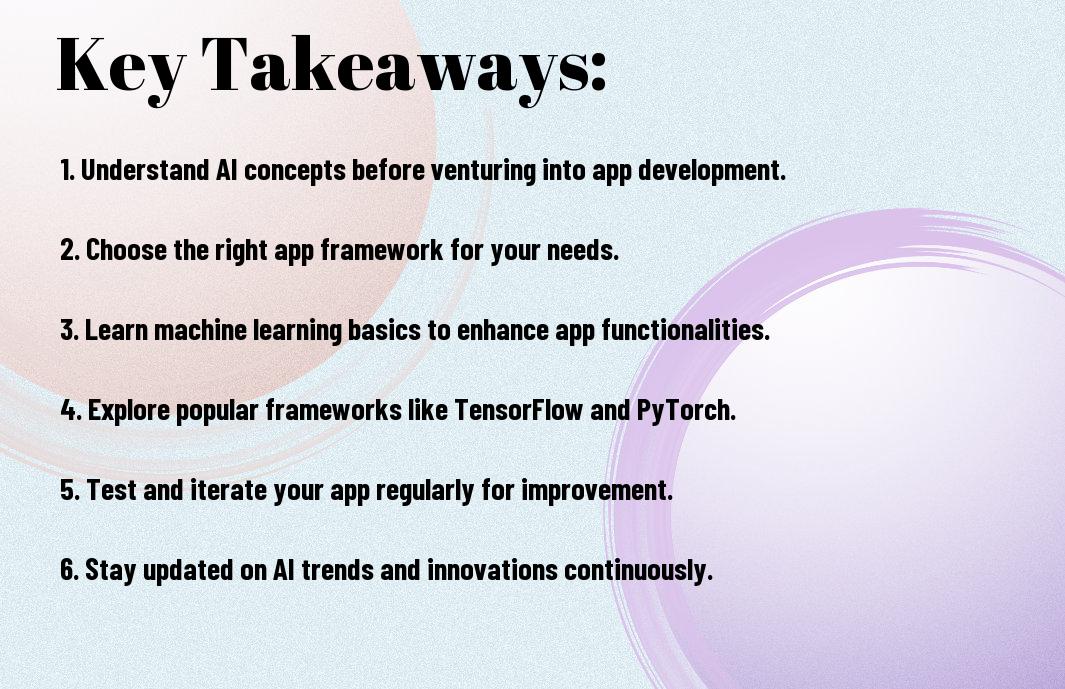
Key Takeaways:

  • Understanding the basics of AI and its integration with app development frameworks is vital for building intelligent and interactive applications that can learn and adapt to user behavior.
  • Popular AI frameworks such as TensorFlow, PyTorch, and Core ML provide pre-built tools and libraries that simplify the development process and enable developers to focus on creating innovative features.
  • App development frameworks like React Native, Flutter, and Xamarin allow for cross-platform development, enabling developers to build AI-powered apps for multiple platforms using a single codebase.
  • When choosing an AI and app development framework, it’s important to consider factors such as ease of use, scalability, and compatibility with existing infrastructure to ensure a smooth development process.
  • Staying up-to-date with the latest advancements in AI and app development frameworks is vital for building competitive and cutting-edge applications that meet the evolving needs of users.

AI Fundamentals

Your journey into AI and app development frameworks begins with understanding the basics of artificial intelligence, and you can learn more about it by checking out A Beginner’s Guide to Coding AI Tools to get started.

Machine Learning Basics

For instance, you’ll need to grasp the concepts of machine learning, which involves training algorithms to make predictions based on data, and this will help you build a strong foundation in AI.

Neural Networks Overview

Any discussion of AI would be incomplete without mentioning neural networks, which are a key component of deep learning, and you’ll need to understand how they work to build effective AI models.

A key aspect of neural networks is their ability to learn from large datasets, allowing you to build complex models that can make accurate predictions, and as you investigate deeper into AI, you’ll discover how neural networks can be applied to various tasks, such as image recognition, natural language processing, and more, enabling you to create innovative AI-powered apps.

Popular AI Development Tools

One of the key aspects of AI and app development is choosing the right tools for your project. You will find a wide range of options, each with its own strengths and weaknesses, to help you build and deploy your AI models.

TensorFlow and PyTorch

On the forefront of AI development, you have frameworks like TensorFlow and PyTorch, which offer extensive libraries and community support to help you get started with building your AI models, allowing you to focus on your project’s specific needs.

OpenAI APIs and Integration

Tools like OpenAI APIs provide you with pre-trained models and seamless integration capabilities, enabling you to incorporate AI functionality into your applications with ease, and allowing you to leverage the power of AI in your development process.

It is worth noting that OpenAI APIs and integration can greatly simplify your development workflow, as you can tap into the capabilities of pre-trained models and focus on fine-tuning them to suit your specific use case, thereby streamlining your AI development process and allowing you to bring your projects to life more efficiently.

Mobile App Frameworks

Many frameworks are available for developing mobile apps, and you can choose the one that best suits your needs. You will find a range of options, from native development platforms to cross-platform solutions, each with its own set of features and benefits.

Native Development Platforms

Mobile devices have unique characteristics, and native development platforms allow you to create apps that take advantage of these features. You can use native platforms to develop apps for specific operating systems, such as iOS or Android, and create a tailored user experience.

Cross-Platform Solutions

At the heart of cross-platform development are frameworks that enable you to create apps for multiple platforms using a single codebase. You can use these solutions to develop apps for both iOS and Android, and share code between platforms, saving time and effort.

In addition to the benefits of code sharing, cross-platform solutions also provide a range of tools and features that make development easier and more efficient. You can use these frameworks to access native APIs, create custom user interfaces, and optimize app performance, allowing you to create high-quality apps that meet your users’ needs.

AI Integration in Apps

Unlike traditional app development, AI integration requires a deeper understanding of machine learning and data analysis, allowing you to create more personalized and interactive user experiences, and you will be able to enhance your app’s functionality with AI-powered features.

Data Processing Components

At this stage, you will be working with various data processing components, such as natural language processing and computer vision, to enable your app to interpret and process complex data, and you can use these components to build intelligent features into your app.

Model Implementation

Integrating AI models into your app requires careful consideration of factors such as data quality and model accuracy, and you will need to ensure that your model is properly trained and tested to deliver reliable results, so you can trust your app’s AI-powered features.

Implementation of AI models in your app involves selecting the right framework and tools, and you will need to consider factors such as scalability and performance to ensure that your app can handle the demands of AI processing, and you should also consider the user experience and ensure that your app’s AI features are intuitive and easy to use.

Development Best Practices

Not following established guidelines can lead to inefficient and ineffective app development. You should prioritize scalability, maintainability, and usability when building your application, ensuring a solid foundation for future growth and updates.

Performance Optimization

Around the time you start developing your app, you’ll want to consider performance optimization techniques, such as minimizing computational overhead and reducing latency, to ensure a seamless user experience.

Security Considerations

Behind every successful app is a robust security framework, and you should prioritize protecting your users’ data by implementing encryption, secure authentication, and access controls to prevent unauthorized access.

At the forefront of your security considerations should be the protection of sensitive user data, and you can achieve this by implementing industry-standard security protocols, regularly updating your software, and conducting thorough testing to identify vulnerabilities, allowing you to address them before they become major issues, and ensuring your app remains a trusted and reliable platform for your users.

Testing and Deployment

Despite the complexity of AI and app development, testing and deployment are vital steps to ensure your product meets user expectations. You will need to evaluate your app’s performance, identify bugs, and make necessary adjustments before launch.

Quality Assurance Methods

Any well-planned testing strategy involves a combination of manual and automated testing to ensure your app’s quality and reliability. You can use various tools and techniques to identify and fix issues, guaranteeing a smooth user experience.

Launch Strategies

On the day of launch, you will need to have a solid plan in place to ensure a successful rollout. You should consider factors such as marketing, user support, and analytics to monitor your app’s performance.

Also, as you prepare to launch your app, you should think about how you will handle user feedback, updates, and potential issues that may arise. You can use this information to improve your app and increase user satisfaction, ultimately driving the success of your product in the market.

Final Words

Considering all points, you now have a solid foundation in AI and app development frameworks. You can apply your knowledge to create innovative solutions, enhancing your skills and staying updated with the latest trends. As you progress, your understanding of AI and app development will deepen, enabling you to make informed decisions about your projects and navigate the ever-evolving tech landscape with confidence, driving your development journey forward with your newfound expertise.

FAQ

Q: What is the best programming language for a beginner to start with when it comes to AI and app development frameworks?

A: For beginners, Python is often considered one of the best programming languages to start with when exploring AI and app development frameworks. This is because Python has a simple syntax, is relatively easy to learn, and has extensive libraries and frameworks such as TensorFlow and Keras for AI, and Flask or Django for web development. Additionally, Python’s large community and wealth of resources make it an ideal choice for those new to programming and AI.

Q: How do I choose the right app development framework for my project, especially when integrating AI components?

A: Choosing the right app development framework depends on several factors including the type of application you’re building, the platforms you’re targeting, and the specific AI components you plan to integrate. For instance, if you’re building a mobile app, you might consider frameworks like React Native or Flutter, which support AI-powered features through libraries like Core ML or TensorFlow Lite. For web applications, frameworks such as Angular, Vue.js, or React, combined with backend frameworks like Node.js, can provide robust support for AI integration. It’s also important to consider the learning curve, community support, and scalability of the framework.

Q: What are some key concepts or skills that a beginner should focus on when learning about AI and app development frameworks?

A: When learning about AI and app development frameworks, beginners should initially focus on gaining a solid understanding of programming fundamentals, including data structures, algorithms, and software design patterns. For AI, understanding machine learning basics such as supervised and unsupervised learning, neural networks, and deep learning is vital. Additionally, familiarity with data preprocessing, model training, and deployment using popular AI libraries is key. For app development, understanding the framework’s architecture, user interface design principles, and how to integrate AI models into the application are vital skills. Practicing with projects and contributing to open-source projects can also help in gaining practical experience and staying updated with the latest trends and technologies in AI and app development.

The Impact of AI on Mobile and Web App Ecosystems

As you navigate the digital landscape, you’re likely aware of the significant role artificial intelligence (AI) plays in shaping your online experiences. Your interactions with mobile and web apps are being transformed by AI-powered features, from personalized recommendations to enhanced security measures. You may wonder how AI is influencing the development and functionality of these apps, and what this means for your daily digital interactions. This blog post will explore the implications of AI on mobile and web app ecosystems, and what you can expect in the future.

Key Takeaways:

  • The integration of Artificial Intelligence (AI) in mobile and web app ecosystems is transforming the way users interact with digital platforms, enabling more personalized and intuitive experiences through predictive analytics and machine learning algorithms.
  • AI-powered chatbots and virtual assistants are becoming increasingly prevalent in apps, providing automated customer support, enhancing user engagement, and streamlining tasks such as data entry and content moderation.
  • The use of AI in app development is also improving security measures, with AI-driven systems capable of detecting and mitigating potential threats, such as malware and data breaches, more effectively than traditional security methods.
  • AI-driven analytics are helping developers gain deeper insights into user behavior, allowing them to optimize app performance, identify areas for improvement, and create more targeted marketing campaigns to reach their intended audience.
  • The incorporation of AI in mobile and web apps is expected to continue driving innovation, with potential applications in areas such as augmented reality, natural language processing, and computer vision, leading to new and exciting possibilities for app developers and users alike.

Evolution of App Development

The advent of AI has significantly transformed the app development landscape, and you are now witnessing a new era of innovation. You can see how AI is changing the way apps are designed, developed, and deployed, and this shift is likely to impact your business in various ways.

Traditional Development Paradigms

Besides the conventional methods, you have been using traditional development paradigms that involve manual coding, testing, and deployment. You are likely familiar with the time-consuming and labor-intensive process of developing apps using these methods.

AI-Driven Development Shifts

For instance, you are now seeing a significant shift towards AI-driven development, which enables faster, more efficient, and automated app development. You can leverage AI-powered tools to streamline your development process, reduce costs, and improve app quality.

In addition, as you examine deeper into AI-driven development, you will discover that it offers numerous benefits, including enhanced user experience, personalized features, and predictive analytics. You can utilize AI-driven development to create more intuitive and engaging apps that meet your users’ evolving needs and preferences, ultimately driving your business forward.

AI Integration Points

One of the key aspects of AI in mobile and web app ecosystems is identifying the right integration points. You need to consider where AI can add the most value to your app, whether it’s through enhanced user experience or improved backend efficiency.

Frontend Intelligence

Around the user interface, AI can be used to personalize your app’s layout and content, making it more intuitive and engaging for your users. You can leverage AI to analyze user behavior and adapt your app’s frontend accordingly, creating a more seamless experience.

Backend Automation

Unlike manual processes, AI can automate repetitive tasks, freeing up your resources for more strategic activities. You can use AI to streamline your app’s backend operations, such as data processing and analytics, making it more efficient and scalable.

Automation of backend processes allows you to focus on improving your app’s core functionality and user experience. You can use AI to identify areas where automation can have the most impact, and then implement solutions that simplify your workflow and reduce errors, ultimately leading to a more robust and reliable app ecosystem for your users.

User Experience Transformation

Now, as AI integrates into mobile and web app ecosystems, you can expect a significant shift in how you interact with these platforms, leading to more intuitive and personalized experiences.

Personalization Engines

One of the key benefits of AI in app development is the ability to create personalized experiences tailored to your preferences and behaviors, making your interactions more engaging and relevant.

Predictive Interfaces

Any interaction you have with an app can be anticipated and responded to by AI-driven predictive interfaces, streamlining your experience and reducing friction.

This predictive capability allows you to receive suggestions, complete tasks more efficiently, and navigate through apps with ease, as the AI learns your patterns and adapts the interface accordingly, making your overall experience more seamless and enjoyable, and enabling you to get the most out of the app’s features and functionalities.

App Security and AI

Despite the numerous benefits of AI in mobile and web app ecosystems, you must consider the potential security risks. As you integrate AI into your apps, you expose yourself to new vulnerabilities, making it necessary to prioritize security measures to protect your users’ data.

Threat Detection Systems

By leveraging AI-powered threat detection systems, you can identify and respond to potential security threats in real-time, ensuring the integrity of your app and protecting your users’ sensitive information.

Privacy Considerations

Before implementing AI in your app, you should consider the potential privacy implications, as AI can collect and process vast amounts of user data, which can be a concern for your users.

Detection of privacy breaches is a significant aspect of AI-powered app security, and as you develop your app, you should ensure that you have measures in place to detect and respond to such breaches, providing your users with a secure and trustworthy experience.

Market Dynamics

For businesses, understanding the impact of AI on mobile and web app ecosystems is imperative, as you can learn more about The Impact of Artificial Intelligence on Mobile App Development and its effects on your business.

Business Model Disruption

One significant effect of AI is the disruption of traditional business models, as you will need to adapt to new technologies and strategies to stay competitive in the market.

Competitive Landscape Changes

Behind the scenes, AI is changing the way companies compete, and you will need to be aware of these changes to make informed decisions about your business.

Disruption in the competitive landscape is driven by AI-powered innovations, and as you navigate this new landscape, you will need to consider how AI is impacting your business and the businesses of your competitors, and how you can leverage AI to gain a competitive edge.

Development Workflow Revolution

After the introduction of AI in mobile and web app development, you will notice a significant shift in your workflow, as AI-powered tools automate repetitive tasks and enhance collaboration among team members.

Code Generation and Testing

With the help of AI, you can generate high-quality code and test it efficiently, reducing the time and effort spent on these tasks and allowing you to focus on more complex aspects of your project.

Maintenance and Updates

To ensure your app remains stable and secure, you will need to perform regular maintenance and updates, and AI can assist you in identifying areas that require attention and providing personalized recommendations for improvement.

It is worth noting that AI-driven maintenance and updates enable you to proactively address potential issues, reducing downtime and improving overall user experience, which is important for the success of your mobile or web app, and you can rely on AI to help you achieve this goal.

Final Words

With these considerations, you now have a deeper understanding of the transformative power of AI on your mobile and web app ecosystems. As you navigate this evolving landscape, you can learn more about The Impact Of Artificial Intelligence On Mobile App Development and how it shapes your digital strategy, ultimately enhancing your user experience and driving your business forward. You will be better equipped to harness the potential of AI in your app development endeavors.

FAQ

Q: What is the current state of AI integration in mobile and web app ecosystems, and how is it transforming the user experience?

A: The integration of Artificial Intelligence (AI) in mobile and web app ecosystems is rapidly advancing, leading to a significant transformation in the user experience. AI-powered features such as personalized recommendations, predictive analytics, and natural language processing are being incorporated into various apps to enhance user engagement and interaction. For instance, virtual assistants like Siri, Google Assistant, and Alexa are using AI to understand voice commands and provide relevant responses, making the user experience more intuitive and seamless. Furthermore, AI-driven chatbots are being used in customer service apps to provide 24/7 support, helping to resolve queries and issues more efficiently.

Q: How is AI impacting the development and maintenance of mobile and web applications, and what are the key benefits for developers?

A: AI is revolutionizing the development and maintenance of mobile and web applications by automating various tasks, improving code quality, and enhancing overall efficiency. AI-powered tools are being used for tasks such as code review, testing, and debugging, allowing developers to focus on more complex and creative aspects of app development. Additionally, AI-driven analytics and monitoring tools are helping developers to identify and fix issues more quickly, resulting in faster time-to-market and improved app performance. The key benefits for developers include increased productivity, reduced costs, and the ability to create more sophisticated and user-friendly apps.

Q: What are the potential risks and challenges associated with the increasing use of AI in mobile and web app ecosystems, and how can they be mitigated?

A: The increasing use of AI in mobile and web app ecosystems also poses several risks and challenges, including concerns around data privacy, security, and bias. As AI systems collect and process vast amounts of user data, there is a risk of data breaches and unauthorized use, which can compromise user trust and confidentiality. Moreover, AI algorithms can perpetuate existing biases and discriminate against certain groups of users, leading to unfair outcomes. To mitigate these risks, developers and organizations must prioritize transparency, accountability, and fairness in AI development, ensuring that AI systems are designed and trained with diverse and representative data sets, and that users have control over their data and how it is used.

Leveraging AI for Real-Time Analytics in Your App

You can enhance your app’s performance by integrating AI-powered real-time analytics, enabling you to make data-driven decisions. Your app generates vast amounts of data, and AI helps you process it instantly, providing valuable insights. By leveraging AI, you can analyze user behavior, track key metrics, and optimize your app for better user experience, ultimately driving your business forward with informed decisions.

Key Takeaways:

  • Integrating AI into your app can significantly enhance real-time analytics capabilities, enabling faster and more accurate decision-making for users and developers alike.
  • AI-powered analytics can process vast amounts of data in real-time, providing insights that might be missed through traditional analysis methods, and helping to identify trends and patterns more efficiently.
  • Implementing AI-driven analytics in your app can lead to improved user experiences, as it allows for personalized content and recommendations based on user behavior and preferences.
  • Real-time analytics powered by AI can also help in detecting and preventing potential issues, such as security breaches or system failures, by monitoring app performance and user activity continuously.
  • To successfully leverage AI for real-time analytics, it’s necessary to choose the right tools and technologies that align with your app’s specific needs and goals, and to ensure seamless integration with existing infrastructure.

Real-Time Analytics Fundamentals

To effectively leverage AI for real-time analytics in your app, you need to understand the basics of real-time analytics, including data collection, processing, and analysis. This foundation will help you make informed decisions about your app’s performance and user behavior.

Data Stream Processing

Above all, your app’s ability to process data streams in real-time is vital for gaining timely insights. You can achieve this by utilizing technologies that handle high-volume data streams, enabling your app to respond quickly to changing user behaviors and preferences.

AI Model Integration

With the right AI models, you can unlock deeper insights into your app’s performance and user behavior. You can integrate AI models into your app to analyze real-time data, identify patterns, and make predictions about future user behavior.

Considering the complexity of AI model integration, you should focus on selecting models that align with your app’s specific needs and goals. You can choose from a variety of models, such as machine learning or deep learning, to analyze your app’s data and provide actionable insights that inform your decision-making process, helping you to optimize your app’s performance and improve user experience.

AI Components for Analytics

Now that you’re exploring AI for real-time analytics, you’ll need to understand the components involved. Your app’s analytics capabilities will rely on these components to process and analyze data efficiently.

Machine Learning Algorithms

Components such as machine learning algorithms will enable your app to learn from data and make predictions, allowing you to make informed decisions about your business.

Neural Network Applications

Around the concept of neural networks, you’ll find various applications that can enhance your app’s analytics, including image and speech recognition, natural language processing, and more.

Algorithms like deep learning and convolutional neural networks will help you unlock the full potential of your app’s neural network applications, enabling you to analyze complex data patterns and make accurate predictions about your users’ behavior.

Implementation Architecture

Many factors contribute to a successful AI-powered analytics system, and you will need to consider several components when designing your architecture, including data ingestion, processing, and storage, as well as the AI algorithms and models that will drive your analytics capabilities.

System Design Patterns

Along with choosing the right technologies, you should consider established system design patterns, such as microservices or event-driven architectures, to ensure your system is flexible, maintainable, and scalable, allowing you to adapt to changing requirements and growing demands.

Scalability Considerations

For your AI-powered analytics system to handle increasing volumes of data and user traffic, you will need to plan for scalability, considering factors such as distributed computing, load balancing, and autoscaling, to ensure your system can handle growth without compromising performance.

Another key aspect of scalability is monitoring and optimizing your system’s resource utilization, as you will need to balance the costs of infrastructure and maintenance with the need for fast and reliable analytics, and by doing so, you can ensure your system scales efficiently and effectively to meet your growing needs.

Performance Optimization

All applications require optimization to ensure seamless performance, and your app is no exception. You can leverage AI to streamline your app’s performance and provide a better user experience.

Data Pipeline Efficiency

Effectively, you can enhance your data pipeline by implementing AI-powered tools that automate data processing, reducing latency and increasing throughput, allowing you to make data-driven decisions in real-time.

Resource Management

Responsively, you can manage your resources by utilizing AI to monitor and allocate resources efficiently, ensuring that your app’s performance is not compromised, and your users have a smooth experience.

Hence, as you implement AI for resource management, you will be able to identify areas of improvement, predict potential bottlenecks, and make informed decisions to optimize your app’s performance, ultimately leading to increased user satisfaction and engagement with your app.

Security and Compliance

Keep your app’s real-time analytics secure by implementing robust measures to protect user data and ensure compliance with relevant regulations, as you integrate AI-powered analytics into your application.

Data Protection Measures

On the path to securing your app, you’ll need to implement robust data protection measures, such as encryption and access controls, to safeguard sensitive user information and maintain trust in your brand.

Regulatory Requirements

Across various jurisdictions, you must comply with a range of regulatory requirements, including data protection laws and industry standards, to avoid penalties and reputational damage.

The specifics of these regulatory requirements will depend on your app’s target market and the type of data you collect, so you’ll need to carefully assess your obligations and develop a compliance strategy that meets your unique needs, ensuring that your use of AI for real-time analytics aligns with relevant laws and regulations, and that you’re transparent with your users about how their data is being used.

Monitoring and Maintenance

Unlike traditional analytics methods, AI-powered real-time analytics requires continuous oversight to ensure optimal performance, allowing you to identify and address issues promptly, thereby maximizing your app’s potential.

System Health Tracking

Beneath the surface of your app’s interface, you need to track system health to prevent downtime and data loss, enabling you to take proactive measures to maintain your app’s stability and performance.

Model Performance Updates

The key to successful AI implementation lies in regularly updating your models to adapt to changing user behavior and preferences, allowing you to refine your app’s analytics and decision-making capabilities.

Monitoring your model’s performance over time, you will be able to identify areas for improvement, update your training data, and retrain your models to ensure they continue to provide accurate and relevant insights, enabling you to make informed decisions about your app’s development and growth, and ultimately enhancing your users’ experience.

Summing up

As a reminder, you can significantly enhance your app’s capabilities by leveraging AI for real-time analytics. You will be able to make data-driven decisions, improving your app’s overall performance and user experience. By integrating AI-powered analytics, you can gain valuable insights into your users’ behavior, allowing you to optimize your app and stay ahead of the competition, ultimately driving your business forward with informed decisions based on real-time data analysis.

FAQ

Q: What are the benefits of integrating AI-powered real-time analytics in my mobile or web application?

A: Integrating AI-powered real-time analytics in your application can significantly enhance user experience by providing instant insights and personalized recommendations. It enables businesses to make data-driven decisions, optimize operations, and improve customer engagement. With real-time analytics, you can track user behavior, identify trends, and respond promptly to changes in the market or user preferences, ultimately leading to increased conversion rates and revenue growth.

Q: How can I ensure the accuracy and reliability of AI-driven real-time analytics in my app?

A: To ensure the accuracy and reliability of AI-driven real-time analytics, it’s important to implement a robust data validation process, utilize high-quality data sources, and continuously monitor the performance of your AI models. Regularly updating and refining your models with new data and feedback from users can also help maintain their accuracy over time. Additionally, leveraging techniques such as data normalization, feature engineering, and cross-validation can further enhance the reliability of your analytics.

Q: What are the key considerations for implementing AI for real-time analytics in my app, especially concerning data privacy and security?

A: When implementing AI for real-time analytics, it’s vital to prioritize data privacy and security. Ensure that you comply with relevant regulations such as GDPR or CCPA by obtaining explicit user consent for data collection and processing. Implement robust data encryption methods to protect user data both in transit and at rest. Furthermore, use secure authentication and authorization protocols to control access to sensitive data and analytics insights. Transparency about what data is collected and how it’s used is also key to building trust with your users.

Building Multilingual Apps with Natural Language AI

As you expand your app’s reach to a global audience, you’ll need to cater to diverse language preferences. You can leverage Natural Language AI to develop multilingual apps, enabling your users to interact in their native languages. With this technology, you can enhance your app’s user experience, increase engagement, and tap into new markets. By integrating Natural Language AI, you can efficiently manage language support and provide personalized experiences for your users worldwide.

Key Takeaways:

  • Developing multilingual apps with natural language AI enables businesses to expand their reach and cater to diverse user bases, improving overall user experience and engagement.
  • Natural language processing (NLP) and machine learning algorithms can be leveraged to build apps that understand and respond to user input in multiple languages, facilitating seamless communication.
  • Integrating language translation and localization capabilities into apps can help companies tap into new markets and increase their global presence, driving revenue growth and competitiveness.
  • Building multilingual apps with natural language AI requires careful consideration of cultural and linguistic nuances to ensure accurate and context-specific translations, avoiding potential miscommunications or misinterpretations.
  • By incorporating natural language AI into multilingual app development, developers can create more intuitive and user-friendly interfaces, enhancing customer satisfaction and loyalty across different languages and regions.

Natural Language AI Fundamentals

Before venturing into building multilingual apps, you need to understand the basics of natural language AI, which enables computers to process and generate human-like language, allowing your app to communicate effectively with users worldwide.

Core Language Processing Components

Among the key elements of natural language AI, you will find tokenization, syntax analysis, and semantics, which are imperative for your app to comprehend and generate text, facilitating interaction with users in their native languages.

Language Model Architecture

Language is at the heart of natural language AI, and you will need to design an architecture that can handle various languages, taking into account their unique characteristics, such as grammar and syntax, to ensure your app provides accurate and context-specific responses.

Components of a language model architecture include encoders, decoders, and attention mechanisms, which you can use to build a robust and flexible system, allowing your app to learn from data and improve its language understanding and generation capabilities over time, enabling you to support multiple languages and dialects in your app.

Multilingual Framework Setup

Now that you have decided to build a multilingual app, setting up a framework is important. You need to consider the languages you want to support and the resources you have available. Your framework should be scalable and flexible to accommodate different languages and regions.

Language Detection Systems

With language detection systems, you can automatically identify the language of your users and provide them with a personalized experience. You can use various libraries and APIs to detect languages and integrate them into your app.

Translation Pipeline Integration

Pipeline integration is a key step in building a multilingual app. You need to integrate your translation pipeline with your development workflow to ensure that your app is translated efficiently and accurately. Your translation pipeline should be able to handle different file formats and languages.

Indeed, integrating a translation pipeline into your development workflow can be complex, but it is worth the effort. You can use various tools and services to automate the translation process, such as machine translation APIs and translation management platforms. By integrating a translation pipeline, you can ensure that your app is translated quickly and accurately, and that you can reach a global audience with your product.

Language Data Management

For building multilingual apps, you need to manage language data effectively. This involves several steps, from collecting and storing data to retrieving and using it in your app.

Data Collection Strategies

Deriving data from various sources is imperative for your multilingual app. You will collect text, speech, and other forms of language data to train your AI models, enabling them to understand and generate human-like language.

Storage and Retrieval Methods

Collecting and organizing your language data is just the first step. You will need to store it securely and retrieve it efficiently to use in your app, ensuring that your AI models can access the data they need to function effectively.

Understanding how to implement effective storage and retrieval methods is vital for your app’s performance. You will want to consider factors such as data format, storage solutions, and retrieval algorithms to ensure that your language data is handled correctly, allowing your app to provide accurate and helpful responses to your users.

Cultural Context Integration

All aspects of your app’s development should consider the cultural context, and for more information on this topic, you can visit Multilingual natural language processing | Fast Data Science to learn more about integrating cultural context into your multilingual app.

Regional Language Adaptations

Adapting your app to regional languages is imperative, as you will need to consider the nuances of each language to ensure your app is effective in different regions, and you should take the time to understand the specific needs of your target audience.

Localization Parameters

Localization is key when developing a multilingual app, and you will need to consider various parameters such as date and time formats, currency, and units of measurement to ensure your app is user-friendly and accessible to a global audience.

At this stage, you will need to conduct thorough research to determine the specific localization parameters that apply to your target regions, and you should consider factors such as language, culture, and regulations to ensure your app meets the needs of your users and complies with local laws and regulations.

Performance Optimization

Once again, you’ll need to focus on optimizing your app’s performance to ensure a seamless user experience, especially when dealing with multiple languages and AI-powered features.

Response Time Enhancement

Across various platforms and devices, you can enhance your app’s response time by leveraging caching, content delivery networks, and optimizing database queries to reduce latency.

Resource Management

After implementing your multilingual app, you’ll need to monitor and manage your resources efficiently to prevent performance degradation, ensuring your app can handle increased traffic and user engagement.

Performance of your app is directly tied to how well you manage your resources, and you can achieve this by setting up alerts, tracking memory usage, and optimizing your code to minimize unnecessary computations, allowing you to identify and address potential bottlenecks before they impact your users.

Security and Privacy

Keep your users’ trust by prioritizing security and privacy in your multilingual app, ensuring their data is protected and their interactions are secure.

Data Protection Protocols

Following the development of your app, adhere to strict data protection protocols, implementing robust encryption and secure storage to safeguard your users’ information.

User Privacy Controls

Privately, you must consider the user’s perspective, providing them with controls to manage their personal data and opt-out of data collection, giving them autonomy over their privacy settings.

Security measures should be implemented to support user privacy controls, allowing you to ensure that your users’ data is handled responsibly, and you can maintain transparency about how their information is being used, giving you the ability to build trust with your users and establish a strong reputation for your app.

Conclusion

The development of multilingual apps with natural language AI enables you to expand your reach globally. You can now create apps that understand and respond to your users’ queries in their native languages, enhancing their experience. By leveraging natural language AI, you can break language barriers and make your app more accessible, increasing your user base and ultimately, your revenue. Your ability to cater to diverse linguistic needs sets you apart in the competitive app market.

FAQ

Q: What are the benefits of using Natural Language AI in building multilingual apps?

A: Building multilingual apps with Natural Language AI offers several benefits, including enhanced user experience, increased accessibility, and broader market reach. Natural Language AI enables apps to understand and respond to user input in multiple languages, making them more inclusive and user-friendly. This technology also allows for more accurate language translation, sentiment analysis, and intent detection, which can improve customer engagement and loyalty. Furthermore, by supporting multiple languages, businesses can expand their customer base and enter new markets, potentially leading to increased revenue and growth.

Q: How does Natural Language AI handle language nuances and cultural differences in multilingual apps?

A: Natural Language AI is designed to handle language nuances and cultural differences by leveraging advanced machine learning algorithms and large datasets. These algorithms can learn to recognize and adapt to the unique characteristics of each language, including idioms, colloquialisms, and cultural references. Additionally, Natural Language AI can be trained on region-specific data to ensure that the app is sensitive to local customs and preferences. This enables multilingual apps to provide more accurate and contextually relevant responses, improving the overall user experience and reducing the risk of cultural or linguistic misinterpretation.

Q: What are the key considerations for integrating Natural Language AI into a multilingual app development project?

A: When integrating Natural Language AI into a multilingual app development project, several key considerations must be taken into account. These include selecting the right Natural Language AI platform and tools, ensuring high-quality training data, and designing an intuitive user interface that can accommodate multiple languages. It is also important to consider factors such as language support, character encoding, and font compatibility to ensure seamless integration and optimal performance. Moreover, developers should prioritize ongoing testing and evaluation to ensure that the Natural Language AI component is functioning correctly and providing accurate results across all supported languages.

Skip to content