Developing Cross-Platform Apps with AI Integration

As you research into the world of mobile app development, you’re likely considering how to create seamless experiences across multiple platforms. You want your app to be accessible and functional on various devices, and integrating Artificial Intelligence (AI) can enhance its capabilities. Your goal is to develop an app that not only runs smoothly on different platforms but also leverages AI to provide personalized user experiences, and this post will guide you through the process of achieving that.

Key Takeaways:

  • Developing cross-platform apps with AI integration enables businesses to reach a wider audience and provide a seamless user experience across different devices and operating systems.
  • AI-powered cross-platform apps can automate tasks, improve performance, and offer personalized experiences, leading to increased user engagement and loyalty.
  • Popular frameworks such as React Native, Flutter, and Xamarin allow developers to build cross-platform apps with AI integration, using a single codebase and reducing development time and costs.
  • Integrating AI and machine learning models into cross-platform apps requires careful consideration of data privacy, security, and ethics to ensure compliance with regulations and maintain user trust.
  • Continuous testing, iteration, and updating of AI-powered cross-platform apps are necessary to ensure they remain relevant, efficient, and effective in meeting evolving user needs and market demands.
Foundations of Cross-Platform Development

A solid understanding of the underlying principles is imperative for developing cross-platform apps with AI integration, and you will need to consider various factors, including your target audience, desired features, and technical requirements.

Native vs. Cross-Platform Architecture

Anyway, when deciding between native and cross-platform architecture, you should weigh the pros and cons of each approach, considering factors such as performance, development time, and maintenance costs, to determine which one best suits your needs.

Modern Development Frameworks

Above all, you will need to choose a suitable framework for your cross-platform app development, and you can select from a range of options, including React Native, Flutter, and Xamarin, each with its own strengths and weaknesses.

Frameworks like React Native and Flutter provide you with the tools and resources you need to build cross-platform apps with AI integration, allowing you to share code across platforms and streamline your development process, which can help you to reduce development time and costs, and you can focus on creating a seamless user experience for your audience.

AI Integration Components

Now, as you examine into the world of cross-platform app development, you’ll need to explore AI integration components. You can learn more about App development with AI to enhance your skills.

Machine Learning Libraries

Libraries such as TensorFlow and Core ML enable you to build intelligent apps, allowing you to focus on your development process.

Neural Network Implementation

Learning from data, you can implement neural networks to improve your app’s performance and user experience.

With neural network implementation, you can enable your app to make predictions, classify data, and make decisions, taking your app to the next level, and as you explore this further, you’ll discover how to optimize your neural network for better performance, making your app more efficient and effective for your users.

Data Management Across Platforms

To effectively manage data across platforms, you’ll need to consider a unified approach. You can explore tools like Free AI-Powered Mobile App Development – Build Cross-Platform Apps to streamline your data management process.

Unified Data Architecture

On the path to developing a cross-platform app, you’ll need to design a unified data architecture that integrates your AI components seamlessly, allowing you to access and manage data efficiently across different platforms.

Cross-Platform Storage Solutions

Against the backdrop of diverse platform requirements, you’ll need to select cross-platform storage solutions that can accommodate your app’s unique needs, ensuring data consistency and security.

Unified storage solutions enable you to manage data across platforms, allowing you to focus on your app’s core functionality. You can leverage cloud-based storage services to store and retrieve data, ensuring that your app’s data is accessible and up-to-date across all platforms, making it easier for you to maintain and update your app.

AI Model Deployment

After developing your AI model, you need to deploy it to your cross-platform app. You’ll have to choose between cloud-based services or on-device processing, each with its own advantages and disadvantages.

Cloud-Based AI Services

Above all, cloud-based AI services provide scalability and cost-effectiveness, allowing you to deploy your model quickly and efficiently, and you can leverage the expertise of cloud providers to manage your AI infrastructure.

On-Device AI Processing

Between these options, on-device processing offers real-time processing and enhanced security, as your data is processed locally on the user’s device, and you can optimize your app’s performance by leveraging the device’s hardware capabilities.

This approach also enables you to provide a seamless user experience, even with limited internet connectivity, and you can ensure that your app’s AI functionality is always available, regardless of network conditions, which is especially important for applications that require real-time processing, such as image recognition or natural language processing.

Performance Optimization

For developing cross-platform apps with AI integration, you need to focus on optimizing performance to ensure a seamless user experience. Your app’s performance is directly related to its success, and you should prioritize it to retain users.

Resource Management

Besides optimizing code, you should manage resources efficiently to prevent memory leaks and reduce battery consumption. You can use various tools to monitor your app’s resource usage and identify areas for improvement.

Response Time Enhancement

Beside other factors, response time plays a significant role in your app’s performance. You can enhance it by optimizing database queries, reducing network latency, and using caching mechanisms to fetch data quickly.

Indeed, enhancing response time requires a thorough analysis of your app’s architecture and workflow. You can use various techniques such as parallel processing, asynchronous programming, and content delivery networks to reduce latency and improve your app’s overall performance, allowing you to provide a better experience for your users.

Security and Privacy

Many cross-platform apps with AI integration face security and privacy concerns, and as you develop your app, you must prioritize these aspects to protect your users’ data and maintain their trust.

Data Protection Protocols

The most effective way to ensure data protection is by implementing robust protocols, such as encryption and secure authentication, to safeguard your users’ sensitive information and prevent unauthorized access.

AI Model Security

Securely designing and testing your AI models is vital to prevent potential vulnerabilities, and you should ensure that your models are trained on secure data and are resistant to attacks, so you can trust your AI-powered app.

Hence, as you focus on AI model security, you will need to consider various factors, including data quality, model interpretability, and explainability, to ensure that your AI-powered app is not only secure but also transparent and fair, allowing you to build a trustworthy relationship with your users.

Final Words

Upon reflecting on your journey to develop cross-platform apps with AI integration, you now possess the knowledge to create innovative solutions. You can leverage AI to enhance your app’s functionality, making it more engaging for users. As you move forward, your expertise will enable you to design and develop cutting-edge apps, streamlining your workflow and expanding your reach across various platforms, ultimately taking your app development to the next level.

FAQ

Q: What are the benefits of developing cross-platform apps with AI integration?

A: Developing cross-platform apps with AI integration offers several benefits, including increased reach and accessibility across different platforms, enhanced user experience through personalized and intelligent features, and improved development efficiency by leveraging a single codebase. Additionally, AI-powered cross-platform apps can provide real-time insights and analytics, enabling data-driven decision-making and driving business growth.

Q: What are the key technologies and tools used for developing cross-platform apps with AI integration?

A: The key technologies and tools used for developing cross-platform apps with AI integration include frameworks such as React Native, Flutter, and Xamarin, which enable cross-platform development. For AI integration, popular tools and technologies include machine learning frameworks like TensorFlow and Core ML, natural language processing (NLP) libraries like NLTK and spaCy, and computer vision libraries like OpenCV. Furthermore, cloud-based services like Google Cloud AI Platform, Microsoft Azure Machine Learning, and Amazon SageMaker provide scalable and secure infrastructure for deploying and managing AI models.

Q: How do developers ensure the security and privacy of user data in cross-platform apps with AI integration?

A: To ensure the security and privacy of user data in cross-platform apps with AI integration, developers should implement robust security measures, such as encryption, secure authentication and authorization, and access controls. Additionally, developers should comply with relevant data protection regulations, like GDPR and CCPA, and implement data anonymization and pseudonymization techniques to protect sensitive user information. Regular security audits, penetration testing, and vulnerability assessments can also help identify and address potential security risks associated with AI-powered cross-platform apps.

Integrating Voice Recognition AI into Mobile Applications

As you consider enhancing your mobile application, you’re likely exploring innovative features to boost user experience. You’re probably aware that voice recognition AI is revolutionizing the way users interact with devices. By integrating this technology into your mobile application, you can enable users to perform tasks more efficiently, using voice commands to navigate and access information. You can leverage voice recognition AI to streamline your app’s functionality and stay ahead of the competition.

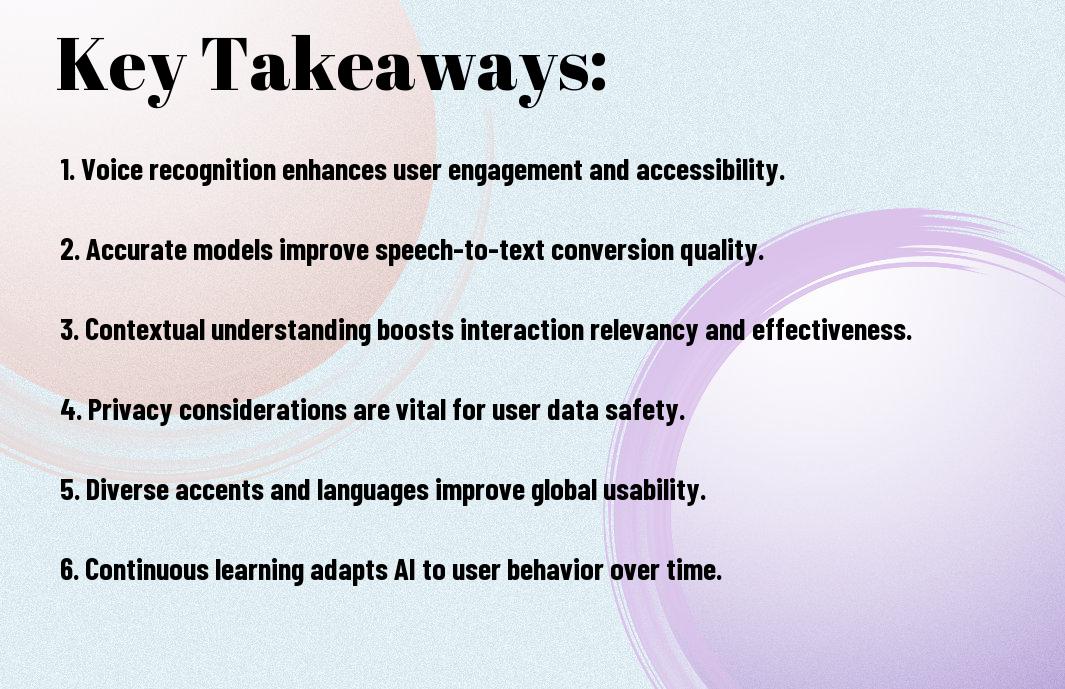
Key Takeaways:

  • Enhanced User Experience: Integrating voice recognition AI into mobile applications provides an intuitive and hands-free experience, allowing users to interact with the app using voice commands, which can be particularly useful for tasks that require hands-on attention.
  • Increased Accessibility: Voice recognition AI can help people with disabilities, such as visual or motor impairments, to use mobile applications more easily, promoting inclusivity and equality in the digital landscape.
  • Improved Efficiency: Voice recognition AI can automate tasks, such as data entry, search, and navigation, making it faster and more efficient for users to complete tasks within the app, and reducing the likelihood of errors.
  • Personalization and Contextual Understanding: Advanced voice recognition AI can understand the context and nuances of voice commands, enabling mobile applications to provide personalized responses, recommendations, and services that cater to individual user preferences and behaviors.
  • Security and Authentication: Voice recognition AI can be used for secure authentication and verification, providing an additional layer of protection against unauthorized access, and reducing the risk of data breaches and cyber attacks.

    Voice Recognition AI Architecture

    While designing your mobile application, you can explore the Voice Recognition AI architecture, which enables you to integrate voice-based interfaces. You can learn more about Voice Agent Configuration for Mobile Apps | Restackio to understand the technical aspects.

    Core Components

    On the basis of your requirements, you will need to identify the core components of Voice Recognition AI, including speech recognition, natural language processing, and text-to-speech synthesis, to develop an efficient system.

    Processing Pipeline

    Beside the core components, you should also consider the processing pipeline, which involves audio input, signal processing, and intent identification to enable seamless voice interactions in your mobile application.

    Architecture of the processing pipeline is designed to handle complex voice commands, allowing you to develop a sophisticated voice recognition system that can accurately interpret your users’ voice inputs and respond accordingly, making your mobile application more user-friendly and interactive.

    Implementation Framework

    Clearly, a well-structured framework is vital for integrating voice recognition AI into your mobile application, enabling you to streamline the development process and ensure seamless functionality.

    API Integration

    Integrating voice recognition APIs into your application allows you to leverage the capabilities of AI-powered speech recognition, enabling you to enhance your app’s user experience and provide more intuitive interactions for your users.

    System Requirements

    With the right system requirements in place, you can ensure that your voice recognition AI integration runs smoothly and efficiently, providing optimal performance and minimizing potential errors or glitches.

    Requirements for your system will depend on the specific needs of your application, but you should consider factors such as processing power, memory, and network connectivity to ensure that your voice recognition AI can function effectively, allowing you to provide the best possible experience for your users.

    User Interface Design

    Now that you’re integrating voice recognition AI into your mobile application, it’s important to consider the user interface design. You’ll want to create an intuitive and seamless experience for your users, allowing them to interact with your app using voice commands.

    Voice Command Patterns

    Besides the visual aspects, you’ll need to design voice command patterns that are easy for users to understand and use. You should consider the tone, language, and syntax of your voice commands to ensure they are consistent throughout your app.

    Response Mechanisms

    Along with designing voice command patterns, you’ll also need to develop response mechanisms that provide feedback to your users. You should consider how your app will respond to voice commands, including the type of feedback and the timing of the response.

    Mechanisms such as text-to-speech, visual cues, and haptic feedback can be used to provide feedback to your users. You can use these mechanisms to let your users know that their voice command has been received and is being processed, helping to create a more interactive and engaging experience.

    Performance Optimization

    Unlike other features, optimizing voice recognition AI in your mobile application requires careful consideration of various factors to ensure seamless user experience. You need to focus on latency management and resource allocation to achieve optimal performance.

    Latency Management

    Beneath the surface of a successful voice recognition system lies effective latency management, which enables your application to respond quickly to user inputs, allowing you to provide a more interactive experience.

    Resource Allocation

    Performing efficient resource allocation is vital for your application’s performance, as you need to balance the computational resources required for voice recognition with other system processes to prevent overload.

    Also, when allocating resources, you should consider the trade-off between accuracy and speed, as more accurate voice recognition models often require more computational power, and you need to find the right balance to meet your application’s specific needs.

    Security Measures

    Not all voice recognition AI systems are created equal, and you must consider the security implications of integrating such technology into your mobile application.

    Data Protection

    Any sensitive information that your application collects and stores must be protected from unauthorized access, and you should implement robust data protection measures to safeguard your users’ personal data.

    Authentication Protocols

    With the rise of voice recognition AI, you need to ensure that your application’s authentication protocols are secure and reliable, using techniques such as multi-factor authentication to verify user identities.

    In addition, you should consider implementing advanced authentication protocols, such as behavioral biometrics, to provide an extra layer of security and protect your users from potential voice spoofing attacks, ensuring that your application is secure and trustworthy.

    Testing Methodologies

    After developing your voice recognition AI integrated mobile application, you need to test it thoroughly to ensure its effectiveness and efficiency. You will have to consider various testing methodologies to validate your application’s performance and identify areas for improvement.

    Accuracy Assessment

    With a focus on evaluating your application’s voice recognition capabilities, you will assess its accuracy in understanding and responding to voice commands, and identify potential errors or inconsistencies that may affect its overall performance.

    User Experience Validation

    Around the time you start testing your application, you will also need to validate its user experience, ensuring that it is intuitive, user-friendly, and provides a seamless interaction experience for your users.

    Understanding how your users interact with your application is key to validating its user experience. You will need to analyze user behavior, gather feedback, and make necessary adjustments to improve the overall user experience, ensuring that your application meets your users’ needs and expectations, and provides a competitive edge in the market, helping you to refine your application and make data-driven decisions to drive its success.

    Summing up

    Drawing together the various aspects of integrating voice recognition AI into mobile applications, you can now enhance your app’s user experience. By incorporating voice assistants, you can increase user engagement and accessibility. For more information on this topic, visit Voice Recognition and Mobile Apps: Integrating Siri and Google Assistant to learn how to improve your app’s functionality and stay ahead in the market with your innovative approach.

    FAQ

    Q: What are the benefits of integrating voice recognition AI into mobile applications?

    A: Integrating voice recognition AI into mobile applications provides several benefits, including enhanced user experience, increased accessibility, and improved efficiency. With voice recognition AI, users can interact with the application using voice commands, which can be especially helpful for individuals with disabilities or those who prefer hands-free interaction. Additionally, voice recognition AI can help to reduce errors and improve the overall accuracy of user input, leading to a more seamless and intuitive user experience.

    Q: How does voice recognition AI work in mobile applications, and what are the technical requirements for implementation?

    A: Voice recognition AI in mobile applications typically works by using natural language processing (NLP) and machine learning algorithms to recognize and interpret spoken words and phrases. The technical requirements for implementation include a reliable internet connection, a compatible device with a microphone, and a software development kit (SDK) or application programming interface (API) that supports voice recognition. Developers must also ensure that the application is optimized for voice recognition, with clear and concise voice commands, and a user interface that is designed to accommodate voice input.

    Q: What are the potential security and privacy concerns associated with integrating voice recognition AI into mobile applications, and how can they be addressed?

    A: The integration of voice recognition AI into mobile applications raises several security and privacy concerns, including the potential for unauthorized access to sensitive user data, eavesdropping, and data breaches. To address these concerns, developers can implement robust security measures, such as encryption, secure authentication protocols, and secure data storage. Additionally, developers should ensure that users are informed about the use of voice recognition AI and provide transparent opt-out options for users who do not want to use voice recognition features. Regular security audits and testing can also help to identify and mitigate potential security vulnerabilities.

Creating Adaptive Learning Apps Using Artificial Intelligence

As you explore the potential of technology in education, you’ll discover the significance of adaptive learning apps in enhancing your learning experience. You can leverage artificial intelligence to create personalized learning pathways, tailored to your needs and abilities. To learn more about integrating AI in education, visit AI in Education: Crafting Adaptive Content to understand how you can revolutionize your learning approach with adaptive technology.

Key Takeaways:

  • Personalization is a key benefit of adaptive learning apps, as they use artificial intelligence to tailor the learning experience to individual students’ needs, abilities, and learning styles.
  • Artificial intelligence can help to identify knowledge gaps and learning difficulties, allowing adaptive learning apps to provide targeted support and feedback to students.
  • Adaptive learning apps can analyze large amounts of data to provide insights into student learning patterns, helping educators to refine their teaching methods and improve student outcomes.
  • The use of machine learning algorithms in adaptive learning apps enables them to continuously learn and improve over time, providing a more effective and efficient learning experience for students.
  • Adaptive learning apps have the potential to increase student engagement and motivation, as they provide a more interactive and dynamic learning experience that is tailored to individual students’ interests and abilities.

Fundamentals of Adaptive Learning

Before submerging into adaptive learning apps, you need to understand the basics of adaptive learning, which involves using technology to tailor the learning experience to your individual needs and abilities, allowing you to learn at your own pace and focus on areas where you need improvement.

Machine Learning Algorithms in Education

Besides traditional teaching methods, machine learning algorithms can be used in education to analyze your learning patterns and provide personalized recommendations, enabling you to make the most out of your learning experience, and helping you to achieve your goals more efficiently.

Personalized Learning Pathways

Personally, you will find that personalized learning pathways are designed to cater to your unique learning style, allowing you to take ownership of your learning journey and make progress at your own pace, with the help of adaptive technology that adjusts to your needs.

Pathways to personalized learning are created by analyzing your strengths, weaknesses, and learning behaviors, and using this information to provide you with customized learning content and activities that meet your individual needs, helping you to stay engaged and motivated throughout your learning journey, and enabling you to achieve your full potential.

AI Components for Adaptive Apps

Clearly, when developing adaptive learning apps, you will need to incorporate various AI components to create a personalized experience for your users. These components work together to analyze user behavior, adjust difficulty levels, and provide real-time feedback.

Neural Networks and Pattern Recognition

Approximately, at the heart of adaptive learning apps are neural networks that enable pattern recognition, allowing your app to identify user learning patterns and adapt accordingly, providing you with valuable insights to improve your app.

Natural Language Processing Integration

Likewise, language plays a significant role in adaptive learning apps, and you can leverage natural language processing (NLP) to enhance user interaction, enabling your app to understand and respond to user queries more effectively, making it more engaging for your users.

Pattern recognition is key to NLP integration, as you can use it to analyze user input, identify areas where they struggle, and provide personalized feedback, enabling you to refine your app’s adaptive capabilities and improve user outcomes, allowing you to create a more effective and engaging learning experience for your users.

Learning Data Analytics

Your learning data analytics plays a significant role in creating adaptive learning apps, as it helps you understand how your students interact with the learning material and identify areas where they need improvement.

Student Performance Metrics

For instance, you can track metrics such as completion rates, scores, and time spent on each topic to gauge student performance and adjust the learning path accordingly, allowing you to make data-driven decisions to enhance your students’ learning experience.

Behavioral Pattern Analysis

Across various learning platforms, you can analyze student behavior, such as navigation patterns, engagement, and drop-off points, to identify trends and preferences that inform your adaptive learning strategy, enabling you to create a more personalized experience for your students.

In addition, behavioral pattern analysis allows you to examine deeper into your students’ learning habits, uncovering insights that can help you refine your content, adjust difficulty levels, and provide targeted support, ultimately leading to better learning outcomes and increased student satisfaction, as you continually refine and improve your adaptive learning app.

Personalization Mechanisms

For effective adaptive learning, you need to incorporate personalization mechanisms that cater to individual learning styles and abilities, enabling your app to adjust its content and difficulty level according to your users’ needs.

Dynamic Content Adjustment

Among the key features of adaptive learning apps is the ability to adjust content in real-time, allowing you to provide your users with the most relevant and engaging learning materials, thereby enhancing their overall learning experience.

Skill Level Assessment

On assessing your users’ skill levels, you can create a more tailored learning experience, identifying areas where they need improvement and providing additional support, which helps you to create a more effective learning pathway for your users.

Even as you assess your users’ skill levels, you can use this information to inform your app’s adaptive algorithms, ensuring that the content and difficulty level are constantly adjusted to meet the unique needs of each user, allowing you to maximize the effectiveness of your adaptive learning app and provide your users with the best possible learning experience.

Real-time Feedback Systems

Not only do adaptive learning apps provide personalized learning experiences, but they also offer real-time feedback systems. You can learn more about how AI is transforming education by visiting Adaptive Learning With AI: Revolutionizing Personalized Education, which highlights the benefits of adaptive learning.

Progress Monitoring Tools

To effectively track student progress, you can utilize progress monitoring tools that provide insights into your learners’ strengths and weaknesses, enabling you to make data-driven decisions.

Intervention Strategies

To develop targeted intervention strategies, you need to identify areas where your learners require additional support, and adaptive learning apps can help you do just that.

The key to successful intervention strategies is to provide your learners with tailored support and guidance, which can be achieved through adaptive learning apps that offer real-time feedback and progress monitoring. You can use this information to adjust your teaching methods and provide your learners with the support they need to succeed.

Development Framework

Now that you have a clear understanding of adaptive learning, it’s time to explore into the development framework. You will need to choose a suitable framework that supports AI integration and can handle complex algorithms.

Technical Architecture

With a solid foundation in place, you can design a technical architecture that meets your needs. You should consider factors such as scalability, security, and data management when creating your architecture.

Integration Protocols

One key aspect of your development framework is integration protocols. You will need to decide on protocols that allow seamless communication between different components of your app.

Understanding how integration protocols work is necessary for creating a cohesive and efficient adaptive learning app. You will need to consider protocols such as API-based integration, microservices architecture, or message queues to ensure that your app can handle multiple data sources and AI-driven feedback loops, allowing you to create a personalized learning experience for your users.

Final Words

To wrap up, you now have a solid foundation for creating adaptive learning apps using artificial intelligence. You can leverage AI to personalize your users’ learning experiences, making your app more engaging and effective. As you launch on this project, you will discover the vast potential of AI in education, and your app will likely become an indispensable tool for your users, enhancing their learning outcomes and overall experience.

FAQ

Q: What is the role of Artificial Intelligence in creating adaptive learning apps, and how does it enhance the learning experience?

A: Artificial Intelligence (AI) plays a significant role in creating adaptive learning apps by enabling them to adjust their content and difficulty level according to the individual learner’s needs and abilities. AI-powered adaptive learning apps use machine learning algorithms to analyze the learner’s performance, behavior, and learning patterns, and then modify the learning pathway to optimize the learning experience. This personalized approach helps learners to learn more effectively, as they are presented with content that is tailored to their strengths, weaknesses, and learning style, thereby enhancing their overall learning experience.

Q: How do adaptive learning apps using Artificial Intelligence assess and analyze learner performance, and what kind of data do they collect?

A: Adaptive learning apps using AI assess and analyze learner performance by collecting and analyzing various types of data, including learning outcomes, assessment results, time spent on tasks, and learner interactions with the app. This data is used to create a learner profile, which includes information about the learner’s knowledge, skills, and learning behaviors. The AI algorithms then analyze this data to identify areas where the learner needs improvement, and adjust the learning content and difficulty level accordingly. The data collected by adaptive learning apps can include clickstream data, assessment scores, learning time, and other metrics that provide insights into the learner’s performance and progress.

Q: Can adaptive learning apps using Artificial Intelligence be used for all subjects and age groups, or are they limited to specific areas of education?

A: Adaptive learning apps using AI can be used for a wide range of subjects and age groups, from elementary school to higher education and even corporate training. These apps can be designed to support various subjects, including math, science, language arts, and social studies, among others. Additionally, AI-powered adaptive learning apps can be tailored to meet the needs of different age groups, including children, adolescents, and adults. The key is to design the app in a way that is engaging, interactive, and relevant to the target audience, and to use AI algorithms that can adapt to the unique needs and abilities of each learner, regardless of age or subject area.

The Future of Personalized Apps – AI at the Core

As you navigate through your daily digital life, you’re likely interacting with various apps that aim to provide a tailored experience. Your preferences, behaviors, and needs are being analyzed to offer a more personalized interaction. With AI at the helm, the future of personalized apps is poised to revolutionize the way you engage with technology, making it more intuitive and responsive to your unique requirements, and you can expect a significant shift in how your digital experiences are curated to meet your individual needs.

Key Takeaways:

  • Personalized apps will increasingly rely on Artificial Intelligence (AI) to deliver tailored experiences, enhancing user engagement and satisfaction by providing relevant content and recommendations.
  • AI-driven apps will leverage machine learning algorithms to analyze user behavior, preferences, and habits, enabling them to adapt and improve over time, offering a more intuitive and responsive experience.
  • The integration of AI in personalized apps will lead to the development of more sophisticated chatbots and virtual assistants, capable of understanding and responding to complex user queries and needs.
  • As AI technology advances, personalized apps will become more proactive, anticipating user needs and offering predictive suggestions, streamlining decision-making processes and saving users time and effort.
  • The future of personalized apps will depend on the ability to balance AI-driven personalization with user privacy and data security concerns, requiring developers to prioritize transparency, consent, and robust data protection measures.

The Evolution of App Personalization

Before submerging into the future of personalized apps, you need to understand how app personalization has evolved over time, from basic user profiles to complex AI-driven systems that learn and adapt to your behavior.

Traditional App Development Models

Across various industries, you’ve seen traditional app development models focus on creating one-size-fits-all solutions, which often fail to meet your unique needs and preferences, leading to a less engaging user experience.

The AI-Driven Shift

Driven by advances in technology, you’re now witnessing a significant shift towards AI-driven app development, where your interactions and behaviors are used to create personalized experiences that cater to your individual needs.

For instance, with AI at the core, you can expect apps to learn your habits and preferences, providing you with tailored recommendations, content, and offers that enhance your overall user experience, making your interactions more meaningful and engaging, and allowing you to get the most out of the apps you use.

Core AI Technologies in Modern Apps

Even as you explore the world of personalized apps, you’ll notice that AI is at the forefront, driving innovation and growth. You’ll find that AI-powered technologies are being integrated into various aspects of app development, enabling more intuitive and interactive user experiences.

Machine Learning Foundations

About the basics of AI, you’ll discover that machine learning is a key component, allowing apps to learn from your behavior and adapt to your preferences. You’ll see how machine learning algorithms enable apps to make predictions, classify data, and make informed decisions.

Neural Networks and Deep Learning Integration

Among the most significant advancements in AI, you’ll find neural networks and deep learning, which enable apps to analyze complex data and make accurate predictions. You’ll notice how these technologies are being used to improve image and speech recognition, natural language processing, and more.

Neural networks are a fundamental aspect of deep learning, allowing apps to learn from large datasets and improve their performance over time. As you examine deeper into the world of personalized apps, you’ll see how neural networks are being used to drive innovation, from chatbots and virtual assistants to personalized recommendations and predictive analytics, enabling you to create more intuitive and engaging user experiences.

Data-Driven Personalization Mechanics

All personalized apps rely on data to create tailored experiences for you. Your interactions, preferences, and behaviors are used to craft unique interfaces, content, and recommendations.

User Behavior Analytics

Beneath the surface of personalized apps, you’ll find complex systems analyzing your every move, helping developers understand your needs and preferences to improve your experience.

Predictive Modeling Systems

Utilizing your data, predictive modeling systems forecast your future actions, enabling apps to proactively serve you with relevant content and features, making your experience more enjoyable and efficient.

DataDriven predictive modeling systems use your historical data to identify patterns and trends, allowing you to receive personalized suggestions and recommendations that cater to your evolving needs and interests, making your interaction with the app more engaging and personalized.

Privacy and Security Considerations

Now that you’re considering the integration of AI in personalized apps, you must think about the potential risks to your users’ data. As you research into the world of AI-driven personalization, you’ll need to prioritize your users’ privacy and security.

Data Protection Frameworks

Along with the development of AI-powered apps, you’ll need to establish robust data protection frameworks to safeguard your users’ information. You should implement strict protocols to ensure that your users’ data is handled responsibly and in compliance with relevant regulations.

Ethical AI Implementation

On the path to creating personalized apps with AI, you’ll encounter various ethical considerations. You should be aware of the potential biases in AI algorithms and take steps to mitigate them, ensuring that your app treats all users fairly and respectfully.

Due to the complexity of AI systems, you’ll need to invest time and resources into developing and implementing ethical AI guidelines that prioritize transparency, accountability, and user trust. As you navigate the process, you’ll be able to create personalized apps that not only deliver exceptional user experiences but also maintain the highest standards of ethical AI implementation, ultimately enhancing your users’ trust in your brand.

The Human-AI Interface

After integrating AI into your personalized apps, you can expect a significant shift in how you interact with them. Your apps will learn your preferences and adapt to your behavior, making your experience more seamless and intuitive.

Adaptive User Experiences

On the surface, adaptive user experiences may seem like a simple concept, but you will find that it has a profound impact on your daily interactions with your apps. Your apps will adjust their layout, content, and features to match your needs, making your life easier and more convenient.

Cognitive Computing Elements

Computing power is advancing rapidly, and you are likely to see significant improvements in cognitive computing elements, such as natural language processing and machine learning, which will enable your apps to understand you better.

For instance, you will be able to have more human-like conversations with your virtual assistants, and your apps will be able to anticipate your needs and provide personalized recommendations, making your experience more enjoyable and engaging. You will be able to unlock new levels of productivity and efficiency as your apps learn to understand your habits and preferences.

Future Implementation Roadmap

To stay ahead, you can explore the latest trends in AI in Mobile App Development: Transforming Apps in 2025 to understand how AI will shape your future apps.

Integration Strategies

Strategically, you will need to plan the integration of AI into your apps, considering factors like data privacy and user experience to ensure seamless adoption.

Scalability Solutions

Future-proofing your apps with scalable solutions will be crucial, allowing you to adapt to growing user demands and evolving AI technologies.

Scalability is key to your app’s success, as you will need to handle increased traffic and data processing while maintaining performance, making informed decisions about infrastructure and resource allocation to support your growing user base.

To wrap up

Drawing together the various threads of discussion, you can see that your future interactions with personalized apps will be shaped by AI. As you continue to use these apps, you’ll notice your experiences becoming increasingly tailored to your preferences. Your data will be harnessed to create bespoke services, making your life easier and more convenient. You can expect AI-driven personalized apps to revolutionize the way you live, work, and interact with technology, transforming your daily life in profound ways.

FAQ

Q: What role will Artificial Intelligence play in the development of future personalized apps?

A: Artificial Intelligence (AI) will be at the core of future personalized apps, enabling them to learn and adapt to individual user behavior and preferences. By integrating AI, apps will be able to analyze vast amounts of user data, identify patterns, and make predictions to provide a more tailored experience. This could include personalized recommendations, customized interfaces, and proactive support, ultimately enhancing user engagement and satisfaction.

Q: How will AI-powered personalized apps impact the way we interact with technology in our daily lives?

A: The integration of AI in personalized apps is expected to revolutionize the way we interact with technology. With AI-driven insights, apps will anticipate and respond to our needs more intuitively, streamlining tasks and making our digital experiences more seamless and efficient. For instance, virtual assistants powered by AI will be able to manage our schedules, suggest relevant content, and even predict our needs based on our habits and preferences, leading to a more integrated and personalized digital lifestyle.

Q: What are the potential benefits and challenges of having AI at the core of personalized apps?

A: The potential benefits of AI-driven personalized apps include enhanced user experience, increased efficiency, and the ability to offer services that are more relevant and timely. However, there are also challenges to consider, such as ensuring data privacy and security, addressing potential biases in AI algorithms, and the need for transparency in how user data is used. Additionally, the development of such apps requires significant investment in AI technology and data analysis capabilities, which can be a barrier for some developers. Despite these challenges, the future of personalized apps with AI at their core promises to deliver innovative solutions that can significantly improve how we interact with and benefit from technology.

Building Data-Driven Applications – A Deep Dive into AI Models

As you launch on developing innovative solutions, you’ll need to harness the power of data to drive your applications. You’ll discover how to leverage AI models to extract insights and make informed decisions. Your journey will involve exploring the complexities of data-driven applications, and you’ll learn how to navigate the process with ease. You’ll gain a deeper understanding of AI models and their role in shaping your application’s success.

Key Takeaways:

  • Developing data-driven applications requires a thorough understanding of AI models and their applications, including supervised, unsupervised, and reinforcement learning techniques to drive business decisions and improve outcomes.
  • Effective data preparation is imperative for building accurate AI models, involving data cleaning, feature engineering, and data transformation to ensure high-quality input and reliable output.
  • Choosing the right AI model for a specific problem involves considering factors such as data size, complexity, and type, as well as the desired outcome, to select the most suitable algorithm and optimize performance.
  • Model evaluation and validation are vital steps in the development process, using metrics such as accuracy, precision, and recall to assess performance and identify areas for improvement.
  • Continuous monitoring and updating of AI models is necessary to adapt to changing data distributions and maintain optimal performance, ensuring that data-driven applications remain effective and reliable over time.

Data Architecture Foundations

The foundation of a data-driven application lies in its data architecture, which you will design to support your AI models. You need to consider the flow of data, from collection to storage and processing, to ensure seamless integration with your application.

Data Collection Systems

Above all, your data collection systems should be able to handle large volumes of data from various sources, which you can then use to train your AI models. You will need to design a system that can collect, process, and transmit data efficiently.

Storage Infrastructure

Driven by data, your storage infrastructure should be scalable and secure, allowing you to store and manage large amounts of data. You will need to consider factors such as data redundancy, backup, and recovery to ensure your data is safe and accessible.

And as you design your storage infrastructure, you should also consider the type of data you will be storing, such as structured or unstructured data, and the level of accessibility you need, to ensure that your storage solution meets your specific needs and supports your AI models effectively, allowing you to make the most of your data.

AI Model Selection

While choosing the right AI model for your application, you need to consider several factors, including data type, complexity, and desired outcome, to ensure you make an informed decision that aligns with your project goals.

Supervised Learning Frameworks

Between the various options available, you will find that supervised learning frameworks are ideal for applications where your data is labeled, allowing you to train models that can make accurate predictions based on your input data.

Neural Network Architectures

Networking through the complexities of neural networks, you will discover a wide range of architectures, each designed to tackle specific tasks, such as convolutional neural networks for image processing or recurrent neural networks for sequential data.

Selection of the appropriate neural network architecture for your application depends on your specific needs, and you should consider factors such as data dimensionality, model complexity, and computational resources to ensure optimal performance and efficiency, allowing you to build a robust and reliable model that meets your requirements.

Model Training Pipeline

After defining your AI model’s architecture, you’ll need to focus on the model training pipeline, which involves a series of steps to prepare your data and train your model. This pipeline is necessary to ensure your model learns from your data effectively.

Data Preprocessing Methods

Preceding the training process, you’ll need to apply data preprocessing methods to clean and transform your data into a suitable format for your model, allowing you to extract relevant features and improve your model’s performance.

Training Optimization Techniques

Against the backdrop of complex models and large datasets, you’ll need to employ training optimization techniques to improve your model’s efficiency and accuracy, such as regularization and hyperparameter tuning, to achieve optimal results.

Also, as you investigate deeper into training optimization techniques, you’ll discover various methods to fine-tune your model, including batch normalization, dropout, and learning rate schedulers, which will help you navigate the complexities of model training and achieve state-of-the-art performance, allowing you to make the most of your data and build a robust AI model that meets your needs.

Integration Strategies

For a seamless integration of AI models into your application, you need to consider various strategies that cater to your specific requirements. You will explore different approaches to integrate AI models, enabling you to make informed decisions about your application’s architecture.

API Development

Integrating AI models through APIs allows you to leverage their capabilities in your application, enabling you to access pre-trained models and integrate them into your system. You can use APIs to simplify the integration process, making it easier to incorporate AI-driven functionality into your application.

Microservices Implementation

The microservices architecture enables you to break down your application into smaller, independent services, allowing you to integrate AI models more efficiently. You can deploy AI models as separate microservices, making it easier to manage and update them without affecting the entire application.

In addition to the benefits of microservices, you can also use containerization to ensure consistency and reliability across different environments, making it easier to deploy and manage your AI models. You can use tools like Docker to containerize your AI models, enabling you to deploy them in a scalable and efficient manner, and ensuring that your application remains performant and responsive.

Performance Optimization

All data-driven applications require optimization to ensure seamless execution. You can learn more about optimizing AI models by visiting A Deep Dive into AI Inference and Solution Patterns | Blog to improve your application’s performance.

Scalability Considerations

On the path to building a data-driven application, you will encounter scalability challenges. You need to consider these factors to ensure your application can handle increased traffic and data.

Resource Management

Against the backdrop of growing application demands, you must manage resources effectively. You should allocate resources wisely to optimize performance and minimize costs.

Performance of your application is heavily dependent on resource management. You will need to monitor and adjust resource allocation regularly to ensure your application is running smoothly and efficiently, allowing you to make the most of your resources and improve your overall application performance.

Security Measures

Keep your data-driven application secure by implementing robust security measures to protect your AI models and data from unauthorized access and breaches.

Data Protection Protocols

On the path to securing your application, you’ll need to establish data protection protocols that ensure the confidentiality, integrity, and availability of your data, allowing you to maintain control over your sensitive information.

Model Security Guidelines

One of the key aspects of securing your AI models is to follow established guidelines that outline best practices for model development, deployment, and maintenance, helping you to minimize potential risks and vulnerabilities.

Guidelines for model security are designed to help you protect your AI models from attacks and breaches, and as you implement these guidelines, you’ll be able to ensure the reliability and trustworthiness of your models, which is vital for maintaining the integrity of your data-driven application, and you can achieve this by regularly updating and monitoring your models, as well as using secure deployment and serving techniques.

Final Words

From above, you have gained a comprehensive understanding of building data-driven applications with AI models. You now know how to harness the power of AI to drive your business forward. With your newfound knowledge, you can develop innovative solutions that unlock new opportunities and drive growth. You will be able to make informed decisions about your AI strategy, and your applications will be more efficient, effective, and scalable, giving you a competitive edge in the market.

FAQ

Q: What are the key components of building data-driven applications, and how do AI models contribute to their development?

A: Building data-driven applications involves several key components, including data collection, data processing, and data analysis. AI models play a significant role in this process by enabling the analysis and interpretation of complex data sets. These models can be used for predictive analytics, pattern recognition, and decision-making, allowing developers to create applications that can learn and adapt to user behavior. By leveraging AI models, developers can create more intelligent and responsive applications that provide personalized experiences for users.

Q: What are some common challenges that developers face when integrating AI models into their applications, and how can they be addressed?

A: Developers often face challenges such as data quality issues, model training and deployment, and ensuring the explainability and transparency of AI-driven decisions. To address these challenges, developers can focus on data preprocessing and validation, use techniques such as data augmentation and transfer learning to improve model performance, and implement model interpretability techniques such as feature attribution and model explainability. Additionally, developers can use cloud-based services and frameworks that provide pre-built AI models and automated machine learning capabilities to simplify the development process.

Q: How can developers ensure that their AI-powered applications are fair, transparent, and accountable, and what are some best practices for deploying AI models in production environments?

A: To ensure that AI-powered applications are fair, transparent, and accountable, developers can implement techniques such as bias detection and mitigation, model interpretability, and transparency in decision-making processes. Best practices for deploying AI models in production environments include monitoring model performance and data drift, using continuous integration and continuous deployment (CI/CD) pipelines, and implementing robust testing and validation procedures. Developers can also use techniques such as model ensemble and stacking to improve model performance and robustness, and use cloud-based services that provide automated model monitoring and maintenance capabilities to ensure that their AI-powered applications are reliable and trustworthy.

Skip to content