AGI Vs. Traditional Search Engines – A Comparative Analysis Of Impacts

As you navigate the digital landscape, you’re likely using search engines to find information. You may have noticed the emergence of Artificial General Intelligence (AGI) search engines, which claim to offer more accurate results. Your search experience is about to change, and understanding the differences between AGI and traditional search engines is important. You will learn how these two technologies impact your online searches and what this means for your daily life in this comparative analysis.

Key Takeaways:

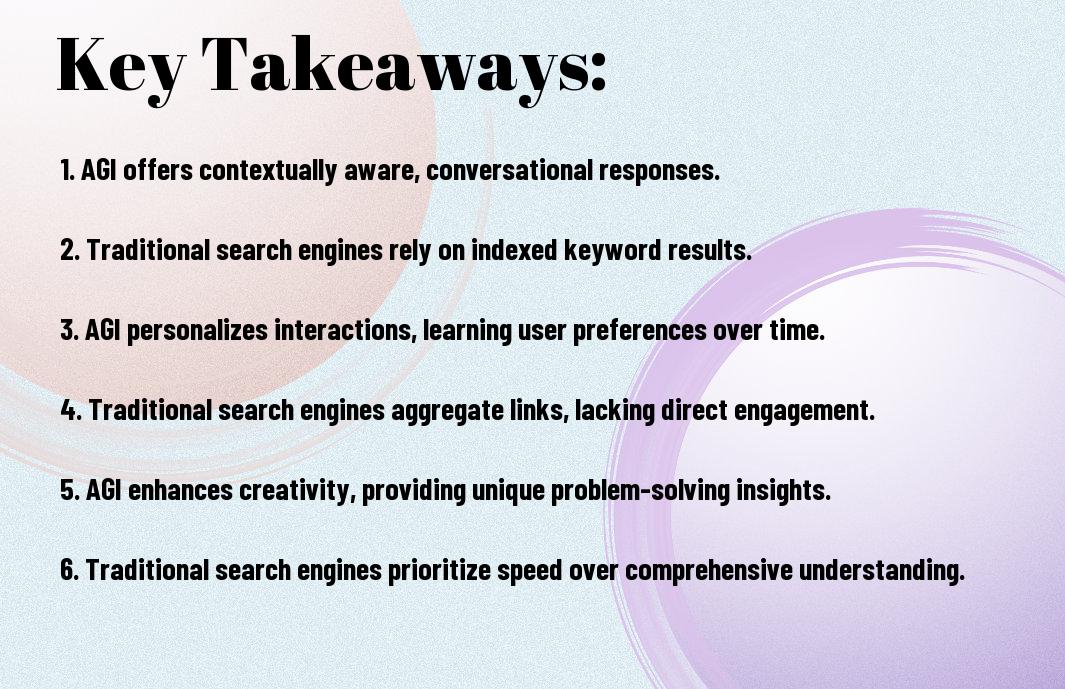
  • AGI (Artificial General Intelligence) has the potential to revolutionize the way we interact with search engines, offering more personalized and accurate results compared to traditional search engines, which rely on algorithms and keyword matching.
  • The impact of AGI on search engines will likely lead to a shift from simple information retrieval to more complex tasks such as question answering, sentiment analysis, and decision-making, enabling users to gain deeper insights and make more informed decisions.
  • The integration of AGI with traditional search engines will also raise important questions about data privacy, bias, and accountability, highlighting the need for developers and policymakers to address these concerns and ensure that the benefits of AGI are realized while minimizing its risks.
Evolution of Search Technology

While exploring the landscape of search technology, you’ll notice significant advancements over the years, transforming the way you access and process information, with traditional search engines being the precursor to more advanced systems.

Traditional Search Engine Architecture

The traditional search engine architecture relies on complex algorithms and keyword indexing to retrieve relevant results, allowing you to find information based on your search queries, but with limitations in understanding context and intent.

AGI-Powered Search Systems

Architecturally, AGI-powered search systems are designed to mimic human-like intelligence, enabling you to interact with search engines in a more natural and intuitive way, using techniques such as natural language processing to understand your search intent.

Consequently, as you probe deeper into AGI-powered search systems, you’ll discover that they can learn and adapt to your search behavior, providing more personalized and accurate results, and even anticipating your information needs, thereby revolutionizing your search experience and redefining the way you interact with search engines.

Core Operational Differences

Any analysis of AGI and traditional search engines must consider their distinct operational frameworks. You will notice that AGI operates on a more complex, integrated level, while traditional search engines rely on indexed databases and algorithms.

Information Processing Methods

Processing information is the foundation of both AGI and traditional search engines, but you will find that AGI’s methods are more dynamic, incorporating various data sources and learning from interactions.

Learning and Adaptation Capabilities

Differences in learning and adaptation are significant, as AGI can evolve based on user behavior and new data, whereas traditional search engines rely on pre-defined algorithms and periodic updates, limiting your search experience.

At the heart of AGI’s learning and adaptation capabilities lies its ability to analyze your search patterns, understand context, and adjust its responses accordingly, providing you with more accurate and personalized results over time, which enhances your overall search experience.

Search Result Quality

All search engines aim to provide you with the most relevant results, but AGI and traditional search engines differ in their approach. You will notice a significant difference in the quality of search results when using these two types of search engines.

Accuracy and Relevance Metrics

By analyzing various metrics, you can evaluate the accuracy and relevance of search results. You will find that AGI-powered search engines often outperform traditional ones in terms of precision and recall, providing you with more accurate results.

Context Understanding

For instance, when you search for something, you expect the search engine to understand the context of your query. You want the search engine to provide results that are relevant to your specific needs, taking into account the nuances of your search query.

Hence, as you explore deeper into the capabilities of AGI-powered search engines, you will discover that they can understand the context of your search query much better than traditional search engines. You will be able to get more personalized and relevant results, making your search experience more efficient and effective, allowing you to find what you need quickly and easily.

User Experience Impact

Once again, you will notice a significant difference in the user experience when comparing AGI to traditional search engines, as AGI provides more intuitive and personalized results, allowing you to find what you’re looking for more efficiently.

Interface and Interaction Models

Around the time you start using AGI, you’ll realize that its interface is more conversational and interactive, enabling you to refine your search queries and receive more accurate results, making your search experience more engaging and effective.

Personalization Capabilities

Interacting with AGI, you’ll discover that its personalization capabilities are more advanced, allowing you to receive tailored results based on your search history and preferences, making your search experience more relevant and useful to you.

The personalization capabilities of AGI also enable you to have a more seamless and integrated search experience, as it can learn your habits and adapt to your needs over time, providing you with more accurate and relevant results, and ultimately saving you time and effort in finding what you’re looking for.

Economic Implications

Despite the potential benefits of AGI, you will need to consider its economic implications, as it may significantly impact your business and investments.

Market Disruption Potential

Around the time AGI is implemented, you can expect significant changes in the market, affecting your search engine usage and online interactions.

Business Model Transformation

About the time you start using AGI, you will notice a shift in business models, as companies adapt to the new technology and its capabilities.

Disruption in traditional business models will force you to rethink your strategies, as AGI changes the way you interact with customers and provide services, ultimately affecting your revenue streams and requiring you to innovate and adapt to stay competitive.

Societal Considerations

Not surprisingly, the rise of AGI and traditional search engines has significant implications for your daily life. You can learn more about Comparing AI Search Engines And Traditional Browsers to understand the differences.

Privacy and Data Handling

Before plunging into the specifics, you should consider how your personal data is handled by these search engines, and how it may impact your online security.

Information Access Equality

Considerations about equal access to information are imperative when evaluating AGI and traditional search engines, as you want to ensure that everyone has a fair chance to access the information they need.

Consequently, you will find that AGI search engines can provide more personalized results, but may also perpetuate existing biases, whereas traditional search engines offer a more standardized experience, but may not account for individual differences, affecting your ability to access relevant information.

Final Words

Taking this into account, you now have a deeper understanding of the impacts of AGI and traditional search engines. Your analysis has shown that AGI offers more personalized and efficient results, while traditional search engines provide a broader scope of information. As you consider your options, you can see that AGI is revolutionizing the way you search and interact with information, making it an crucial tool for your future inquiries. Your choice between AGI and traditional search engines will depend on your specific needs and preferences.

FAQ

Q: What is the primary difference between AGI and traditional search engines in terms of their approach to information retrieval?

A: The primary difference between AGI (Artificial General Intelligence) and traditional search engines lies in their approach to information retrieval. Traditional search engines rely on keyword-based searches, using algorithms to match search queries with relevant web pages. In contrast, AGI-powered search engines use natural language processing and machine learning to understand the context and intent behind a search query, providing more accurate and personalized results.

Q: How do AGI and traditional search engines differ in their ability to handle complex search queries?

A: AGI-powered search engines have the ability to handle complex search queries more effectively than traditional search engines. AGI can understand the nuances of human language, including idioms, metaphors, and context-dependent expressions, allowing it to provide more accurate results for complex queries. Traditional search engines, on the other hand, may struggle with complex queries, relying on keyword matching rather than true understanding.

Q: What are the implications of AGI on the user experience compared to traditional search engines?

A: The implications of AGI on the user experience are significant. AGI-powered search engines can provide users with more relevant and personalized results, reducing the need for multiple searches and clicks. Additionally, AGI can learn a user’s preferences and adapt to their behavior over time, providing a more tailored experience. Traditional search engines, while improving, still often require users to sift through numerous results to find what they are looking for.

Q: How do AGI and traditional search engines impact the way businesses and organizations approach search engine optimization (SEO)?

A: The impact of AGI on SEO is substantial. With AGI-powered search engines, businesses and organizations will need to focus on creating high-quality, contextually relevant content that resonates with their target audience. Traditional SEO tactics, such as keyword stuffing and link schemes, may become less effective as AGI-powered search engines prioritize user experience and relevance over technical optimization. Traditional search engines, while still requiring some level of optimization, are more forgiving of these tactics.

Q: What are the potential long-term consequences of widespread adoption of AGI-powered search engines compared to traditional search engines?

A: The potential long-term consequences of widespread adoption of AGI-powered search engines are far-reaching. AGI could fundamentally change the way we interact with information, enabling more efficient and effective discovery of knowledge. Additionally, AGI-powered search engines could lead to new opportunities for businesses and organizations to connect with their audiences, driving innovation and growth. However, there are also concerns about the potential for AGI to exacerbate existing biases and inequalities, highlighting the need for careful consideration and regulation as these technologies continue to evolve.

Future-Proofing Your Queries – How AGI Will Reshape How We Search

As you navigate the ever-evolving digital landscape, your search habits are about to undergo a significant transformation. With the emergence of Artificial General Intelligence (AGI), the way you retrieve information will become more efficient and intuitive. You will need to adapt your query strategies to maximize the potential of AGI-powered search engines, and this blog post will guide you through the process, helping you to stay ahead of the curve and make the most of this revolutionary technology.

Key Takeaways:

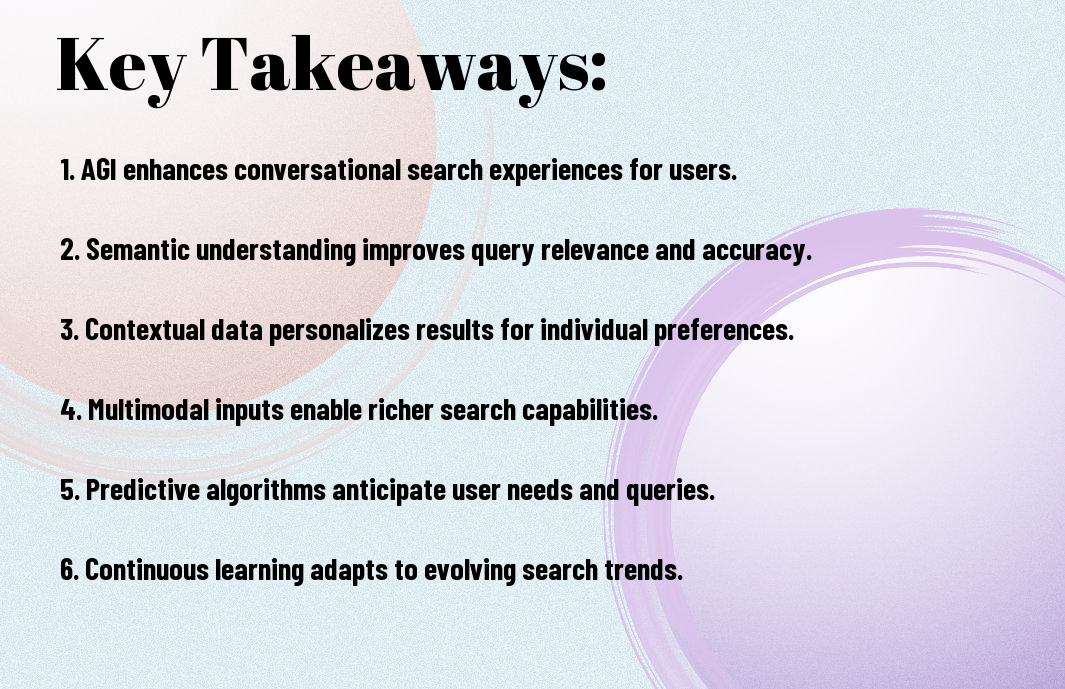
  • The development of Artificial General Intelligence (AGI) is expected to significantly impact the way we search for information, with potential advancements in natural language processing and query understanding, enabling more accurate and relevant search results.
  • As AGI integrates with search systems, it may lead to a shift from keyword-based searches to more conversational and intuitive query methods, allowing users to ask complex questions and receive personalized responses.
  • To prepare for this future, it’s important to consider how AGI will influence search behaviors and adapt strategies to leverage its capabilities, such as using more nuanced and context-specific queries to retrieve relevant information.

    Evolution of Search Behavior

    Your search behavior is about to undergo a significant transformation with the advent of Artificial General Intelligence (AGI). You will soon be able to interact with search engines in a more intuitive and natural way.

    Traditional Keyword-Based Queries

    Queries have long been the foundation of search, relying on specific keywords to yield relevant results. You have likely used this method countless times, but it has its limitations, often failing to capture the nuances of your intent.

    Natural Language Processing Revolution

    One of the most significant advancements in search technology is the integration of Natural Language Processing (NLP). You will be able to ask questions and receive answers in a more human-like conversation, making your search experience more efficient and effective.

    To fully leverage the potential of NLP, you need to understand how it enables search engines to comprehend the context and intent behind your queries. You can then use this knowledge to craft more effective searches, getting the information you need quickly and accurately, and making the most of the search revolution brought about by AGI.

    AGI’s Impact on Search Mechanics

    One of the significant effects of Artificial General Intelligence (AGI) on search mechanics is the ability to understand your intent and provide personalized results. As you explore the possibilities of AGI, you can learn more about Future-Proofing Higher Education and its implications on your search queries.

    Contextual Understanding

    Besides the ability to process vast amounts of data, AGI will enable your search queries to be understood in context, allowing for more accurate results and a more efficient search experience.

    Predictive Query Formation

    Contextually, AGI will be able to anticipate your search queries, providing suggestions and auto-completing your searches to save you time and effort.

    In fact, as you begin to use AGI-powered search engines, you will notice that your search queries become more efficient and effective, allowing you to find the information you need quickly and easily, and enabling you to make the most of your time and your searches.

    Semantic Search Transformation

    Many experts predict that AGI will revolutionize the way you search for information. As you prepare for this shift, consider learning How to future-proof your digital presence in the era of AI-powered search to stay ahead. This will help you understand how to optimize your online presence for the future of search.

    Intent Recognition

    With the rise of AGI, you will see a significant improvement in intent recognition, allowing search engines to better understand your search queries and provide more accurate results. This means you will get more relevant information, faster.

    Multi-Modal Search Integration

    An crucial aspect of semantic search transformation is the integration of multi-modal search, enabling you to search using various modes such as voice, text, and images. This will make it easier for you to find what you’re looking for, using your preferred method.

    Intent is key when it comes to multi-modal search integration, as you will be able to search using natural language, and the search engine will understand your intent behind the search query, providing you with more accurate and relevant results, and enhancing your overall search experience.

    Personal Search Ecosystems

    To stay ahead, you’ll need to adapt to the changing search landscape, and you can start by exploring resources like Thriving in the AI Age: A Guide to Future-Proofing Your Career Plan, which can help you navigate the future of search.

    Adaptive Learning Profiles

    Personally, you will have more control over your search experience with adaptive learning profiles, which will learn your preferences and adjust search results accordingly, allowing you to find relevant information more efficiently.

    Privacy-Conscious Personalization

    Personably, you will have more autonomy over your personal data with privacy-conscious personalization, which prioritizes your security and anonymity while still providing tailored search results.

    The level of personalization in privacy-conscious personalization will depend on your willingness to share data, and you will have the ability to adjust your settings to balance personalization with privacy, giving you more control over your search experience and allowing you to make informed decisions about your data.

    Cross-Platform Query Intelligence

    Keep in mind that future query systems will need to seamlessly integrate across various platforms, allowing you to access information effortlessly, regardless of the device or interface you use.

    Universal Search Protocols

    To achieve this, universal search protocols will be developed, enabling your queries to be understood and processed consistently across different platforms, ensuring a unified search experience.

    Device-Agnostic Responses

    Seeking information will become more intuitive as device-agnostic responses are designed to provide you with relevant results, regardless of the device you’re using, making your search experience more efficient and personalized.

    The device-agnostic responses will also take into account your past searches, location, and preferences, allowing you to receive tailored results that meet your specific needs, and as you interact with these systems, you will notice a significant improvement in the accuracy and relevance of the information you receive, making your overall search experience more enjoyable and productive.

    Human-AGI Search Collaboration

    Once again, you will find yourself at the forefront of a revolution, as AGI transforms the way you search for information, enabling more efficient and effective query resolution, and you will be able to leverage AGI’s capabilities to enhance your search experience.

    Interactive Refinement

    Across various domains, you will be able to engage with AGI systems to refine your search queries, allowing for more precise and relevant results, and you will be able to iteratively improve your search outcomes through this collaborative process.

    Knowledge Co-Creation

    Beside the advancements in search refinement, you will also be able to co-create knowledge with AGI systems, generating new insights and perspectives that were previously unimaginable, and you will be able to harness the power of AGI to augment your own knowledge and understanding.

    Even as you explore the possibilities of knowledge co-creation with AGI, you will begin to realize the vast potential for innovation and discovery that this collaboration enables, and you will be able to apply this newfound knowledge to drive progress in your own field, leading to breakthroughs and advancements that would have been impossible without the aid of AGI.

    To wrap up

    From above, you can see that future-proofing your queries is necessary. As you prepare for the impact of AGI on search, you will need to adapt your strategies. You will have to consider how AGI will reshape the way you search and interact with information. By understanding these changes, you can position yourself for success and make the most of the opportunities that AGI will bring to your search capabilities. You will be able to navigate the future of search with confidence.

    FAQ

    Q: What is the impact of Artificial General Intelligence (AGI) on the way we search for information?

    A: The integration of AGI into search systems is expected to revolutionize the way we query and interact with information. AGI-powered search engines will be able to understand the context and intent behind a query, providing more accurate and personalized results. This will enable users to find relevant information more efficiently, and also discover new information that they may not have found otherwise.

    Q: How will AGI change the way we formulate our queries?

    A: With AGI, users will no longer need to rely on keyword-based searches. Instead, they will be able to ask more complex and nuanced questions, using natural language to convey their intent. AGI-powered search engines will be able to understand the subtleties of human language, allowing users to ask follow-up questions and engage in a more conversational search experience.

    Q: What are the benefits of using AGI-powered search engines for future-proofing our queries?

    A: The benefits of using AGI-powered search engines include improved accuracy, increased efficiency, and enhanced user experience. AGI-powered search engines will be able to learn and adapt to changing user behavior and preferences, ensuring that search results remain relevant and up-to-date. Additionally, AGI will enable search engines to provide more comprehensive and insightful results, helping users to make more informed decisions.

    Q: How will AGI handle ambiguous or unclear queries?

    A: AGI-powered search engines will be able to handle ambiguous or unclear queries by using machine learning algorithms to clarify the user’s intent. AGI will analyze the context of the query, including the user’s search history and preferences, to provide more accurate and relevant results. If the query is still unclear, AGI will be able to ask follow-up questions to clarify the user’s intent, ensuring that the user receives the most relevant and accurate results possible.

    Q: What are the potential risks and challenges associated with relying on AGI-powered search engines?

    A: While AGI-powered search engines offer many benefits, there are also potential risks and challenges associated with their use. These include concerns around data privacy and security, as well as the potential for biased or inaccurate results. Additionally, there is a risk that AGI-powered search engines could become overly reliant on machine learning algorithms, leading to a lack of transparency and accountability in the search process. To mitigate these risks, it is vital to develop and implement robust guidelines and regulations for the development and use of AGI-powered search engines.

Feel Free To Use Or Modify Any Of These Headlines For Your Blog!

You’re about to discover a treasure trove of headlines that you can use or modify to elevate your blog posts. Your blog deserves attention-grabbing titles that drive engagement and boost traffic. You’ll find a variety of options to suit your style and tone, helping you to craft compelling headlines that resonate with your audience and set your blog up for success. You can use them as is or tweak them to fit your unique voice and brand.

Key Takeaways:

  • The statement “Feel Free To Use Or Modify Any Of These Headlines For Your Blog!” suggests that the provided headlines are open-source and can be utilized by bloggers without any copyright restrictions, allowing for flexibility and customization to fit their content needs.
  • By offering the freedom to modify headlines, bloggers can personalize their titles to better match their writing style, tone, and audience, potentially increasing engagement and readability of their blog posts.
  • This approach promotes creativity and collaboration, as bloggers can build upon existing headline ideas, adapt them to their niche, and share their own modified versions, contributing to a community-driven exchange of ideas and inspiration.

The Art of Headline Crafting

Your headlines are the first thing your readers see, and they can make or break your content’s success. You need to craft them carefully to grab attention and entice readers to click. A well-crafted headline can increase engagement, boost conversions, and set your content apart from the competition.

Power Words That Grab Attention

By incorporating power words into your headlines, you can create a lasting impression on your readers. You can use action verbs, emotional triggers, and persuasive language to make your headlines more compelling and attention-grabbing, helping you to stand out in a crowded online space.

Creating Emotional Connections

Linking your headlines to your readers’ emotions can be an effective way to create a connection. You can use words that evoke feelings of excitement, curiosity, or nostalgia to make your headlines more relatable and engaging, allowing you to build a stronger bond with your audience.

Plus, when you create emotional connections with your headlines, you can increase the chances of your content being shared, liked, and commented on. You can use storytelling techniques, questions, or personal anecdotes to make your headlines more personal and emotive, helping you to build trust and credibility with your readers, and ultimately driving more traffic to your blog.

Headline Formulas That Work

If you’re looking to craft compelling headlines, you’ll want to explore proven formulas that drive engagement. You can use these formulas to create attention-grabbing headlines that resonate with your audience.

Numbers and Lists

Around the web, you’ll find numerous examples of effective headlines that incorporate numbers and lists, making it easy for you to follow suit and create your own.

Problem-Solution Format

Headline writers often use the problem-solution format to create compelling headlines that speak directly to your audience’s needs, offering solutions to their problems.

Consequently, as you use the problem-solution format, you’ll find that your headlines become more effective at capturing attention and driving engagement, helping you to better connect with your target audience and achieve your goals.

Engaging Your Audience

Unlike traditional marketing methods, crafting compelling headlines can significantly boost your blog’s visibility. You can find inspiration for your headlines on platforms like 9 Types of Blog Headlines/Titles That Hook Like Crazy in 2025, which can help you create captivating titles.

Question-Based Headlines

On the other hand, using question-based headlines can pique your readers’ interest and encourage them to click on your blog post to find the answer.

Making Bold Statements

Your headlines can also make bold statements to grab attention and entice your audience to learn more about your blog post.

Plus, making bold statements in your headlines allows you to showcase your confidence and expertise in your subject matter, which can help establish your authority and build trust with your readers, making them more likely to engage with your content and share it with others.

Headline Optimization

All successful bloggers understand the importance of crafting compelling headlines that capture their audience’s attention. You can boost your blog’s visibility by optimizing your headlines, making them more appealing and effective.

SEO-Friendly Approaches

For instance, incorporating relevant keywords into your headlines can significantly improve your blog’s search engine ranking, allowing you to reach a wider audience and increase your online presence, as you tailor your content to meet your readers’ needs.

Character Length and Readability

About the length and readability of your headlines, you should consider the balance between conveying your message and keeping it concise, ensuring your headlines are easy to read and understand, making it simpler for your audience to engage with your content.

Hence, as you focus on optimizing the character length and readability of your headlines, you will find that your audience is more likely to click on your blog posts, and your overall engagement will increase, allowing you to achieve your blogging goals more effectively, and you will be able to adjust your strategy accordingly to better suit your audience’s preferences.

Common Headline Mistakes

After crafting your headlines, take a moment to evaluate their effectiveness. You can learn from others, such as Blogging by Numbers: How to Create Headlines That Get Retweeted, to improve your skills.

Avoiding Clickbait

Against the temptation to use sensational headlines, you should prioritize honesty and clarity in your titles, ensuring they accurately reflect the content of your blog post.

Maintaining Authenticity

At the heart of a successful headline is authenticity, which you can achieve by using your unique voice and style, making your headlines stand out from the crowd.

The key to maintaining authenticity in your headlines is to stay true to your brand’s tone and language, avoiding the use of overly promotional or generic phrases that can make your headlines seem insincere, and instead, focusing on creating titles that resonate with your target audience and reflect the value you offer.

Testing and Refining

Despite the importance of creating a great headline, it’s not a one-time task. You will need to test and refine your headlines to ensure they are effective.

A/B Testing Methods

On the other hand, you can use A/B testing methods to compare two different headlines and see which one performs better. You can use this method to test different variables, such as wording, length, and tone.

Analytics and Performance

About your blog’s performance, you can use analytics tools to track the effectiveness of your headlines. You can see which headlines are getting the most clicks, shares, and engagement.

But as you research deeper into analytics, you will discover that there is more to it than just tracking numbers. You can use analytics to identify patterns, trends, and correlations between your headlines and your audience’s behavior, allowing you to make data-driven decisions to improve your headlines and increase your blog’s overall performance.

Final Words

Taking this into account, you can now confidently use or modify any of these headlines for your blog. You have the freedom to pick the ones that best fit your content and style. Your blog will surely benefit from these attention-grabbing headlines, and you will be able to attract more readers and increase engagement. You can experiment with different options to find what works best for your audience and your brand.

FAQ

Q: What is the purpose of providing these headlines for my blog?

A: The purpose of providing these headlines is to assist you in creating engaging and attention-grabbing titles for your blog posts. These headlines are designed to be informative, entertaining, and relevant to your target audience, helping to increase reader engagement and drive more traffic to your blog.

Q: Can I modify the headlines to fit my specific blog’s tone and style?

A: Absolutely, you are encouraged to modify the headlines to fit the unique tone and style of your blog. The headlines are meant to be starting points, and you can adjust the wording, length, and tone to best suit your blog’s voice and audience. This will help ensure that the headlines align with your brand and resonate with your readers.

Q: Are the headlines suitable for all types of blogs and niches?

A: While the headlines are designed to be versatile, they may be more suitable for certain types of blogs and niches than others. You can browse through the headlines and select the ones that best fit your blog’s topic and audience. If you need more specific or customized headlines, you can also use the provided headlines as inspiration to create your own unique titles.

Q: How can I use these headlines to improve my blog’s search engine optimization (SEO)?

A: Using the provided headlines can help improve your blog’s SEO by incorporating relevant keywords and phrases that your target audience is searching for. By including these keywords in your headlines, you can increase the visibility of your blog posts in search engine results, driving more organic traffic to your site. Additionally, you can use the headlines as a starting point to create meta descriptions and optimize your blog post’s meta tags.

Q: Are there any limitations or restrictions on using these headlines for my blog?

A: No, there are no limitations or restrictions on using these headlines for your blog. You are free to use, modify, and distribute the headlines as you see fit, without any attribution or permission required. The headlines are provided as a resource to help you create engaging and effective blog titles, and you can use them in any way that benefits your blog and audience.

Creating Intelligent Apps – A Beginner’s Guide to AI Integration

As you initiate on building innovative applications, you’re likely considering how to harness the power of artificial intelligence to enhance your app’s capabilities. You want your app to learn, adapt, and interact with users in a more intelligent way. With AI integration, you can unlock new features and functionalities that set your app apart from the rest. In this guide, you’ll discover the fundamentals of AI integration and how to get started with creating intelligent apps that transform your users’ experience.

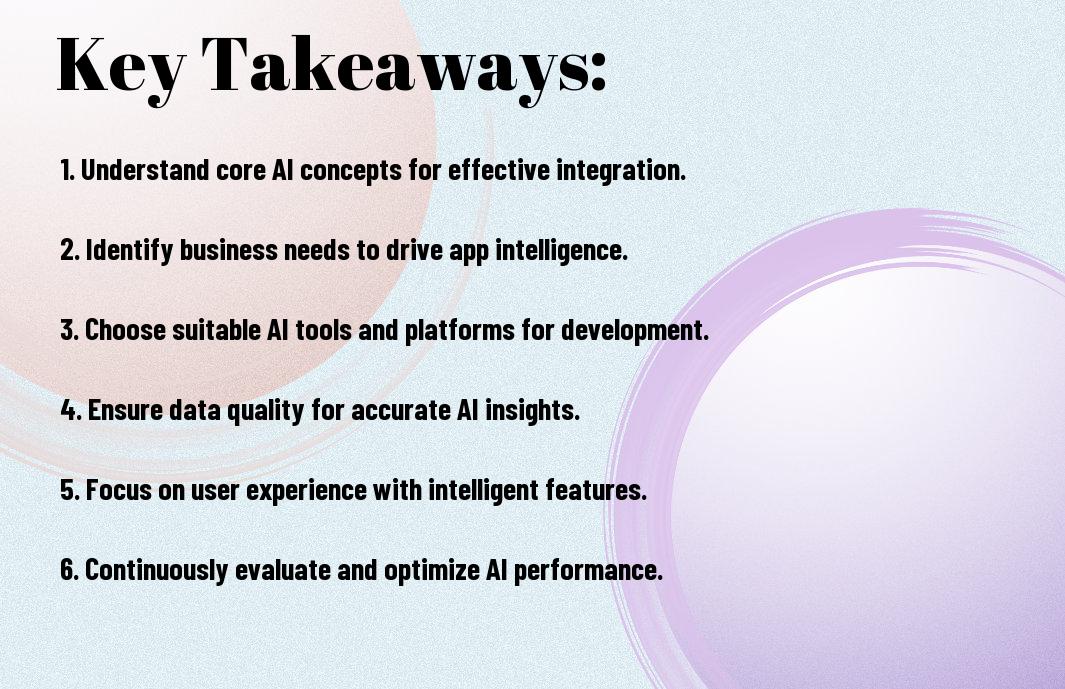
Key Takeaways:

  • Understanding the basics of Artificial Intelligence (AI) and its applications is vital for creating intelligent apps that can learn, adapt, and interact with users in a more human-like way.
  • Identifying the right AI technology, such as machine learning or natural language processing, is vital to achieving the desired functionality and user experience in an app.
  • Integrating AI into an app requires a strategic approach, including data collection, model training, and testing to ensure the AI system is accurate and reliable.
  • Developers should consider the ethical implications of AI integration, including data privacy, security, and bias, to build trust with users and maintain a positive reputation.
  • Staying up-to-date with the latest advancements in AI and continuously monitoring user feedback is necessary to improve and refine the AI-powered features in an app over time.

Foundations of AI in Modern Applications

Your journey to creating intelligent apps begins with understanding the basics of AI and its role in modern applications, where you’ll discover how AI enhances user experience and improves performance.

Core AI Components for Apps

At the heart of AI integration are components such as natural language processing, computer vision, and predictive analytics, which you can leverage to build innovative features into your apps.

Essential Machine Learning Models

To develop intelligent apps, you’ll need to familiarize yourself with machine learning models like decision trees, neural networks, and clustering algorithms, which enable your apps to learn from data and make informed decisions.

With a solid grasp of these important machine learning models, you can create apps that analyze user behavior, provide personalized recommendations, and automate tasks, ultimately enhancing the overall user experience and setting your apps apart from the competition, as you examine deeper into the world of AI integration, you’ll find that machine learning models are the backbone of intelligent apps, allowing you to build sophisticated features that drive engagement and loyalty.

Planning Your AI Integration

While planning your AI integration, you need to consider several factors that will impact your project’s success. You must evaluate your goals, identify potential challenges, and develop a strategy to overcome them.

Project Requirements Assessment

On the path to integrating AI, you will need to assess your project requirements, determining what features and functionalities you want to implement, and what data you will need to support them. You should consider your target audience, their needs, and how AI can enhance their experience.

Resource Allocation Strategy

Integrating AI into your app requires a well-thought-out resource allocation strategy, where you will need to decide how to allocate your resources, including budget, personnel, and technology, to ensure successful AI integration. You should consider your available resources and prioritize your needs.

Hence, as you develop your resource allocation strategy, you will need to consider the skills and expertise of your team, the cost of AI tools and technologies, and the potential return on investment. You should also consider the time and effort required to integrate AI into your app, and plan accordingly to ensure a smooth and successful implementation.

Development Environment Setup

Despite the complexity of AI integration, setting up your development environment is straightforward. You can start by exploring resources like BUILD YOUR OWN AI: A Beginner’s Guide to Creating Intelligent Apps to get familiar with the process. This will help you understand the basics of AI development and prepare your environment for integration.

Required Tools and Frameworks

Encompassing the right tools and frameworks is crucial for your AI project. You will need to choose a suitable programming language, such as Python or Java, and select appropriate libraries and frameworks to support your AI model development.

API Configurations

Once you have set up your environment, one of the next steps is to configure your API. You will need to decide on the API endpoints, data formats, and authentication methods to ensure seamless communication between your app and the AI model.

The API configuration process involves defining the interface through which your app will interact with the AI model. You will need to consider factors such as data security, scalability, and performance to ensure your API is robust and reliable. As you proceed with the configuration, you will be able to integrate your AI model with your app, enabling it to make intelligent decisions and provide personalized experiences for your users.

Building Smart Features

Once again, you’ll need to consider the type of features that will make your app intelligent, such as machine learning, natural language processing, and predictive analytics, to create a seamless user experience.

Natural Language Processing Implementation

On the path to creating intelligent apps, you will encounter various tools and techniques, including natural language processing, which enables your app to understand and generate human-like text or speech, allowing you to build conversational interfaces.

Predictive Analytics Integration

About the time you start integrating predictive analytics, you will be able to forecast user behavior, preferences, and needs, enabling you to make data-driven decisions and create personalized experiences for your users.

Natural progression of your app’s development will lead you to explore deeper into predictive analytics, where you can leverage machine learning algorithms to analyze user data, identify patterns, and make predictions about future behavior, allowing you to optimize your app’s performance, improve user engagement, and increase conversions, ultimately enhancing your overall user experience.

Data Management

Not all data is created equal, and you need to understand how to manage it effectively to create intelligent apps. You will need to collect, store, and process large amounts of data to train your AI models.

Training Data Organization

With well-organized training data, you can develop more accurate AI models. You should categorize and label your data to ensure it is easily accessible and usable for your models.

Real-time Data Processing

Any delay in processing data can affect the performance of your app, and you need to ensure that your system can handle real-time data processing. You should consider using streaming data processing tools to handle high-volume data streams.

Further, to achieve real-time data processing, you will need to invest in a robust infrastructure that can handle large amounts of data. You should consider using cloud-based services or distributed computing systems to process data in real-time, enabling your app to respond quickly to user inputs and changing conditions.

Testing AI Functionality

To ensure your AI-integrated app functions as intended, thorough testing is necessary. You will need to verify that the AI components are working correctly and providing accurate results.

Performance Metrics

After establishing a testing framework, you can begin to evaluate your app’s performance using key metrics such as accuracy, precision, and recall. You will use these metrics to identify areas for improvement and optimize your AI functionality.

User Experience Validation

Beside technical performance, you must also validate that your app provides a seamless user experience. You will need to test how users interact with the AI-powered features and gather feedback to inform future improvements.

This user experience validation process involves observing how your app’s AI functionality impacts the overall user journey, from onboarding to achieving the desired outcome. You will want to assess whether the AI-driven features are intuitive, responsive, and aligned with your users’ expectations, allowing you to refine your app and create a more engaging experience for your target audience.

Final Words

To wrap up, you now have a solid foundation in creating intelligent apps with AI integration. You have learned the basics of AI and how to implement them in your applications. With this knowledge, you can enhance your app’s capabilities, making it more engaging and user-friendly. As you move forward, you will be able to develop innovative solutions, leveraging AI to improve your users’ experience and take your app to the next level, making your development journey more efficient and successful.

FAQ

Q: What are the basic requirements for creating intelligent apps with AI integration?

A: To create intelligent apps with AI integration, you need to have a good understanding of programming languages such as Python, Java, or C++. Additionally, you should be familiar with machine learning frameworks like TensorFlow or PyTorch, and have a basic knowledge of data structures and algorithms. You will also need a computer with a decent processor, RAM, and storage to handle the computational demands of AI models. Furthermore, it’s imperative to have a dataset relevant to your app’s purpose to train and test your AI models.

Q: How do I choose the right AI framework for my intelligent app?

A: Choosing the right AI framework depends on your app’s specific needs, your team’s expertise, and the type of AI model you want to implement. For example, if you’re building a computer vision-based app, you might choose OpenCV, while for natural language processing tasks, you might opt for NLTK or spaCy. You should also consider factors like the framework’s compatibility with your chosen programming language, its scalability, and the size of its community, which can be an indicator of the availability of resources and support. It’s also a good idea to experiment with different frameworks to see which one works best for your specific use case.

Q: What are some common challenges faced during AI integration in app development, and how can I overcome them?

A: Some common challenges faced during AI integration include data quality issues, model accuracy, and scalability. To overcome these challenges, it’s imperative to ensure that your dataset is diverse, well-labeled, and sufficiently large. You should also monitor your model’s performance regularly and fine-tune it as needed. Additionally, consider using cloud-based services like Google Cloud AI Platform or Amazon SageMaker, which provide scalable infrastructure and pre-built AI models to simplify the integration process. It’s also important to stay up-to-date with the latest developments in the field of AI and to be patient, as AI integration can be a complex and time-consuming process that requires careful planning and execution.

How to Integrate AI Models into Your Mobile Application

You’re looking to enhance your mobile application with artificial intelligence, and you want to know where to start. Integrating AI models can seem complex, but with the right approach, you can unlock new capabilities and improve user experience. As you begin on this journey, you’ll need to consider your application’s specific needs and choose the right AI models to achieve your goals, and this post will guide you through the process, helping you make informed decisions about your AI integration strategy.

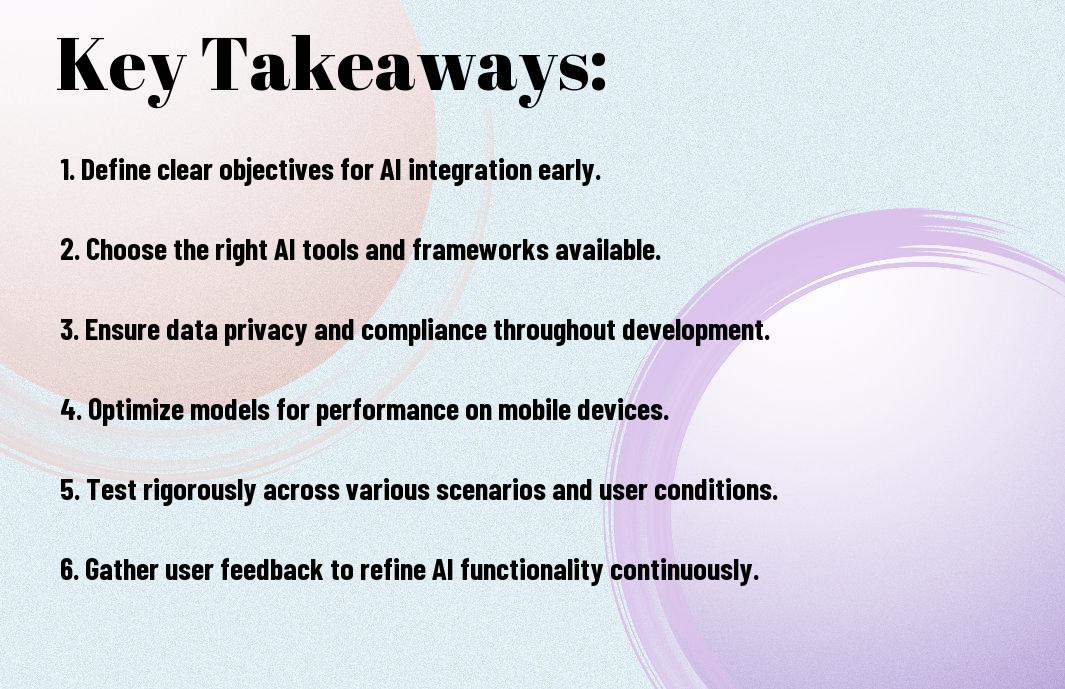
Key Takeaways:

  • Define the purpose and scope of AI integration in your mobile application to determine the type of AI model needed and ensure alignment with your app’s goals and functionality.
  • Choose the right AI framework and tools, such as TensorFlow or Core ML, to develop and deploy AI models that are compatible with your mobile platform and meet performance requirements.
  • Design a user-friendly interface to interact with AI models, providing clear instructions and feedback to users, and ensuring a seamless experience that enhances the overall app usability.
  • Address data privacy and security concerns by implementing robust data protection measures, such as encryption and access controls, to safeguard user data used for AI model training and inference.
  • Continuously monitor and update AI models to improve their accuracy and performance, using techniques such as model retraining and updates, to ensure the AI-powered features remain effective and relevant over time.

AI Model Selection

To integrate AI into your mobile application, you need to select the right model. You can learn more about this process in our article How to Integrate AI into Your App: 7 Steps Guide, which provides a comprehensive overview of the integration process.

Popular Mobile AI Frameworks

The most popular frameworks for mobile AI development are TensorFlow, Core ML, and ML Kit, which offer a range of tools and resources to help you build and deploy AI models in your app.

Model Size and Performance Trade-offs

Mobile app developers often face trade-offs between model size and performance, as larger models can provide more accurate results but may slow down your app.

A key consideration when selecting an AI model is the balance between model size and performance, as you want your app to be responsive and efficient while still providing accurate results, so you need to evaluate your options carefully to choose the best model for your specific use case.

Technical Requirements

While integrating AI models into your mobile application, you’ll need to consider various factors, as outlined in A Complete Guide to How to Integrate AI Into Your App, to ensure seamless execution.

Hardware Specifications

Above all, your device should have sufficient processing power and memory to handle AI-driven tasks, enabling you to run complex models efficiently on your mobile application.

Software Dependencies

For successful integration, you’ll need to install specific software libraries and frameworks that support AI model development, such as TensorFlow or Core ML, to power your mobile application.

Even with the right hardware and software in place, you’ll still need to ensure that your development environment is properly configured to handle the unique demands of AI model integration, which may involve installing additional tools and plugins to support tasks like model training and testing, allowing you to effectively integrate AI into your mobile application.

Implementation Process

After selecting the AI model, you can proceed with integrating it into your mobile application, which involves several steps that you need to follow carefully to ensure seamless functionality.

Model Preparation

Beneath the surface of your application, you need to prepare your AI model by training and testing it with relevant data to ensure it provides accurate results and integrates well with your app’s existing infrastructure.

API Integration

Meanwhile, you will need to integrate your AI model with your application’s API, which allows you to access the model’s functionality and retrieve results, enabling you to leverage the power of AI in your mobile app.

Another important aspect of API integration is handling requests and responses, as you will need to send input data to the AI model and receive output data, which you can then use to update your application’s UI and provide a seamless user experience, and you should consider using established APIs and frameworks to simplify this process and ensure your application is scalable and maintainable.

Performance Optimization

Not all AI models are created equal, and optimizing their performance is key to a seamless user experience in your mobile application.

Model Compression Techniques

Betwixt the various methods available, you’ll find that model pruning and quantization can significantly reduce the size of your AI models, making them more efficient for mobile use.

Memory Management

Modeled after the principles of efficient data handling, you’ll want to ensure that your application’s memory usage is optimized to prevent crashes and slow performance.

Plus, by implementing strategies such as caching and lazy loading, you can further improve your application’s memory management, allowing your users to enjoy a smoother experience when interacting with your AI-powered mobile application, and you can achieve this by carefully monitoring your app’s memory usage and adjusting your strategies accordingly to get the best results for your users.

User Experience Design

All aspects of user experience design must be considered when integrating AI models into your mobile application, as it directly impacts your users’ overall satisfaction and engagement with your app.

Response Time Management

Between the time a user interacts with your app and the time they receive a response, you must optimize the AI model’s processing speed to ensure a seamless experience, as slow response times can lead to frustration and app abandonment.

Interface Adaptation

Around the AI model’s capabilities, you should design an interface that is intuitive and easy to use, allowing your users to easily interact with the AI-powered features and understand the results.

With a well-designed interface, you can enhance your users’ experience and encourage them to explore the AI-driven features of your app, which can lead to increased user engagement and loyalty, as you provide them with a personalized and dynamic experience that meets their needs and expectations.

Security Measures

Once again, as you integrate AI models into your mobile application, you must prioritize security to protect your users’ data and prevent potential threats.

Data Protection

With the increasing use of AI models, you need to ensure that your users’ data is encrypted and stored securely, adhering to strict data protection policies to maintain their trust.

Model Access Control

Driven by the need for security, you should implement access controls to restrict unauthorized access to your AI models, ensuring that only authorized personnel can modify or update them.

Consequently, as you implement model access control, you will be able to monitor and track all changes made to your AI models, allowing you to identify and address any potential security vulnerabilities, and thereby protecting your application and users from potential threats.

Conclusion

As a reminder, you now have the knowledge to integrate AI models into your mobile application. You can leverage AI to enhance your app’s functionality, improving your users’ experience. By following the steps outlined, you will be able to successfully incorporate AI models, making your application more efficient and intelligent, and ultimately, taking your business to the next level with your newly acquired skills.

FAQ

Q: What are the initial steps to integrate AI models into my mobile application?

A: To integrate AI models into your mobile application, start by defining the specific AI functionality you want to implement, such as image recognition, natural language processing, or predictive analytics. Next, choose a suitable AI framework or library that supports your mobile platform, like Core ML for iOS or TensorFlow Lite for Android. Ensure your development team has the necessary skills and expertise in AI and mobile app development. Finally, plan the integration process, considering factors like data privacy, security, and user experience.

Q: How do I select the most appropriate AI model for my mobile application?

A: Selecting the right AI model for your mobile application involves several considerations. First, identify the specific task or problem you want the AI to solve. Then, evaluate different AI models based on their accuracy, complexity, and compatibility with your mobile platform. Consider factors like model size, computational requirements, and power consumption, as these can impact your app’s performance and user experience. You may also need to compare models from different providers or develop your own custom model using machine learning frameworks like TensorFlow or PyTorch. Additionally, ensure the chosen model aligns with your app’s goals and enhances its functionality without compromising security or privacy.

Q: What are the key challenges and considerations when deploying AI models in a mobile application?

A: When deploying AI models in a mobile application, several challenges and considerations arise. One key challenge is ensuring the model’s accuracy and reliability in real-world scenarios, which may involve continuous model training and updates. Another consideration is data privacy and security, as AI models often process sensitive user data. You must implement robust security measures to protect this data and comply with relevant regulations like GDPR or CCPA. Furthermore, optimizing the model for mobile devices is crucial to prevent increased battery consumption, heat generation, or slower performance. Regular testing and user feedback are also vital to identify and address any issues that may arise after the deployment of the AI-powered features.

Skip to content