As you navigate the ever-evolving digital landscape, your search habits are about to undergo a significant transformation. With the emergence of Artificial General Intelligence (AGI), the way you retrieve information will become more efficient and intuitive. You will need to adapt your query strategies to maximize the potential of AGI-powered search engines, and this blog post will guide you through the process, helping you to stay ahead of the curve and make the most of this revolutionary technology.
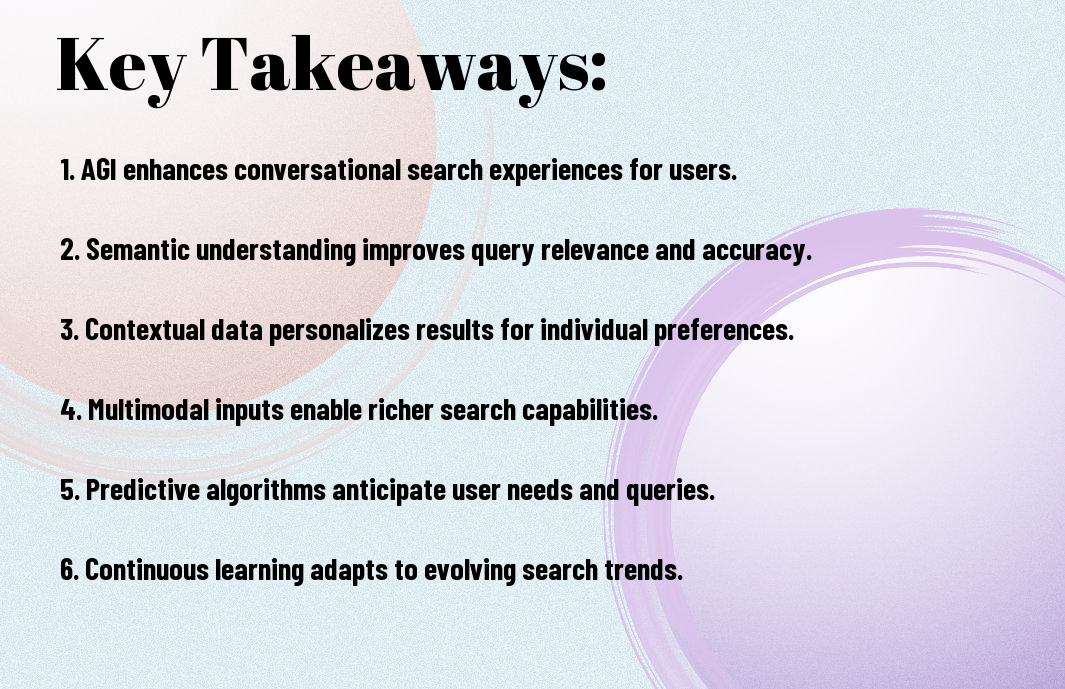
Key Takeaways:
- The development of Artificial General Intelligence (AGI) is expected to significantly impact the way we search for information, with potential advancements in natural language processing and query understanding, enabling more accurate and relevant search results.
- As AGI integrates with search systems, it may lead to a shift from keyword-based searches to more conversational and intuitive query methods, allowing users to ask complex questions and receive personalized responses.
- To prepare for this future, it’s important to consider how AGI will influence search behaviors and adapt strategies to leverage its capabilities, such as using more nuanced and context-specific queries to retrieve relevant information.
Evolution of Search Behavior
Your search behavior is about to undergo a significant transformation with the advent of Artificial General Intelligence (AGI). You will soon be able to interact with search engines in a more intuitive and natural way.
Traditional Keyword-Based Queries
Queries have long been the foundation of search, relying on specific keywords to yield relevant results. You have likely used this method countless times, but it has its limitations, often failing to capture the nuances of your intent.
Natural Language Processing Revolution
One of the most significant advancements in search technology is the integration of Natural Language Processing (NLP). You will be able to ask questions and receive answers in a more human-like conversation, making your search experience more efficient and effective.
To fully leverage the potential of NLP, you need to understand how it enables search engines to comprehend the context and intent behind your queries. You can then use this knowledge to craft more effective searches, getting the information you need quickly and accurately, and making the most of the search revolution brought about by AGI.
AGI’s Impact on Search Mechanics
One of the significant effects of Artificial General Intelligence (AGI) on search mechanics is the ability to understand your intent and provide personalized results. As you explore the possibilities of AGI, you can learn more about Future-Proofing Higher Education and its implications on your search queries.
Contextual Understanding
Besides the ability to process vast amounts of data, AGI will enable your search queries to be understood in context, allowing for more accurate results and a more efficient search experience.
Predictive Query Formation
Contextually, AGI will be able to anticipate your search queries, providing suggestions and auto-completing your searches to save you time and effort.
In fact, as you begin to use AGI-powered search engines, you will notice that your search queries become more efficient and effective, allowing you to find the information you need quickly and easily, and enabling you to make the most of your time and your searches.
Semantic Search Transformation
Many experts predict that AGI will revolutionize the way you search for information. As you prepare for this shift, consider learning How to future-proof your digital presence in the era of AI-powered search to stay ahead. This will help you understand how to optimize your online presence for the future of search.
Intent Recognition
With the rise of AGI, you will see a significant improvement in intent recognition, allowing search engines to better understand your search queries and provide more accurate results. This means you will get more relevant information, faster.
Multi-Modal Search Integration
An crucial aspect of semantic search transformation is the integration of multi-modal search, enabling you to search using various modes such as voice, text, and images. This will make it easier for you to find what you’re looking for, using your preferred method.
Intent is key when it comes to multi-modal search integration, as you will be able to search using natural language, and the search engine will understand your intent behind the search query, providing you with more accurate and relevant results, and enhancing your overall search experience.
Personal Search Ecosystems
To stay ahead, you’ll need to adapt to the changing search landscape, and you can start by exploring resources like Thriving in the AI Age: A Guide to Future-Proofing Your Career Plan, which can help you navigate the future of search.
Adaptive Learning Profiles
Personally, you will have more control over your search experience with adaptive learning profiles, which will learn your preferences and adjust search results accordingly, allowing you to find relevant information more efficiently.
Privacy-Conscious Personalization
Personably, you will have more autonomy over your personal data with privacy-conscious personalization, which prioritizes your security and anonymity while still providing tailored search results.
The level of personalization in privacy-conscious personalization will depend on your willingness to share data, and you will have the ability to adjust your settings to balance personalization with privacy, giving you more control over your search experience and allowing you to make informed decisions about your data.
Cross-Platform Query Intelligence
Keep in mind that future query systems will need to seamlessly integrate across various platforms, allowing you to access information effortlessly, regardless of the device or interface you use.
Universal Search Protocols
To achieve this, universal search protocols will be developed, enabling your queries to be understood and processed consistently across different platforms, ensuring a unified search experience.
Device-Agnostic Responses
Seeking information will become more intuitive as device-agnostic responses are designed to provide you with relevant results, regardless of the device you’re using, making your search experience more efficient and personalized.
The device-agnostic responses will also take into account your past searches, location, and preferences, allowing you to receive tailored results that meet your specific needs, and as you interact with these systems, you will notice a significant improvement in the accuracy and relevance of the information you receive, making your overall search experience more enjoyable and productive.

Human-AGI Search Collaboration
Once again, you will find yourself at the forefront of a revolution, as AGI transforms the way you search for information, enabling more efficient and effective query resolution, and you will be able to leverage AGI’s capabilities to enhance your search experience.
Interactive Refinement
Across various domains, you will be able to engage with AGI systems to refine your search queries, allowing for more precise and relevant results, and you will be able to iteratively improve your search outcomes through this collaborative process.
Knowledge Co-Creation
Beside the advancements in search refinement, you will also be able to co-create knowledge with AGI systems, generating new insights and perspectives that were previously unimaginable, and you will be able to harness the power of AGI to augment your own knowledge and understanding.
Even as you explore the possibilities of knowledge co-creation with AGI, you will begin to realize the vast potential for innovation and discovery that this collaboration enables, and you will be able to apply this newfound knowledge to drive progress in your own field, leading to breakthroughs and advancements that would have been impossible without the aid of AGI.
To wrap up
From above, you can see that future-proofing your queries is necessary. As you prepare for the impact of AGI on search, you will need to adapt your strategies. You will have to consider how AGI will reshape the way you search and interact with information. By understanding these changes, you can position yourself for success and make the most of the opportunities that AGI will bring to your search capabilities. You will be able to navigate the future of search with confidence.
FAQ
Q: What is the impact of Artificial General Intelligence (AGI) on the way we search for information?
A: The integration of AGI into search systems is expected to revolutionize the way we query and interact with information. AGI-powered search engines will be able to understand the context and intent behind a query, providing more accurate and personalized results. This will enable users to find relevant information more efficiently, and also discover new information that they may not have found otherwise.
Q: How will AGI change the way we formulate our queries?
A: With AGI, users will no longer need to rely on keyword-based searches. Instead, they will be able to ask more complex and nuanced questions, using natural language to convey their intent. AGI-powered search engines will be able to understand the subtleties of human language, allowing users to ask follow-up questions and engage in a more conversational search experience.
Q: What are the benefits of using AGI-powered search engines for future-proofing our queries?
A: The benefits of using AGI-powered search engines include improved accuracy, increased efficiency, and enhanced user experience. AGI-powered search engines will be able to learn and adapt to changing user behavior and preferences, ensuring that search results remain relevant and up-to-date. Additionally, AGI will enable search engines to provide more comprehensive and insightful results, helping users to make more informed decisions.
Q: How will AGI handle ambiguous or unclear queries?
A: AGI-powered search engines will be able to handle ambiguous or unclear queries by using machine learning algorithms to clarify the user’s intent. AGI will analyze the context of the query, including the user’s search history and preferences, to provide more accurate and relevant results. If the query is still unclear, AGI will be able to ask follow-up questions to clarify the user’s intent, ensuring that the user receives the most relevant and accurate results possible.
Q: What are the potential risks and challenges associated with relying on AGI-powered search engines?
A: While AGI-powered search engines offer many benefits, there are also potential risks and challenges associated with their use. These include concerns around data privacy and security, as well as the potential for biased or inaccurate results. Additionally, there is a risk that AGI-powered search engines could become overly reliant on machine learning algorithms, leading to a lack of transparency and accountability in the search process. To mitigate these risks, it is vital to develop and implement robust guidelines and regulations for the development and use of AGI-powered search engines.