As you research into the world of virtual reality, you’ll discover the potential to create immersive experiences like never before. With the integration of Artificial Intelligence (AI), you can develop interactive virtual reality apps that simulate real-world environments, allowing your users to engage in unique ways. You’ll have the ability to design personalized experiences, adapting to your users’ needs and preferences, and opening up new avenues for entertainment, education, and training, enabling you to push the boundaries of what’s possible in this exciting field.
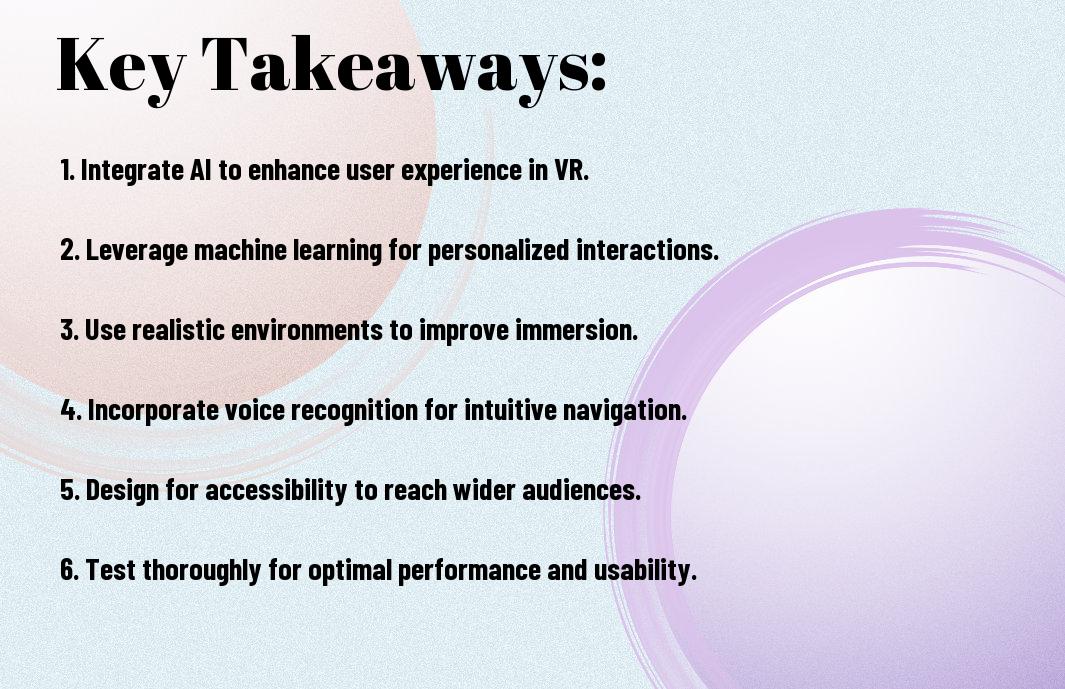
Key Takeaways:
- Developing interactive virtual reality (VR) apps with artificial intelligence (AI) enables the creation of immersive and dynamic experiences that can simulate real-world environments and respond to user interactions in a more human-like way.
- AI-powered VR apps can be used in various industries such as education, healthcare, and entertainment, allowing for personalized and engaging experiences that enhance learning, therapy, and enjoyment.
- Integrating AI into VR apps requires a deep understanding of machine learning algorithms, computer vision, and natural language processing, as well as expertise in VR development tools and platforms.
- Interactive VR apps with AI can provide real-time feedback and analysis, enabling users to track their progress, identify areas for improvement, and receive personalized recommendations for future interactions.
- The development of AI-powered VR apps also raises important considerations around data privacy, user safety, and accessibility, highlighting the need for developers to prioritize these factors in the design and deployment of these applications.

Virtual Reality Fundamentals
Before stepping into creating interactive virtual reality apps with AI, you need to understand the basics of virtual reality. You will learn about the components and platforms that make up this technology, allowing you to create immersive experiences for your users.
VR Hardware Components
Alongside the development of virtual reality, you will encounter various hardware components such as head-mounted displays, sensors, and controllers that enable you to interact with virtual environments, making your experience more engaging and realistic.
Software Development Platforms
Platforms like Unity and Unreal Engine provide you with the tools and resources necessary to build and design your virtual reality applications, giving you the flexibility to create unique and interactive experiences for your users.
Hardware dependencies are minimized when using these software development platforms, as they support a wide range of devices and allow you to focus on creating engaging content for your virtual reality apps, enabling you to bring your vision to life and share it with your audience.
Artificial Intelligence Integration
Assuming you have a basic understanding of virtual reality, integrating artificial intelligence can enhance your app’s interactivity, allowing you to create more immersive experiences for your users.
Machine Learning Models for VR
Models such as decision trees and clustering algorithms can be used to analyze user behavior and adapt your virtual environment accordingly, enabling you to tailor your app to your users’ preferences.
Neural Networks in Interactive Environments
For instance, you can utilize neural networks to generate realistic responses to user input, creating a more engaging and dynamic experience in your virtual reality app.
At this point, you can leverage neural networks to analyze user interactions and generate personalized content, taking your virtual reality app to the next level, and allowing you to offer your users a unique and captivating experience that sets your app apart from others in the market.
User Experience Design
Many factors contribute to a successful virtual reality app, and you can learn more about The Power of Generative AI in VR: A Gateway to Innovation to improve your design. As you develop your app, consider the user’s experience and how you can create an immersive environment.
Spatial Interface Development
With a focus on spatial awareness, you can create an intuitive interface that allows users to navigate your virtual reality world with ease, making your app more engaging and user-friendly.
Interactive Element Placement
Interface design is key to creating an interactive virtual reality experience, and you should consider the placement of interactive elements to guide the user through your app.
It is necessary to balance interactive elements with the overall user experience, ensuring that your app is both engaging and easy to use, allowing you to create a virtual reality experience that draws the user in and keeps them invested in your app.
Development Framework
Now that you have a solid understanding of the concept, it’s time to investigate the development framework for creating interactive virtual reality apps with AI. You will need to choose a suitable framework that supports your requirements and integrates well with your AI model.
Core Programming Requirements
Any development framework you choose should have core programming requirements such as support for popular programming languages, a user-friendly interface, and extensive documentation. You should consider factors like scalability, performance, and compatibility with your AI model when selecting a framework.
AI Model Implementation
Between the various AI models available, you need to select one that aligns with your app’s requirements and integrates seamlessly with your chosen framework. You should consider factors like model complexity, training data, and computational resources when making your selection.
Also, as you implement your AI model, you will need to consider how to optimize its performance, ensure data privacy and security, and provide a seamless user experience. You should test and refine your model regularly to ensure it meets your app’s requirements and functions as expected, providing your users with an immersive and interactive experience.
Performance Optimization
Not all virtual reality apps are created equal, and you will need to optimize your app’s performance to ensure a seamless user experience. You can achieve this by implementing various techniques that reduce latency and improve rendering speeds.
Real-time Rendering Techniques
On the topic of rendering, you will need to utilize real-time rendering techniques to generate high-quality graphics quickly. You can use methods like level of detail and occlusion culling to reduce the computational load on your system.
Resource Management
Among the most important aspects of performance optimization is managing your app’s resources efficiently. You can use tools like profiling and monitoring to identify areas where your app is using excessive resources, and then optimize those areas to improve performance.
At the heart of effective resource management is understanding how your app uses resources like CPU, memory, and bandwidth. You can use this knowledge to optimize your app’s performance by reducing unnecessary resource usage, and allocating resources more efficiently to ensure a smooth and responsive user experience in your virtual reality app.
Testing and Debugging
Unlike traditional app development, testing virtual reality apps with AI requires a more immersive and interactive approach, where you need to ensure that your app responds correctly to user input and provides a seamless experience.
User Interaction Testing
With your virtual reality app developed, you will test how users interact with it, checking for any inconsistencies or bugs that may affect the overall experience, and making adjustments as needed to ensure a smooth and engaging interaction.
AI Response Validation
Any issues with your AI’s response can significantly impact the user experience, so you will need to thoroughly test and validate your AI’s responses to ensure they are accurate and relevant, and make adjustments as needed to improve the overall performance of your app.
Further, when validating your AI’s responses, you will want to consider factors such as context, user input, and environmental factors, to ensure that your AI is able to adapt and respond appropriately, providing a more realistic and engaging experience for your users, and helping you to refine and improve your app’s overall performance and functionality.
Summing up
To wrap up, you now have a solid foundation for creating interactive virtual reality apps with AI. You can leverage your knowledge to design immersive experiences, integrating AI-driven features that enhance user engagement. As you develop your skills, your ability to craft innovative VR apps will grow, enabling you to push the boundaries of what is possible in this exciting field, and deliver unique experiences that leave a lasting impact on your users.
FAQ
Q: What are the key components required to create interactive virtual reality (VR) apps with Artificial Intelligence (AI)?
A: To create interactive VR apps with AI, several key components are necessary. These include a powerful computer or device capable of handling VR and AI processing, a VR headset or device for the user to experience the virtual environment, and software development kits (SDKs) that support both VR and AI integration. Additionally, a programming language such as C#, Java, or Python is needed for developing the app, along with AI frameworks like TensorFlow or PyTorch for integrating machine learning models. Lastly, 3D modeling and animation tools are necessary for creating immersive and interactive virtual environments.
Q: How can AI enhance the user experience in virtual reality apps?
A: AI can significantly enhance the user experience in virtual reality apps by introducing dynamic and adaptive elements. For instance, AI-powered chatbots can provide personalized guides or assistants within the virtual environment, offering real-time information and support. AI-driven avatars can simulate realistic behaviors, making interactions within the VR world feel more natural and engaging. Furthermore, machine learning algorithms can analyze user behavior and preferences, allowing the VR app to adjust its difficulty level, content, or even the narrative in real-time to keep the user engaged and interested. This level of personalization and interactivity can make VR experiences feel more immersive and enjoyable.
Q: What are the potential challenges and limitations of developing interactive VR apps with AI, and how can developers overcome them?
A: Developing interactive VR apps with AI comes with several challenges and limitations. One of the main issues is the high computational power required to run both VR and AI smoothly, which can lead to hardware constraints and increased development costs. Another challenge is ensuring that the AI integration is seamless and does not compromise the VR experience with latency or glitches. To overcome these challenges, developers can utilize cloud computing for offloading AI processing, optimize their code for better performance, and conduct thorough testing to identify and fix any issues before release. Additionally, staying updated with the latest advancements in VR and AI technologies, as well as collaborating with experts from both fields, can help in navigating the complexities of developing interactive VR apps with AI.