
As you commence on your journey to create innovative mobile apps, you’ll discover the significance of artificial intelligence (AI) in enhancing user experience. You’re likely aware that AI-driven mobile apps are revolutionizing the way you interact with devices. Your goal is to develop apps that think, learn, and adapt to user behavior, and this guide will walk you through the process, helping you get started with AI-driven mobile app development and unlocking your full potential as a developer.
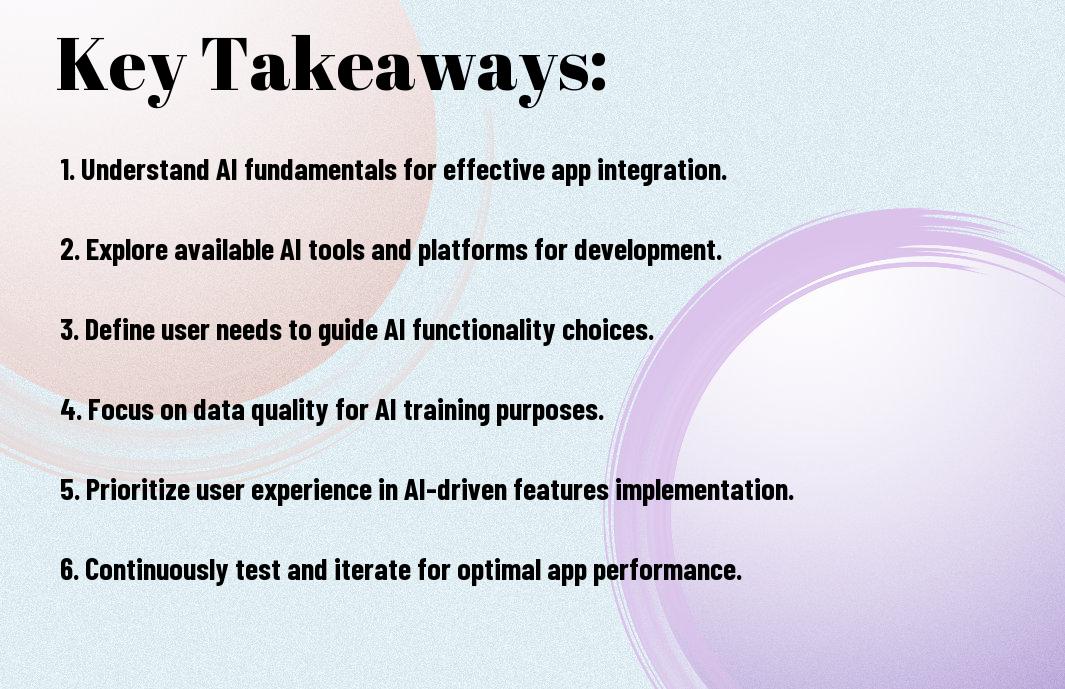
Key Takeaways:
- Embracing AI in mobile app development can significantly enhance user experience by providing personalized interactions, predictive analytics, and automated decision-making processes.
- AI-driven mobile apps can leverage machine learning algorithms to analyze user behavior, preferences, and patterns, enabling developers to create more intuitive and engaging applications.
- Integrating AI into mobile app development requires a solid understanding of data science, machine learning, and software development, making it imperative to have a skilled team with diverse expertise.
- AI-powered mobile apps can drive business growth by improving operational efficiency, reducing costs, and unlocking new revenue streams through innovative features and services.
- As AI technology continues to evolve, mobile app developers must stay up-to-date with the latest advancements and trends to create cutting-edge applications that meet the evolving needs of users and stay competitive in the market.
AI Fundamentals in Mobile Development
A strong understanding of AI fundamentals is crucial for developing intelligent mobile apps. You will need to learn about various AI concepts and technologies to create innovative and engaging user experiences. Your mobile app development journey begins with understanding the basics of AI and its applications in mobile development.
Core AI Technologies for Apps
By leveraging natural language processing, computer vision, and predictive analytics, you can build mobile apps that offer personalized experiences. You will need to explore these core AI technologies to determine which ones align with your app’s goals and objectives. Your choice of AI technology will depend on the type of app you are developing and the features you want to include.
Machine Learning Integration Basics
For building intelligent mobile apps, you need to understand the basics of machine learning integration. You will need to learn how to collect and preprocess data, train models, and deploy them in your app. Your goal is to create an app that can learn from user interactions and improve over time.
In fact, machine learning integration is a key aspect of AI-driven mobile app development, and you will need to consider factors such as data quality, model accuracy, and user privacy. You should also explore various machine learning frameworks and tools to determine which ones best fit your app’s requirements and your development workflow. As you probe deeper into machine learning integration, you will discover new opportunities to enhance your app’s functionality and user experience.
Essential Tools and Frameworks
Assuming you have a basic understanding of AI-driven mobile app development, you’ll need to familiarize yourself with the important tools and frameworks that power this technology. You’ll find a range of options available, each with its own strengths and weaknesses, to help you build and deploy your app.
Popular AI Development Platforms
Against the backdrop of a rapidly evolving AI landscape, you’ll encounter popular development platforms like Google’s TensorFlow and Microsoft’s Azure Machine Learning, which provide the foundation for your AI-driven mobile app. You can leverage these platforms to streamline your development process and create more sophisticated apps.
Mobile-Specific AI Libraries
After selecting your development platform, you’ll need to choose mobile-specific AI libraries that integrate seamlessly with your app. You can explore libraries like Core ML for iOS and ML Kit for Android, which offer a range of pre-trained models and APIs to enhance your app’s functionality.
Hence, as you examine deeper into mobile-specific AI libraries, you’ll discover that they provide a wide range of features, from image and speech recognition to natural language processing and predictive analytics. You can use these libraries to create more personalized and engaging user experiences, setting your app apart from the competition and driving user loyalty.
Building Smart User Experiences
Unlike traditional mobile app development, AI-driven development focuses on creating personalized and intuitive user experiences. You can leverage AI to analyze user behavior and preferences, enabling your app to adapt and respond accordingly, making it more engaging and user-friendly.
Natural Language Processing Features
Against the backdrop of increasing demand for voice-activated interfaces, you can integrate natural language processing features into your app, allowing users to interact with it using voice commands, making it more accessible and convenient for them.
Computer Vision Applications
Any mobile app can benefit from computer vision capabilities, which enable your app to interpret and understand visual data from images and videos, allowing you to develop innovative features such as object detection, facial recognition, and augmented reality experiences.
At the heart of computer vision applications lies the ability to analyze and process visual data, enabling you to develop apps that can, for instance, detect objects, classify images, or track movements, opening up a wide range of possibilities for your app’s functionality and user experience, and you can utilize this technology to create more engaging and interactive apps that cater to your users’ needs.
AI Performance Optimization
Not all AI-driven mobile apps are created equal, and you’ll need to optimize your app’s performance to ensure a seamless user experience. You’ll want to focus on improving your app’s speed, efficiency, and overall performance to keep your users engaged.
Resource Management
Betwixt the various components of your app, you’ll need to manage resources effectively to prevent bottlenecks and optimize performance. You’ll want to allocate resources wisely, ensuring that your app’s AI components are utilizing the right amount of memory, CPU, and battery power.
Model Efficiency Techniques
Across the board, model efficiency techniques can help improve your app’s performance by reducing computational complexity and memory usage. You’ll want to explore techniques such as model pruning, quantization, and knowledge distillation to optimize your app’s AI models.
Another key aspect of model efficiency techniques is the use of transfer learning, which allows you to leverage pre-trained models and fine-tune them for your specific use case. By doing so, you can significantly reduce the amount of training data and computational resources required, resulting in a more efficient and performant AI-driven mobile app that meets your users’ expectations and provides a better overall experience.

Data Management and Privacy
For any AI-driven mobile app, managing data effectively is vital to its success, and you will need to consider how to handle user data in a way that is both secure and transparent, ensuring that your app complies with relevant regulations and maintains user trust.
Data Collection Strategies
Similarly, for your app to function effectively, you will need to develop data collection strategies that are tailored to your specific needs, allowing you to gather the information necessary to power your AI-driven features while also being mindful of user privacy and data protection.
Security Implementation
Furthermore, for the security of your app, you will need to implement robust security measures to protect user data, including encryption, secure authentication, and access controls, to prevent unauthorized access and ensure that your app is secure.
But as you research deeper into security implementation, you will realize that it’s not just about protecting user data, but also about ensuring the integrity of your app and its AI-driven features, which requires a comprehensive approach to security that includes regular updates, testing, and monitoring to stay ahead of potential threats and vulnerabilities, and you should consider consulting with security experts to ensure your app meets the highest security standards.
Testing AI-Powered Features
Once again, you’ll need to ensure your AI-driven mobile app functions as intended, and that’s where testing comes in, allowing you to identify and fix issues before launch, saving your time and resources in the long run, and ultimately enhancing your app’s overall user experience.
Quality Assurance Methods
Assuring the quality of your AI-powered features is vital, you will need to implement various testing methods, such as unit testing, integration testing, and user acceptance testing, to guarantee your app meets the required standards and functions seamlessly, giving you confidence in your product.
Performance Metrics
By monitoring performance metrics, you can evaluate your app’s efficiency, including parameters like processing time, memory usage, and battery consumption, helping you optimize your app’s performance and provide a better experience for your users, which is vital for your app’s success.
The performance metrics you track will depend on your app’s specific requirements, but you should consider factors like latency, throughput, and error rates, as these will give you valuable insights into your app’s performance, allowing you to make data-driven decisions to improve your app, and as you analyze these metrics, you will be able to identify areas for improvement, and make adjustments to enhance your app’s overall performance, and user satisfaction.
Summing up
Presently, you have gained a comprehensive understanding of AI-driven mobile app development. You can now leverage this knowledge to create innovative apps that enhance your users’ experience. As you begin on your development journey, you will find that your skills and expertise will continue to evolve, enabling you to build more sophisticated and intelligent applications that meet your users’ evolving needs and exceed their expectations, ultimately driving success for your business and enhancing your reputation as a developer.
FAQ
Q: What is AI-Driven Mobile App Development and how does it differ from traditional mobile app development?
A: AI-Driven Mobile App Development refers to the process of creating mobile applications that utilize Artificial Intelligence (AI) and Machine Learning (ML) technologies to provide personalized, intuitive, and dynamic user experiences. Unlike traditional mobile app development, AI-Driven Mobile App Development focuses on integrating AI-powered features such as predictive analytics, natural language processing, and computer vision to enhance the app’s functionality and user engagement. This approach enables developers to create more sophisticated and adaptive apps that can learn from user behavior and improve over time.
Q: What are the key benefits of using AI in mobile app development, and how can it improve the overall user experience?
A: The key benefits of using AI in mobile app development include enhanced personalization, improved user engagement, and increased efficiency. AI-powered apps can analyze user behavior, preferences, and patterns to provide tailored recommendations, content, and experiences. Additionally, AI-driven apps can automate routine tasks, simplify complex processes, and offer real-time support, resulting in a more seamless and intuitive user experience. By leveraging AI, developers can create apps that are more responsive, interactive, and user-friendly, ultimately driving higher user satisfaction and loyalty.
Q: What skills and tools do developers need to get started with AI-Driven Mobile App Development, and what are the best practices for implementing AI-powered features?
A: To get started with AI-Driven Mobile App Development, developers should have a solid foundation in programming languages such as Java, Swift, or Kotlin, as well as experience with AI and ML frameworks like TensorFlow, Core ML, or ML Kit. They should also be familiar with data analysis, computer vision, and natural language processing concepts. In terms of tools, developers can utilize popular AI-powered development platforms like Google’s ML Kit, Apple’s Core ML, or Microsoft’s Azure Machine Learning. Best practices for implementing AI-powered features include starting with a clear understanding of the app’s goals and user needs, designing intuitive AI-driven interfaces, and continuously testing and refining the app’s AI-powered features to ensure optimal performance and user experience.