
As you explore the latest trends in technology, you’re likely noticing the significant impact of Artificial Intelligence (AI) on various industries, including app development. Your mobile experience is being revolutionized by AI-powered apps that offer personalized experiences and enhanced functionality. You can expect AI to continue transforming the app development landscape, enabling developers to create more intelligent and user-centric applications that meet your evolving needs and expectations.
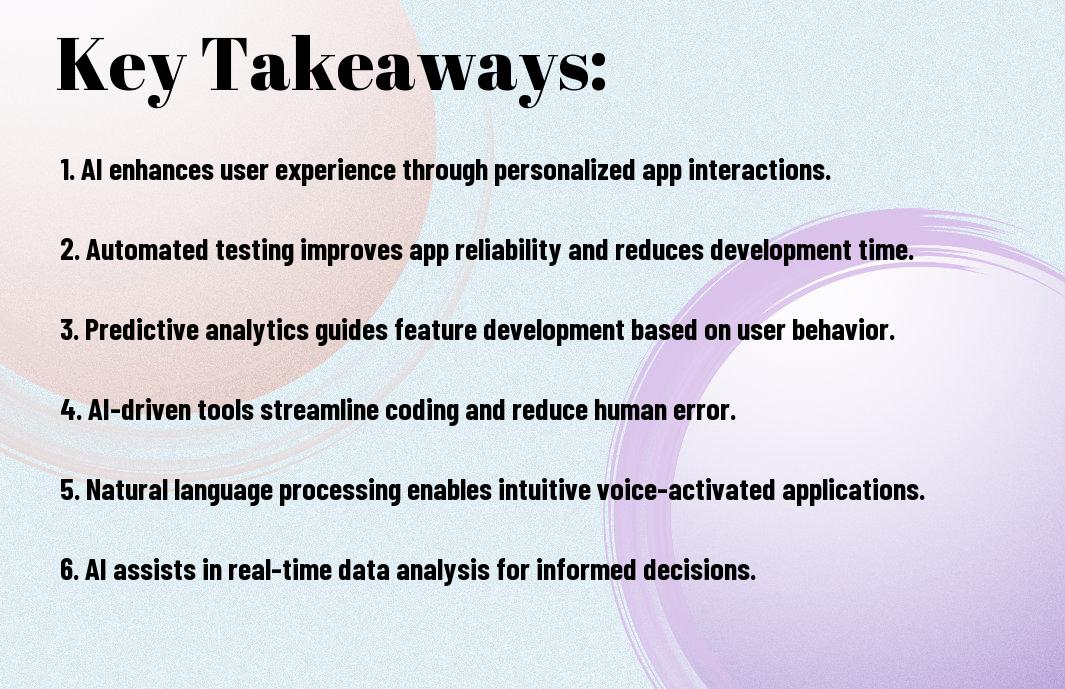
Key Takeaways:
- AI is revolutionizing the app development process by automating tasks, improving efficiency, and enhancing user experience, allowing developers to focus on more complex and creative aspects of development.
- Machine learning algorithms and natural language processing are being integrated into apps to provide personalized experiences, predict user behavior, and offer intelligent recommendations, increasing user engagement and loyalty.
- AI-powered tools are enabling developers to build apps faster and with greater accuracy, reducing the time and cost associated with traditional development methods, and making it possible to deploy apps across multiple platforms.
- The use of AI in app development is also improving app security, as AI-powered systems can detect and respond to threats in real-time, protecting user data and preventing cyber attacks.
- As AI technology continues to evolve, we can expect to see more innovative and sophisticated apps that leverage AI capabilities, such as augmented reality, computer vision, and voice recognition, to create immersive and interactive user experiences.
The Rise of AI in Development
Your app development process is about to get a significant boost with the integration of Artificial Intelligence (AI). AI is revolutionizing the way you design, develop, and deploy apps, making them more efficient and user-friendly.
Machine Learning Integration
Alongside the growth of AI, you’re seeing a surge in machine learning integration, enabling your apps to learn from user behavior and adapt to their needs, making them more personalized and interactive.
Natural Language Processing Tools
Among the various AI-powered tools, Natural Language Processing (NLP) is one that you’ll find particularly useful, allowing your apps to understand and process human language, enabling features like voice assistants and chatbots.
Machine learning algorithms are being used to improve NLP tools, enabling your apps to better understand the nuances of human language, including context, tone, and intent. As you explore deeper into NLP, you’ll discover its potential to transform the way your apps interact with users, making them more intuitive and user-friendly, and you’ll be able to create more sophisticated and engaging user experiences.
AI-Powered Development Tools
There’s a growing trend of using AI in app development, and you can learn more about it by checking out Does the Future of Mobile App Development Belong to AI? to stay updated on the latest advancements.
Code Generation Systems
On the forefront of AI-powered development tools are code generation systems, which enable you to generate code snippets and even entire applications, streamlining your development process and reducing errors.
Automated Testing Platforms
To ensure the quality and reliability of your app, you can utilize automated testing platforms, which use AI to identify and fix bugs, allowing you to focus on other aspects of development.
Due to the complexity of modern apps, automated testing platforms are becoming increasingly important, as they help you test your app under various scenarios, devices, and conditions, giving you confidence in your app’s performance and user experience, and enabling you to make data-driven decisions to improve it.
Predictive Development Models
To stay ahead in the app development game, you need to leverage predictive development models that use AI to forecast your needs and optimize your workflow. This enables you to create more efficient and effective apps, saving you time and resources in the long run. You can focus on high-level tasks while AI handles the mundane ones.
Smart Code Completion
Completing your code with intelligent suggestions, smart code completion tools use AI to learn your coding habits and provide relevant recommendations. You can work more efficiently, as you get suggestions for code snippets, functions, and even entire blocks of code, allowing you to develop your app faster and with fewer errors.
Error Detection Systems
For enhanced app quality, you can utilize error detection systems that use AI to identify and fix bugs in your code. You can ensure your app is stable and functions as intended, providing a better user experience and protecting your reputation as a developer.
Even further, error detection systems can help you identify potential issues before they become major problems, allowing you to take proactive measures to prevent errors and improve your app’s overall performance. You can then focus on refining your app’s features and functionality, knowing that the foundation is solid and error-free.

AI-Enhanced User Experience
All aspects of app development are being transformed by AI, as you can learn more about in How AI Is Revolutionizing App Development, enabling you to create more engaging and intuitive interfaces.
Personalization Algorithms
Around every corner, you’ll find AI-driven personalization algorithms that help tailor your app to individual users’ needs, making their experience more enjoyable and relevant.
Behavioral Analysis
Below the surface, AI-powered behavioral analysis is helping you understand your users’ habits and preferences, allowing you to refine your app and improve user retention.
AI-Enhanced behavioral analysis enables you to examine deeper into your users’ behavior, identifying patterns and trends that inform your development decisions, and ultimately, enhance your app’s overall user experience, allowing you to stay ahead of the competition and meet your users’ evolving needs.
Cross-Platform Development
After considering the various aspects of app development, you’ll find that AI is revolutionizing the field of cross-platform development, enabling you to create apps that can run seamlessly on multiple platforms.
Adaptive Learning Systems
To achieve efficient cross-platform development, you can utilize adaptive learning systems that allow your apps to adjust to different platforms and devices, ensuring a consistent user experience across all your devices.
Multi-Device Optimization
Among the key benefits of AI in cross-platform development is the ability to optimize your apps for multiple devices, enabling you to reach a broader audience and increase your app’s visibility.
In fact, when you optimize your apps for multiple devices, you can ensure that your users have a consistent and engaging experience, regardless of the device they use, which can lead to increased user satisfaction and loyalty, ultimately driving the success of your app.
Future Development Landscape
For the future of app development, you can expect significant changes with the integration of AI, enabling you to create more efficient and personalized applications, and transforming your development process.
No-Code AI Solutions
Nocode platforms are emerging, allowing you to build AI-powered apps without extensive coding knowledge, making it easier for you to develop and deploy applications quickly.
Real-Time Development Analytics
Any moment you spend on development, you can now leverage real-time analytics to track your progress, identify areas for improvement, and optimize your app’s performance, helping you make data-driven decisions.
At the heart of real-time development analytics is the ability to monitor user behavior, track key performance indicators, and analyze feedback, enabling you to refine your app and enhance your users’ experience, allowing you to stay ahead in the competitive app development landscape and meet your users’ evolving needs.
To wrap up
The future of app development is being reshaped by AI, and you are at the forefront of this transformation. As you explore the possibilities of AI, you will discover new ways to enhance your app’s user experience, improve performance, and streamline development processes. With AI, your apps will become more intuitive, personalized, and responsive, allowing you to deliver exceptional value to your users and stay ahead in the competitive market.
FAQ
Q: What role is AI playing in the future of app development, and how is it changing the industry?
A: AI is significantly impacting the future of app development by introducing automation, personalization, and predictive analytics. With AI, developers can create more intuitive and user-friendly apps that learn from user behavior and adapt to their needs. This shift is enabling developers to focus on more complex and creative tasks, while AI handles repetitive and mundane operations, thereby increasing efficiency and reducing development time. As a result, the app development industry is experiencing a significant transformation, with AI-driven apps becoming the new norm.
Q: How is AI enhancing the user experience in mobile apps, and what benefits can users expect from AI-powered apps?
A: AI is revolutionizing the user experience in mobile apps by providing personalized recommendations, predictive maintenance, and automated support. With AI-powered apps, users can enjoy tailored content, streamlined navigation, and proactive issue resolution. Additionally, AI-driven apps can analyze user behavior and preferences, enabling them to offer more relevant and engaging experiences. Users can expect AI-powered apps to be more responsive, intuitive, and effective in meeting their needs, ultimately leading to increased satisfaction and loyalty.
Q: What skills and knowledge do app developers need to acquire to stay ahead in the AI-driven app development landscape, and how can they leverage AI tools and technologies?
A: To stay ahead in the AI-driven app development landscape, developers need to acquire skills in machine learning, natural language processing, and data analytics. They should also be familiar with AI frameworks, such as TensorFlow and Core ML, and have experience with AI-powered development tools, like chatbot builders and predictive analytics platforms. By leveraging AI tools and technologies, developers can create more sophisticated and user-friendly apps, and stay competitive in a rapidly evolving industry. Furthermore, developers should stay up-to-date with the latest AI trends and advancements, and be willing to continuously learn and adapt to new technologies and methodologies.


