App

The Ultimate Guide to AI-Powered App Creation

As you launch on creating your own app, you’re likely aware of the impact artificial intelligence can have on its success. You want to harness the power of AI to streamline development, enhance user experience, and drive engagement. Your goal is to create an app that stands out from the crowd, and AI can help you achieve that. In this guide, you will learn how to leverage AI to bring your app vision to life, from design to deployment, and unlock your full potential as a developer.

Key Takeaways:

  • AI-powered app creation enables developers to build more intelligent and interactive applications, enhancing user experience and engagement through personalized features and automated processes.
  • To get started with AI-powered app development, it’s necessary to choose the right tools and frameworks that align with your project goals, such as machine learning libraries and natural language processing APIs.
  • Designing an AI-powered app requires a deep understanding of user needs and behaviors, allowing developers to create tailored solutions that meet specific demands and preferences.
  • Integrating AI into app development can significantly reduce development time and costs, as automated testing and debugging tools help identify and fix issues more efficiently.
  • As AI technology continues to evolve, staying up-to-date with the latest trends and advancements is vital for creating innovative and competitive AI-powered apps that drive business success and customer satisfaction.
AI Development Fundamentals

For a successful AI-powered app, you need to understand the basics of AI development, including machine learning and neural networks, to create an effective and efficient application that meets your needs and goals.

Machine Learning Frameworks

Beyond the basics, you’ll find that machine learning frameworks such as TensorFlow and PyTorch provide you with the tools and libraries necessary to build and train your AI models, allowing you to focus on developing your app’s unique features and functionality.

Neural Network Basics

Beneath the surface of AI development, you’ll discover that neural networks are a fundamental component, consisting of layers of interconnected nodes that process and transmit information, enabling your app to learn and make decisions based on the data it receives.

Further exploration of neural network basics will help you understand how to design and optimize your networks to achieve the best results for your app, taking into account factors such as data quality, network architecture, and training algorithms, to ensure your AI-powered app performs at its best and provides your users with a seamless and intuitive experience.

App Creation Tools

Some of the most popular app creation tools utilize AI to streamline the development process, making it easier for you to bring your ideas to life. These tools offer a range of features, from automated coding to design assistance, allowing you to focus on the creative aspects of your app.

No-Code AI Platforms

Along with the rise of AI, no-code platforms have become increasingly popular, enabling you to create apps without extensive coding knowledge. These platforms provide drag-and-drop interfaces and pre-built templates, making it easy for you to get started.

Advanced Development Environments

Before stepping into advanced development environments, you should consider the following tools:

  1. AI-powered IDEs
  2. Machine learning frameworks

Development Tools

Tool Description
AI-powered IDEs Intelligent coding assistance
Machine learning frameworks Pre-built algorithms for complex tasks

You can use these tools to create complex apps with ease.

Understanding the capabilities of advanced development environments is key to creating sophisticated apps. You can leverage these environments to:

  1. Build custom AI models
  2. Integrate with existing systems

Advanced Development Features

Feature Benefit
Custom AI models Tailored to your app’s specific needs
System integration Seamless data exchange and workflow automation

By utilizing these features, you can take your app development to the next level and create innovative, AI-powered solutions.

Data Integration

After setting up your AI-powered app, you’ll need to integrate data from various sources. You can explore tools like The 6 best AI app builders in 2025 to streamline your data integration process, making it easier for you to manage your app’s data.

Data Collection Methods

Alongside other methods, an crucial step in data integration is collecting data from various sources, which you can do through APIs, web scraping, or user input, allowing you to gather the data you need to power your app.

Processing and Analysis

Before you can use your data, you’ll need to process and analyze it, which involves cleaning, transforming, and modeling your data to extract insights that inform your app’s decision-making processes, helping you to make the most of your data.

Plus, as you examine deeper into processing and analysis, you’ll discover that you can use machine learning algorithms to identify patterns and trends in your data, enabling you to make predictions and improve your app’s performance, which is crucial for creating a seamless user experience and driving business success, and you can use this information to refine your app and make data-driven decisions.

User Experience Design

Now that you’re considering creating an AI-powered app, you’ll want to learn more about the process, which you can find in How to Build an AI app in 2025 [Complete Guide], to ensure your app provides a seamless user experience.

AI-Driven Interface Elements

Around the time you start designing your app, you’ll need to think about incorporating AI-driven interface elements that will enhance your user’s experience and make your app more engaging.

Predictive Interactions

To take your app to the next level, you’ll want to focus on creating predictive interactions that anticipate your user’s needs and provide personalized experiences.

Indeed, by leveraging AI-powered predictive interactions, you can create an app that learns your user’s behavior and adapts to their preferences, making it more likely that they will continue to use your app and become loyal customers, which is necessary for the success of your app, and as you examine deeper into the world of AI-powered app creation, you’ll discover more ways to utilize predictive interactions to enhance your user’s experience.

App Intelligence Features

All AI-powered apps rely on intelligent features to enhance user experience. You can integrate various features, such as natural language processing and computer vision, to make your app more interactive and engaging.

Natural Language Processing

One of the key features you can incorporate is natural language processing, which enables your app to understand and respond to user input in a more human-like way, allowing you to create a more personalized experience for your users.

Computer Vision Integration

Between the various features, computer vision integration stands out, enabling your app to interpret and understand visual data from images and videos, allowing you to create more immersive experiences for your users.

In fact, with computer vision integration, you can develop apps that can detect objects, recognize faces, and even track movements, opening up a wide range of possibilities for your app’s functionality and user engagement, and you can use this technology to create more sophisticated and interactive features that set your app apart from others.

Testing and Optimization

Your app’s performance is key to its success, and testing is an vital step in ensuring it meets your standards, with AI-powered tools streamlining the process and providing valuable insights.

Performance Metrics

Any assessment of your app’s performance relies on tracking key metrics, such as load times, crash rates, and user engagement, which AI can analyze to identify areas for improvement.

User Behavior Analysis

Users expect a seamless experience, and analyzing their behavior helps you understand how they interact with your app, allowing you to make data-driven decisions to enhance their experience.

A deeper explore user behavior analysis reveals that you can leverage AI to study user patterns, preferences, and pain points, enabling you to refine your app’s features, fix issues, and ultimately boost user satisfaction and retention, which is vital for your app’s long-term success.

Conclusion

Drawing together the insights from this guide, you now have a comprehensive understanding of AI-powered app creation. You can leverage your newfound knowledge to develop innovative apps that transform your business and enhance your users’ experience. With your skills and expertise, you can unlock the full potential of AI and create cutting-edge apps that drive success and growth for your organization, taking your mobile strategy to the next level with your expertise in AI-powered app creation.

FAQ

Q: What is the main benefit of using AI in app creation, and how can it enhance the development process?

A: The main benefit of using AI in app creation is that it enables developers to automate repetitive tasks, improve app performance, and provide personalized user experiences. AI-powered tools can help with tasks such as data analysis, code generation, and testing, allowing developers to focus on more complex and creative aspects of app development. Additionally, AI can help improve app security, reduce bugs, and enhance overall user engagement, making it an imperative component of modern app creation.

Q: What kind of skills and knowledge are required to create an AI-powered app, and are there any specific tools or platforms that can facilitate the process?

A: To create an AI-powered app, developers should have a solid understanding of programming languages such as Python, Java, or Swift, as well as experience with machine learning frameworks like TensorFlow or Core ML. Familiarity with data structures, algorithms, and software design patterns is also necessary. Additionally, developers can leverage various tools and platforms, such as Google Cloud AI Platform, Microsoft Azure Machine Learning, or Apple’s Core ML, to streamline the development process and integrate AI capabilities into their apps. These platforms provide pre-built models, APIs, and development kits that can help simplify the process of building AI-powered apps.

Q: How can developers ensure that their AI-powered apps are transparent, fair, and unbiased, and what steps can be taken to address potential ethical concerns?

A: To ensure that AI-powered apps are transparent, fair, and unbiased, developers should prioritize data quality, implement robust testing and validation procedures, and regularly audit their AI models for potential biases. They should also provide clear explanations of how the AI system works, what data it collects, and how it makes decisions. Furthermore, developers can adopt ethical guidelines and frameworks, such as those provided by the AI Now Institute or the IEEE, to help address potential concerns around AI transparency, accountability, and fairness. By taking these steps, developers can build trust with their users and create AI-powered apps that are both effective and responsible.

Integrating Natural Language Processing into Your App

As you consider enhancing your app’s capabilities, you’re likely exploring ways to improve user experience. You can leverage Natural Language Processing (NLP) to enable your app to understand and interact with users in a more human-like way. By integrating NLP, you can unlock features like voice commands, sentiment analysis, and text classification, allowing your app to better serve your users’ needs and preferences. You will be able to create a more intuitive and engaging experience for your users.

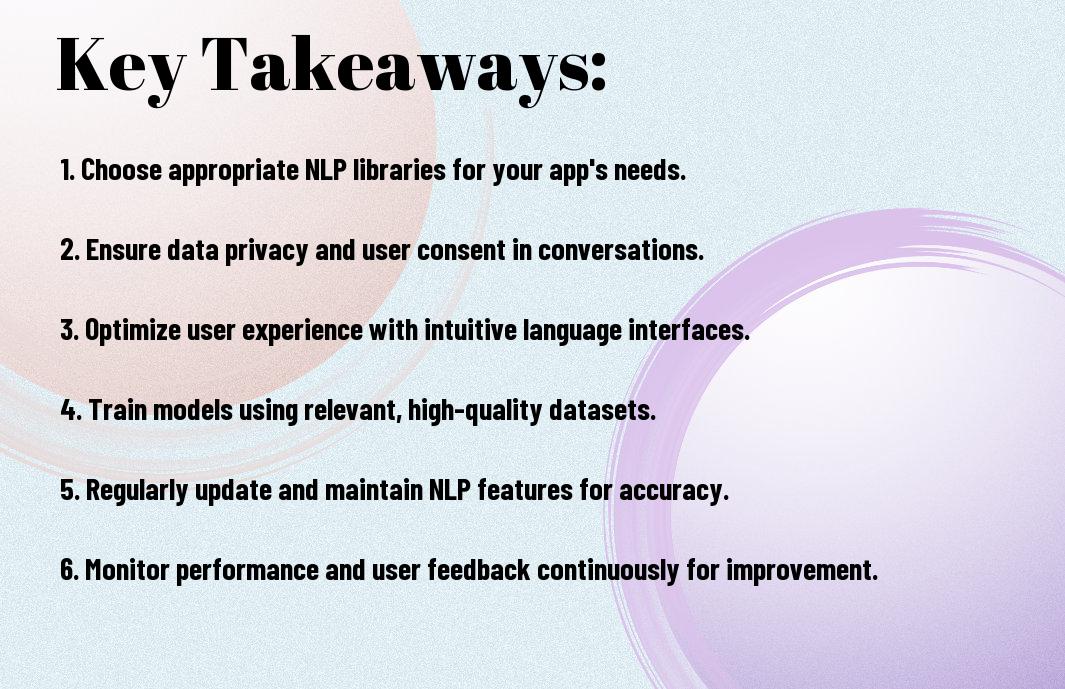
Key Takeaways:

  • Integrating Natural Language Processing (NLP) into your app can significantly enhance user experience by enabling more intuitive and human-like interactions, allowing users to communicate with your app in a more natural way.
  • NLP can be used to analyze and understand user input, such as text or speech, and generate relevant responses, making it a powerful tool for building conversational interfaces, chatbots, and virtual assistants.
  • To successfully integrate NLP into your app, you’ll need to choose the right NLP library or framework, such as NLTK, spaCy, or Stanford CoreNLP, and consider factors like language support, accuracy, and scalability.
  • NLP can also be used to improve app functionality, such as sentiment analysis, entity recognition, and topic modeling, which can help you better understand user behavior and preferences, and make data-driven decisions.
  • As NLP technology continues to evolve, it’s imperative to stay up-to-date with the latest developments and advancements, and consider how you can leverage NLP to drive innovation and differentiation in your app, and stay ahead of the competition.

Fundamentals of NLP Integration

For a successful NLP integration, you need to understand the basics of natural language processing and its applications in your app. You will learn how to leverage NLP to enhance your app’s functionality and user experience.

Core NLP Components

Beneath the surface of NLP integration lies a complex system of algorithms and techniques. You will discover the key components that enable your app to process and understand human language, allowing you to make informed decisions about your NLP strategy.

API Selection and Setup

For your NLP integration to be effective, you need to choose the right API and set it up correctly. You will explore the various options available and learn how to select the one that best fits your app’s needs, ensuring seamless integration and optimal performance.

And as you probe deeper into API selection and setup, you will consider factors such as scalability, security, and compatibility, ensuring that your NLP integration is robust and reliable, and that you can easily maintain and update it as your app evolves, allowing you to focus on providing the best possible experience for your users.

Text Processing Architecture

If you’re looking to integrate natural language processing into your app, you’ll need to design a robust text processing architecture. This involves several components working together to analyze and understand human language, enabling your app to make informed decisions and take appropriate actions.

Data Preprocessing Pipeline

Piping in raw text data, you’ll need to clean and normalize it to prepare for analysis, removing unnecessary characters, correcting spelling errors, and transforming it into a format suitable for your language models.

Language Models and Tokenization

Across various natural language processing tasks, you’ll utilize language models and tokenization techniques to break down text into individual words or tokens, analyzing their context and meaning to extract insights and make predictions.

Architecture of your language models and tokenization techniques will play a significant role in determining the accuracy and efficiency of your text processing pipeline, as you’ll need to select the most suitable models and techniques for your specific use case, considering factors such as performance, scalability, and interpretability, to ensure your app provides accurate and reliable results.

Implementation Strategies

Unlike other technologies, integrating Natural Language Processing (NLP) into your app can be straightforward. You can find guidance on How to integrate Natural Language processing (NLP) techniques into AI prompt engineering to inform your approach.

RESTful API Integration

Around the time you start designing your NLP integration, you’ll need to consider RESTful API integration, which allows your app to communicate with NLP services seamlessly, enabling efficient data exchange and processing.

Local Processing Solutions

The choice between local and cloud-based NLP solutions depends on your specific needs. You can opt for local processing solutions, which provide more control over data and processing, but may require more resources and maintenance.

Plus, when you choose local processing solutions, you’ll have the flexibility to customize and optimize NLP models for your specific use case, allowing for more accurate and relevant results, and you can ensure the security and privacy of your users’ data by keeping it on your own servers.

Performance Optimization

Despite the complexity of NLP tasks, you can optimize your app’s performance by implementing efficient algorithms and data structures, allowing your users to enjoy a seamless experience.

Memory Management

Beneath the surface of your app’s performance lies the importance of managing memory usage, and you can achieve this by using techniques such as caching and reducing data redundancy, ultimately enhancing your app’s overall efficiency.

Response Time Enhancement

Underneath the hood of your app’s performance optimization lies the need to enhance response times, and you can accomplish this by leveraging parallel processing and optimizing database queries, resulting in faster processing of NLP tasks.

Management of response times is vital to ensuring your users have a positive experience with your app, and you can further improve this by analyzing user behavior and optimizing your NLP models to handle common queries more efficiently, allowing you to provide a more responsive and engaging experience for your users.

Security Considerations

Many security concerns arise when integrating Natural Language Processing into your app, and you must address them to protect your users’ data and maintain their trust.

Data Privacy Protocols

Around the clock, you should ensure that your app adheres to strict data privacy protocols, safeguarding sensitive information and preventing unauthorized access.

Authentication Methods

Along with data privacy, you need to implement robust authentication methods to verify user identities and prevent malicious activities within your app.

Further, when implementing authentication methods, you should consider multi-factor authentication, such as biometric verification or one-time passwords, to add an extra layer of security and protect your users’ accounts from unauthorized access, allowing you to provide a secure and reliable experience for your users.

Testing and Validation

Keep in mind that testing and validation are necessary steps in integrating NLP into your app, ensuring your system functions as expected and provides accurate results.

Accuracy Metrics

Around the evaluation of your NLP system, you will need to consider various metrics, such as precision, recall, and F1 score, to assess its performance and identify areas for improvement.

Load Testing Procedures

Towards optimizing your NLP system’s performance, you should conduct load testing to determine how it handles a large volume of user requests and data, helping you identify potential bottlenecks.

The load testing procedures you implement will help you understand how your system scales and performs under real-world conditions, allowing you to make adjustments and improvements to ensure a seamless user experience, and you can use various tools and techniques to simulate a large number of users and test your system’s limits, giving you valuable insights into its performance and reliability.

Conclusion

Ultimately, you can enhance your app’s user experience by integrating Natural Language Processing into your app. You will be able to provide more personalized and interactive experiences for your users. To learn more about how to implement this technology, visit Natural Language Processing (NLP) for Smarter Mobile Apps to discover new ways to improve your app’s functionality and stay ahead of the competition with your innovative approach.

FAQ

Q: What are the benefits of integrating Natural Language Processing (NLP) into my app?

A: Integrating NLP into your app can significantly enhance user experience by enabling more intuitive and natural interactions. NLP allows your app to understand and process human language, making it possible to implement features such as voice commands, text analysis, and sentiment analysis. This can lead to increased user engagement, improved customer satisfaction, and a competitive edge in the market. Additionally, NLP can help automate tasks, provide personalized recommendations, and offer multilingual support, further expanding your app’s capabilities and reach.

Q: How do I choose the right NLP technology for my app, considering the variety of tools and services available?

A: Choosing the right NLP technology for your app depends on several factors, including the specific use case, the size and complexity of your project, and your development team’s expertise. You should consider the type of NLP tasks you want to perform, such as text classification, entity recognition, or language translation. Evaluate the accuracy, scalability, and customization options of different NLP tools and services, such as cloud-based APIs or open-source libraries. It’s also important to assess the integration complexity, cost, and support offered by the provider. Conducting thorough research, reading reviews, and testing demos or free versions can help you make an informed decision that aligns with your app’s requirements and goals.

Q: What are the common challenges faced during the integration of NLP into an app, and how can they be addressed?

A: Common challenges during NLP integration include data quality issues, model accuracy, and scalability. Poor data quality can significantly impact NLP model performance, so ensuring that your training data is relevant, diverse, and well-annotated is imperative. Model accuracy can be improved by selecting the appropriate algorithm, fine-tuning hyperparameters, and continuously updating the model with new data. Scalability issues can be addressed by using cloud-based services that offer automatic scaling, optimizing resource allocation, and implementing efficient processing pipelines. Additionally, challenges related to user privacy and security, such as data encryption and access control, must be carefully considered and mitigated to maintain user trust and comply with regulations. Collaborating with NLP experts, monitoring performance metrics, and staying updated with the latest advancements in the field can also help overcome these challenges and achieve successful NLP integration.

Innovative App Ideas Powered by AI

As you explore the world of mobile applications, you’ll discover that AI-powered apps are revolutionizing the way you interact with technology. You can leverage AI to create innovative solutions that simplify your life, making tasks more efficient and convenient. Your next big idea can be transformed into a reality with the help of AI, enabling you to develop apps that learn and adapt to your needs, providing personalized experiences like never before. You are on the cusp of unlocking a new era of app development.

Key Takeaways:

  • AI-powered apps can revolutionize industries such as healthcare, finance, and education by providing personalized experiences and automating tasks, leading to increased efficiency and productivity.
  • Integrating AI into mobile apps enables developers to create innovative solutions like virtual assistants, chatbots, and image recognition systems, which can enhance user engagement and interaction.
  • AI-driven apps can analyze large amounts of data, providing valuable insights and predictions that help businesses make informed decisions and drive growth.
  • Developers can leverage AI-powered tools and frameworks to build intelligent apps that learn from user behavior, adapt to changing environments, and offer tailored recommendations.
  • As AI technology continues to evolve, we can expect to see more innovative app ideas emerge, transforming the way we live, work, and interact with technology, and opening up new opportunities for businesses and individuals alike.

    The Evolution of AI-Powered Apps

    Before plunging into innovative app ideas, you need to understand the history of AI-powered apps. You’ve seen significant advancements in AI technology, leading to more sophisticated and user-friendly applications.

    Current Market Landscape

    Emerging trends indicate a shift towards AI-driven solutions, and you can expect to see more apps leveraging machine learning and natural language processing. You will notice that many industries are adopting AI-powered apps to enhance user experience and improve efficiency.

    Technological Foundations

    At the core of AI-powered apps are complex algorithms and data analytics, which you can utilize to develop intelligent and interactive applications. You will find that understanding these foundations is important to creating effective AI-powered apps.

    Even as you explore the possibilities of AI-powered apps, you should consider the underlying technologies that make them possible. You will discover that advancements in areas like computer vision, speech recognition, and predictive analytics are enabling the development of more sophisticated AI-powered apps, allowing you to create innovative solutions that meet your users’ needs.

    Personal Assistant Applications

    You can leverage AI to create innovative personal assistant applications that make your life easier. These apps can manage your schedule, send messages, and even control your smart home devices.

    Voice-Activated Solutions

    At the forefront of personal assistant technology are voice-activated solutions, allowing you to control your apps with voice commands, making it easier to multitask and access information on-the-go.

    Predictive Behavior Systems

    One of the most exciting developments in personal assistant apps is predictive behavior systems, which use AI to learn your habits and anticipate your needs, providing you with personalized recommendations and streamlining your daily routine.

    Further, by utilizing machine learning algorithms, these systems can analyze your behavior and adapt to your changing needs, making your personal assistant app an indispensable tool in your daily life, helping you stay organized and focused on your goals, and allowing you to get the most out of your time.

    Healthcare and Wellness Apps

    Not only can AI-powered healthcare apps improve your overall well-being, but they can also help you manage chronic conditions and receive personalized care. You can expect to see innovative solutions that cater to your specific needs, making healthcare more accessible and efficient.

    Diagnostic Tools

    Around the clock, AI-driven diagnostic tools can analyze your medical data, providing accurate diagnoses and enabling you to take proactive measures to maintain your health. You can rely on these tools to identify potential health risks and take preventive action.

    Patient Monitoring Solutions

    With the help of AI-powered patient monitoring solutions, you can track your vital signs and receive real-time feedback on your condition, allowing you to make informed decisions about your care. You can expect to see improved health outcomes and enhanced quality of life.

    Further, patient monitoring solutions can help you manage your medication, schedule appointments, and communicate with your healthcare provider, streamlining your care and reducing the risk of complications. You can take control of your health, making it easier to manage chronic conditions and achieve your wellness goals.

    Business Intelligence Apps

    Once again, you can leverage AI to enhance your business operations with innovative app ideas, focusing on data-driven insights to inform your decisions and drive growth.

    Data Analytics Platforms

    Along with the rise of big data, you can develop AI-powered data analytics platforms to help you make sense of your data, identifying trends and patterns that inform your business strategy.

    Decision-Making Assistants

    About to make a key decision, you can rely on AI-driven decision-making assistants to provide you with predictive analytics and recommendations, enabling you to make informed choices.

    Apps like these can be integrated into your existing workflows, providing you with real-time insights and suggestions, allowing you to adjust your approach as needed, and ultimately, driving your business forward with data-backed confidence, as you navigate complex decision-making processes with your decision-making assistants by your side.

    Educational Technology

    All innovative app ideas in educational technology are powered by AI, which you can explore in 15+ Innovative AI Mobile App Ideas for Your Startup to enhance your knowledge.

    Adaptive Learning Systems

    Systems like AI-powered adaptive learning systems help you create personalized learning paths for your students, making learning more effective and efficient.

    Personalized Curriculum Tools

    Below the surface of traditional learning methods, AI-powered personalized curriculum tools offer you a more tailored approach to education, allowing you to focus on individual student needs.

    Hence, with personalized curriculum tools, you can develop a more student-centric approach, enabling you to identify knowledge gaps and skill deficiencies, and provide targeted support to help your students achieve their full potential.

    Smart Home Integration

    Now, with AI-powered smart home integration, you can control and monitor your home’s systems seamlessly. This technology enables you to automate tasks, making your life easier and more convenient.

    Environment Control Apps

    Along with the rise of smart homes, you can use environment control apps to adjust lighting, temperature, and entertainment systems with ease, allowing you to customize your living space to your preferences.

    Security Management Systems

    Home security is a top priority, and with AI-powered security management systems, you can rest assured that your home is protected. You can monitor your home remotely and receive alerts in case of any suspicious activity.

    It is worth noting that these security management systems can learn your daily routines and adapt to your habits, providing an additional layer of security and peace of mind for you and your family, allowing you to feel safe and secure in your own home.

    Summing up

    So, as you explore innovative app ideas powered by AI, you’ll discover new possibilities for your business. You can leverage AI to enhance your app’s functionality, making it more intuitive and user-friendly. By embracing AI-driven solutions, you can stay ahead of the competition and provide your users with a unique experience, ultimately driving your success in the digital landscape, and transforming your vision into a reality with your innovative app ideas.

    FAQ

    Q: What are some innovative app ideas powered by AI that can transform the healthcare industry?

    A: Some innovative app ideas powered by AI that can transform the healthcare industry include AI-powered chatbots for patient engagement and support, personalized medicine apps that use machine learning to tailor treatment plans to individual patients, and medical imaging analysis apps that use deep learning to diagnose diseases more accurately and quickly. These apps have the potential to improve patient outcomes, enhance the overall quality of care, and increase efficiency in healthcare services.

    Q: How can AI-powered apps enhance the customer experience in the retail industry?

    A: AI-powered apps can enhance the customer experience in the retail industry in several ways, including personalized product recommendations based on purchase history and browsing behavior, virtual try-on features that use augmented reality to allow customers to see how products would look on them, and chatbots that provide instant customer support and answer frequently asked questions. Additionally, AI-powered apps can help retailers to analyze customer data and preferences, enabling them to offer targeted promotions and improve the overall shopping experience.

    Q: What are the key considerations for developing and deploying AI-powered apps, and how can developers ensure their apps are secure and reliable?

    A: When developing and deploying AI-powered apps, key considerations include ensuring the quality and accuracy of the data used to train the AI models, selecting the right AI algorithms and frameworks for the specific use case, and implementing robust security measures to protect user data and prevent potential biases. Developers can ensure their apps are secure and reliable by following best practices such as encrypting user data, using secure authentication and authorization protocols, and regularly testing and updating the app to fix any bugs or vulnerabilities. By taking these steps, developers can build trust with their users and create AI-powered apps that are both innovative and reliable.

The Intersection of AI and App Design – Trends to Watch

As you examine into the world of app design, you’ll notice the significant impact of Artificial Intelligence (AI) on your user experience. Your apps are becoming smarter, and it’s important to understand the trends shaping this intersection. You can learn more about The Intersection of UI/UX Design and AI, and how it’s transforming the digital landscape, enabling you to create more intuitive and engaging apps that meet your users’ evolving needs.

Key Takeaways:

  • AI-powered design tools are becoming increasingly popular, enabling developers to create more intuitive and user-friendly apps with minimal coding requirements, thus streamlining the design process.
  • Personalization is a significant trend in app design, with AI-driven algorithms allowing for tailored user experiences based on individual preferences and behaviors, leading to increased user engagement and satisfaction.
  • Voice UI and conversational design are emerging as key areas of focus, with AI-powered chatbots and virtual assistants revolutionizing the way users interact with apps and access information.
  • AI-driven analytics and feedback mechanisms are helping designers to test, refine, and optimize their apps more effectively, reducing the risk of errors and improving overall user experience.
  • As AI continues to evolve, app designers must prioritize transparency, explainability, and ethics in their design decisions, ensuring that AI-powered features are fair, unbiased, and respectful of user data and privacy.

AI Revolution in App Interfaces

While designing your app, you’ll notice that AI is transforming the way interfaces are created, making them more intuitive and user-friendly, allowing you to craft a seamless experience for your users.

Natural Language Processing Integration

Around the time you start developing your app, you’ll find that natural language processing is being integrated into various aspects, enabling your users to interact with your app using voice commands, making it more accessible and convenient for them.

Adaptive User Experience Systems

One of the key benefits of AI in app design is the ability to create adaptive user experience systems, which allow you to personalize your app’s interface and functionality based on your users’ behavior and preferences, enabling you to deliver a tailored experience.

Due to the advancements in AI, you can now create adaptive systems that learn from your users’ interactions and adjust accordingly, providing a unique experience for each user, and as you examine deeper into this technology, you’ll find that it can significantly enhance your app’s overall user engagement and retention rates, allowing you to build a loyal user base.

Machine Learning Design Patterns

There’s a growing need to incorporate machine learning into your app design, enabling more personalized and intuitive user experiences. You can leverage machine learning to analyze user behavior, preferences, and patterns, allowing your app to adapt and improve over time.

Predictive UI Elements

Across various industries, you’ll find predictive UI elements that anticipate your users’ needs, providing them with relevant information and streamlining their interactions. You can use predictive UI elements to offer personalized recommendations, simplify navigation, and enhance overall user engagement.

Behavioral Pattern Recognition

Recognizing patterns in user behavior is important for creating effective machine learning design patterns. You can use behavioral data to identify trends, preferences, and pain points, allowing you to refine your app’s design and improve user satisfaction.

Due to the complexity of human behavior, you’ll need to consider various factors when implementing behavioral pattern recognition in your app. You’ll need to collect and analyze large amounts of data, ensuring that your algorithms can accurately identify patterns and make informed decisions. As you investigate deeper into behavioral pattern recognition, you’ll be able to create more sophisticated and responsive app designs that meet your users’ evolving needs.

Visual Intelligence in Apps

Once again, you’ll notice how AI is revolutionizing the app design landscape, particularly in visual intelligence, which enables apps to interpret and understand visual data from users, leading to more personalized experiences.

Automated Design Generation

Along with advancements in AI, you can expect to see automated design generation become more prevalent, allowing you to create app designs quickly and efficiently, freeing up your time to focus on other aspects of development.

Real-time Design Optimization

About to change the way you approach app design, real-time design optimization uses AI to analyze user behavior and adjust your app’s design accordingly, ensuring a seamless user experience.

Design decisions are made easier with real-time design optimization, as you can see how users interact with your app and make data-driven decisions to improve the design, leading to increased user engagement and retention, and ultimately, a better overall app experience for your users.

Voice and Gesture Integration

After exploring the latest advancements in AI, you’ll notice a significant shift towards voice and gesture integration in app design, enabling more intuitive and seamless user interactions.

Multimodal Interaction Systems

Above all, you’ll find that multimodal interaction systems, which combine voice, gesture, and text inputs, are becoming increasingly popular, allowing you to create more engaging and immersive experiences for your users.

Context-Aware Responses

Responding to the need for more personalized interactions, you’ll see a rise in context-aware responses, where apps adapt to your behavior, location, and preferences, providing you with more relevant and timely feedback.

Multimodal interactions, such as voice and gesture integration, enable you to create context-aware responses that take into account your users’ surroundings, actions, and intentions, allowing you to design more intelligent and responsive apps that meet your users’ evolving needs.

Personalization Algorithms

Your app’s success relies on providing a tailored experience, and personalization algorithms are key to achieving this, enabling you to offer users content and features that meet their individual needs and preferences.

User Preference Learning

Any effort to implement personalization algorithms must start with learning your users’ preferences, which involves collecting and analyzing data on their behavior, interests, and interactions with your app to create detailed profiles.

Dynamic Content Adaptation

Against the backdrop of evolving user behavior, dynamic content adaptation allows you to adjust your app’s content in real-time, ensuring that it remains relevant and engaging, and that you can respond promptly to changes in your users’ preferences.

Due to the complexity of user behavior, dynamic content adaptation is most effective when powered by machine learning, which enables your app to learn from user interactions and make predictions about future behavior, allowing for a more personalized experience that keeps users coming back.

Ethical Design Considerations

Now that AI is increasingly integrated into app design, you need to consider the ethical implications of your creations. As you develop AI-powered apps, you must prioritize ethical design principles to ensure your users’ trust and safety.

Privacy-First AI Implementation

On the path to creating responsible AI, you should implement privacy-first measures, protecting your users’ sensitive information and maintaining transparency in data collection and usage.

Transparent Decision Making

With the rise of AI-driven decision making, you can ensure accountability by providing clear explanations for the actions your app takes, enabling your users to understand the reasoning behind the decisions made by your AI system.

Making transparent decision making a core aspect of your app’s design, you can establish trust with your users, as they will be able to see how their data is being used and how decisions are being made, allowing them to make informed choices about their interaction with your app.

Final Words

Presently, you are well-equipped to navigate the evolving landscape of AI and app design. As you move forward, you will see your designs become more intuitive and user-friendly. You can expect your apps to learn and adapt to your users’ needs, creating a more personalized experience. Your understanding of these trends will help you stay ahead of the curve, driving innovation and growth in your designs.

FAQ

Q: What role does Artificial Intelligence (AI) play in modern app design, and how is it transforming the user experience?

A: AI is revolutionizing the app design landscape by enabling personalized experiences, streamlining user interfaces, and enhancing overall usability. Through machine learning algorithms, apps can now adapt to individual user behaviors, offering tailored content, predictive analytics, and intelligent assistance. This integration of AI in app design is setting new standards for user engagement, making interactions more intuitive and efficient. As AI technology continues to evolve, we can expect even more sophisticated and human-like interfaces that seamlessly integrate into our daily lives.

Q: How are trends in AI and app design influencing the development of voice-activated and gesture-controlled interfaces?

A: The convergence of AI and app design is significantly impacting the development of voice-activated and gesture-controlled interfaces. AI-powered voice assistants, for instance, are becoming increasingly prevalent, allowing users to interact with apps using natural language. Similarly, advancements in machine learning are enabling more accurate gesture recognition, paving the way for touchless interactions. These trends are not only redefining how users interact with apps but also opening up new possibilities for accessibility and hands-free control, especially in environments where traditional screen interaction is impractical or unsafe.

Q: What implications do the emerging trends at the intersection of AI and app design have for developers, and how should they approach integrating AI into their design processes?

A: For developers, the integration of AI into app design presents both opportunities and challenges. To stay ahead, developers should adopt a user-centered approach, focusing on how AI can enhance the user experience without overwhelming it. This involves understanding the ethical implications of AI, ensuring transparency, and prioritizing user privacy and security. Furthermore, developers need to stay updated with the latest AI technologies and design principles, incorporating feedback mechanisms to continuously improve and personalize the app experience. By doing so, developers can harness the full potential of AI to create innovative, intuitive, and highly engaging apps that meet the evolving expectations of users.

From Concept to Code – Best Practices for AI-Driven App Development

As you launch on developing an AI-driven app, you’ll need to navigate a complex process that requires careful planning and execution. Your goal is to create an app that not only meets but exceeds user expectations. You’ll need to consider several factors, from conceptualization to coding, to ensure your app is efficient, scalable, and user-friendly. By following best practices, you can streamline your development process and create a successful AI-driven app that sets your business apart.

Key Takeaways:

  • Define a clear project scope and objectives to ensure successful AI-driven app development, as this helps in identifying the right technologies and resources needed for the project.
  • Develop a robust data strategy to support AI model training and validation, including data collection, preprocessing, and integration with the app’s core functionality.
  • Adopt a human-centered design approach to create an intuitive user interface that effectively interacts with the AI components, providing a seamless user experience.
  • Implement a continuous testing and validation process to ensure the AI-driven app meets the required performance, security, and reliability standards, and to identify areas for improvement.
  • Stay up-to-date with the latest advancements in AI technologies and trends to leverage their potential and maintain a competitive edge in the market, and to continuously refine and improve the app’s AI capabilities.

Fundamental Principles of AI-Driven Development

The foundation of successful AI-driven app development lies in understanding the underlying principles that guide your design and implementation decisions, enabling you to create effective and efficient AI-powered applications that meet your users’ needs.

Core AI Integration Concepts

Against the backdrop of rapidly evolving AI technologies, you will need to familiarize yourself with key concepts such as machine learning, natural language processing, and computer vision to develop a comprehensive understanding of how AI can be integrated into your app.

Technical Requirements and Architecture

For your AI-driven app to be scalable and performant, you must carefully consider the technical requirements and architecture that will support your AI-powered features, including data storage, processing power, and integration with other systems.

Hence, as you explore deeper into the technical aspects of your AI-driven app, you will need to evaluate your infrastructure and ensure it can handle the demands of AI processing, which may involve significant data processing, complex algorithms, and high-performance computing, allowing you to optimize your app’s performance and deliver a seamless user experience.

Planning Phase

One of the most significant steps in AI-driven app development is the planning phase, where you lay the foundation for your project’s success. You will define your project’s objectives, identify your target audience, and determine the resources needed to bring your concept to life.

Project Scope Definition

Any ambiguity in your project’s scope can lead to delays and cost overruns, so it’s important to clearly define what you want to achieve with your AI-driven app. You should identify the specific problems you’re trying to solve and the features that will help you solve them.

AI Model Selection Criteria

Planning your AI model selection carefully is vital to your project’s success. You need to consider factors such as data quality, model complexity, and scalability to ensure that your AI model meets your app’s requirements and is aligned with your business goals.

Phase by phase, you will evaluate different AI models and select the one that best fits your needs. You will consider factors such as accuracy, interpretability, and training time, and you will choose the model that balances these factors in a way that supports your app’s functionality and user experience. As you select your AI model, you will also consider the data required to train and validate it, and you will plan for the resources needed to deploy and maintain it.

Design Patterns for AI Applications

Not all AI applications are created equal, and you need to consider various design patterns to ensure your app is efficient and effective. You will explore different patterns and principles to apply to your AI-driven app development.

System Architecture Patterns

Behind every successful AI application lies a well-designed system architecture, and you should consider patterns such as microservices and event-driven architecture to ensure scalability and flexibility in your app.

Data Flow Optimization

Patterns of data flow are imperative in AI applications, and you need to optimize data flow to ensure your app is performing at its best, considering factors such as data processing and storage.

Patterns of data flow optimization will help you streamline your app’s data processing, allowing you to focus on improving your AI model’s performance, and you can achieve this by implementing efficient data pipelines and minimizing data latency, which will ultimately enhance your app’s overall user experience.

Code Implementation Strategies

To ensure successful AI-driven app development, you need to consider several factors, including the choice of programming languages, frameworks, and tools. Your goal is to create a scalable and maintainable codebase that can handle complex AI computations.

Clean Code Practices for AI Components

Components such as neural networks and machine learning models require careful design and implementation. You should follow established principles and guidelines to ensure your AI components are modular, reusable, and easy to integrate with other parts of your application.

Testing and Validation Methods

At every stage of development, you need to test and validate your AI components to ensure they function as expected. You should use various testing techniques, such as unit testing and integration testing, to identify and fix errors early on.

Also, when testing and validating your AI-driven app, you should consider using techniques such as cross-validation and performance metrics to evaluate the accuracy and reliability of your models. You can use tools like JUnit and PyUnit to automate testing and ensure your code is robust and reliable, which will help you to identify and fix issues quickly, and ultimately, deliver a high-quality application that meets your requirements.

Performance Optimization

Despite the complexity of AI-driven app development, you can achieve optimal performance by analyzing your code and identifying bottlenecks. You can find valuable insights and discussions on AI app development on I don’t understand how they build apps with AI : r/webdev, which can help you improve your development process.

Resource Management

Beneath the surface of your app’s performance lies effective resource management, which you can achieve by allocating resources efficiently and minimizing waste, allowing your app to run smoothly and efficiently.

Scalability Considerations

Optimizing your app’s scalability is vital to its success, and you should consider factors such as user growth and data storage to ensure your app can handle increased traffic and demand.

Consequently, as you consider scalability, you will need to think about how your app will handle increased traffic, data storage, and user growth, and plan accordingly to ensure a seamless user experience, by designing a scalable architecture and leveraging cloud services or load balancing techniques to distribute the load and prevent bottlenecks.

Security and Ethics

All AI-driven app development projects require careful consideration of security and ethics to ensure the protection of user data and the responsible use of AI technology. You must prioritize these aspects to maintain user trust and avoid potential risks.

Data Protection Protocols

Against the backdrop of increasing data breaches, you should implement robust data protection protocols to safeguard your users’ sensitive information. You will need to ensure that your app complies with relevant data protection regulations and standards.

Ethical AI Implementation Guidelines

Around the development of your AI-driven app, you should establish clear guidelines for ethical AI implementation, ensuring that your AI systems are fair, transparent, and accountable. You should consider the potential impact of your AI technology on your users and society as a whole.

Considering the guidelines you establish for ethical AI implementation, you will need to continuously monitor and evaluate your AI systems to ensure they align with your values and principles. You should also be prepared to adapt and update your guidelines as your AI technology evolves and new challenges emerge, ensuring that your app remains a positive and beneficial tool for your users.

Final Words

To wrap up, you now have a comprehensive understanding of the best practices for AI-driven app development, from concept to code. You can apply these principles to your projects, streamlining your development process and creating more efficient, effective, and user-friendly applications. By following these guidelines, you will be able to harness the full potential of AI and take your app development to the next level, enhancing your skills and delivering high-quality results with your projects.

FAQ

Q: What are the key considerations when initiating an AI-driven app development project, and how can I ensure a smooth transition from concept to code?

A: When starting an AI-driven app development project, it’s crucial to define a clear project scope, identify the target audience, and determine the desired outcomes. Conducting thorough market research and analyzing competitors can help inform your concept and ensure it meets the needs of your users. Additionally, establishing a cross-functional team with expertise in AI, development, and design can facilitate effective collaboration and communication throughout the project lifecycle. By prioritizing these factors, you can set your project up for success and streamline the transition from concept to code.

Q: How can I ensure that my AI-driven app is both functional and user-friendly, and what role does design play in the development process?

A: To create an AI-driven app that is both functional and user-friendly, it’s vital to prioritize design thinking and user experience (UX) principles. This involves creating wireframes, prototypes, and testing your app with real users to gather feedback and iterate on your design. Furthermore, incorporating AI-driven features such as natural language processing, computer vision, or machine learning algorithms should be done in a way that enhances the user experience, rather than overwhelming it. By balancing functionality with intuitive design, you can create an app that is both effective and engaging, and that meets the evolving needs of your users.

Q: What are some best practices for testing and validating AI-driven apps, and how can I ensure that my app is reliable, secure, and scalable?

A: To ensure that your AI-driven app is reliable, secure, and scalable, it’s crucial to implement a robust testing and validation strategy. This includes conducting thorough unit testing, integration testing, and user acceptance testing (UAT) to identify and address any bugs or issues. Additionally, leveraging techniques such as continuous integration and continuous deployment (CI/CD) can help streamline your testing and deployment process, while also ensuring that your app is secure and compliant with relevant regulations. By prioritizing testing and validation, you can mitigate risks, ensure a high-quality user experience, and position your app for long-term success in a rapidly evolving market.

Skip to content