
As you launch on creating your own app, you’re likely aware of the impact artificial intelligence can have on its success. You want to harness the power of AI to streamline development, enhance user experience, and drive engagement. Your goal is to create an app that stands out from the crowd, and AI can help you achieve that. In this guide, you will learn how to leverage AI to bring your app vision to life, from design to deployment, and unlock your full potential as a developer.

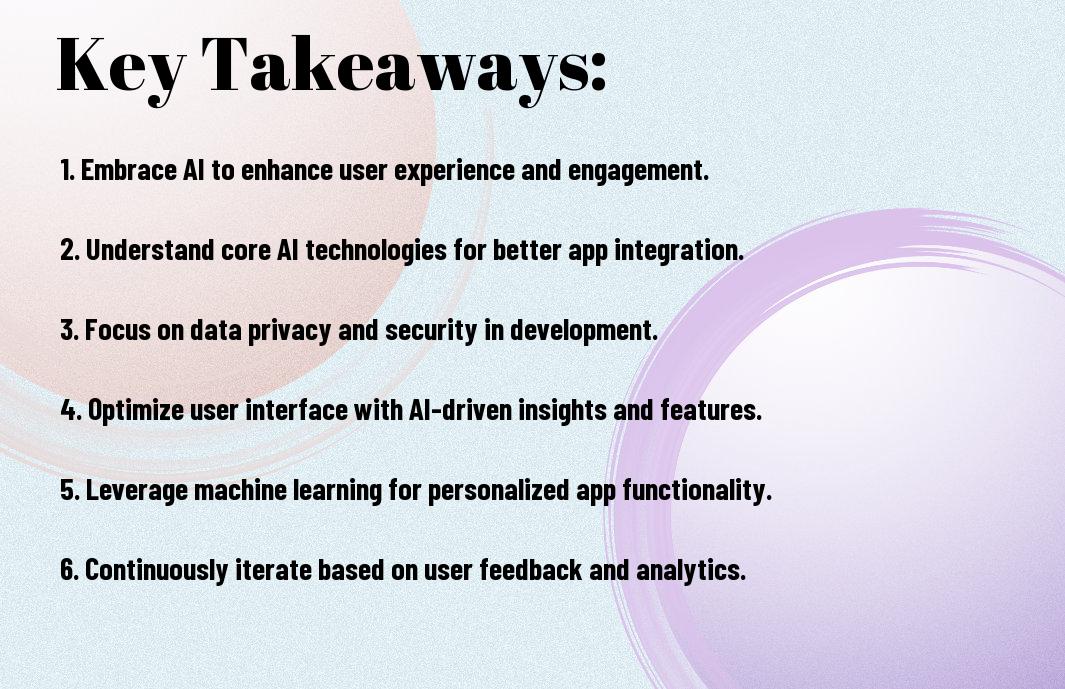
Key Takeaways:
- AI-powered app creation enables developers to build more intelligent and interactive applications, enhancing user experience and engagement through personalized features and automated processes.
- To get started with AI-powered app development, it’s necessary to choose the right tools and frameworks that align with your project goals, such as machine learning libraries and natural language processing APIs.
- Designing an AI-powered app requires a deep understanding of user needs and behaviors, allowing developers to create tailored solutions that meet specific demands and preferences.
- Integrating AI into app development can significantly reduce development time and costs, as automated testing and debugging tools help identify and fix issues more efficiently.
- As AI technology continues to evolve, staying up-to-date with the latest trends and advancements is vital for creating innovative and competitive AI-powered apps that drive business success and customer satisfaction.
AI Development Fundamentals
For a successful AI-powered app, you need to understand the basics of AI development, including machine learning and neural networks, to create an effective and efficient application that meets your needs and goals.
Machine Learning Frameworks
Beyond the basics, you’ll find that machine learning frameworks such as TensorFlow and PyTorch provide you with the tools and libraries necessary to build and train your AI models, allowing you to focus on developing your app’s unique features and functionality.
Neural Network Basics
Beneath the surface of AI development, you’ll discover that neural networks are a fundamental component, consisting of layers of interconnected nodes that process and transmit information, enabling your app to learn and make decisions based on the data it receives.
Further exploration of neural network basics will help you understand how to design and optimize your networks to achieve the best results for your app, taking into account factors such as data quality, network architecture, and training algorithms, to ensure your AI-powered app performs at its best and provides your users with a seamless and intuitive experience.
App Creation Tools
Some of the most popular app creation tools utilize AI to streamline the development process, making it easier for you to bring your ideas to life. These tools offer a range of features, from automated coding to design assistance, allowing you to focus on the creative aspects of your app.
No-Code AI Platforms
Along with the rise of AI, no-code platforms have become increasingly popular, enabling you to create apps without extensive coding knowledge. These platforms provide drag-and-drop interfaces and pre-built templates, making it easy for you to get started.
Advanced Development Environments
Before stepping into advanced development environments, you should consider the following tools:
- AI-powered IDEs
- Machine learning frameworks
Development Tools
| Tool | Description |
|---|---|
| AI-powered IDEs | Intelligent coding assistance |
| Machine learning frameworks | Pre-built algorithms for complex tasks |
You can use these tools to create complex apps with ease.
Understanding the capabilities of advanced development environments is key to creating sophisticated apps. You can leverage these environments to:
- Build custom AI models
- Integrate with existing systems
Advanced Development Features
| Feature | Benefit |
|---|---|
| Custom AI models | Tailored to your app’s specific needs |
| System integration | Seamless data exchange and workflow automation |
By utilizing these features, you can take your app development to the next level and create innovative, AI-powered solutions.
Data Integration
After setting up your AI-powered app, you’ll need to integrate data from various sources. You can explore tools like The 6 best AI app builders in 2025 to streamline your data integration process, making it easier for you to manage your app’s data.
Data Collection Methods
Alongside other methods, an crucial step in data integration is collecting data from various sources, which you can do through APIs, web scraping, or user input, allowing you to gather the data you need to power your app.
Processing and Analysis
Before you can use your data, you’ll need to process and analyze it, which involves cleaning, transforming, and modeling your data to extract insights that inform your app’s decision-making processes, helping you to make the most of your data.
Plus, as you examine deeper into processing and analysis, you’ll discover that you can use machine learning algorithms to identify patterns and trends in your data, enabling you to make predictions and improve your app’s performance, which is crucial for creating a seamless user experience and driving business success, and you can use this information to refine your app and make data-driven decisions.
User Experience Design
Now that you’re considering creating an AI-powered app, you’ll want to learn more about the process, which you can find in How to Build an AI app in 2025 [Complete Guide], to ensure your app provides a seamless user experience.
AI-Driven Interface Elements
Around the time you start designing your app, you’ll need to think about incorporating AI-driven interface elements that will enhance your user’s experience and make your app more engaging.
Predictive Interactions
To take your app to the next level, you’ll want to focus on creating predictive interactions that anticipate your user’s needs and provide personalized experiences.
Indeed, by leveraging AI-powered predictive interactions, you can create an app that learns your user’s behavior and adapts to their preferences, making it more likely that they will continue to use your app and become loyal customers, which is necessary for the success of your app, and as you examine deeper into the world of AI-powered app creation, you’ll discover more ways to utilize predictive interactions to enhance your user’s experience.
App Intelligence Features
All AI-powered apps rely on intelligent features to enhance user experience. You can integrate various features, such as natural language processing and computer vision, to make your app more interactive and engaging.
Natural Language Processing
One of the key features you can incorporate is natural language processing, which enables your app to understand and respond to user input in a more human-like way, allowing you to create a more personalized experience for your users.
Computer Vision Integration
Between the various features, computer vision integration stands out, enabling your app to interpret and understand visual data from images and videos, allowing you to create more immersive experiences for your users.
In fact, with computer vision integration, you can develop apps that can detect objects, recognize faces, and even track movements, opening up a wide range of possibilities for your app’s functionality and user engagement, and you can use this technology to create more sophisticated and interactive features that set your app apart from others.
Testing and Optimization
Your app’s performance is key to its success, and testing is an vital step in ensuring it meets your standards, with AI-powered tools streamlining the process and providing valuable insights.
Performance Metrics
Any assessment of your app’s performance relies on tracking key metrics, such as load times, crash rates, and user engagement, which AI can analyze to identify areas for improvement.
User Behavior Analysis
Users expect a seamless experience, and analyzing their behavior helps you understand how they interact with your app, allowing you to make data-driven decisions to enhance their experience.
A deeper explore user behavior analysis reveals that you can leverage AI to study user patterns, preferences, and pain points, enabling you to refine your app’s features, fix issues, and ultimately boost user satisfaction and retention, which is vital for your app’s long-term success.
Conclusion
Drawing together the insights from this guide, you now have a comprehensive understanding of AI-powered app creation. You can leverage your newfound knowledge to develop innovative apps that transform your business and enhance your users’ experience. With your skills and expertise, you can unlock the full potential of AI and create cutting-edge apps that drive success and growth for your organization, taking your mobile strategy to the next level with your expertise in AI-powered app creation.
FAQ
Q: What is the main benefit of using AI in app creation, and how can it enhance the development process?
A: The main benefit of using AI in app creation is that it enables developers to automate repetitive tasks, improve app performance, and provide personalized user experiences. AI-powered tools can help with tasks such as data analysis, code generation, and testing, allowing developers to focus on more complex and creative aspects of app development. Additionally, AI can help improve app security, reduce bugs, and enhance overall user engagement, making it an imperative component of modern app creation.
Q: What kind of skills and knowledge are required to create an AI-powered app, and are there any specific tools or platforms that can facilitate the process?
A: To create an AI-powered app, developers should have a solid understanding of programming languages such as Python, Java, or Swift, as well as experience with machine learning frameworks like TensorFlow or Core ML. Familiarity with data structures, algorithms, and software design patterns is also necessary. Additionally, developers can leverage various tools and platforms, such as Google Cloud AI Platform, Microsoft Azure Machine Learning, or Apple’s Core ML, to streamline the development process and integrate AI capabilities into their apps. These platforms provide pre-built models, APIs, and development kits that can help simplify the process of building AI-powered apps.
Q: How can developers ensure that their AI-powered apps are transparent, fair, and unbiased, and what steps can be taken to address potential ethical concerns?
A: To ensure that AI-powered apps are transparent, fair, and unbiased, developers should prioritize data quality, implement robust testing and validation procedures, and regularly audit their AI models for potential biases. They should also provide clear explanations of how the AI system works, what data it collects, and how it makes decisions. Furthermore, developers can adopt ethical guidelines and frameworks, such as those provided by the AI Now Institute or the IEEE, to help address potential concerns around AI transparency, accountability, and fairness. By taking these steps, developers can build trust with their users and create AI-powered apps that are both effective and responsible.


