
As you navigate the ever-evolving landscape of mobile apps, you’re likely aware of the increasing importance of effective monetization strategies. Your ability to generate revenue from your app is directly tied to its success, and AI is revolutionizing the way you approach this challenge. You’re now able to leverage AI-powered tools to optimize your app’s monetization, and this shift is transforming the industry. You can expect to learn how AI is changing the game for app developers and publishers, and how you can harness its power to boost your app’s revenue.
Key Takeaways:
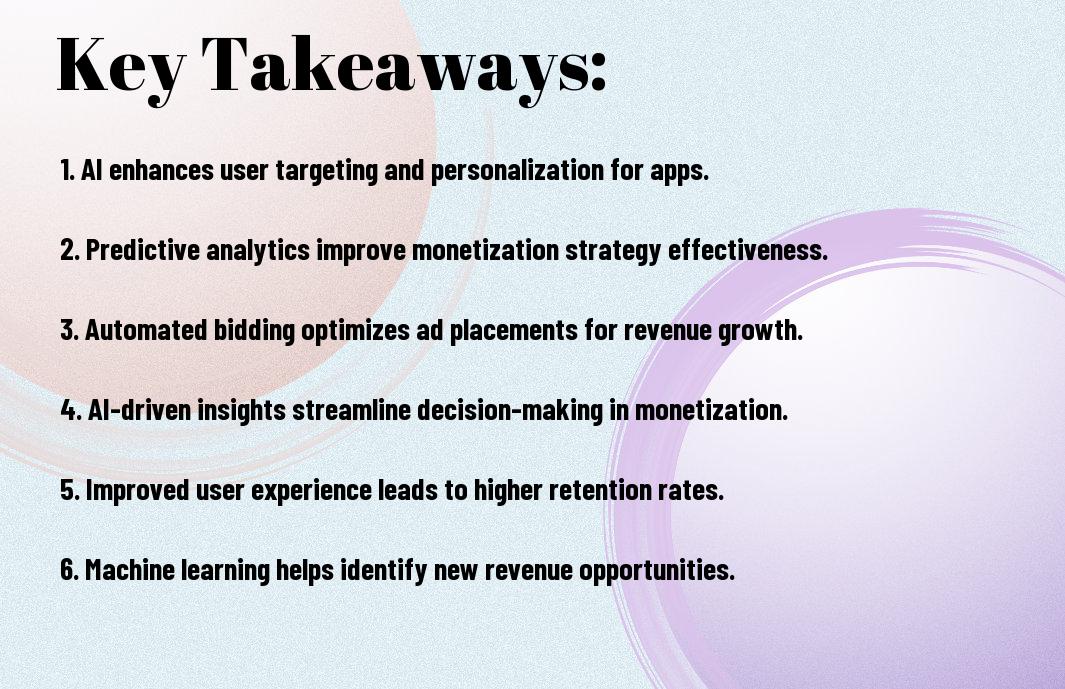
- The integration of Artificial Intelligence (AI) in app monetization strategies is transforming the way developers approach revenue generation, enabling more personalized and efficient advertising experiences for users.
- AI-driven algorithms can analyze user behavior and preferences, allowing for targeted advertising that increases engagement and conversion rates, thereby boosting app revenue.
- AI-powered tools can help optimize in-app purchasing and subscription models by predicting user lifetime value and identifying the most effective pricing strategies.
- The use of AI in app monetization also enhances user experience by minimizing intrusive ads and ensuring that the advertising content is relevant and non-disruptive to the user’s interaction with the app.
- As AI technology continues to evolve, it is expected to play an increasingly significant role in app monetization, enabling developers to create more sophisticated and effective revenue streams that balance user experience with revenue goals.

AI-Driven Revenue Models
The emergence of AI-driven revenue models has transformed the app monetization landscape, enabling you to maximize your earnings through data-driven strategies. You can leverage AI to analyze user behavior, optimize pricing, and deliver personalized experiences, ultimately increasing your revenue streams.
Machine Learning in Pricing Optimization
Beneath the surface of AI-driven revenue models lies the power of machine learning, which you can utilize to optimize your pricing strategies. You can use machine learning algorithms to analyze user behavior and adjust your pricing accordingly, ensuring you maximize your revenue.
Predictive Analytics for User Behavior
Optimizing your app’s performance relies heavily on understanding your users’ behavior, and you can achieve this through predictive analytics. You can use predictive analytics to forecast user behavior, identifying trends and patterns that inform your monetization strategies and help you make data-driven decisions.
At the heart of predictive analytics for user behavior is the ability to analyze vast amounts of data, which you can use to create detailed user profiles and tailor your app’s experience to meet their needs. You can use this information to develop targeted advertising campaigns, offer personalized recommendations, and optimize your in-app purchases, ultimately enhancing your users’ experience and increasing your revenue.
Personalization Through AI
One of the key benefits of AI in app monetization is the ability to personalize the user experience. You can use AI to analyze user behavior and tailor your app’s content and ads to individual users, increasing engagement and revenue.
Dynamic Content Delivery
With the help of AI, you can deliver content that is tailored to each user’s preferences and behavior, ensuring that your app stays relevant and engaging. You can use AI to optimize your content delivery, providing users with the most relevant and interesting content at the right time.
Smart User Segmentation
At the heart of effective personalization is smart user segmentation, which allows you to group users based on their behavior, demographics, and preferences. You can use AI to analyze user data and create targeted segments, enabling you to deliver personalized content and ads that resonate with each group.
Content that is tailored to specific user segments can significantly increase user engagement and conversion rates. As you implement smart user segmentation, you will be able to identify high-value user groups and deliver targeted content that meets their needs, ultimately driving more revenue for your app. You will be able to refine your monetization strategy, ensuring that your app is optimized for maximum revenue and user satisfaction.
Automated Advertising Systems
Now, as you explore the world of app monetization, you’ll find that automated advertising systems are becoming increasingly popular, allowing you to optimize your ad revenue with ease. You can learn more about the latest trends in app monetization by visiting The Future of Mobile App Monetization: Top Trends & Strategies to stay ahead of the game.
Real-time Bid Optimization
Any adjustments you make to your ad bidding strategy can significantly impact your revenue, and with automated systems, you can optimize bids in real-time, ensuring you get the best possible price for your ad space.
Ad Placement Intelligence
Among the key benefits of automated advertising systems is the ability to optimize ad placement, ensuring that your ads are seen by the right people at the right time, increasing their effectiveness and your revenue.
Plus, with ad placement intelligence, you can analyze user behavior and preferences to determine the most effective ad placements, allowing you to maximize your ad revenue and create a better user experience, as you can place ads in a way that is non-intrusive and engaging for your users.
AI-Enhanced User Experience
Once again, you’ll find that AI is revolutionizing the way you approach app monetization, this time by enhancing user experience, which directly impacts your revenue streams.
Smart Feature Recommendations
Recommendations based on user behavior help you personalize your app, making it more appealing to your target audience and increasing the likelihood of in-app purchases and engagement.
Engagement Pattern Analysis
About the way users interact with your app, AI analyzes patterns to help you understand what keeps them engaged, allowing you to adjust your strategies accordingly.
Also, by delving deeper into engagement pattern analysis, you can identify trends and preferences, enabling you to tailor your content and features to meet the evolving needs of your users, thereby boosting retention and monetization potential.
Data-Driven Monetization
After implementing AI in your app, you can leverage data to inform your monetization strategies. You can learn more about effective monetization techniques by checking out How should you monetize your AI features? – by Palle Broe, which provides valuable insights to help you optimize your approach.
Revenue Stream Diversification
Driven by data, you can create a robust monetization strategy that includes multiple revenue streams, allowing you to adapt to changing market conditions and user behavior, ensuring your app remains profitable.
Performance Metrics Analysis
Above all, analyzing performance metrics is crucial to understanding your app’s financial performance, enabling you to make data-driven decisions to improve your monetization strategy and increase revenue.
Diversification of revenue streams is key to a successful monetization strategy, and by analyzing performance metrics, you can identify areas of improvement, optimize your approach, and ultimately increase your app’s revenue, allowing you to achieve your business goals and stay competitive in the market.
Ethical Considerations
Your approach to AI in app monetization strategies must consider the ethical implications, ensuring that your methods are fair and respectful of users.
User Privacy Protection
Besides the benefits of AI, you need to prioritize user data protection, implementing robust security measures to safeguard sensitive information and maintain trust.
Transparent AI Implementation
Behind every successful AI-powered monetization strategy is a transparent approach, where you clearly disclose how user data is used and provide opt-out options when necessary.
Protection of user rights is imperative when implementing AI in your app monetization strategies, and being transparent about AI-driven decisions helps build trust and credibility with your audience, allowing you to leverage AI effectively while maintaining a positive user experience.
Conclusion
To wrap up, you now have a deeper understanding of the rise of AI in app monetization strategies. You can leverage AI to optimize your app’s revenue streams, making data-driven decisions to boost your earnings. With AI, you can personalize your users’ experiences, increasing engagement and driving growth. By incorporating AI into your monetization strategy, you can stay ahead of the competition and maximize your app’s potential.
FAQ
Q: What is the current state of AI in app monetization strategies and how is it impacting the industry?
A: The integration of Artificial Intelligence (AI) in app monetization strategies is rapidly evolving, transforming the way apps generate revenue. Currently, AI is being used to personalize user experiences, optimize ad placements, and predict user behavior. This shift is significantly impacting the industry by enabling app developers to create more effective and user-friendly monetization models, leading to increased revenue and improved user engagement. As AI technology continues to advance, we can expect to see even more innovative and sophisticated app monetization strategies emerge.
Q: How can app developers leverage AI to enhance their in-app advertising and maximize revenue?
A: App developers can leverage AI to enhance their in-app advertising by utilizing machine learning algorithms to analyze user data and behavior. This allows for the creation of highly targeted and personalized ad experiences, increasing the likelihood of user engagement and conversion. Additionally, AI can be used to optimize ad placements, formats, and pricing in real-time, ensuring maximum revenue potential. By integrating AI into their in-app advertising strategies, developers can create a more seamless and non-intrusive user experience, while also driving revenue growth.
Q: What are the potential challenges and limitations of implementing AI in app monetization strategies, and how can developers overcome them?
A: While AI offers significant opportunities for app monetization, there are also potential challenges and limitations to consider. One of the primary concerns is data quality and privacy, as AI algorithms require large amounts of user data to function effectively. Developers must ensure that they are collecting and using data in a transparent and secure manner. Another challenge is the potential for AI-driven ad experiences to become overly intrusive or annoying, leading to user frustration and decreased engagement. To overcome these challenges, developers must carefully balance the use of AI with user experience considerations, and prioritize transparency, privacy, and user consent. By doing so, they can harness the power of AI to create effective and user-friendly app monetization strategies.


