As you develop and refine your applications, you’re likely looking for ways to make complex data more engaging and accessible to your users. Your goal is to create an intuitive and informative experience, and data visualization plays a significant role in achieving this. By integrating artificial intelligence into your data visualization strategies, you can unlock new possibilities for presenting insights and trends, enabling your users to make more informed decisions and driving your app’s overall success.

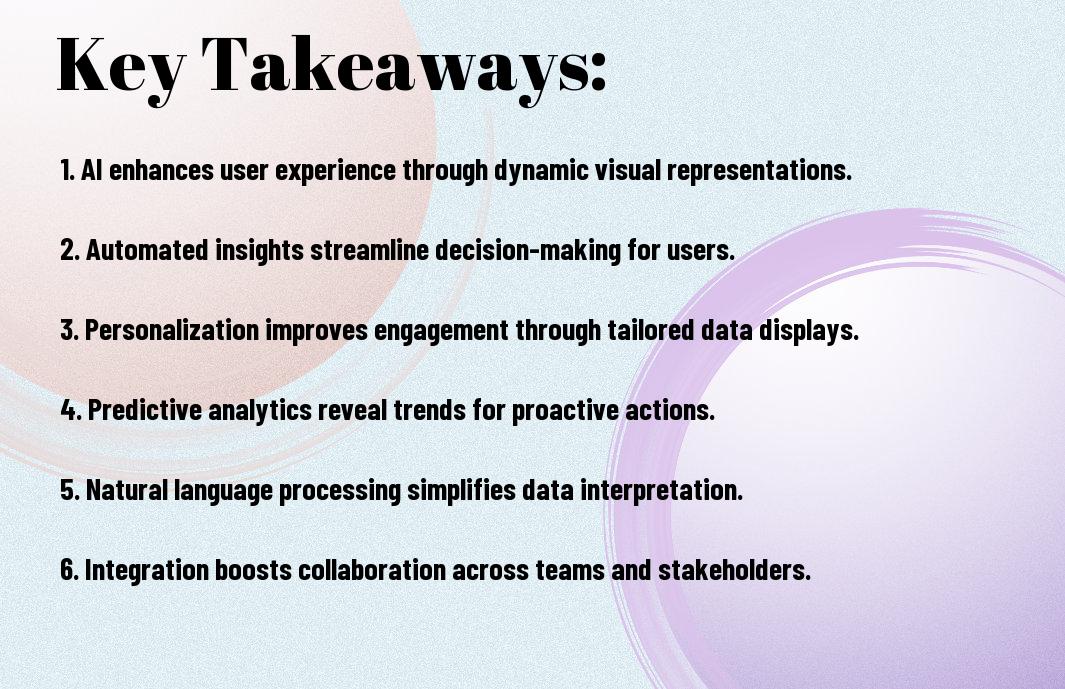
Key Takeaways:
- Integrating artificial intelligence (AI) into data visualization in apps can significantly enhance user experience by providing more accurate and personalized insights, thus increasing user engagement and interaction with the application.
- AI-driven data visualization can automate the process of identifying trends and patterns in complex data sets, allowing for faster and more informed decision-making for both businesses and individuals using the apps.
- The use of AI in data visualization enables the creation of dynamic and interactive visualizations that adapt to the user’s preferences and behavior, offering a more intuitive and user-friendly interface.
- AI-powered data visualization tools can handle large volumes of data from various sources, making it easier to integrate multiple data sets and provide a comprehensive view of the information, which is particularly beneficial for applications that rely on real-time data analysis.
- By leveraging machine learning algorithms, AI can predict user needs and offer suggestions for visualization, thereby streamlining the data analysis process and making data visualization more accessible to a broader range of users, including those without extensive data analysis backgrounds.
Core Principles of AI-Enhanced Data Visualization
For effective data visualization, you need to understand how artificial intelligence enhances your visualizations, making them more informative and engaging. You can leverage AI to analyze large datasets, identify patterns, and create interactive visualizations that help you make data-driven decisions.
Machine Learning Pattern Recognition
On the basis of machine learning algorithms, you can recognize patterns in your data, enabling you to identify trends and correlations that may not be immediately apparent. You can use these insights to create more accurate and informative visualizations.
Automated Visual Optimization
After integrating AI into your data visualization process, you can automate the optimization of your visualizations, ensuring that they are tailored to your specific needs and audience. You can use AI to adjust colors, layouts, and other visual elements to create a more effective and engaging visualization.
Visualization is a key aspect of your data analysis, and automated visual optimization can help you refine your visualizations to better communicate your findings. You can use AI to experiment with different visualization types, such as bar charts, scatter plots, or heat maps, to determine which one best conveys your message, allowing you to focus on interpreting your data and making informed decisions.
Smart Color and Layout Systems
Some of the most effective ways to elevate data visualization in apps involve leveraging artificial intelligence to create more intuitive and engaging user experiences, and you can achieve this by incorporating smart color and layout systems that adapt to your needs.
Dynamic Color Palette Generation
Between the various options available, AI-powered tools can help you generate dynamic color palettes that enhance your data visualization, allowing you to focus on the insights that matter most to your work.
Contextual Space Utilization
Among the key benefits of smart layout systems is their ability to optimize the use of space in your app, ensuring that your data visualizations are clear and easy to understand, and you can use this to your advantage to create more effective dashboards and reports.
Consequently, as you probe deeper into contextual space utilization, you will find that AI can help you create layouts that automatically adjust to the size and complexity of your data, allowing you to make the most of your screen real estate and present your insights in a more compelling and accessible way, which can significantly enhance your ability to extract valuable information from your data and make informed decisions based on your findings.
Predictive Analytics Visualization
Once again, you can leverage AI to enhance your data visualization capabilities, particularly with predictive analytics. You can explore Top 5 AI Tools for Data Visualization to Consider in 2025 to discover the latest trends and tools.
Real-time Data Forecasting
About to make informed decisions, you need real-time data forecasting to analyze current trends and predict future outcomes, enabling you to adjust your strategy accordingly.
Trend Pattern Highlighting
Predictive analytics helps you identify trend patterns in your data, allowing you to make data-driven decisions and stay ahead of the competition.
Realtime trend pattern highlighting enables you to respond quickly to changes in your data, giving you a competitive edge in the market, and you can use this insight to optimize your business strategies and improve your overall performance.
Interactive Intelligence
All aspects of your app’s data visualization can be enhanced with artificial intelligence, enabling you to create a more engaging and personalized experience for your users.
User Behavior Adaptation
Along with AI-driven insights, you can adapt your app’s data visualization to your users’ behavior, providing them with a tailored experience that meets their specific needs and preferences.
Responsive Design Elements
Beside the personalized experience, you can also use AI to optimize your app’s design elements, such as layout and visuals, to ensure a seamless user experience across various devices and platforms.
The responsive design elements in your app can be further enhanced by using AI to analyze user interactions and adjust the layout, color scheme, and other visual elements to create a more intuitive and engaging experience, allowing you to make data-driven decisions to improve your app’s overall performance and user satisfaction.
Performance Optimization
Not all data visualization apps are created equal, and you’ll need to consider performance optimization to ensure your app runs smoothly, especially when dealing with large datasets.
Data Processing Efficiency
The effectiveness of your app’s data processing capabilities will directly impact user experience, and you should focus on streamlining your data pipelines to minimize latency and maximize throughput, allowing your app to handle complex data with ease, so you can provide your users with a seamless experience.
Rendering Techniques
With the right rendering techniques, you can significantly improve your app’s performance, and you should explore various options, such as hardware acceleration and caching, to optimize the visualization process, enabling your app to render complex visualizations quickly and efficiently, so you can deliver high-quality results to your users.
Hence, as you probe deeper into rendering techniques, you’ll discover that leveraging AI-powered rendering engines can help you achieve even better performance, allowing your app to adapt to different hardware configurations and user preferences, so you can provide a personalized experience that meets your users’ unique needs, and you can focus on creating engaging and informative visualizations that drive insights and decision-making.
Accessibility and Inclusivity
To create an inclusive app, you need to consider the diverse needs of your users. This involves incorporating features that cater to different abilities and preferences, ensuring that everyone can effectively engage with your data visualizations.
AI-Driven Accessibility Features
Among the various tools at your disposal, AI-driven accessibility features can significantly enhance the user experience. You can leverage AI to generate alt-text for images, provide audio descriptions, and offer personalized font sizes and colors, making your app more accessible to a broader audience.
Multi-format Presentation
Inclusivity is key when presenting data, and offering multiple formats is an effective way to achieve this. You can use AI to generate different formats, such as text, images, and audio, allowing users to choose the format that best suits their needs.
But as you explore deeper into multi-format presentation, you’ll find that it’s not just about providing alternative formats, but also about ensuring that each format is optimized for the user’s device and preferences. You can use AI to analyze user behavior and adapt the presentation format accordingly, creating a more personalized and engaging experience for your users.
To wrap up
Now that you’ve explored the potential of artificial intelligence in elevating data visualization in apps, you can enhance your user experience by leveraging AI-driven insights. You will be able to create more engaging and informative visualizations, allowing your users to make data-driven decisions. With AI, your apps will provide more accurate and personalized experiences, setting you apart from the competition and driving your business forward. You can now unlock new possibilities for your apps with AI-powered data visualization.
FAQ
Q: What role does Artificial Intelligence play in elevating data visualization in apps?
A: Artificial Intelligence (AI) plays a significant role in elevating data visualization in apps by enabling the automatic generation of insights and patterns from complex data sets. AI-powered algorithms can analyze large volumes of data, identify trends, and create interactive and dynamic visualizations that help users understand the data more effectively. This leads to better decision-making and improved user experience. Additionally, AI-driven data visualization can adapt to user behavior and preferences, providing personalized insights and recommendations.
Q: How can developers integrate Artificial Intelligence into their data visualization tools to enhance user engagement?
A: Developers can integrate Artificial Intelligence into their data visualization tools by utilizing machine learning libraries and frameworks that provide pre-built functions for data analysis and visualization. They can also use natural language processing (NLP) to enable users to interact with data visualizations using voice or text commands. Furthermore, developers can leverage AI-powered analytics platforms that offer automated data storytelling and insights generation, allowing users to explore data in a more intuitive and engaging way. By integrating AI, developers can create data visualizations that are not only informative but also interactive and immersive.
Q: What are the potential benefits of using Artificial Intelligence in data visualization for business intelligence and decision-making?
A: The potential benefits of using Artificial Intelligence in data visualization for business intelligence and decision-making are numerous. AI-powered data visualization can help businesses identify new opportunities, predict market trends, and optimize operations by uncovering hidden patterns and correlations in data. Additionally, AI-driven data visualization can facilitate faster decision-making by providing real-time insights and recommendations, enabling businesses to respond quickly to changing market conditions. Moreover, AI can help reduce the risk of human error in data analysis, providing more accurate and reliable insights that inform strategic business decisions. Overall, the integration of AI in data visualization can lead to improved business outcomes, increased competitiveness, and enhanced innovation.