As you strive to improve your website or application’s user experience, you can leverage AI-driven insights to inform your design decisions. You can learn more about how AI enhances user experiences by reading about AI-Driven UX Design: Enhancing user experiences with machine learning. By utilizing AI, you can create a more intuitive and seamless navigation experience for your users, ultimately driving engagement and conversion.

Key Takeaways:
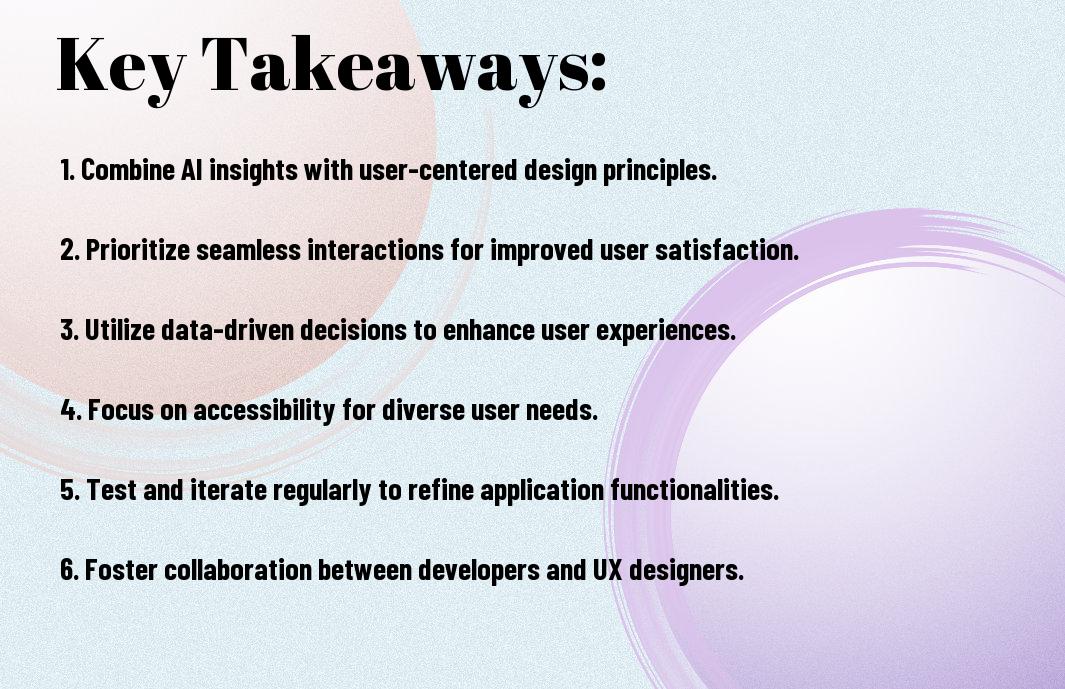
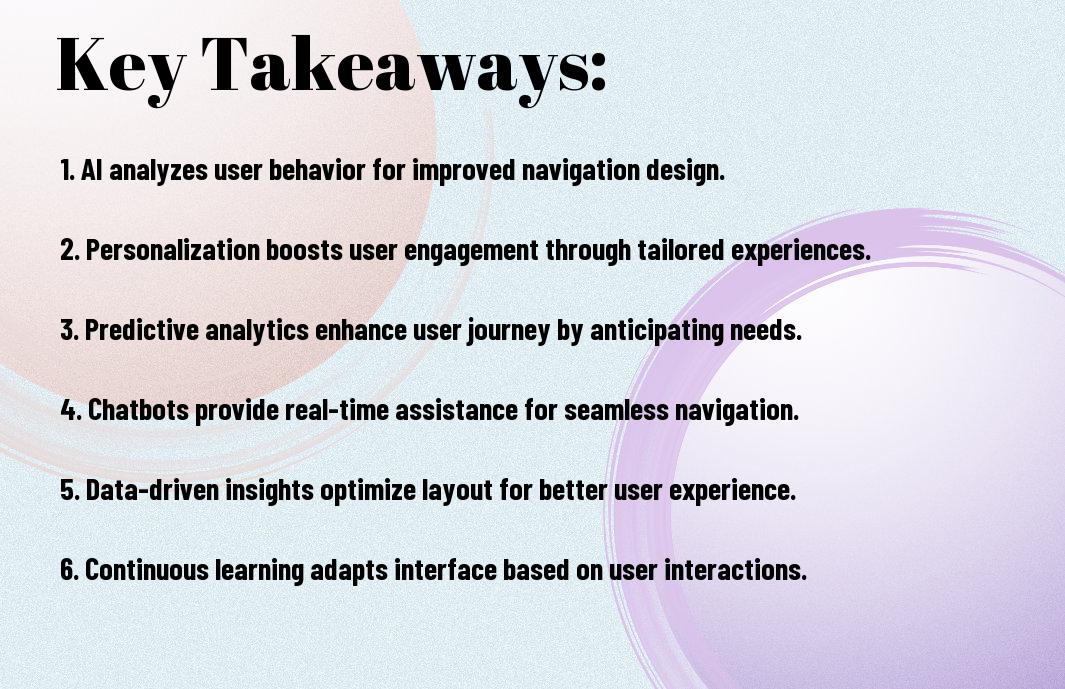
- AI-driven insights can significantly improve navigation by analyzing user behavior and providing personalized recommendations, leading to a more intuitive and user-friendly experience.
- Implementing AI-powered analytics can help identify pain points and areas of improvement in the navigation process, allowing for data-driven decision making and optimization.
- AI-driven insights can enhance the overall user experience by providing real-time feedback and suggestions, enabling users to quickly find what they are looking for and complete their goals efficiently.
- By leveraging machine learning algorithms, businesses can develop predictive models that anticipate user needs and preferences, resulting in a more seamless and engaging navigation experience.
- Integrating AI-driven insights into navigation and UX design can lead to increased user satisfaction, reduced bounce rates, and improved conversion rates, ultimately driving business success and growth.
AI Navigation Fundamentals
A key aspect of enhancing navigation and UX is understanding the role of AI in driving insights, and you will find that AI navigation fundamentals provide a solid foundation for your understanding of this complex topic.
Machine Learning in Navigation Systems
Taking a closer look at machine learning in navigation systems, you will discover that it enables your website or application to learn from user behavior and adapt to their needs, making your navigation more intuitive and user-friendly.
Pattern Recognition for User Behavior
Any analysis of user behavior begins with recognizing patterns, and you can use AI-driven insights to identify how users interact with your navigation system, allowing you to make data-driven decisions to improve your UX.
Plus, as you probe deeper into pattern recognition for user behavior, you will be able to identify trends and anomalies in how users navigate your website or application, enabling you to refine your navigation system and create a more seamless experience for your users, which can lead to increased engagement and conversion rates, ultimately benefiting your business and enhancing your overall user experience.
Data Collection and Analysis
While gathering data, you’ll need to consider various factors that impact your navigation and UX. Your goal is to collect relevant information that will help you make informed decisions.
User Interaction Metrics
Users typically interact with your platform in unique ways, providing valuable insights into their behavior. You can track metrics such as click-through rates, time spent on pages, and bounce rates to understand your users’ preferences.
Behavioral Data Processing
Collecting behavioral data is important to understanding your users’ needs. You can analyze data from various sources, including social media, search queries, and user feedback, to identify patterns and trends that inform your design decisions.
And as you explore deeper into behavioral data processing, you’ll discover that it involves complex algorithms and machine learning techniques to analyze large datasets. You’ll be able to identify areas of improvement, optimize your navigation, and create a more personalized experience for your users, ultimately enhancing your overall UX.
Predictive Navigation Models
Despite the complexity of user behavior, predictive navigation models can help you anticipate and prepare for various scenarios, enhancing your overall user experience. By analyzing user data and patterns, you can create personalized navigation paths that cater to individual preferences, leading to increased engagement and satisfaction.
Algorithm Implementation
Alongside the development of predictive models, you’ll need to consider the algorithm implementation that will drive your navigation system. As you design your algorithm, you’ll want to ensure it can process large amounts of data efficiently, providing accurate predictions and recommendations to inform your navigation design.
Real-time Adaptation Systems
Around the implementation of real-time adaptation systems, you’ll be able to adjust your navigation in response to changing user behavior, allowing you to stay ahead of the curve and provide a more dynamic experience. This enables you to refine your navigation strategy based on immediate feedback, creating a more responsive and user-friendly interface.
Navigation through real-time adaptation systems allows you to refine your approach based on immediate user feedback, creating a more responsive and user-friendly interface. As you implement these systems, you’ll be able to monitor user behavior and adjust your navigation strategy accordingly, ensuring that your users can find what they need quickly and efficiently, and that you can adapt to changing user needs over time, ultimately leading to increased user satisfaction and engagement with your platform.
User Experience Enhancement
Keep in mind that AI-driven insights can significantly improve your website’s navigation and overall user experience. By leveraging these insights, you can create a more intuitive and engaging interface that meets your users’ needs.
Personalized Navigation Paths
Following the analysis of user behavior, you can create personalized navigation paths that cater to individual preferences, enhancing their overall experience and encouraging them to explore your site further.
Interface Optimization
Among the key benefits of AI-driven insights is the ability to optimize your interface for maximum usability, allowing you to streamline your design and make data-driven decisions to improve your users’ experience.
Interface optimization is a key aspect of enhancing user experience, as it enables you to refine your design based on real-user behavior, ensuring that your website is tailored to meet the needs of your target audience, and as you continue to analyze user interactions, you can make informed decisions to further refine your interface, ultimately leading to increased user satisfaction and engagement with your website.
Performance Metrics
Now that you have implemented AI-driven insights, it’s imperative to track your navigation and UX performance using relevant metrics, allowing you to refine your strategy and optimize your user experience.
Navigation Efficiency Indicators
About the metrics you choose, consider those that evaluate navigation efficiency, such as click-through rates and time spent on pages, to gauge how well your AI-driven insights are guiding users through your platform.
User Satisfaction Measurements
An imperative aspect of performance metrics is measuring user satisfaction, which can be achieved through surveys, feedback forms, and other tools that help you understand your users’ needs and preferences, enabling you to make data-driven decisions to improve your UX.
User satisfaction is a key performance indicator that you should closely monitor, as it directly impacts your overall user experience and retention rates; by analyzing user feedback and behavior, you can identify areas for improvement and make targeted adjustments to your AI-driven navigation and UX strategy, ultimately enhancing your users’ overall experience and driving engagement with your platform.
Implementation Framework
For a successful integration of AI-driven insights, you need to establish a clear plan and timeline. This involves setting specific goals, identifying key performance indicators, and allocating necessary resources. Your implementation framework should be tailored to your organization’s unique needs and objectives.
Integration Guidelines
With careful planning, you can ensure a seamless integration of AI-driven insights into your existing systems. You should consider factors such as data quality, system compatibility, and user adoption to maximize the benefits of AI-driven navigation and UX enhancements.
System Requirements
Before implementing AI-driven insights, you need to assess your system’s capabilities and limitations. You should evaluate your current infrastructure, software, and hardware to determine if they can support the integration of AI-driven tools and technologies.
For instance, you may need to upgrade your servers or invest in new software to support the processing and analysis of large datasets. You should also consider the scalability of your system to ensure it can handle increased traffic and user engagement resulting from AI-driven navigation and UX enhancements. This will help you make informed decisions about your system requirements and ensure a successful implementation.
Summing up
Following this, you can leverage AI-driven insights to enhance your navigation and UX. By doing so, you will be able to create more personalized and intuitive experiences for your users. To learn more about how AI is changing the landscape of user experience, you can visit The Impact of AI on UX Design Strategies – Yellowbrick and discover new ways to improve your design strategies, ultimately benefiting your users and your business.
FAQ
Q: What are AI-driven insights and how can they enhance navigation in digital products?
A: AI-driven insights refer to the use of artificial intelligence and machine learning algorithms to analyze user behavior, preferences, and patterns, providing valuable information to improve the user experience. By leveraging these insights, digital products can enhance navigation by predicting user intent, simplifying complex interfaces, and offering personalized recommendations, ultimately leading to increased user engagement and satisfaction. For instance, AI-driven insights can help identify areas of friction in the user journey, allowing designers to optimize the navigation flow and reduce bounce rates.
Q: How can AI-driven insights inform the design of intuitive and user-friendly interfaces?
A: AI-driven insights can inform the design of intuitive and user-friendly interfaces by providing data-driven recommendations on layout, content, and functionality. By analyzing user behavior and feedback, AI algorithms can identify patterns and trends that inform design decisions, such as the placement of calls-to-action, the simplification of menus, and the optimization of search functionality. Additionally, AI-driven insights can help designers identify areas where users are experiencing difficulty or frustration, enabling them to make targeted design improvements that enhance the overall user experience.
Q: Can AI-driven insights be used to personalize the user experience and improve navigation for specific user segments?
A: Yes, AI-driven insights can be used to personalize the user experience and improve navigation for specific user segments. By analyzing user behavior, preferences, and demographics, AI algorithms can create detailed user profiles that enable personalized recommendations, content, and navigation paths. For example, AI-driven insights can help identify power users who require more advanced features and functionality, while also identifying new users who may require additional guidance and support. By tailoring the user experience to specific segments, digital products can increase user engagement, conversion rates, and overall satisfaction, ultimately driving business success.