Solutions

From Data to Apps – Using AI Models for Innovative Solutions

As you navigate the world of technology, you’re likely aware of the vast amounts of data at your disposal. You can harness this data to create innovative solutions using AI models, transforming your approach to problem-solving. Your ability to leverage AI will enable you to develop cutting-edge applications, driving growth and efficiency in various aspects of your life and business. You will learn how to bridge the gap between data and applications, unlocking new possibilities and opportunities.

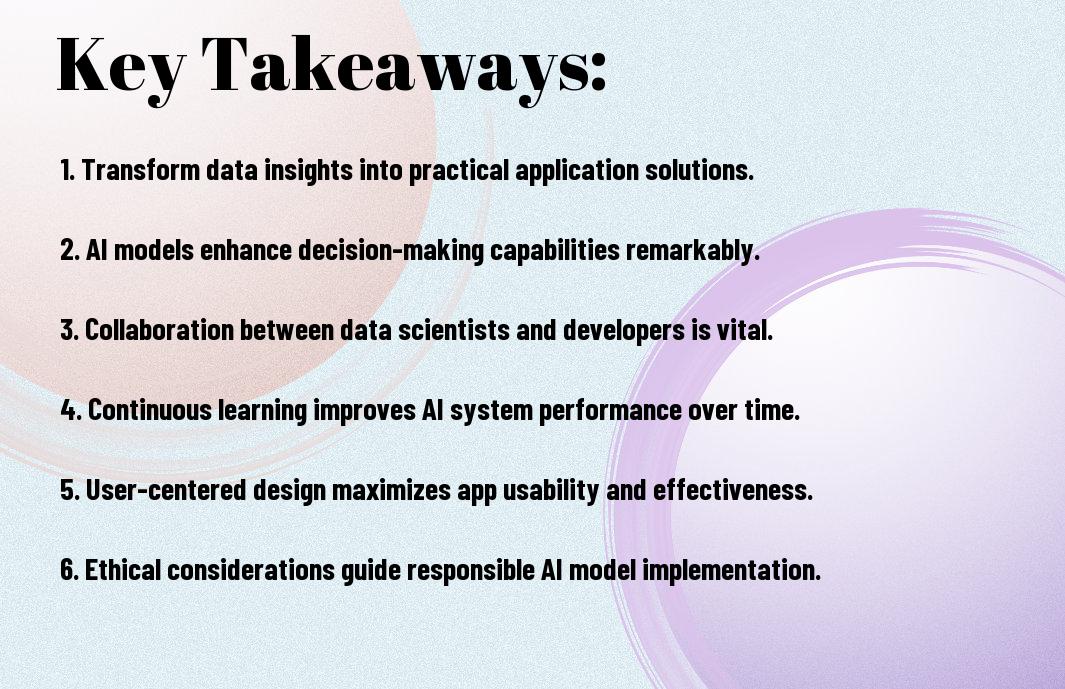
Key Takeaways:

  • AI models can be leveraged to transform data into actionable insights, enabling the development of innovative applications that drive business value and improve decision-making processes.
  • Effective integration of AI models into app development requires a deep understanding of the underlying data, as well as the ability to identify opportunities for automation and optimization.
  • By using AI models, developers can create more personalized and interactive user experiences, leading to increased user engagement and loyalty.
  • The use of AI models in app development also enables real-time data analysis and processing, allowing for more agile and responsive applications that can adapt to changing user needs.
  • As AI technology continues to evolve, it is likely to play an increasingly important role in shaping the future of app development, with potential applications in areas such as predictive maintenance, intelligent interfaces, and autonomous systems.
Data Collection and Preparation

A key step in developing innovative solutions using AI models is collecting and preparing your data. You will need to gather data from various sources, ensure its quality, and transform it into a suitable format for analysis.

Raw Data Sources

The initial step in data collection involves identifying and gathering raw data from sources such as databases, files, or external data providers, which will serve as the foundation for your AI models, and you should consider the relevance and accuracy of the data you collect.

Data Cleaning Methods

Cleaning your data is crucial to remove inconsistencies and errors, and you can use various techniques such as data normalization, handling missing values, and data transformation to prepare your data for analysis, allowing you to develop more accurate AI models.

Another important aspect of data cleaning methods is data validation, where you verify the accuracy and consistency of your data, and you can use data profiling and data quality metrics to identify and address any data quality issues, ensuring that your AI models are trained on high-quality data, which is crucial for developing reliable and effective solutions.

AI Model Selection

You will need to consider several factors when selecting an AI model for your innovative solution, including the type of problem you’re trying to solve and the data you have available.

Machine Learning Frameworks

After evaluating your options, you can choose from popular machine learning frameworks such as TensorFlow or PyTorch to build and train your model.

Model Architecture Types

You can select from various model architecture types, including:

  • Feedforward Neural Networks
  • Convolutional Neural Networks
  • Recurrent Neural Networks
  • Transformers
  • Autoencoders

Recognizing the strengths and weaknesses of each type will help you make an informed decision.

Behind the scenes, the key to selecting the right model lies in understanding your data and the problem you’re trying to solve. The following table breaks down the characteristics of different model types:

Model Type Description
Feedforward Neural Networks Simple, efficient, and effective for basic tasks
Convolutional Neural Networks Ideal for image and signal processing tasks
Recurrent Neural Networks Suitable for sequential data and time-series forecasting
Transformers State-of-the-art for natural language processing tasks
Autoencoders Useful for dimensionality reduction and anomaly detection

Learning from your data and the problem you’re trying to solve, you can choose the most suitable model architecture type. You can select from various options, including:

  • Feedforward Neural Networks
  • Convolutional Neural Networks
  • Recurrent Neural Networks
  • Transformers
  • Autoencoders

Recognizing the strengths and weaknesses of each type will help you make an informed decision. The following table provides a summary of the characteristics of different model types:

Model Type Description
Feedforward Neural Networks Simple, efficient, and effective for basic tasks
Convolutional Neural Networks Ideal for image and signal processing tasks
Recurrent Neural Networks Suitable for sequential data and time-series forecasting
Transformers State-of-the-art for natural language processing tasks
Autoencoders Useful for dimensionality reduction and anomaly detection

Development Pipeline

Now that you have your AI model, it’s time to integrate it into your development pipeline, enabling you to create innovative solutions that transform your data into actionable insights and user-friendly apps.

Training Procedures

To train your AI model effectively, you will need to prepare your data, select the appropriate algorithms, and fine-tune the model’s parameters to achieve optimal performance, allowing you to develop a robust and reliable model that meets your needs.

Testing and Validation

Procedures for testing and validation are important to ensure your AI model functions as expected, and you can evaluate its performance using various metrics and benchmarks to identify areas for improvement, enabling you to refine your model and achieve better results.

Another aspect of testing and validation involves evaluating your model’s ability to generalize to new, unseen data, and you can use techniques such as cross-validation to assess its performance and make adjustments as needed, allowing you to develop a model that is both accurate and reliable, and that provides valuable insights and solutions for your users.

App Integration

Not only does app integration enable seamless interaction between different components, but it also allows you to leverage AI models for innovative solutions, enhancing your overall user experience.

API Development

Above all, you will need to focus on developing robust APIs that can effectively communicate with your AI models, ensuring a smooth data exchange and enabling you to build powerful applications.

Frontend Implementation

Behind the scenes, your frontend implementation plays a significant role in showcasing the capabilities of your AI models, and you will need to design an intuitive interface that allows users to interact with your application effortlessly.

Consequently, as you explore deeper into frontend implementation, you will discover that a well-designed user interface can make a significant difference in how your users perceive and utilize your application, and you should prioritize creating an engaging and user-friendly experience that showcases your AI models’ capabilities.

Performance Optimization

After developing your AI model, you need to focus on optimizing its performance to ensure it runs efficiently and effectively, which is imperative for creating innovative solutions.

Model Efficiency

Optimizing your model’s architecture and parameters is key to achieving better performance, and you can use various techniques to streamline your model’s efficiency, allowing you to make the most of your data.

Resource Management

Besides model efficiency, managing your resources effectively is vital to optimizing performance, and you should consider factors such as computational power and memory usage to ensure your model runs smoothly.

Consequently, as you research deeper into resource management, you will find that allocating the right amount of resources to your model can significantly impact its performance, and you can use various tools and techniques to monitor and adjust your resource allocation, allowing you to get the best out of your model and create innovative solutions that meet your needs.

Security and Privacy

Keep your AI models secure by leveraging Data Platforms: The Driving Force Behind AI Innovation to protect your data. This ensures your innovative solutions are reliable and trustworthy.

Data Protection

Only by implementing robust security measures can you safeguard your data from unauthorized access, ensuring the integrity of your AI models.

User Privacy Controls

Before deploying your AI-powered app, consider implementing user privacy controls to maintain transparency and trust with your users.

Controls such as opt-out options and data anonymization allow you to balance your need for data with your users’ right to privacy, enabling you to build trust and ensure the long-term success of your app.

To wrap up

Conclusively, you now have a comprehensive understanding of how to leverage AI models to transform data into innovative applications. You can utilize your newfound knowledge to develop cutting-edge solutions, enhancing your ability to make informed decisions and drive business growth. By applying these concepts, you will be able to unlock the full potential of your data, leading to increased efficiency and competitiveness in your industry, and ultimately, driving your success.

FAQ

Q: What is the main goal of using AI models for innovative solutions in the “From Data to Apps” approach?

A: The primary objective of leveraging AI models in the “From Data to Apps” methodology is to transform raw data into actionable insights and user-friendly applications, enabling businesses and organizations to make data-driven decisions, automate processes, and create innovative products and services that meet the evolving needs of their customers and stakeholders.

Q: How do AI models contribute to the development of innovative solutions in the “From Data to Apps” framework?

A: AI models play a significant role in the “From Data to Apps” framework by providing the capability to analyze large datasets, identify patterns, and make predictions or recommendations. These models can be used for a variety of tasks, such as natural language processing, computer vision, and predictive analytics, allowing developers to create intelligent applications that can learn, adapt, and improve over time, thereby driving innovation and delivering value to users.

Q: What skills and expertise are required to successfully implement AI models for innovative solutions in the “From Data to Apps” approach?

A: To effectively implement AI models in the “From Data to Apps” approach, individuals and teams require a combination of skills and expertise in data science, machine learning, software development, and domain-specific knowledge. This includes proficiency in programming languages such as Python, R, or Julia, experience with AI frameworks and libraries like TensorFlow or PyTorch, and a deep understanding of data preprocessing, model training, and deployment. Additionally, collaboration and communication skills are necessary for working with cross-functional teams to identify business needs, design solutions, and integrate AI models into larger applications and systems.

Overcoming Development Hurdles with AI Solutions

As you navigate the complexities of development, you often encounter hurdles that slow your progress. Your projects can be delayed or derailed by inefficiencies, errors, and limitations. However, with the integration of AI solutions, you can overcome these challenges and streamline your development process. You can leverage AI to automate tasks, enhance decision-making, and improve overall productivity, ultimately driving your projects forward with greater ease and efficiency.

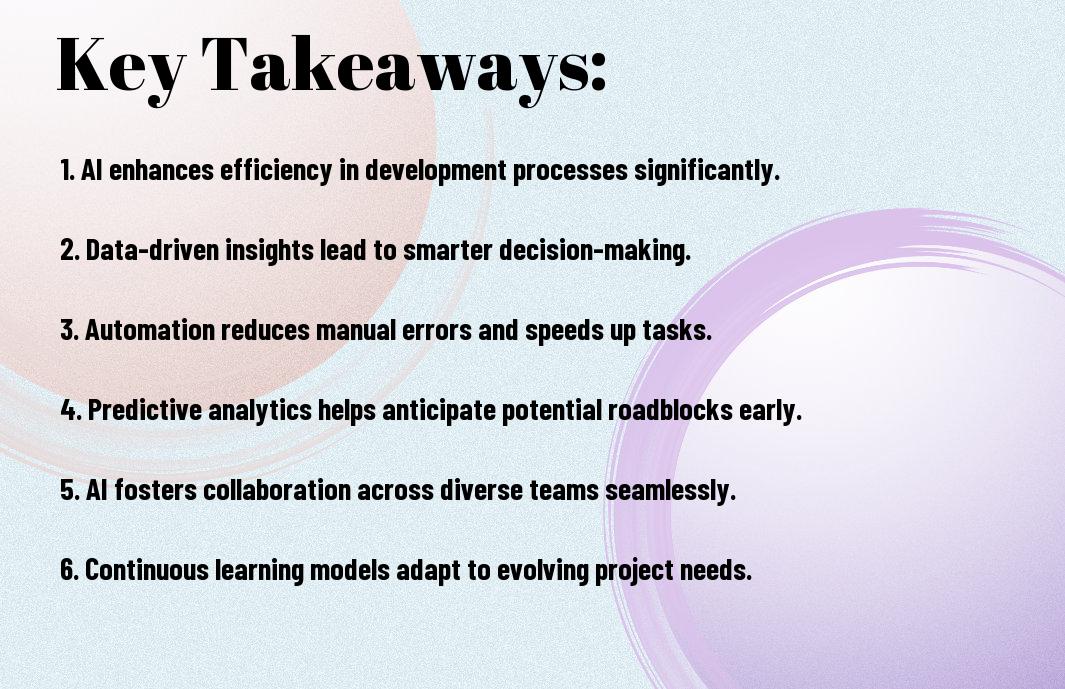
Key Takeaways:

  • Implementing AI solutions can significantly accelerate development processes by automating repetitive tasks and enhancing productivity, allowing teams to focus on more complex and creative aspects of their work.
  • AI-powered tools can help identify and mitigate potential development hurdles, such as bugs and compatibility issues, early on, reducing the risk of project delays and cost overruns.
  • AI-driven analytics can provide valuable insights into user behavior and preferences, enabling developers to create more user-centric and effective solutions that meet the needs of their target audience.
  • AI solutions can facilitate collaboration and communication among development teams, stakeholders, and clients, ensuring that all parties are aligned and working towards a common goal.
  • By leveraging AI solutions, organizations can stay ahead of the competition and drive innovation, unlocking new opportunities for growth and expansion in an increasingly complex and rapidly evolving development landscape.

Current Development Challenges

A major obstacle you face in your development journey is the presence of various hurdles that can slow down your progress and hinder your success.

Technical Bottlenecks

Besides the complexity of your project, you also encounter technical difficulties that can be overwhelming, such as outdated tools and inefficient coding practices.

Resource Limitations

Barriers to your development process often arise from limited resources, including insufficient funding, inadequate personnel, and restricted access to necessary tools and technology.

Hence, as you navigate these resource limitations, you will need to prioritize your needs, allocate your resources efficiently, and explore alternative solutions to ensure the successful completion of your project, which is where AI solutions can offer significant benefits to you.

AI Integration Fundamentals

There’s no denying that AI integration is a key aspect of overcoming development hurdles, and you will need to understand the basics of AI to implement it effectively in your projects. You can start by learning about the different types of AI technologies and how they can be applied to your specific use case.

Machine Learning Applications

Following your initial research, you’ll find that machine learning is a subset of AI that enables systems to learn from data without being explicitly programmed, and you can leverage this technology to automate tasks and improve your development process. You will be able to identify areas where machine learning can add value to your project.

Neural Network Solutions

Above all, neural networks are a type of machine learning model that can be used to solve complex problems, and you can utilize them to improve your development workflow. You will be able to design and implement neural networks that can learn from your data and make predictions or decisions.

The neural network solutions you implement will depend on your specific needs and goals, and you will need to consider factors such as data quality, model complexity, and computational resources when designing your neural network architecture. You can use neural networks to analyze large datasets, identify patterns, and make predictions, which can help you to overcome development hurdles and improve your overall productivity.

Smart Development Tools

Your development process can be significantly enhanced with the integration of AI-powered tools, designed to streamline tasks and improve overall efficiency, allowing you to focus on high-level decision making.

Automated Code Generation

Bridging the gap between manual coding and automation, AI-driven solutions can generate high-quality code, saving you time and reducing the likelihood of human error, enabling you to meet deadlines and deliver projects more effectively.

Predictive Testing Systems

Around the concept of predictive testing, you can leverage AI to identify potential issues before they arise, ensuring your applications are more stable and reliable, which in turn enhances user experience and satisfaction.

Considering the capabilities of predictive testing systems, you can analyze user behavior, detect anomalies, and forecast potential problems, allowing you to proactively address them and maintain a high level of quality in your development projects, ultimately leading to better outcomes and increased customer loyalty.

Performance Optimization

Not only can AI solutions help you overcome development hurdles, but they can also enhance your overall performance. You can learn more about the challenges of implementing AI by visiting 3 Hurdles to AI Adoption and How to Overcome Them to improve your development process.

AI-Driven Analytics

About the benefits of AI-driven analytics, you’ll find that they provide valuable insights to inform your decision-making, enabling you to make data-driven choices that drive your development forward.

Resource Management

Among the key aspects of performance optimization, you’ll need to focus on effective resource management to ensure your development process runs smoothly and efficiently.

Optimization of your resources is key to achieving your development goals, and with AI solutions, you can streamline your workflow, allocate tasks more efficiently, and make the most of your resources, allowing you to deliver high-quality results and stay ahead of the competition, as you work to overcome development hurdles and achieve success in your projects.

Development Workflow Enhancement

To streamline your development process, you can leverage AI solutions to enhance your workflow, making it more efficient and productive. By implementing AI-powered tools, you can automate repetitive tasks, improve collaboration, and reduce errors, ultimately leading to faster time-to-market and increased customer satisfaction.

Automated Decision Making

Besides manual decision-making, AI-driven systems can analyze vast amounts of data, providing you with insights to make informed decisions. This enables you to optimize your development process, allocate resources effectively, and predict potential roadblocks, ensuring your project stays on track.

Quality Assurance Systems

Beneath the surface of your development process, AI-powered quality assurance systems can help you identify and fix defects early on. By integrating these systems, you can ensure your product meets the highest standards, reducing the likelihood of post-launch issues and improving overall customer experience.

With quality assurance systems in place, you can focus on developing innovative features and functionalities, while AI takes care of testing and validation. This not only saves you time and resources but also enables you to deliver high-quality products that meet your customers’ expectations, ultimately enhancing your brand reputation and loyalty.

Risk Mitigation Strategies

Keep your development project on track by implementing effective risk mitigation strategies, leveraging AI solutions to identify and address potential issues before they become major problems, allowing you to navigate challenges with confidence and ensure your project’s success.

AI-Based Security Measures

Relying on AI-powered security tools, you can enhance your project’s defenses, protecting your data and systems from cyber threats, and enabling you to focus on development, knowing your assets are secure and your risks are minimized.

Error Prevention Methods

Above all, your goal is to prevent errors from occurring in the first place, and with AI-driven error prevention methods, you can analyze your code, identify potential issues, and take corrective action, ensuring your project’s stability and reliability.

Measures such as automated testing, code review, and predictive analytics can help you detect and prevent errors, allowing you to refine your development process, streamline your workflow, and deliver high-quality results, giving you a competitive edge in the market and enabling you to achieve your project’s objectives with greater ease and efficiency.

Conclusion

Ultimately, you can overcome development hurdles with AI solutions by leveraging their capabilities to streamline your processes and improve efficiency. You will be able to automate repetitive tasks, enhance decision-making, and drive innovation in your organization. By embracing AI, you can unlock your full potential and achieve your goals, making your development journey smoother and more successful. Your business will thrive with the power of AI solutions.

FAQ

Q: What are the common development hurdles that AI solutions can help overcome?

A: AI solutions can help overcome a variety of development hurdles, including data analysis and interpretation, automation of repetitive tasks, and prediction of potential issues. By leveraging machine learning algorithms and natural language processing, AI can quickly process large amounts of data, identify patterns, and provide insights that can inform development decisions. Additionally, AI-powered automation can help streamline development workflows, reduce manual errors, and increase overall efficiency. By predicting potential issues, AI can also help developers identify and address problems early on, reducing the risk of delays and cost overruns.

Q: How can AI solutions improve the development process, and what benefits can developers expect?

A: AI solutions can improve the development process in several ways, including enhancing code quality, reducing debugging time, and improving collaboration among team members. By analyzing code and identifying potential errors, AI can help developers write cleaner, more efficient code. AI-powered debugging tools can also help developers quickly identify and fix issues, reducing the time spent on debugging and increasing overall productivity. Furthermore, AI-powered collaboration tools can help team members communicate more effectively, assign tasks, and track progress, leading to faster development times and higher-quality outputs. By leveraging AI solutions, developers can expect to see significant improvements in development speed, quality, and efficiency.

Q: What are the key considerations for implementing AI solutions in development, and how can developers get started?

A: When implementing AI solutions in development, there are several key considerations to keep in mind, including data quality, algorithm selection, and integration with existing systems. Developers should ensure that their data is accurate, complete, and relevant to the problem they are trying to solve. They should also carefully select the most appropriate AI algorithms and tools for their specific use case, and consider factors such as scalability, security, and maintainability. To get started, developers can begin by identifying areas of their development process that could benefit from AI, and then exploring the various AI solutions and tools available. They can also experiment with AI-powered development tools and platforms, and seek out training and support to help them get the most out of their AI investments.

Skip to content