Security

Using AI for Enhanced App Security and Fraud Detection

As you develop and deploy your mobile applications, you face numerous security threats that can compromise your users’ sensitive data. You need to stay ahead of potential breaches and fraud attempts. By leveraging Artificial Intelligence (AI), you can significantly enhance your app’s security and detect fraudulent activities in real-time, protecting your users and your business from financial losses and reputational damage. You can utilize AI-powered tools to identify and mitigate risks, ensuring a secure experience for your users.

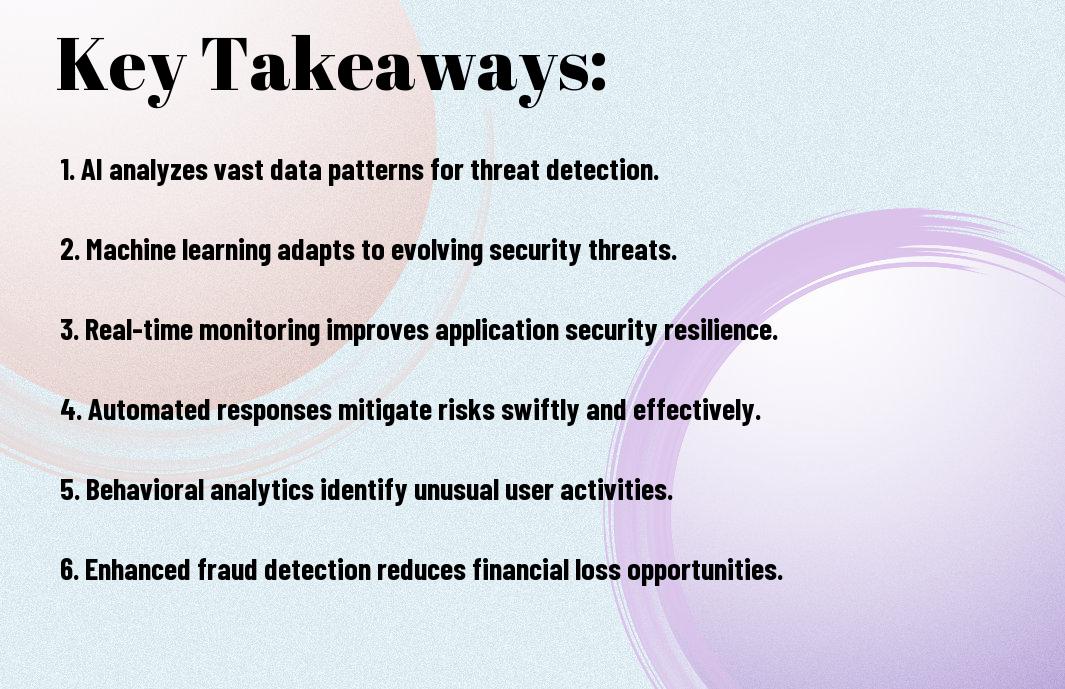
Key Takeaways:

  • Implementing AI-powered security solutions can significantly enhance app security by detecting and preventing fraudulent activities in real-time, reducing the risk of financial losses and reputational damage.
  • AI-driven fraud detection systems can analyze vast amounts of data, identify patterns, and flag suspicious behavior, allowing for swift action to be taken against potential threats.
  • Machine learning algorithms can be trained to recognize and adapt to new fraud patterns, enabling apps to stay ahead of emerging threats and improve their overall security posture.
  • AI-powered security tools can also help apps comply with regulatory requirements and industry standards, such as GDPR and PCI-DSS, by providing robust security measures and audit trails.
  • By leveraging AI for app security and fraud detection, businesses can improve customer trust, reduce false positives, and create a safer and more secure user experience.
    AI Security Foundations

    A solid understanding of AI security foundations is necessary for you to leverage AI for enhanced app security and fraud detection. You can learn more about AI Best Practices for Fraud Detection in FinTech to improve your security measures.

    Machine Learning Models in Security

    Alongside your security efforts, you’ll find that machine learning models play a significant role in detecting and preventing threats, allowing you to strengthen your app’s security posture.

    Neural Networks for Threat Detection

    Around the clock, neural networks can help you detect threats in real-time, enabling you to respond quickly to potential security breaches and protect your users’ data.

    Indeed, as you explore deeper into neural networks for threat detection, you’ll discover that they can be trained to identify complex patterns and anomalies, helping you stay one step ahead of potential threats and ensuring your app’s security is always up-to-date.

    Real-time Threat Monitoring

    You can significantly enhance your app’s security by implementing real-time threat monitoring, which enables you to detect and respond to potential threats as they emerge.

    Behavioral Analysis Systems

    To effectively identify suspicious activity, you can utilize behavioral analysis systems that track user behavior and flag deviations from normal patterns, allowing you to take swift action to protect your app.

    Pattern Recognition Algorithms

    Among the most effective tools for real-time threat monitoring are pattern recognition algorithms, which enable you to identify and flag potential threats based on established patterns of malicious behavior.

    Pattern recognition algorithms are a key component of your app’s security arsenal, allowing you to analyze vast amounts of data and identify potential threats in real-time, giving you the ability to respond quickly and effectively to emerging threats, thereby protecting your users and your business from potential harm, and ensuring the integrity of your app.

    Fraud Prevention Mechanisms

    All organizations can benefit from implementing AI-powered fraud prevention mechanisms to protect their apps from malicious activities. You can leverage AI to analyze user behavior, detect anomalies, and prevent fraudulent transactions.

    Transaction Anomaly Detection

    Around the clock, your app’s transactions can be monitored using AI-powered systems that identify suspicious patterns and alert you to potential fraud. You can then take swift action to prevent financial losses and protect your users.

    User Authentication Enhancement

    Only by leveraging AI-driven authentication methods can you significantly enhance the security of your app. You can use machine learning algorithms to analyze user behavior and verify identities, ensuring that only authorized users access your app.

    It is necessary to note that AI-powered user authentication enhancement can be tailored to your specific needs, allowing you to choose the most effective methods for your app, such as biometric authentication or behavioral analysis, to provide an additional layer of security and protect your users’ sensitive information.

    AI-Powered Risk Assessment

    Once again, you can leverage AI to enhance your app’s security by implementing AI-powered risk assessment, which helps identify potential threats and vulnerabilities in your system, allowing you to take proactive measures to mitigate them.

    Predictive Analysis Models

    Models like machine learning algorithms and statistical models enable you to analyze patterns and anomalies in user behavior, helping you detect and prevent fraudulent activities, and improve your app’s overall security posture.

    Risk Scoring Systems

    Among the various tools at your disposal, risk scoring systems are particularly effective in evaluating the likelihood of a user posing a threat to your app, assigning a score based on their behavior and other factors, and enabling you to take targeted actions.

    And as you implement risk scoring systems, you’ll be able to refine your approach over time, incorporating new data and insights to improve the accuracy of your risk assessments, and making more informed decisions about how to protect your app and your users from potential threats.

    Security Response Automation

    Many organizations are turning to AI-powered security response automation to enhance their app security and fraud detection capabilities. You can leverage AI to analyze threats, identify patterns, and respond to incidents in real-time, freeing up your security team to focus on more strategic tasks.

    Incident Response Integration

    Among the key benefits of security response automation is the ability to integrate incident response into your existing security infrastructure. You can use AI to streamline your incident response processes, ensuring that your team is notified and equipped to handle threats as they arise, and that your users are protected from potential harm.

    Automated Mitigation Protocols

    Across the various aspects of app security, automated mitigation protocols play a significant role in preventing and responding to threats. You can use AI to develop and implement automated protocols that detect and mitigate threats in real-time, reducing the risk of damage to your app and protecting your users’ sensitive information.

    Indeed, automated mitigation protocols are a powerful tool in your arsenal against app security threats. You can use AI to analyze traffic patterns, identify potential threats, and automatically block malicious activity, ensuring that your app remains secure and your users are protected. By leveraging AI-powered automated mitigation protocols, you can enhance your app’s security posture and stay one step ahead of emerging threats.

    Data Privacy Compliance

    Not only is AI-enhanced security a powerful tool for detecting fraud, but it also plays a significant role in ensuring your app’s data privacy compliance, allowing you to protect your users’ sensitive information and maintain their trust.

    AI Ethics in Security

    Ethically, you must consider the implications of using AI in your app’s security measures, ensuring that your implementation is fair, transparent, and respectful of your users’ rights, which helps you build a secure and trustworthy environment for them.

    Regulatory Framework Integration

    Along with the integration of AI in your app’s security, you need to ensure that your approach aligns with regulatory requirements, allowing you to navigate the complex landscape of data protection laws and regulations that apply to your app and its users.

    Further, as you probe into regulatory framework integration, you will find that understanding the specific laws and regulations applicable to your app, such as GDPR or CCPA, is crucial for your compliance strategy, enabling you to make informed decisions about your AI-powered security measures and ensure your app meets the necessary standards for data privacy and protection, giving you and your users peace of mind.

    Summing up

    Conclusively, you can leverage AI to bolster your app’s security and detect fraud more effectively. By integrating AI-powered solutions, you can significantly reduce the risk of cyber threats. For more insights, visit How AI is Revolutionizing Financial Cybersecurity to learn how you can protect your digital assets and stay ahead of potential threats.

    FAQ

    Q: What role does AI play in enhancing app security and fraud detection?

    A: AI plays a significant role in enhancing app security and fraud detection by utilizing machine learning algorithms to analyze user behavior, identify patterns, and detect anomalies in real-time. This enables apps to stay one step ahead of potential threats and prevent fraudulent activities, thereby protecting user data and maintaining the integrity of the app. By integrating AI-powered security measures, apps can reduce the risk of cyber attacks, data breaches, and other security threats, ensuring a safe and secure user experience.

    Q: How does AI-powered fraud detection work in mobile apps?

    A: AI-powered fraud detection in mobile apps works by analyzing various parameters such as user behavior, device information, and transaction patterns to identify potential fraudulent activities. The AI algorithm is trained on a large dataset of legitimate and fraudulent transactions, enabling it to learn and improve its detection capabilities over time. When a suspicious activity is detected, the AI system alerts the app’s security team, allowing them to take prompt action to prevent further damage. This proactive approach helps to minimize losses and protect users from financial and identity theft.

    Q: Can AI completely eliminate the risk of fraud and security threats in mobile apps?

    A: While AI significantly enhances app security and fraud detection, it is not a foolproof solution that can completely eliminate the risk of fraud and security threats. AI systems can be evaded by sophisticated attackers using advanced techniques such as deepfake technology, social engineering, and zero-day exploits. Therefore, it is vital to implement a multi-layered security approach that combines AI-powered detection with other security measures, such as encryption, two-factor authentication, and regular security updates, to provide comprehensive protection against various types of threats and ensure the security and integrity of mobile apps.

Building Secure Apps with AI-Driven Threat Detection

As you develop your applications, you need to prioritize security to protect your users’ sensitive data. You can leverage AI-driven threat detection to identify and mitigate potential threats in real-time, ensuring your apps are secure. Your goal is to stay one step ahead of cyber threats, and AI-driven solutions can help you achieve this by analyzing patterns and anomalies to detect potential security breaches, allowing you to take proactive measures to safeguard your applications and maintain user trust.

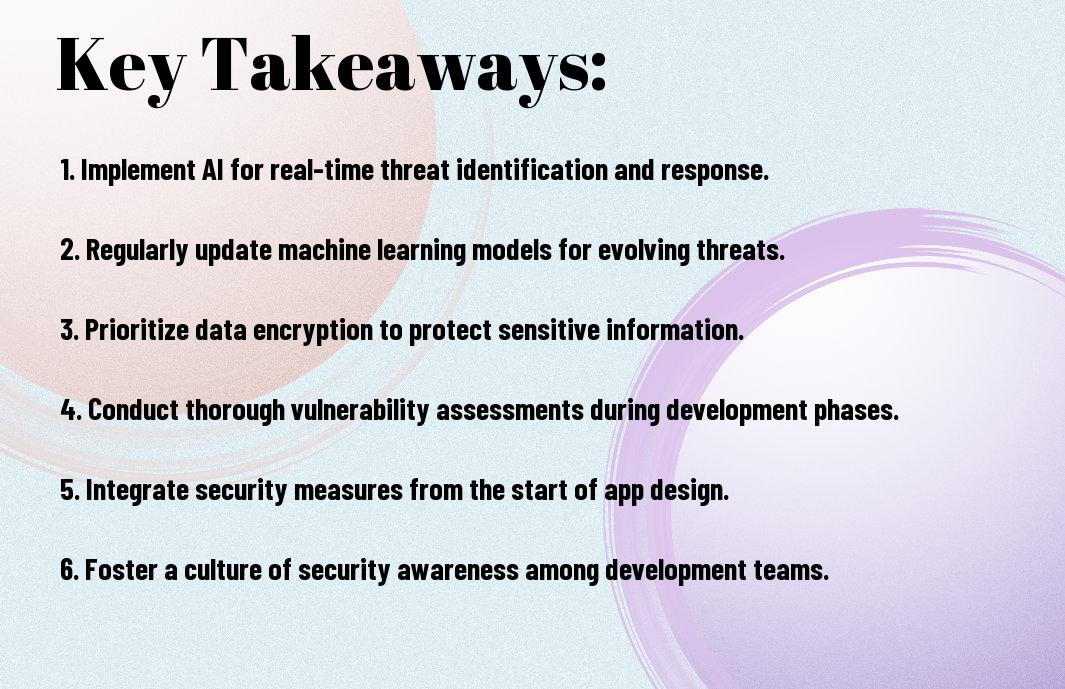
Key Takeaways:

  • Implementing AI-driven threat detection in app development enhances security by identifying and mitigating potential threats in real-time, reducing the risk of data breaches and cyber attacks.
  • AI-powered systems can analyze vast amounts of data, including user behavior and system logs, to detect anomalies and predict potential security threats, allowing for proactive measures to be taken.
  • Integrating AI-driven threat detection into the development process enables developers to identify and address security vulnerabilities early on, reducing the likelihood of exploits and minimizing the impact of potential attacks.
  • AI-driven threat detection can help improve incident response times by quickly identifying and isolating affected areas, allowing for swift remediation and minimizing downtime.
  • Continuous monitoring and analysis of app performance and user behavior through AI-driven threat detection enables developers to refine and improve their security measures, staying ahead of emerging threats and protecting sensitive data.

Fundamental Security Principles

While developing secure apps, you need to consider several key factors to protect your users’ data. Your approach should include a combination of security measures to prevent threats and ensure the integrity of your application.

Core Security Requirements

Foundational to your app’s security are the core requirements that you must implement to safeguard against common threats, including authentication, authorization, and data encryption, which will help you establish a robust security posture.

AI Integration Points

By incorporating AI-driven threat detection into your app, you can significantly enhance your security capabilities, allowing you to identify and respond to potential threats more effectively, and you will be able to leverage machine learning algorithms to analyze user behavior and detect anomalies.

Further, as you integrate AI into your app’s security framework, you will be able to automate many security-related tasks, freeing up your resources to focus on higher-level security strategy and development, and you can use AI to analyze vast amounts of data, identifying patterns and potential vulnerabilities that may have gone undetected by human analysts, ultimately strengthening your app’s overall security.

AI-Based Threat Detection Architecture

You need to understand the components that make up an AI-based threat detection system to build secure apps, and this understanding will help you design a robust architecture for your application.

Detection Engine Components

By analyzing various components, you can identify the most effective ones for your threat detection system, including machine learning models and rules-based systems that work together to identify potential threats.

Data Processing Pipeline

Along with the detection engine, a data processing pipeline is necessary to handle the vast amounts of data that your application generates, and you must ensure that this pipeline is efficient and scalable.

This data processing pipeline is where your application’s data is collected, processed, and analyzed, and you will need to consider factors such as data ingestion, storage, and analysis when designing this pipeline, to ensure that your threat detection system can handle large volumes of data and provide accurate results in real-time.

Real-Time Monitoring Systems

Once again, you can leverage AI-driven threat detection to enhance your app’s security with real-time monitoring systems, allowing you to stay ahead of potential threats. You can learn more about how AI is transforming mobile app security by visiting Enhancing Mobile App Security Through AI: A Paradigm Shift to discover the latest trends and best practices.

Behavioral Analysis

Betwixt the various techniques used in AI-driven threat detection, you will find behavioral analysis, which enables you to identify and flag suspicious activity in your app, helping you to take proactive measures to prevent attacks.

Pattern Recognition

Around the concept of pattern recognition, you can develop a system that identifies and learns from patterns in your app’s data, allowing you to detect and respond to potential threats more effectively.

And as you examine deeper into pattern recognition, you will find that it enables your app to learn from experience, adapting to new threats and improving its detection capabilities over time, giving you greater confidence in your app’s security and allowing you to focus on delivering a seamless user experience.

Implementation Strategies

Many organizations are turning to AI-driven threat detection to build secure apps, and you can too by leveraging the right implementation strategies. You will need to consider various factors, including data quality, algorithm selection, and system integration, to ensure effective threat detection.

Integration Framework

Against the backdrop of increasingly complex threat landscapes, you must design an integration framework that seamlessly incorporates AI-driven threat detection into your existing security infrastructure, allowing you to respond quickly to emerging threats.

Security Controls

Beside the integration framework, you will need to establish robust security controls to prevent unauthorized access to your app and data, and you can achieve this by implementing measures such as encryption, authentication, and access management.

But as you implement these security controls, you should also consider the potential impact on your app’s performance and user experience, and you will need to strike a balance between security and usability to ensure that your app remains effective and appealing to your users. You can achieve this by conducting thorough testing and validation of your security controls, and by continuously monitoring your app’s performance and security posture.

Response Mechanisms

All effective threat detection systems require robust response mechanisms to mitigate potential threats. You need to consider how your app will respond to detected threats, ensuring your users’ safety and security.

Automated Responses

With automated response capabilities, you can quickly contain and neutralize threats, minimizing damage to your app and its users. You can configure your system to automatically block malicious activity, alerting you to potential threats.

Manual Intervention Protocols

Across your organization, you should establish clear protocols for manual intervention, ensuring that your team can quickly respond to complex threats. You will need to define roles, responsibilities, and procedures for your team to follow in the event of a security incident.

Protocols for manual intervention should be well-documented and regularly updated, allowing you to refine your response strategy as new threats emerge. You should also provide your team with the necessary training and resources to effectively respond to security incidents, ensuring that your app and its users are protected.

Performance Optimization

Keep your application’s performance in mind when integrating AI-driven threat detection, as it can impact your user experience and overall security posture. You need to ensure that your app’s performance is not compromised while maintaining robust security measures.

System Scalability

Optimizing your system’s scalability is crucial to handle increased traffic and data processing demands. You can achieve this by leveraging cloud services, load balancing, and autoscaling to ensure your application remains responsive and secure.

Resource Management

Among the key factors affecting your application’s performance is efficient resource management. You should monitor your resource utilization and allocate them effectively to prevent bottlenecks and ensure seamless threat detection.

Management of resources is vital to maintaining your application’s performance and security. You can achieve this by implementing monitoring tools, setting up alerts, and automating resource allocation to ensure your application runs smoothly and efficiently, allowing you to focus on delivering a secure user experience.

Summing up

On the whole, you now have a better understanding of building secure apps with AI-driven threat detection. As you move forward, you can leverage AI to enhance your app’s security by utilizing AI Threat Detection: Leverage AI to Detect Security Threats to identify potential threats and protect your users’ data, ultimately ensuring your app’s integrity and your users’ trust in your brand.

FAQ

Q: What are the benefits of using AI-driven threat detection in building secure apps?

A: The benefits of using AI-driven threat detection in building secure apps include enhanced security, improved incident response, and reduced risk of data breaches. AI-powered systems can analyze vast amounts of data in real-time, identifying potential threats and anomalies that may evade traditional security measures. This enables developers to respond quickly to emerging threats, protecting user data and preventing financial losses. Additionally, AI-driven threat detection can help identify vulnerabilities in the app’s code, allowing for proactive measures to be taken to prevent exploitation.

Q: How does AI-driven threat detection integrate with existing security measures to build secure apps?

A: AI-driven threat detection can be seamlessly integrated with existing security measures, such as firewalls, intrusion detection systems, and encryption technologies. By leveraging machine learning algorithms and data analytics, AI-powered systems can analyze data from various sources, including network traffic, user behavior, and system logs. This integrated approach enables developers to gain a comprehensive understanding of potential threats, allowing for more effective threat mitigation and incident response strategies. Furthermore, AI-driven threat detection can be used to automate security tasks, freeing up resources for more strategic and high-value security activities.

Q: What are the key considerations for implementing AI-driven threat detection in building secure apps, and how can developers ensure its effectiveness?

A: When implementing AI-driven threat detection in building secure apps, key considerations include data quality, algorithmic transparency, and continuous monitoring. Developers should ensure that the AI system is trained on high-quality, diverse data sets to minimize bias and optimize accuracy. Additionally, the AI system should be designed to provide transparent and explainable results, enabling developers to understand the reasoning behind threat detections. Continuous monitoring and evaluation of the AI system’s performance are also crucial to ensure its effectiveness in detecting emerging threats and adapting to evolving attack vectors. By carefully considering these factors, developers can harness the power of AI-driven threat detection to build secure, reliable, and trustworthy apps that protect user data and maintain user trust.

Skip to content