Predictive

Predictive Analytics In Marketing – The AI Advantage For Anticipating Consumer Behavior

As you navigate the complex world of marketing, you’re likely aware of the importance of staying one step ahead of your competitors. You understand that anticipating your consumers’ needs and behaviors is key to driving sales and growth. With the help of predictive analytics and artificial intelligence, you can now unlock the power of data-driven insights to forecast your customers’ actions, allowing you to make informed decisions and tailor your marketing strategies to meet their evolving needs, giving your business a significant edge in the market.

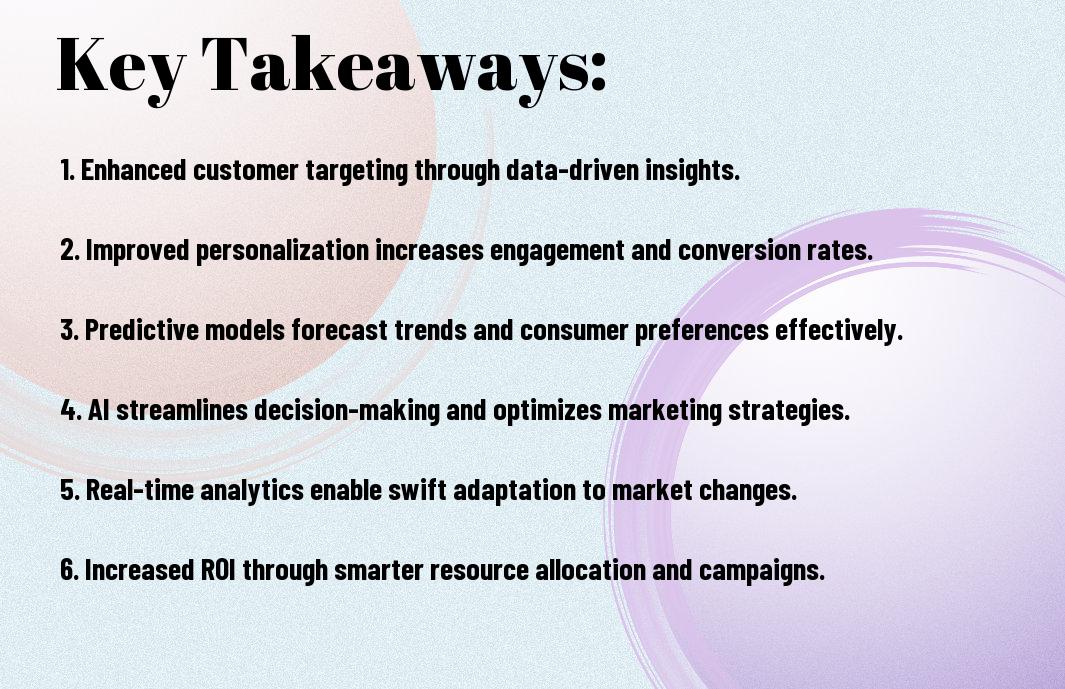
Key Takeaways:

  • Predictive analytics in marketing enables businesses to anticipate consumer behavior by analyzing historical data and real-time trends, allowing for more effective targeting and personalization of marketing efforts.
  • The integration of Artificial Intelligence (AI) in predictive analytics enhances the accuracy of forecasts, enabling marketers to make data-driven decisions and stay ahead of the competition in a rapidly changing market landscape.
  • By leveraging predictive analytics and AI, marketers can identify high-value customer segments, optimize marketing campaigns, and improve customer engagement, ultimately driving revenue growth and improving return on investment (ROI) for marketing initiatives.
The Evolution of Marketing Analytics

Your understanding of consumer behavior is about to take a significant leap forward with the integration of predictive analytics in marketing, enabling you to anticipate and respond to customer needs more effectively.

Traditional Marketing Methods

The traditional approach to marketing relied heavily on historical data and manual analysis, limiting your ability to respond quickly to changing consumer trends and preferences.

The AI Revolution in Consumer Insights

Against the backdrop of rapid technological advancements, you are now empowered with AI-driven tools that can process vast amounts of data, uncovering hidden patterns and predicting future behavior with unprecedented accuracy.

Indeed, as you probe deeper into the capabilities of AI in marketing analytics, you will discover that it not only enhances your understanding of consumer behavior but also enables you to create highly personalized and targeted marketing campaigns, significantly improving your return on investment and customer engagement metrics, allowing you to stay ahead of the competition in an increasingly complex and dynamic market landscape.

Core Components of Predictive Analytics

While exploring predictive analytics, you’ll discover that it involves several key elements that work together to anticipate consumer behavior, enabling you to make informed decisions and drive your marketing strategy forward.

Data Collection and Processing

For instance, gathering and processing data is vital, as you will be relying on this information to build accurate models and make predictions about your target audience’s behavior, allowing you to tailor your marketing efforts to their needs.

Machine Learning Algorithms

About the algorithms used in predictive analytics, you should know that they play a significant role in analyzing data and identifying patterns, helping you to uncover insights that can inform your marketing strategy and improve your overall customer experience.

It is worth noting that machine learning algorithms can be applied in various ways, such as clustering, decision trees, and regression analysis, enabling you to analyze complex data sets and make predictions about future outcomes, which can be used to optimize your marketing campaigns and improve your return on investment, allowing you to stay ahead of the competition and achieve your business goals.

Consumer Behavior Patterns

To understand your target audience, you need to analyze their behavior patterns, which can be achieved through predictive analytics, enabling you to make informed decisions and stay ahead of the competition.

Digital Footprint Analysis

Across various online platforms, you can collect data on your customers’ digital footprints, including their browsing history, search queries, and social media activities, to gain insights into their preferences and interests.

Purchase Pattern Recognition

An analysis of your customers’ purchase history and behavior can help you identify patterns and trends, allowing you to predict their future purchases and tailor your marketing strategies accordingly, giving you a competitive edge in the market.

Consumer purchase patterns can be complex and influenced by various factors, including seasonal trends, personal preferences, and economic conditions, so when you recognize and understand these patterns, you can develop targeted marketing campaigns that resonate with your audience, increasing the likelihood of conversion and driving business growth, and as you explore deeper into the data, you can refine your strategies to meet the evolving needs of your customers.

AI-Powered Marketing Tools

Once again, you can leverage AI to enhance your marketing strategy, and to learn more about this, you can visit Predictive Analytics: Anticipating Customer Behavior With AI to get insights on how to anticipate consumer behavior.

Recommendation Engines

At this point, you can utilize recommendation engines to suggest products to your customers based on their past purchases and browsing history, allowing you to personalize their experience.

Dynamic Pricing Systems

Between the various AI-powered marketing tools, dynamic pricing systems stand out as they enable you to adjust prices in real-time based on demand and supply.

This allows you to maximize your revenue and stay competitive in the market, as you can respond quickly to changes in demand, ensuring that your prices are always optimal, and you can make data-driven decisions to drive your business forward, ultimately leading to increased profitability and customer satisfaction.

Real-Time Decision Making

Unlike traditional marketing methods, predictive analytics enables you to make informed decisions quickly. You can learn more about Predictive Analytics in Marketing to improve your strategy.

Automated Campaign Optimization

Around the clock, your marketing campaigns can be optimized using predictive analytics, allowing you to target your audience more effectively and increase your return on investment.

Personalization at Scale

An necessary aspect of predictive analytics is personalization, enabling you to tailor your marketing efforts to individual consumers, thereby enhancing their experience and fostering brand loyalty.

Another significant benefit of personalization at scale is that it allows you to analyze vast amounts of consumer data, identifying patterns and preferences that can inform your marketing strategy, helping you to create targeted campaigns that resonate with your audience and drive engagement, ultimately leading to increased conversions and revenue for your business.

Privacy and Ethical Considerations

After implementing predictive analytics in your marketing strategy, you should consider the ethical implications, as discussed in Predictive Analytics in Marketing: Anticipating Customer Behavior with AI, to ensure your methods are transparent and respectful of consumer data.

Data Protection Frameworks

Betwixt the lines of data collection and analysis, you must establish robust data protection frameworks to safeguard consumer information and maintain compliance with regulations.

Consumer Trust Building

The foundation of successful predictive analytics lies in building trust with your consumers, which can be achieved by being open about your data collection and usage practices.

Trust is a key factor in consumer trust building, as you need to demonstrate that you value and protect their personal information, and use it to provide them with relevant and personalized experiences, rather than exploiting it for your own gain, allowing you to foster a loyal customer base and drive long-term growth.

Final Words

The ability to anticipate consumer behavior is now at your fingertips with predictive analytics in marketing. You can leverage AI to analyze your data and make informed decisions. Your marketing strategies will become more effective, allowing you to stay ahead of the competition. You will be able to personalize your approach, increasing the likelihood of successful campaigns and driving business growth. By embracing predictive analytics, you will unlock new opportunities and take your marketing to the next level.

FAQ

Q: What is Predictive Analytics in Marketing and how does it help in anticipating consumer behavior?

A: Predictive Analytics in Marketing is the use of advanced statistical models and machine learning algorithms to analyze historical data and predict future consumer behavior. It helps marketers anticipate consumer needs, preferences, and actions, enabling them to make informed decisions and create targeted marketing campaigns that drive engagement, conversion, and revenue. By leveraging predictive analytics, marketers can identify high-value customer segments, optimize marketing channels, and personalize customer experiences, ultimately gaining a competitive edge in the market.

Q: How does Artificial Intelligence (AI) enhance Predictive Analytics in Marketing?

A: Artificial Intelligence (AI) significantly enhances Predictive Analytics in Marketing by enabling the analysis of large datasets, identifying complex patterns, and making predictions with high accuracy. AI-powered predictive models can process vast amounts of data, including social media, customer feedback, and transactional data, to identify trends and anomalies that may not be apparent through traditional analysis. Additionally, AI-driven predictive analytics can automate many marketing tasks, such as lead scoring, customer segmentation, and campaign optimization, freeing up marketers to focus on strategic decision-making and creative campaign development.

Q: What types of data are used in Predictive Analytics for Marketing, and how is it collected?

A: Predictive Analytics for Marketing uses a wide range of data types, including customer demographic data, transactional data, social media data, customer feedback, and behavioral data. This data is collected from various sources, such as customer relationship management (CRM) systems, social media platforms, customer surveys, and website analytics tools. Additionally, marketers can collect data from external sources, such as market research reports, industry trends, and economic indicators, to gain a more comprehensive understanding of consumer behavior and market dynamics.

Q: How can Predictive Analytics help marketers measure the effectiveness of their marketing campaigns and optimize their marketing strategies?

A: Predictive Analytics helps marketers measure the effectiveness of their marketing campaigns by providing insights into key performance indicators (KPIs) such as conversion rates, customer acquisition costs, and return on investment (ROI). By analyzing these metrics, marketers can identify which marketing channels, campaigns, and tactics are driving the most value and adjust their strategies accordingly. Predictive analytics can also help marketers optimize their marketing strategies by identifying areas of improvement, such as optimizing email subject lines, personalizing content, and refining targeting parameters, to maximize campaign effectiveness and minimize waste.

Q: What are some common challenges and limitations of implementing Predictive Analytics in Marketing, and how can they be overcome?

A: Common challenges and limitations of implementing Predictive Analytics in Marketing include data quality issues, lack of skilled resources, and integration with existing marketing systems. To overcome these challenges, marketers should prioritize data quality and governance, invest in training and upskilling their teams, and ensure seamless integration with existing marketing technologies. Additionally, marketers should start with small-scale pilot projects, focus on high-impact use cases, and continuously monitor and evaluate the effectiveness of their predictive analytics initiatives to ensure maximum ROI and business impact.

Creating Predictive Apps with AI Models for Forecasting

You are on the verge of revolutionizing your business with predictive apps that utilize AI models for forecasting. Your ability to anticipate trends and make informed decisions will significantly improve with these cutting-edge tools. By integrating AI models into your applications, you will be able to analyze complex data sets and make accurate predictions, giving you a competitive edge in your industry. Your predictive apps will enable you to stay ahead of the curve and drive business success.

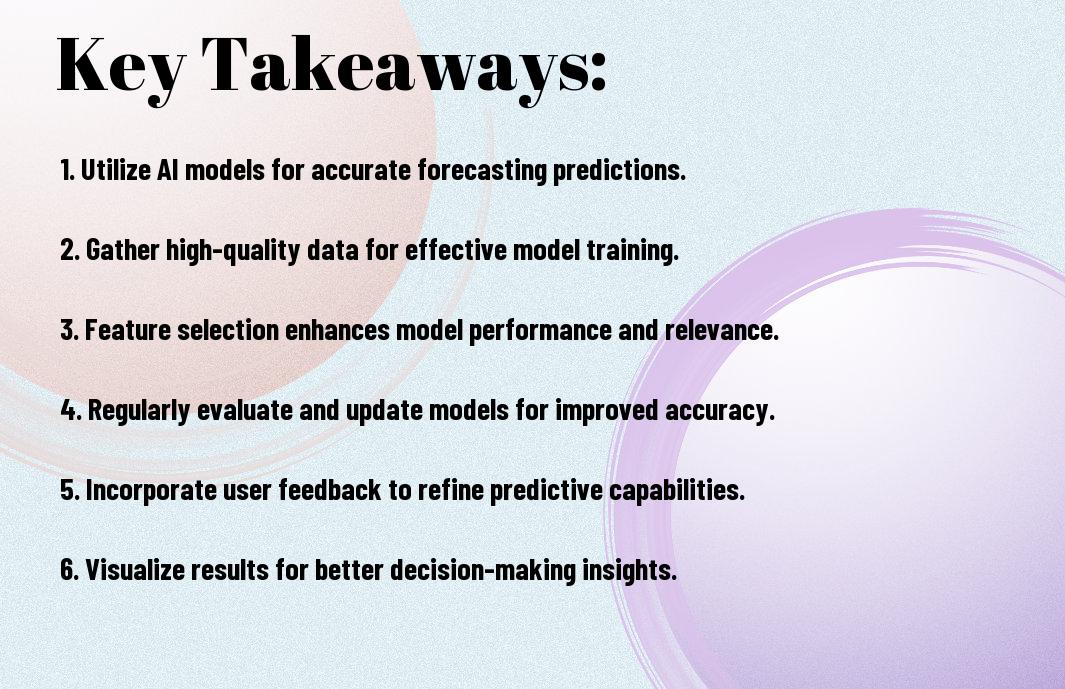
Key Takeaways:

  • Integrating AI models into predictive apps can significantly enhance forecasting capabilities, allowing businesses to make informed decisions based on data-driven insights.
  • Effective predictive apps require high-quality data, which must be properly cleaned, processed, and analyzed to generate accurate forecasts and reliable predictions.
  • Machine learning algorithms, such as regression and time series analysis, are imperative components of predictive apps, enabling them to identify patterns and trends in complex data sets.
  • Predictive apps can be applied to various industries, including finance, healthcare, and retail, to forecast sales, demand, and customer behavior, among other key performance indicators.
  • Continuous monitoring and updating of AI models is necessary to ensure the accuracy and relevance of predictive apps, as changing market conditions and new data can impact forecasting performance over time.

Fundamentals of AI Predictive Apps

A key aspect of creating predictive apps with AI models is understanding the underlying technology that drives them. As you explore into the world of predictive apps, you’ll discover the importance of integrating AI models into your development process, enabling your apps to make accurate forecasts and informed decisions.

Core Machine Learning Components

Mechanisms such as neural networks and decision trees are imperative components of machine learning, allowing you to build complex models that can analyze data and make predictions. You’ll need to understand how these components work together to create a robust predictive app.

Data Processing Architecture

After designing your predictive app, you’ll need to consider the data processing architecture that will support it. You’ll want to ensure that your app can handle large amounts of data, process it efficiently, and provide accurate predictions in real-time.

Predictive analytics relies heavily on the data processing architecture you choose, as it enables your app to analyze vast amounts of data, identify patterns, and make informed decisions. As you design your data processing architecture, you’ll need to consider factors such as scalability, performance, and security to ensure that your app can handle the demands of predictive analytics.

Model Selection for Forecasting

Any predictive app relies on a well-chosen model to generate accurate forecasts, and you will need to select the most suitable one for your specific use case, considering factors such as data characteristics and performance metrics.

Time Series Models

Before submerging into the world of forecasting, you should consider traditional time series models, such as ARIMA or SARIMA, which are widely used for their simplicity and effectiveness in capturing trends and seasonality in your data.

Neural Network Frameworks

On the other hand, you may find that neural network frameworks, like TensorFlow or PyTorch, offer more flexibility and power for your forecasting tasks, allowing you to handle complex patterns and large datasets with ease.

This approach enables you to leverage the capabilities of deep learning, such as recurrent neural networks (RNNs) or long short-term memory (LSTM) networks, to improve the accuracy of your forecasts, and you can experiment with different architectures to find the best fit for your specific problem, making the most of your data and computational resources.

Data Pipeline Development

Keep in mind that developing a data pipeline is important for creating predictive apps with AI models. You will need to design a system that can handle large amounts of data and process it efficiently.

Data Collection Methods

By utilizing various data sources, you can gather relevant information for your predictive app. You will need to determine the best methods for collecting data, such as APIs, web scraping, or user input.

Preprocessing Techniques

On the path to developing a predictive app, you will need to clean and preprocess your data. You can use techniques such as data normalization, feature scaling, and handling missing values to prepare your data for modeling.

Plus, when preprocessing your data, you should consider the specific requirements of your AI model. You may need to transform your data into a suitable format, such as converting categorical variables into numerical variables, or encoding text data into numerical representations. By doing so, you can ensure that your data is ready for modeling and that your predictive app will produce accurate forecasts.

App Architecture Design

Once again, you’ll need to consider the overall structure of your predictive app, taking into account the AI models and forecasting components. Your app’s architecture should be designed to handle complex data processing and provide a seamless user experience.

Backend Infrastructure

Above all, your backend infrastructure should be scalable and secure, able to handle large amounts of data and support your AI models. You’ll need to choose the right technologies and tools to build a robust backend that meets your app’s needs.

API Integration Points

Integrating your AI models with your app’s frontend is vital, and you’ll need to define clear API integration points to enable seamless communication. You’ll want to ensure that your API is well-documented and easy to use, allowing you to focus on developing your app’s features.

A key aspect of API integration points is ensuring that they are flexible and adaptable to changing requirements. As you continue to develop and refine your predictive app, you’ll likely need to make adjustments to your API integration points, so it’s crucial that you design them with scalability and flexibility in mind, allowing you to make changes quickly and efficiently, and enabling you to deliver a high-quality user experience.

Model Training and Optimization

Not all AI models are created equal, and you will need to train and optimize yours to achieve the best results for your predictive app. You will have to consider various factors, including data quality and algorithm selection, to ensure your model performs well.

Training Workflows

Traversing the process of training your AI model, you will need to design a workflow that suits your specific needs, allowing you to refine your model and improve its accuracy over time, which will help you to achieve your goals.

Performance Metrics

Against the backdrop of your predictive app’s goals, you will need to evaluate your model’s performance using relevant metrics, such as accuracy and precision, to determine its effectiveness and identify areas for improvement, helping you to make informed decisions.

Workflows for evaluating performance metrics involve tracking your model’s performance over time, allowing you to identify trends and patterns, and make adjustments as needed to optimize your model’s performance, enabling you to refine your predictive app and improve its forecasting capabilities, which will help you to achieve better results and make more informed decisions with your predictive app.

Deployment Strategies

Unlike traditional app development, deploying predictive apps with AI models requires careful planning to ensure seamless integration and optimal performance. You need to consider various factors, including data storage, security, and scalability, to guarantee your app’s success.

Cloud Platform Integration

Across various cloud platforms, you can deploy your predictive app, leveraging their scalability and reliability. You will be able to choose from a range of services that cater to your specific needs, ensuring your app is always available and performing at its best.

Scaling Considerations

Strategically, you should plan for scaling your predictive app to handle increased traffic and data. You will need to consider factors such as server capacity, data storage, and network bandwidth to ensure your app can handle growth without compromising performance.

The key to successful scaling is to monitor your app’s performance regularly, identifying potential bottlenecks and addressing them before they become major issues. You can use various tools and services to help you scale your app, such as load balancing, autoscaling, and content delivery networks, ensuring your predictive app remains responsive and reliable as your user base grows.

Final Words

Considering all points, you now have a solid foundation for creating predictive apps with AI models for forecasting. You can leverage your knowledge to develop innovative solutions, enhancing your ability to make informed decisions. With your newfound understanding, you will be able to build and implement effective predictive models, driving your business forward and staying ahead of the competition. Your predictive apps will enable you to forecast trends and patterns, giving you a competitive edge in the market.

FAQ

Q: What are the key steps involved in creating predictive apps with AI models for forecasting?

A: Creating predictive apps with AI models for forecasting involves several key steps. First, it’s vital to define the problem you’re trying to solve and identify the type of data you’ll need to collect and analyze. Next, you’ll need to prepare your data by cleaning, transforming, and splitting it into training and testing sets. Then, you’ll need to select and train a suitable AI model, such as a machine learning or deep learning model, using your training data. After training the model, you’ll need to evaluate its performance using metrics such as accuracy, precision, and recall. Finally, you’ll need to deploy your model in a production-ready environment, such as a cloud-based platform, and integrate it with your predictive app. Additionally, you’ll need to continuously monitor and update your model to ensure it remains accurate and effective over time.

Q: What types of AI models are best suited for forecasting and predictive analytics?

A: There are several types of AI models that are well-suited for forecasting and predictive analytics, including autoregressive integrated moving average (ARIMA) models, exponential smoothing (ES) models, and machine learning models such as random forests, gradient boosting, and neural networks. The choice of model will depend on the specific problem you’re trying to solve, the type of data you have, and the level of complexity you’re willing to tolerate. For example, ARIMA and ES models are often used for time series forecasting, while machine learning models are often used for more complex forecasting tasks, such as predicting customer churn or demand. Deep learning models, such as recurrent neural networks (RNNs) and long short-term memory (LSTM) networks, are also being increasingly used for forecasting and predictive analytics due to their ability to handle large amounts of data and complex patterns.

Q: How can I ensure the accuracy and reliability of my predictive app with AI models for forecasting?

A: Ensuring the accuracy and reliability of your predictive app with AI models for forecasting requires careful attention to several factors. First, you’ll need to ensure that your data is of high quality, complete, and relevant to the problem you’re trying to solve. You’ll also need to carefully evaluate the performance of your model using metrics such as mean absolute error (MAE), mean squared error (MSE), and root mean squared percentage error (RMSPE). Additionally, you’ll need to consider techniques such as cross-validation, walk-forward optimization, and backtesting to ensure that your model is generalizing well to new, unseen data. Finally, you’ll need to continuously monitor your model’s performance in production and update it as necessary to ensure it remains accurate and effective over time. This may involve retraining the model on new data, adjusting the model’s parameters, or switching to a different model altogether.

Skip to content