
As you navigate through your daily digital life, you’re likely interacting with various apps that aim to provide a tailored experience. Your preferences, behaviors, and needs are being analyzed to offer a more personalized interaction. With AI at the helm, the future of personalized apps is poised to revolutionize the way you engage with technology, making it more intuitive and responsive to your unique requirements, and you can expect a significant shift in how your digital experiences are curated to meet your individual needs.
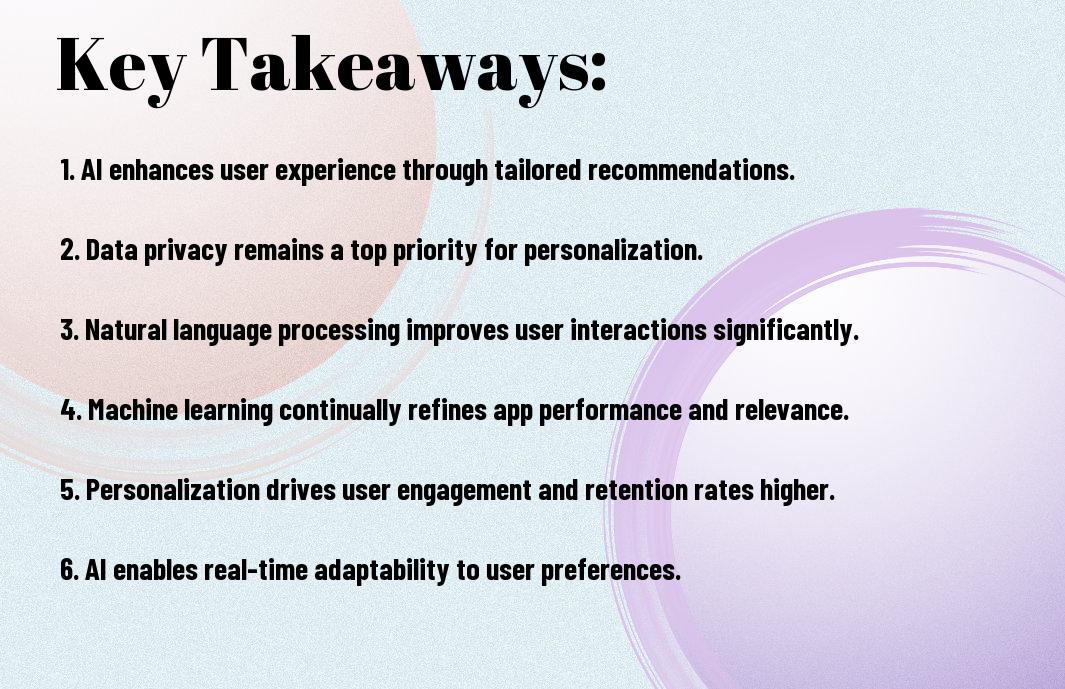
Key Takeaways:
- Personalized apps will increasingly rely on Artificial Intelligence (AI) to deliver tailored experiences, enhancing user engagement and satisfaction by providing relevant content and recommendations.
- AI-driven apps will leverage machine learning algorithms to analyze user behavior, preferences, and habits, enabling them to adapt and improve over time, offering a more intuitive and responsive experience.
- The integration of AI in personalized apps will lead to the development of more sophisticated chatbots and virtual assistants, capable of understanding and responding to complex user queries and needs.
- As AI technology advances, personalized apps will become more proactive, anticipating user needs and offering predictive suggestions, streamlining decision-making processes and saving users time and effort.
- The future of personalized apps will depend on the ability to balance AI-driven personalization with user privacy and data security concerns, requiring developers to prioritize transparency, consent, and robust data protection measures.
The Evolution of App Personalization
Before submerging into the future of personalized apps, you need to understand how app personalization has evolved over time, from basic user profiles to complex AI-driven systems that learn and adapt to your behavior.
Traditional App Development Models
Across various industries, you’ve seen traditional app development models focus on creating one-size-fits-all solutions, which often fail to meet your unique needs and preferences, leading to a less engaging user experience.
The AI-Driven Shift
Driven by advances in technology, you’re now witnessing a significant shift towards AI-driven app development, where your interactions and behaviors are used to create personalized experiences that cater to your individual needs.
For instance, with AI at the core, you can expect apps to learn your habits and preferences, providing you with tailored recommendations, content, and offers that enhance your overall user experience, making your interactions more meaningful and engaging, and allowing you to get the most out of the apps you use.
Core AI Technologies in Modern Apps
Even as you explore the world of personalized apps, you’ll notice that AI is at the forefront, driving innovation and growth. You’ll find that AI-powered technologies are being integrated into various aspects of app development, enabling more intuitive and interactive user experiences.
Machine Learning Foundations
About the basics of AI, you’ll discover that machine learning is a key component, allowing apps to learn from your behavior and adapt to your preferences. You’ll see how machine learning algorithms enable apps to make predictions, classify data, and make informed decisions.
Neural Networks and Deep Learning Integration
Among the most significant advancements in AI, you’ll find neural networks and deep learning, which enable apps to analyze complex data and make accurate predictions. You’ll notice how these technologies are being used to improve image and speech recognition, natural language processing, and more.
Neural networks are a fundamental aspect of deep learning, allowing apps to learn from large datasets and improve their performance over time. As you examine deeper into the world of personalized apps, you’ll see how neural networks are being used to drive innovation, from chatbots and virtual assistants to personalized recommendations and predictive analytics, enabling you to create more intuitive and engaging user experiences.
Data-Driven Personalization Mechanics
All personalized apps rely on data to create tailored experiences for you. Your interactions, preferences, and behaviors are used to craft unique interfaces, content, and recommendations.
User Behavior Analytics
Beneath the surface of personalized apps, you’ll find complex systems analyzing your every move, helping developers understand your needs and preferences to improve your experience.
Predictive Modeling Systems
Utilizing your data, predictive modeling systems forecast your future actions, enabling apps to proactively serve you with relevant content and features, making your experience more enjoyable and efficient.
DataDriven predictive modeling systems use your historical data to identify patterns and trends, allowing you to receive personalized suggestions and recommendations that cater to your evolving needs and interests, making your interaction with the app more engaging and personalized.
Privacy and Security Considerations
Now that you’re considering the integration of AI in personalized apps, you must think about the potential risks to your users’ data. As you research into the world of AI-driven personalization, you’ll need to prioritize your users’ privacy and security.
Data Protection Frameworks
Along with the development of AI-powered apps, you’ll need to establish robust data protection frameworks to safeguard your users’ information. You should implement strict protocols to ensure that your users’ data is handled responsibly and in compliance with relevant regulations.
Ethical AI Implementation
On the path to creating personalized apps with AI, you’ll encounter various ethical considerations. You should be aware of the potential biases in AI algorithms and take steps to mitigate them, ensuring that your app treats all users fairly and respectfully.
Due to the complexity of AI systems, you’ll need to invest time and resources into developing and implementing ethical AI guidelines that prioritize transparency, accountability, and user trust. As you navigate the process, you’ll be able to create personalized apps that not only deliver exceptional user experiences but also maintain the highest standards of ethical AI implementation, ultimately enhancing your users’ trust in your brand.

The Human-AI Interface
After integrating AI into your personalized apps, you can expect a significant shift in how you interact with them. Your apps will learn your preferences and adapt to your behavior, making your experience more seamless and intuitive.
Adaptive User Experiences
On the surface, adaptive user experiences may seem like a simple concept, but you will find that it has a profound impact on your daily interactions with your apps. Your apps will adjust their layout, content, and features to match your needs, making your life easier and more convenient.
Cognitive Computing Elements
Computing power is advancing rapidly, and you are likely to see significant improvements in cognitive computing elements, such as natural language processing and machine learning, which will enable your apps to understand you better.
For instance, you will be able to have more human-like conversations with your virtual assistants, and your apps will be able to anticipate your needs and provide personalized recommendations, making your experience more enjoyable and engaging. You will be able to unlock new levels of productivity and efficiency as your apps learn to understand your habits and preferences.
Future Implementation Roadmap
To stay ahead, you can explore the latest trends in AI in Mobile App Development: Transforming Apps in 2025 to understand how AI will shape your future apps.
Integration Strategies
Strategically, you will need to plan the integration of AI into your apps, considering factors like data privacy and user experience to ensure seamless adoption.
Scalability Solutions
Future-proofing your apps with scalable solutions will be crucial, allowing you to adapt to growing user demands and evolving AI technologies.
Scalability is key to your app’s success, as you will need to handle increased traffic and data processing while maintaining performance, making informed decisions about infrastructure and resource allocation to support your growing user base.
To wrap up
Drawing together the various threads of discussion, you can see that your future interactions with personalized apps will be shaped by AI. As you continue to use these apps, you’ll notice your experiences becoming increasingly tailored to your preferences. Your data will be harnessed to create bespoke services, making your life easier and more convenient. You can expect AI-driven personalized apps to revolutionize the way you live, work, and interact with technology, transforming your daily life in profound ways.
FAQ
Q: What role will Artificial Intelligence play in the development of future personalized apps?
A: Artificial Intelligence (AI) will be at the core of future personalized apps, enabling them to learn and adapt to individual user behavior and preferences. By integrating AI, apps will be able to analyze vast amounts of user data, identify patterns, and make predictions to provide a more tailored experience. This could include personalized recommendations, customized interfaces, and proactive support, ultimately enhancing user engagement and satisfaction.
Q: How will AI-powered personalized apps impact the way we interact with technology in our daily lives?
A: The integration of AI in personalized apps is expected to revolutionize the way we interact with technology. With AI-driven insights, apps will anticipate and respond to our needs more intuitively, streamlining tasks and making our digital experiences more seamless and efficient. For instance, virtual assistants powered by AI will be able to manage our schedules, suggest relevant content, and even predict our needs based on our habits and preferences, leading to a more integrated and personalized digital lifestyle.
Q: What are the potential benefits and challenges of having AI at the core of personalized apps?
A: The potential benefits of AI-driven personalized apps include enhanced user experience, increased efficiency, and the ability to offer services that are more relevant and timely. However, there are also challenges to consider, such as ensuring data privacy and security, addressing potential biases in AI algorithms, and the need for transparency in how user data is used. Additionally, the development of such apps requires significant investment in AI technology and data analysis capabilities, which can be a barrier for some developers. Despite these challenges, the future of personalized apps with AI at their core promises to deliver innovative solutions that can significantly improve how we interact with and benefit from technology.