As you begin on building innovative applications, you’ll need to leverage the power of artificial intelligence. Your goal is to create cutting-edge solutions that transform industries and revolutionize user experiences. To achieve this, you require the right tools and technologies. You’ll explore the best AI frameworks that enable you to develop next-generation applications, unlocking new possibilities and driving business success. Your journey to creating intelligent and interactive applications starts with the right foundation, and this post will guide you through the top AI frameworks to get you started.
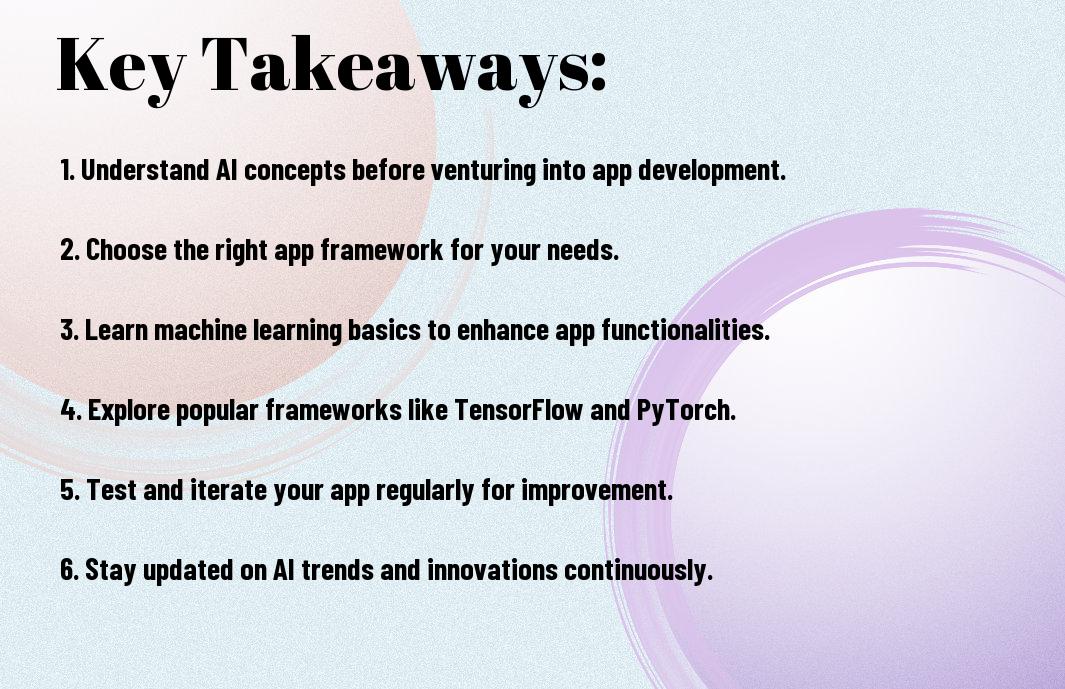
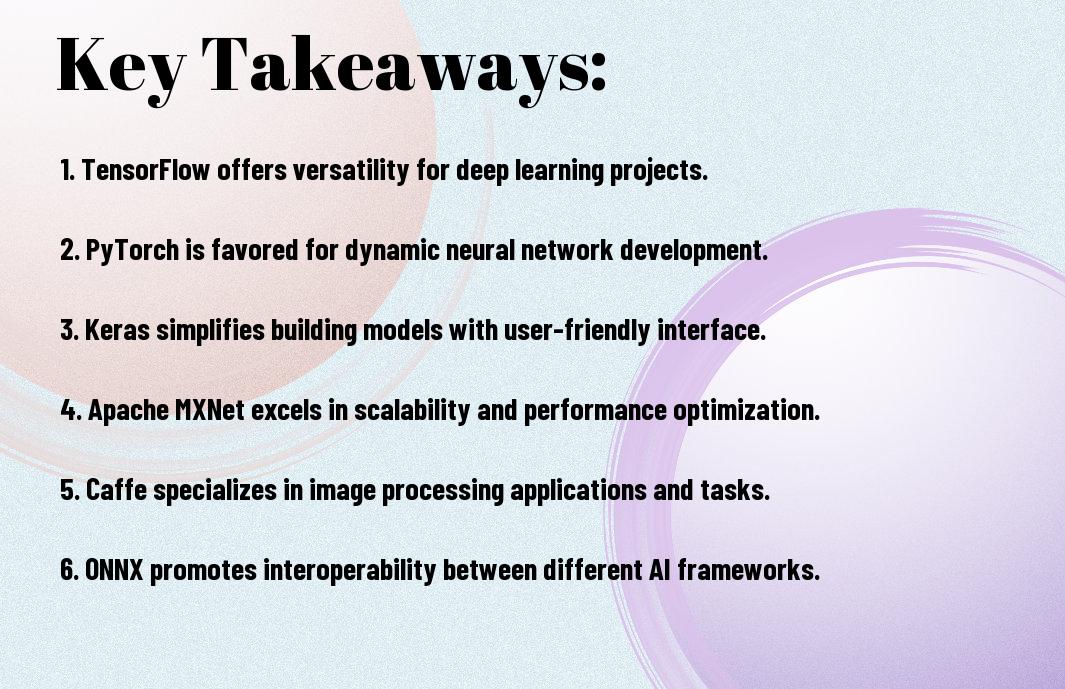
Key Takeaways:
- TensorFlow and PyTorch are two of the most popular AI frameworks used for building next-gen applications, offering a wide range of tools and libraries for tasks such as computer vision, natural language processing, and predictive analytics.
- Microsoft Cognitive Toolkit (CNTK) is another powerful AI framework that allows developers to build and train deep learning models, with a focus on scalability and performance.
- Keras is a high-level AI framework that provides an easy-to-use interface for building and training neural networks, making it a great choice for developers who are new to AI and machine learning.
- OpenCV is a computer vision framework that provides a wide range of tools and libraries for tasks such as image and video processing, object detection, and facial recognition, making it a great choice for building applications that require computer vision capabilities.
- Scikit-learn is a machine learning framework that provides a wide range of algorithms and tools for tasks such as classification, regression, and clustering, making it a great choice for building applications that require predictive analytics and data analysis capabilities.
Evolution of AI Frameworks
Your journey to creating next-gen applications begins with understanding the evolution of AI frameworks, which have transformed significantly over the years, and you can explore the List of Top Generative AI Frameworks and Tools for 2025 to stay updated.
Historical Development
Developing from simple machine learning algorithms, AI frameworks have come a long way, and as you research into their history, you’ll discover how they paved the way for modern applications.
Current Technology Landscape
Against the backdrop of rapid technological advancements, you’re now faced with a plethora of AI frameworks to choose from, each with its unique features and capabilities.
Current advancements in AI frameworks have led to the development of more sophisticated and specialized tools, allowing you to create complex applications with ease, and as you explore these frameworks, you’ll find that they cater to your specific needs, whether it’s natural language processing, computer vision, or predictive analytics.
Popular AI Development Tools
Even with numerous AI frameworks available, you can narrow down your options by focusing on the most popular ones, which offer extensive community support and a wide range of resources to help you get started with your next-gen application development.
TensorFlow Ecosystem
Besides being an open-source framework, TensorFlow offers a comprehensive ecosystem that includes tools like TensorFlow Lite and TensorFlow.js, allowing you to develop and deploy AI models across various platforms, making it a versatile choice for your AI development needs.
PyTorch Framework
Below the surface of PyTorch’s dynamic computation graph lies a powerful framework that enables you to build and train AI models rapidly, thanks to its modular design and automatic differentiation capabilities, making it an ideal choice for your rapid prototyping and development requirements.
Due to its simplicity and flexibility, PyTorch has become a favorite among developers, allowing you to easily integrate it with other tools and frameworks, and its strong GPU support enables you to train complex models quickly, giving you a significant edge in developing and deploying your next-gen applications.
Deep Learning Frameworks
Keep in mind that deep learning frameworks are vital for building next-gen applications, as they provide the necessary tools and libraries to create complex models. You can utilize these frameworks to develop applications with advanced capabilities, such as image and speech recognition, natural language processing, and more.
Core Components
For instance, when working with deep learning frameworks, you will typically encounter core components like tensors, automatic differentiation, and optimization algorithms, which are necessary for building and training your models. You can use these components to create custom models tailored to your specific needs.
Neural Network Architecture
For example, when designing a neural network architecture, you will need to consider factors like layer types, connections, and activation functions, which can significantly impact your model’s performance. You can experiment with different architectures to find the one that best suits your application.
Due to the complexity of neural network architectures, you will need to carefully evaluate your design choices to ensure they align with your project’s goals. You can use your knowledge of deep learning frameworks to create and train models that achieve state-of-the-art performance, and your applications will benefit from the advanced capabilities they provide.

Natural Language Processing Tools
After exploring various AI frameworks, you’ll find that natural language processing (NLP) tools are vital for creating next-gen applications that can understand and interact with users in a more human-like way, enabling you to build more sophisticated and engaging interfaces.
Framework Capabilities
Prior to selecting an NLP framework, you should consider the capabilities you need, as you will want to choose one that aligns with your project’s requirements, allowing you to leverage features such as sentiment analysis, entity recognition, and language translation to enhance your application.
Implementation Methods
Along with choosing the right framework, you need to consider the implementation methods, as you will want to ensure that your NLP tool integrates seamlessly with your existing infrastructure, enabling you to focus on developing innovative features and improving user experience.
Language support is a key aspect of implementation methods, as you will need to decide which languages your application will support, and ensure that your NLP framework can handle the nuances of each language, allowing you to reach a broader audience and provide a more personalized experience for your users.
Computer Vision Frameworks
Once again, you’ll find that computer vision frameworks are crucial for creating next-gen applications, enabling your system to interpret and understand visual data from images and videos, and make informed decisions based on that data.
Image Processing Tools
After selecting a suitable framework, you can utilize image processing tools to enhance, manipulate, and analyze your images, allowing your application to extract valuable insights and features from visual data.
Video Analysis Systems
Across various industries, you can leverage video analysis systems to detect objects, track movements, and recognize patterns, making it possible to develop innovative applications such as surveillance systems and autonomous vehicles.
Frameworks like OpenCV and TensorFlow provide you with the necessary tools to build and deploy video analysis systems, enabling your application to process and analyze video feeds in real-time, and make data-driven decisions based on the insights extracted from the video data, allowing you to create more sophisticated and intelligent applications.
Edge Computing AI Solutions
Not all AI frameworks are created equal, and when it comes to edge computing, you need solutions that can process data in real-time, reducing latency and improving performance, which is imperative for your next-gen applications.
Mobile Development Frameworks
For instance, when developing mobile applications, you can leverage frameworks like TensorFlow Lite or Core ML to create seamless user experiences, enabling your apps to run efficiently on edge devices.
IoT Integration Tools
Edge computing enables you to integrate AI with IoT devices, allowing your applications to collect and process data from various sources, making your solutions more intelligent and responsive to user needs.
In fact, as you examine deeper into IoT integration tools, you will discover a wide range of libraries and software development kits (SDKs) that simplify the process of connecting your AI models to IoT devices, enabling you to create more sophisticated and automated applications that can analyze data and make decisions in real-time.
Final Words
As a reminder, you now have the knowledge to create next-gen applications using top AI frameworks. You can leverage your newfound understanding to develop innovative solutions, enhancing your applications and staying ahead in the market. With your skills, you will be able to build cutting-edge products, driving your business forward and improving your customers’ experiences. Your ability to harness AI will unlock new opportunities, enabling you to achieve your goals and succeed in the rapidly evolving tech landscape.
FAQ
Q: What are the most popular AI frameworks used to create next-gen applications?
A: The most popular AI frameworks used to create next-gen applications include TensorFlow, PyTorch, and Keras. TensorFlow is an open-source framework developed by Google, known for its extensive community support and wide range of tools. PyTorch, developed by Facebook, is popular for its ease of use and rapid prototyping capabilities. Keras, on the other hand, is a high-level framework that provides an easy-to-use interface for building neural networks. These frameworks are widely used in various applications, including natural language processing, computer vision, and predictive analytics.
Q: What are the key factors to consider when selecting an AI framework for next-gen application development?
A: When dicking out an AI framework for next-gen application development, several key factors should be considered. These include the type of application being developed, the level of complexity, and the required scalability. Additionally, the framework’s compatibility with existing infrastructure, the size and activity of its community, and the availability of documentation and support are also important considerations. Furthermore, the framework’s support for various AI and machine learning algorithms, as well as its integration with other tools and technologies, should also be evaluated. By carefully considering these factors, developers can choose the most suitable framework for their specific needs and ensure the success of their next-gen application.
Q: How do AI frameworks contribute to the development of next-gen applications, and what benefits do they offer?
A: AI frameworks significantly contribute to the development of next-gen applications by providing pre-built components, tools, and libraries that simplify and accelerate the development process. These frameworks offer a range of benefits, including improved efficiency, increased accuracy, and enhanced scalability. They enable developers to focus on building innovative applications, rather than starting from scratch, and provide access to advanced AI and machine learning capabilities. Additionally, AI frameworks facilitate collaboration and knowledge sharing among developers, promoting the creation of more sophisticated and powerful next-gen applications. By leveraging these frameworks, developers can create applications that are more intelligent, interactive, and user-friendly, leading to improved user experiences and increased business value.