
As you probe into the world of app development, you’re likely to encounter the concept of deep learning, a subset of machine learning that’s revolutionizing the way your apps interact with users. You can leverage deep learning to create smarter, more intuitive apps that learn from user behavior and adapt to their needs. By harnessing the power of deep learning, you can take your app development to the next level, enabling your apps to make predictions, classify data, and drive innovation in unprecedented ways, transforming your user experience.

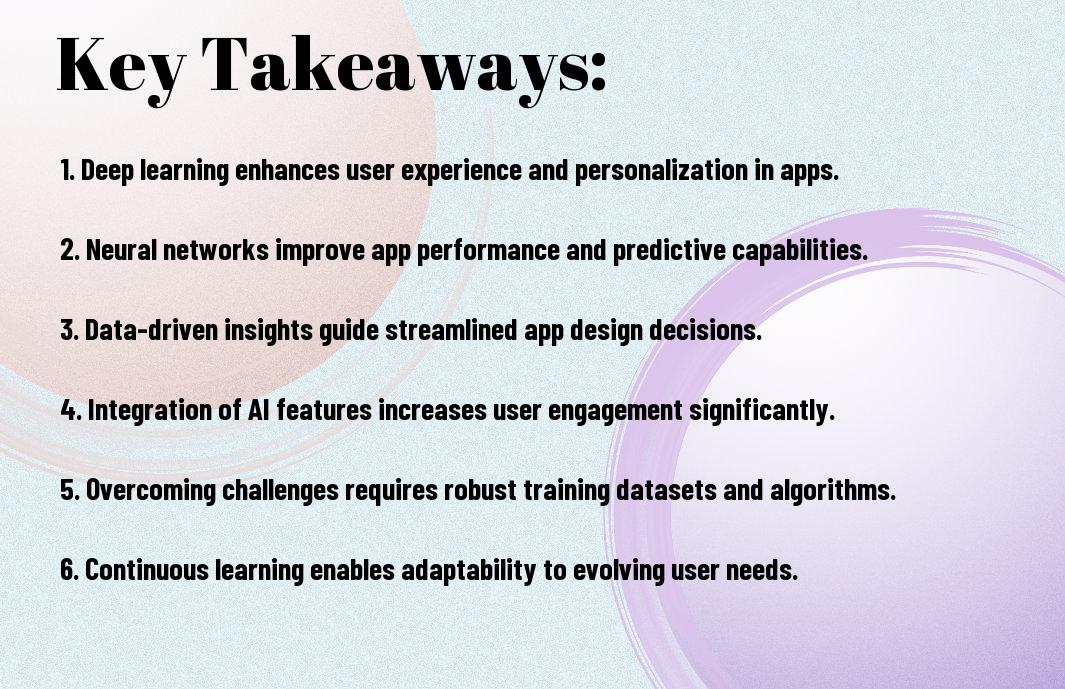
Key Takeaways:
- Deep learning can significantly enhance the user experience in smart app development by enabling features such as image and speech recognition, natural language processing, and predictive analytics.
- Integrating deep learning models into mobile apps can improve their performance, security, and functionality, leading to increased user engagement and retention.
- Developers can leverage pre-trained deep learning models and frameworks, such as TensorFlow and PyTorch, to streamline the development process and reduce the need for extensive machine learning expertise.
- Deep learning-powered apps can provide personalized experiences for users by analyzing their behavior, preferences, and usage patterns, enabling targeted recommendations and advertisements.
- As deep learning technology continues to evolve, it is likely to play an increasingly important role in the development of smart apps, enabling new use cases and applications across various industries, including healthcare, finance, and education.
Deep Learning Fundamentals in App Development
A key aspect of developing smart apps is understanding deep learning fundamentals, which you can explore further by visiting Can you explain the process of creating a simple application using neural networks to gain insights into the process.
Neural Networks Architecture for Apps
Applications relying on neural networks are designed to mimic human brain functions, allowing you to create complex models that can learn and adapt to your users’ behavior, making your app more intuitive and user-friendly.
Training Models for Mobile Environments
To develop efficient models, you need to consider the limitations and capabilities of mobile devices, ensuring that your app’s performance is optimized for various platforms and hardware configurations, which will help you to create a seamless user experience.
Learning from data is crucial in training models for mobile environments, and as you research deeper into this process, you will discover that your app’s ability to learn from user interactions and adapt to new data will significantly enhance its overall performance and user engagement, allowing you to refine your app and make it more responsive to your users’ needs.
Smart Features Integration
If you’re looking to create a cutting-edge app, integrating smart features is necessary. You can leverage deep learning to enhance your app’s functionality and user experience. By incorporating advanced technologies, you can set your app apart from the competition and provide your users with a unique experience.
Natural Language Processing Components
For instance, you can utilize natural language processing (NLP) components to enable voice commands, sentiment analysis, and text classification in your app. You can use NLP to improve your app’s user interface and make it more interactive, allowing your users to engage with your app in a more natural way.
Computer Vision Elements
At the forefront of smart feature integration is computer vision, which enables your app to interpret and understand visual data from images and videos. You can use computer vision to develop features such as facial recognition, object detection, and image classification, making your app more intuitive and engaging.
Due to the advancements in computer vision, you can now develop apps that can analyze and understand visual data in real-time, enabling features such as augmented reality, gesture recognition, and more. You can use these features to create immersive experiences for your users, setting your app apart from others in the market.
Performance Optimization
Your application’s performance is directly tied to its success, and deep learning models can be computationally intensive, making optimization important for smart app development.
Model Compression Techniques
Against the backdrop of increasing model complexity, you can leverage techniques like pruning and quantization to reduce model size and improve inference speed.
Resource Management Strategies
Condensing your resources effectively is key to optimizing performance, and you can achieve this by allocating resources dynamically and utilizing cloud services to scale your application.
Hence, as you implement resource management strategies, you will be able to monitor and control resource utilization, ensuring that your application runs smoothly and efficiently, which is vital for providing a seamless user experience, and you can achieve this by setting up monitoring tools and alerts to notify you of potential issues before they impact your users.
User Experience Enhancement
Despite the complexity of deep learning, you can leverage it to enhance your app’s user experience, making it more intuitive and engaging for your users.
Predictive Interface Adaptation
By utilizing predictive models, you can adapt your app’s interface to anticipate your users’ needs, providing a more seamless experience and increasing user satisfaction.
Personalization Algorithms
One key aspect of user experience enhancement is the use of personalization algorithms, which allow you to tailor your app’s content and features to individual users’ preferences and behaviors.
Personalization enables you to create a unique experience for each user, increasing engagement and loyalty, and you can achieve this by analyzing user data and incorporating machine learning models into your app development process, allowing you to make data-driven decisions and continuously improve your app’s user experience.
Data Management and Privacy
Keep in mind that managing data is a significant aspect of deep learning in smart app development, as you handle sensitive user information and ensure its security.
Secure Data Handling
Handling sensitive data requires robust security measures, as you protect your users’ information from unauthorized access and potential breaches.
Local Processing Methods
Across various platforms, you can utilize local processing methods to enhance data security, allowing your app to process data on-device, thereby minimizing the risk of data exposure.
Privacy is a major concern when implementing local processing methods, as you need to ensure that your app adheres to strict data protection regulations, giving you greater control over your users’ data and maintaining their trust in your app.
Implementation Framework
Now that you have a solid understanding of deep learning, you can begin implementing it in your app development. For more information on integrating AI, visit Harnessing Artificial Intelligence in Mobile Apps to explore key applications.
Development Workflow
Beneath the surface of your app’s development lies a complex workflow. You will need to design, develop, and train your deep learning models to ensure seamless integration with your app’s existing infrastructure.
Testing and Deployment
Any issues that arise during testing can be ironed out through rigorous quality assurance processes. You should test your app thoroughly to ensure that the deep learning components are functioning as intended.
To ensure a smooth deployment, you will need to monitor your app’s performance and make any necessary adjustments to the deep learning models. You can then deploy your app, confident that the deep learning components will enhance your users’ experience.
Conclusion
Hence, as you explore into the world of smart app development, you will find that harnessing deep learning can significantly enhance your projects. You can leverage its capabilities to create more intuitive and responsive applications, ultimately elevating your users’ experience. By integrating deep learning into your development process, you can unlock new possibilities and stay ahead in the competitive tech landscape, making your apps more innovative and effective.
FAQ
Q: What is deep learning and how can it be applied to smart app development?
A: Deep learning is a subset of machine learning that involves the use of artificial neural networks to analyze and interpret data. In the context of smart app development, deep learning can be used to enable apps to learn from user behavior, make predictions, and improve performance over time. For example, deep learning can be used to develop image and speech recognition systems, natural language processing, and predictive analytics. By leveraging deep learning, developers can create more intelligent and personalized apps that provide a better user experience.
Q: What are the benefits of using deep learning in smart app development, and how can it improve the user experience?
A: The benefits of using deep learning in smart app development include improved accuracy, enhanced personalization, and increased efficiency. Deep learning algorithms can analyze large amounts of data and learn from user behavior, allowing apps to provide more accurate and relevant recommendations, predictions, and responses. Additionally, deep learning can enable apps to automate tasks, reduce latency, and improve overall performance. By leveraging deep learning, developers can create apps that are more intuitive, responsive, and engaging, leading to a better user experience and increased user satisfaction.
Q: What are the challenges and limitations of harnessing deep learning for smart app development, and how can developers overcome them?
A: The challenges and limitations of harnessing deep learning for smart app development include the need for large amounts of high-quality training data, significant computational resources, and expertise in deep learning algorithms and techniques. Additionally, deep learning models can be complex and difficult to interpret, making it challenging to identify and address errors or biases. To overcome these challenges, developers can use techniques such as data augmentation, transfer learning, and model pruning to reduce the need for large amounts of training data and computational resources. They can also use tools and frameworks such as TensorFlow, PyTorch, and Keras to simplify the development and deployment of deep learning models. Furthermore, developers can collaborate with data scientists and machine learning experts to ensure that deep learning models are accurate, reliable, and fair.