
Customer

The Essential Role Of AI Agents In Enhancing Customer Experience

As you navigate the ever-evolving landscape of customer service, you’re likely to encounter AI agents that are transforming the way you interact with businesses. You expect personalized and efficient support, and AI agents are designed to deliver just that. By leveraging AI technology, you can provide your customers with 24/7 assistance, streamlining your support processes and enhancing overall customer satisfaction. Your business can benefit from AI agents in numerous ways, and this post will explore the key advantages of integrating them into your customer experience strategy.

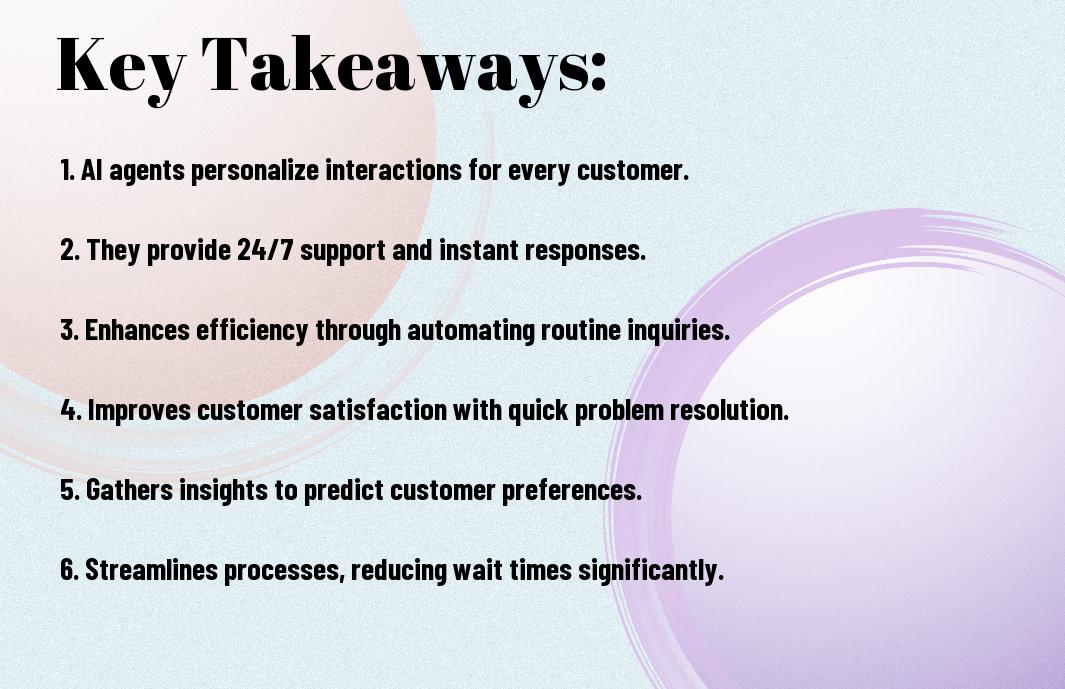
Key Takeaways:

  • AI agents play a significant role in enhancing customer experience by providing personalized support and services, allowing businesses to build stronger relationships with their customers and improve overall satisfaction.
  • AI-powered chatbots and virtual assistants can handle a high volume of customer inquiries, freeing up human customer support agents to focus on more complex issues and providing a more efficient experience for customers.
  • By leveraging AI agents, businesses can gain valuable insights into customer behavior and preferences, enabling them to make data-driven decisions and tailor their services to meet the evolving needs of their customers, ultimately driving loyalty and retention.
The Evolution of AI in Customer Service

While exploring the history of customer service, you’ll notice a significant shift towards technology-driven solutions, with AI agents playing a vital role in enhancing your customer experience.

Traditional Customer Service Limitations

Service delivery has long been hindered by human limitations, such as emotional fatigue and limited working hours, affecting your ability to provide 24/7 support to your customers.

Rise of AI-Powered Solutions

Beneath the surface of traditional customer service lies a new era of AI-powered solutions, enabling you to automate tasks and provide personalized support to your customers.

This rise of AI-powered solutions has transformed the customer service landscape, allowing you to leverage machine learning algorithms and natural language processing to analyze customer interactions and deliver tailored responses, ultimately enhancing your customer experience and building brand loyalty. As you examine deeper into AI-powered solutions, you’ll discover the potential to streamline your customer service operations, reduce response times, and increase customer satisfaction.

Core Components of AI Customer Service Agents

If you’re looking to enhance your customer experience, you’ll want to understand the core components of AI customer service agents, which you can learn more about in The Role of AI in Enhancing Customer Experience. This will help you make informed decisions about implementing AI in your business.

Natural Language Processing

Along with advancements in technology, natural language processing has become a key aspect of AI customer service agents, enabling them to understand and respond to your customers’ queries more effectively.

Machine Learning Capabilities

Like human learning, machine learning capabilities allow AI agents to improve their performance over time, enabling them to provide more personalized and efficient support to your customers.

And as you research deeper into machine learning capabilities, you’ll discover that they enable AI agents to analyze vast amounts of data, identify patterns, and make predictions, allowing them to provide proactive and tailored support to your customers, ultimately enhancing their overall experience with your brand.

Customer Experience Transformation

All businesses strive to deliver exceptional customer experiences, and AI agents play a significant role in achieving this goal. You can leverage AI to analyze customer data, preferences, and behaviors, enabling your company to provide personalized interactions and tailored solutions.

Personalization at Scale

By harnessing the power of AI, you can offer personalized experiences to your customers at scale, increasing their satisfaction and loyalty. Your business can use AI-driven insights to create targeted marketing campaigns, product recommendations, and customized support, making your customers feel valued and understood.

Real-Time Response Systems

With the implementation of AI-powered response systems, you can respond to customer inquiries and concerns in real-time, ensuring timely and effective issue resolution. Your customers will appreciate the prompt attention, leading to increased trust and loyalty in your brand.

Further, real-time response systems enabled by AI allow you to proactively address customer issues, reducing the likelihood of escalation and improving overall customer satisfaction. You can integrate AI-driven chatbots, virtual assistants, and other tools to provide 24/7 support, ensuring that your customers receive assistance whenever they need it, and enhancing their experience with your brand.

Business Impact and ROI

To maximize the benefits of AI agents, you need to understand their impact on your business. By implementing AI agents, you can enhance customer experience, leading to increased loyalty and retention, ultimately driving revenue growth and improving your bottom line.

Cost Efficiency Metrics

Against the backdrop of rising operational costs, AI agents can help you streamline processes, reducing the need for human intervention and minimizing errors, thereby saving you time and money.

Customer Satisfaction Indicators

One of the key benefits of AI agents is their ability to provide personalized support, helping you to improve customer satisfaction and loyalty, which is necessary for your business’s long-term success.

Customer satisfaction is a key indicator of the effectiveness of your AI agents, and you can measure it through various metrics, such as net promoter score, customer effort score, and first contact resolution rate, allowing you to refine your strategy and make data-driven decisions to further enhance your customer experience.

Implementation Strategies

Keep in mind that successful implementation of AI agents in customer experience requires a well-planned approach, you can learn more about The Role of AI Agents in Enhancing Customer Service to improve your strategy.

Integration with Existing Systems

On the technical side, you will need to integrate AI agents with your existing systems to ensure seamless customer experience, this will enable you to provide personalized support to your customers.

Staff Training and Adaptation

After implementing AI agents, you should focus on training your staff to work alongside these agents, this will help your team to effectively handle complex customer queries.

Adaptation to AI-powered customer service is key to your success, as you will need to continuously monitor and evaluate the performance of your AI agents, and make adjustments as needed to ensure they are meeting your customer experience goals, and providing the best possible support to your customers.

Future Trends and Innovations

Unlike traditional customer service methods, AI agents are revolutionizing the way you interact with your customers, and their impact will only continue to grow in the future, enabling you to provide more personalized and efficient support.

Predictive Customer Service

On the horizon, you can expect AI-powered predictive customer service to become more prevalent, allowing you to anticipate and address customer issues before they even arise, enhancing your overall customer experience.

Emotional Intelligence in AI

Innovations in emotional intelligence are being integrated into AI agents, enabling you to better understand and respond to your customers’ emotions, leading to more empathetic and human-like interactions.

Further, as you explore the potential of emotional intelligence in AI, you will discover that it can help you to create more personalized and engaging customer experiences, allowing you to build stronger relationships with your customers and drive long-term loyalty, making it an crucial aspect of your customer experience strategy.

To wrap up

Presently, you can see that AI agents play a significant role in enhancing your customer experience. You will find that they provide personalized support, quick resolutions, and 24/7 assistance. As you implement AI agents, your business will likely see improved customer satisfaction and loyalty. You can expect to gain a competitive edge by leveraging AI agents to streamline your customer service operations and deliver exceptional experiences. Your customers will appreciate the efficiency and accuracy that AI agents bring to the table.

FAQ

Q: What is the role of AI agents in enhancing customer experience?

A: AI agents play a significant role in enhancing customer experience by providing personalized and efficient support to customers. They can analyze customer data, behavior, and preferences to offer tailored solutions and recommendations, thereby improving customer satisfaction and loyalty. Additionally, AI agents can help automate routine tasks, freeing up human customer support agents to focus on more complex and emotionally charged issues, leading to a more empathetic and humanized customer experience.

Q: How do AI agents improve customer engagement and interaction?

A: AI agents improve customer engagement and interaction by providing 24/7 support, quick response times, and multilingual capabilities. They can also analyze customer sentiment and emotions, enabling them to respond in a more empathetic and personalized manner. Furthermore, AI agents can facilitate seamless transitions between different communication channels, such as from chat to voice or email, ensuring a consistent and cohesive customer experience across all touchpoints.

Q: Can AI agents really understand and respond to customer emotions and sentiment?

A: Yes, AI agents can be trained to understand and respond to customer emotions and sentiment using natural language processing (NLP) and machine learning algorithms. These technologies enable AI agents to analyze customer language, tone, and behavior, and respond in a way that acknowledges and addresses their emotional state. This empathetic response can help to diffuse tension, build trust, and create a more positive customer experience.

Q: How do AI agents help in personalizing the customer experience?

A: AI agents help in personalizing the customer experience by analyzing customer data, behavior, and preferences to create unique profiles and tailor-made solutions. They can offer personalized product recommendations, content, and offers based on individual customer interests and needs. Additionally, AI agents can help to identify customer pain points and preferences, enabling companies to make data-driven decisions and implement targeted improvements to their products and services.

Q: What are the benefits of using AI agents in customer experience, and how do they impact business outcomes?

A: The benefits of using AI agents in customer experience include improved customer satisfaction, increased loyalty, and enhanced retention. AI agents can also help to reduce customer support costs, improve response times, and increase first-contact resolution rates. By providing a more personalized, efficient, and empathetic customer experience, AI agents can drive business outcomes such as increased revenue, improved brand reputation, and competitive differentiation, ultimately leading to long-term growth and success.

How can customer reviews and testimonials influence conversion rates

Most customers rely heavily on the experiences and opinions of others when making purchasing decisions. When you come across positive reviews and testimonials from satisfied customers, it builds trust and credibility in the product or service. This social proof not only reassures you but also influences your decision-making process, ultimately leading to higher conversion rates. Understanding the impact of customer feedback can help you leverage it to your advantage and boost your sales.

Key Takeaways:

  • Builds trust: Customer reviews and testimonials provide social proof which helps build trust with potential customers.
  • Increases credibility: Positive reviews from satisfied customers can increase the credibility of your products or services.
  • Boosts conversions: By showcasing real customer experiences and feedback, you can persuade more visitors to make a purchase, thus boosting conversion rates.

The Power of Social Proof

Defining Social Proof

To understand the influence of customer reviews and testimonials on conversion rates, you need to grasp the concept of social proof. Essentially, social proof is the idea that people tend to follow the actions of others when making decisions, especially in uncertain situations. In the context of e-commerce, this means that when potential customers see positive reviews and testimonials from satisfied buyers, they are more likely to trust the product or service being offered.

The Psychology Behind Social Proof

On a psychological level, social proof taps into our innate desire to conform and seek validation from others. When you see that a product or service has been positively recommended by others, you are more inclined to believe that it is a safe and wise choice. This phenomenon is rooted in the idea that the wisdom of the crowd often surpasses individual judgment, making social proof a powerful tool for influencing consumer behavior.

An interesting aspect of the psychology behind social proof is the principle of informational social influence. This means that when you are unsure about a decision, you are more likely to look to others for guidance. By showcasing positive customer reviews and testimonials on your website or product pages, you are providing valuable information that can help sway potential customers towards making a purchase.

Customer Reviews as a Conversion Driver

The Impact of Positive Reviews

Positive customer reviews are a powerful tool in driving conversion rates. When potential customers see glowing testimonials from satisfied buyers like yourself, it creates a sense of trust and credibility in the product or service. These positive reviews serve as social proof, assuring you that others have had a great experience, making you more likely to make a purchase decision.

The Detrimental Effect of Negative Reviews

Impact

Negative reviews can have a significant impact on conversion rates. When you come across unfavorable feedback from other customers, it raises doubts about the product or service quality in your mind. You may start questioning whether you should proceed with the purchase, leading to hesitation and ultimately, abandonment of the transaction.

Conversion

It’s crucial to address negative reviews promptly and effectively. Offering solutions, compensations, or simply acknowledging the issues raised can help rebuild trust with potential customers like you who may have been discouraged by the negative feedback.

The Role of Review Quantity and Quality

Role

Both the quantity and quality of reviews play a crucial role in influencing conversion rates. When you see a product with a large number of positive reviews, you are more likely to trust the overall rating and feel confident in your purchase decision. Additionally, detailed and descriptive reviews can provide you with valuable insights into the product, helping you make an informed choice.

Detrimental

On the other hand, a lack of reviews or an abundance of vague, low-quality feedback can deter you from proceeding with a purchase. It’s important for businesses to encourage satisfied customers like you to leave detailed and authentic reviews to help build credibility and trust among potential buyers.

Testimonials: A More Personal Touch

Many times, when you are researching a product or service, you come across customer reviews that provide valuable insights into the quality and reliability of what you are interested in. However, there is a distinction between customer reviews and testimonials that you should be aware of.

The Difference Between Reviews and Testimonials

For understanding, reviews are typically brief and focus on the overall experience with the product or service, highlighting the pros and cons. On the other hand, testimonials are more in-depth and personal. They often tell a story of how the product or service positively impacted the customer’s life, creating an emotional connection that reviews might lack.

Using Testimonials to Build Trust

Touching on the emotional aspect, testimonials have the power to build trust and credibility in a way that reviews may not. When you read a testimonial from someone who shares a similar background or problem as yours, you can relate to their experience and envision how the product or service could benefit you as well.

Testimonials offer a more personal touch compared to reviews, making them more persuasive and impactful in influencing your decision-making process. The detailed accounts of how a product or service solved a specific issue for a customer can resonate with you on a deeper level, creating a sense of trust and reliability in the brand.

Effective Testimonial Placement Strategies

An important aspect of using testimonials effectively is where and how you place them on your website or marketing materials. Testimonials strategically placed near a call-to-action or product description can provide that final nudge needed to convert a potential customer into a paying one. By placing testimonials in high-visibility areas, you ensure that potential customers see positive feedback right when they need it.

Testimonials can act as social proof, reassuring you of your decision to purchase a product or service. Seeing positive testimonials from satisfied customers can alleviate any doubts or concerns you may have, serving as a critical factor in your decision-making process.

Building Credibility with Customer Endorsements

Despite the ever-growing digital landscape, trust remains a crucial factor in a consumer’s decision-making process. One of the most effective ways to build trust and credibility with your audience is through customer endorsements. Whether it’s in the form of reviews, testimonials, or case studies, showcasing positive experiences from real customers can significantly influence conversion rates.

The Importance of Authenticity

Building authenticity in your customer endorsements is key to earning the trust of your audience. When potential customers see genuine reviews and testimonials from others who have had positive experiences with your products or services, they are more likely to believe in the value you offer. Authentic endorsements create a sense of transparency and integrity, showing that you have nothing to hide and are confident in the quality of what you provide.

Highlighting Expert Endorsements

Authenticity is crucial, but highlighting expert endorsements can take your credibility to the next level. When industry experts or influencers endorse your brand, it not only validates your offerings but also positions you as a trusted authority in your field. Expert endorsements can help you reach a wider audience and attract customers who value the opinions of thought leaders in the industry.

Customer endorsements are powerful tools that can significantly impact your conversion rates. By showcasing positive feedback from satisfied customers, you provide social proof that reassures potential buyers and helps them feel more confident in their decision to purchase from you.

Leveraging User-Generated Content

Leveraging user-generated content, such as customer reviews, photos, and videos, can further strengthen your credibility. User-generated content adds a level of authenticity that traditional marketing tactics often lack. When potential customers see real people using and enjoying your products or services, they are more likely to trust your brand and be swayed towards making a purchase.

Credibility is the foundation of trust in the digital age, and customer endorsements play a crucial role in establishing that credibility. By authentically showcasing positive experiences from both customers and experts, you can build trust, attract new customers, and ultimately increase your conversion rates.

The Role of Reviews and Testimonials in the Buyer’s Journey

Awareness Stage: Building Trust

All successful relationships are built on trust, and the same applies to the relationship between a consumer and a brand. One way to establish trust at the Awareness Stage of the buyer’s journey is through authentic customer reviews and testimonials. When you come across positive reviews from real customers who have had a good experience with a product or service, it sets a foundation of reliability and credibility in your mind. This initial trust is crucial as you start your journey as a potential buyer.

Consideration Stage: Addressing Concerns

To further address any doubts or concerns you may have during the Consideration Stage of the buyer’s journey, reviews and testimonials play a vital role. You can read about other customers’ experiences, both positive and negative, which can provide valuable insights into how the product or service performs in real life. This information helps you weigh the pros and cons effectively, guiding your decision-making process. Moreover, testimonials that resonate with your specific needs and challenges can reassure you that the product or service is the right choice for you.

Considering reviews and testimonials during the Consideration Stage not only helps you make an informed decision but also adds a layer of transparency to the brand-consumer relationship. By sharing honest feedback, previous customers contribute to a community of trust and empowerment, aiding you in evaluating options and making the best possible choice.

Decision Stage: Sealing the Deal

As you reach the Decision Stage of the buyer’s journey, the accumulation of positive reviews and testimonials can significantly influence your final decision. Trust plays a pivotal role here, as you are more inclined to trust the collective voice of many satisfied customers than just the brand’s self-promotion. The social proof provided by reviews and testimonials can give you the confidence needed to move forward with your purchase, knowing that others have been happy with the same decision.

Understanding the impact of reviews and testimonials at the Decision Stage is crucial for brands looking to convert potential customers into loyal ones. By showcasing the positive experiences of past customers, brands can create a sense of trust and credibility that resonates with you as you make your final purchasing choice.

Overcoming Common Objections

Once again, customer reviews and testimonials can significantly impact your conversion rates, but it’s crucial to address common objections that may arise. By proactively tackling skepticism and doubts, dealing with fake or biased reviews, and managing your online reputation, you can build trust and credibility with potential customers.

Addressing Skepticism and Doubt

Overcoming skepticism and doubt is crucial when it comes to customer reviews and testimonials. People may question the authenticity of the feedback or wonder if the reviews are cherry-picked to only show the positive aspects of your products or services. To address this, ensure that your reviews come from verified customers, display a range of opinions – both positive and negative, and respond transparently to any concerns raised in the reviews.

Dealing with Fake or Biased Reviews

Common concerns about customer reviews include the possibility of fake or biased feedback influencing perceptions. It’s important to implement measures to detect and remove fake reviews. Remember that authenticity is key to building trust, so prioritize gathering genuine feedback from real customers to provide an accurate representation of your business.

With the rise of online review platforms, the issue of fake or biased reviews has become increasingly prevalent. Some businesses may resort to unethical practices to boost their ratings, leading to distrust among consumers. By actively monitoring and addressing any suspected fake reviews, you can maintain credibility and demonstrate your commitment to transparency.

Managing Online Reputation

For businesses, managing your online reputation is a continuous effort that involves monitoring feedback, addressing customer concerns promptly, and maintaining a positive brand image. Your online reputation is a reflection of how your customers perceive your business, so it’s crucial to actively engage with reviews and testimonials to build a strong, trustworthy reputation.

Understanding the impact of customer reviews on your online reputation is key to leveraging their potential to influence conversion rates. By consistently delivering quality products or services, actively seeking and responding to feedback, and showcasing authentic customer testimonials, you can enhance your online reputation and ultimately drive conversions.

Conclusion

With these considerations in mind, it is clear that customer reviews and testimonials play a crucial role in influencing conversion rates. By providing social proof and building credibility for your business, positive reviews can significantly impact a potential customer’s decision-making process. People are more likely to trust the opinions of others who have had first-hand experience with a product or service, making reviews a powerful tool for increasing conversions.

Keep in mind, the quality and quantity of reviews matter, so encourage your satisfied customers to leave feedback and engage with any negative reviews in a constructive manner. By actively managing and leveraging customer testimonials, you can create a positive image for your brand and ultimately improve your conversion rates. Harness the power of social proof and watch your business thrive!

FAQ

Q: How can customer reviews and testimonials influence conversion rates?

A: Customer reviews and testimonials provide social proof for your products or services, helping to build trust and credibility with potential customers. When shoppers see positive reviews from other satisfied customers, they are more likely to trust your brand and make a purchase, ultimately resulting in higher conversion rates.

Q: Are customer reviews and testimonials important for e-commerce businesses?

A: Yes, customer reviews and testimonials are crucial for e-commerce businesses. They help create a sense of transparency and authenticity, which can significantly impact a customer’s decision-making process. Positive reviews can also help differentiate your brand from competitors and build long-term customer loyalty.

How can businesses effectively leverage customer reviews and testimonials to boost conversion rates?

A: Businesses can leverage customer reviews and testimonials by prominently displaying them on their website, product pages, or marketing materials. They can also encourage satisfied customers to leave reviews by offering incentives or making the process seamless. Responding to reviews, both positive and negative, shows that you value customer feedback and can further enhance your brand’s reputation.

How can analyzing customer behavior on a website lead to improved conversion rates

Many websites struggle with converting visitors into customers. However, by delving into the intricacies of customer behavior on your website, you can uncover valuable insights that pave the way to enhanced conversion rates. Understanding what your visitors do, where they click, how long they stay, and what prompts them to leave can empower you to optimize your site for better engagement and ultimately drive more conversions. Let’s explore how analyzing and leveraging customer behavior data can be the key to boosting your conversion rates.

Key Takeaways:

  • Understanding User Journey: Analyzing customer behavior helps in tracking the user journey on a website, identifying key touchpoints, and determining where users drop off.
  • Optimizing Customer Experience: By studying customer behavior, businesses can make data-driven improvements to website layout, content, and functionality to enhance user experience and drive conversions.
  • Personalizing Marketing Strategies: Leveraging customer behavior data allows businesses to create personalized marketing strategies, such as targeted messaging and product recommendations, to increase conversion rates.

The Power of Customer Insights

What drives customer decisions

To improve conversion rates on your website, it’s crucial to understand the factors that drive your customers’ decisions. By analyzing customer behavior, you can gain valuable insights into their preferences, motivations, and pain points. This information is like a compass that guides you in tailoring your website content, design, and marketing strategies to better meet the needs and expectations of your target audience.

Through customer behavior analysis, you can uncover patterns such as which pages attract the most attention, where customers tend to drop off in the sales funnel, and what elements compel them to make a purchase. Armed with these insights, you can make informed decisions on how to optimize your website for a seamless and engaging user experience, ultimately leading to increased conversions.

The importance of data-driven decision-making

To boost your conversion rates effectively, it’s crucial to embrace data-driven decision-making. Relying on data and analytics rather than guesswork allows you to make strategic choices backed by evidence. By monitoring metrics like bounce rates, click-through rates, and conversion rates, you can identify areas for improvement and track the impact of changes you implement on your website.

Data-driven decision-making empowers you to move beyond subjective opinions and base your optimization strategies on concrete data. It enables you to prioritize initiatives that have the most significant impact on improving conversions, leading to a more efficient and effective marketing approach.

Identifying Patterns in Customer Behavior

While analyzing customer behavior on a website, one key aspect is identifying patterns that can provide valuable insights into user interactions. By understanding how visitors navigate your site, you can make informed decisions to enhance their experience and ultimately increase conversion rates.

Analyzing website traffic and engagement metrics

Any website has a wealth of data waiting to be analyzed, from the number of visitors to the pages they visit, time spent on each page, bounce rate, and more. By delving into these metrics, you can uncover patterns such as peak traffic times, popular pages, and areas where visitors tend to drop off. This information allows you to optimize your site layout, content, and calls to action to better align with user behavior.

Recognizing patterns in user interactions

Analyzing how users interact with your website can reveal crucial patterns in their behavior. From the links they click on to the forms they fill out, each action provides insights into their preferences and decision-making process. By recognizing these patterns, you can tailor your website to guide users towards conversion more effectively.

This deeper level of understanding can help you anticipate user needs and optimize their journey on your website. By recognizing patterns in user interactions, you can create a more personalized and seamless experience that encourages visitors to take the desired actions, ultimately boosting conversion rates.

Uncovering Pain Points and Friction

Not all visitors to your website are going to smoothly navigate through it and end up making a purchase or converting in the way you intend. By analyzing customer behavior on your website, you can uncover potential pain points and sources of friction that may be hindering the user experience and causing high bounce rates.

Identifying areas of high bounce rates

The first step in improving conversion rates is to identify areas of high bounce rates on your website. Bounce rates indicate the percentage of visitors who navigate away from your site after viewing only one page. By analyzing which pages have the highest bounce rates, you can pinpoint potential issues such as slow loading times, confusing navigation, or irrelevant content that may be turning visitors away.

Pinpointing obstacles in the user journey

One of the key aspects of analyzing customer behavior is understanding the user journey on your website. By tracking the paths that users take from the moment they land on your site to the point of conversion, you can pinpoint obstacles that may be causing users to drop off before completing the desired action. This could include a complex checkout process, a lack of clear calls-to-action, or even trust issues that prevent users from feeling confident in making a purchase.

Friction in the user experience refers to any element on your website that hinders the user from smoothly progressing towards a conversion. These can include anything from confusing navigation menus, lengthy forms, or even technical issues like slow loading times. By identifying and addressing these points of friction, you can create a more seamless and engaging user experience that encourages visitors to convert and take the desired action on your website.

Optimizing the User Experience

All successful websites understand the importance of optimizing the user experience to improve conversion rates. This involves creating a seamless journey for your visitors from landing on your site to making a purchase or completing a desired action. By paying attention to user behavior and making strategic changes, you can significantly enhance the overall user experience and boost conversion rates.

Streamlining navigation and search functionality

Search functionality plays a crucial role in helping users find what they are looking for on your website quickly and efficiently. By analyzing customer behavior related to search queries, you can identify common search patterns and optimize your search functionality to deliver more accurate results. Additionally, streamlining navigation by simplifying menu structures and ensuring easy access to key pages can improve user engagement and drive conversions.

Enhancing visual design and content clarity

Search functionality alone is not enough to keep users engaged on your website. Enhancing visual design and content clarity is equally important in improving the overall user experience. By analyzing customer behavior related to page views and time spent on various pages, you can identify areas where visual design and content clarity can be improved. This might include optimizing layouts, using high-quality images, and ensuring that content is easy to read and understand.

Enhancing visual design and content clarity goes beyond just aesthetics. It also involves ensuring that your website is visually appealing, user-friendly, and conveys your brand message effectively. By making your website visually engaging and easy to navigate, you can create a positive user experience that encourages visitors to stay longer and ultimately convert.

Personalization and Targeting

After The role of customer behavior analysis in conversion rate optimization, you can leverage customer data to create personalized experiences and targeted content that resonate with your audience, ultimately leading to improved conversion rates.

Leveraging customer data for tailored experiences

With the information gathered from analyzing customer behavior on your website, you can tailor the user experience to meet the specific needs and preferences of your audience. By understanding how users interact with your site, you can personalize their journey, providing relevant recommendations, content, and messaging to guide them towards conversion.

Creating targeted content and offers

experiences. By utilizing customer data, you can create targeted content and offers that speak directly to the interests and pain points of your audience. Whether it’s recommending products based on past purchases or displaying promotions tailored to individual browsing behaviors, personalized content and offers can significantly increase the likelihood of conversion.

Offers: This targeted approach not only enhances the user experience but also increases the chances of driving conversions. By delivering the right message to the right person at the right time, you can capture their attention and compel them to take the desired action, ultimately boosting your conversion rates.

A/B Testing and Experimentation

Now, let’s talk about A/B testing and experimentation, a vital technique to improve conversion rates on your website. By running controlled experiments where different versions of a web page are shown to users randomly, you can analyze which design or content elements lead to higher engagement and conversions. This method allows you to make data-driven decisions to enhance the user experience and drive more conversions.

Designing effective experiments to validate hypotheses

On the path to optimizing your website for better conversion rates, it’s crucial to design experiments that help you validate your hypotheses effectively. Start by defining a clear hypothesis, such as “Changing the color of the call-to-action button will increase conversions.” Then, create variations of the webpage with the different button colors and use A/B testing tools to track and measure user interactions. By setting specific goals and metrics to analyze, you can gather valuable insights to understand what resonates best with your audience and drives them to take desired actions.

Iterating and refining based on test results

Refining your website based on the results of A/B tests is a continuous process that can lead to significant improvements in conversion rates over time. Once you have collected data from experiments, analyze the results to identify trends and patterns. If a certain design or content change is proven to drive better results, consider implementing it permanently on your website. However, don’t stop there. Iterate on your findings by testing new hypotheses and refining your strategies to keep optimizing for improved conversions continually.

With each iteration and refinement based on test results, you can fine-tune your website to better cater to your audience’s preferences and behaviors. By engaging in a cycle of testing, analyzing, and implementing changes, you can ensure that your website is always evolving to maximize conversions and provide an optimal user experience for your visitors.

To wrap up

By analyzing customer behavior on your website, you can gain valuable insights into how visitors interact with your site and identify areas for improvement. Understanding where customers are dropping off in the sales funnel, what content they are engaging with the most, and what features they are using can help you optimize your website for better conversion rates. This data-driven approach allows you to make informed decisions that can lead to increased sales and revenue.

Keep in mind, the key to improving conversion rates lies in continuously monitoring and analyzing customer behavior on your website. By leveraging tools like heatmaps, session recordings, and A/B testing, you can identify trends, test hypotheses, and make data-driven changes that align with your customers’ preferences and needs. Through this iterative process of optimization, you can create a more user-friendly and compelling website that not only attracts visitors but also converts them into loyal customers.

FAQ

Q: How can analyzing customer behavior on a website lead to improved conversion rates?

A: By analyzing customer behavior on a website, businesses can gain insights into how visitors interact with the site, where they drop off in the conversion process, and what elements are most engaging. This information can be used to make data-driven decisions to optimize the website for a better user experience, ultimately leading to improved conversion rates.

Q: What are some key metrics to look at when analyzing customer behavior on a website?

A: Some key metrics to look at when analyzing customer behavior on a website include bounce rate, page views, time on page, conversion rate, click-through rate, and exit pages. By tracking these metrics, businesses can identify patterns and trends in user behavior and make informed decisions to enhance the website’s performance.

Q: How can businesses use A/B testing to analyze customer behavior and improve conversion rates?

A: A/B testing involves creating two versions of a webpage (A and B) with slight variations and testing them with different segments of website visitors to see which version performs better in terms of conversion rates. By analyzing the results of A/B testing, businesses can understand which design elements or content resonate better with their target audience and make data-driven changes to optimize conversion rates.

Skip to content