
As you consider enhancing your app’s user experience, you’re likely thinking about how to provide instant support and personalized interactions. You can achieve this by developing chatbots and virtual assistants, which can help you automate tasks, answer frequent questions, and offer tailored guidance. By integrating these technologies, you can streamline your app’s functionality and improve user engagement, making your app more intuitive and user-friendly, and ultimately, driving business success. You will learn how to do this in this post.
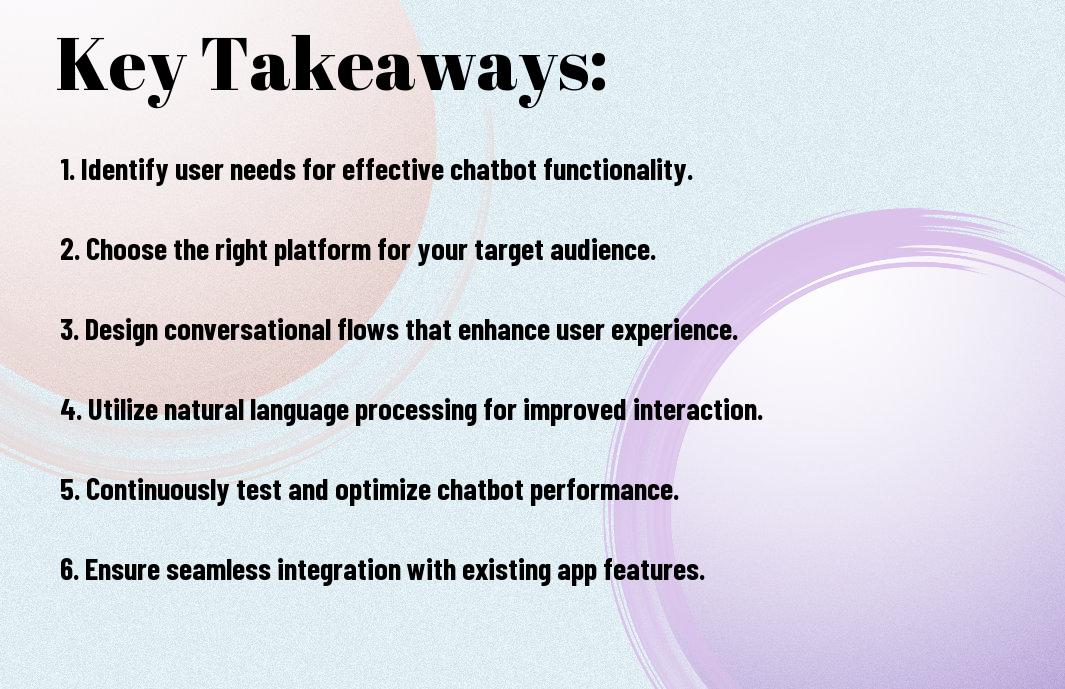
Key Takeaways:
- Defining the purpose and functionality of a chatbot or virtual assistant is crucial to determine its role within an app and how it will interact with users to provide a seamless experience.
- Understanding the target audience and their needs is vital to design a conversational interface that is intuitive and user-friendly, allowing for effective communication and problem-solving.
- Choosing the right technology and development tools, such as natural language processing (NLP) and machine learning algorithms, is necessary to build a sophisticated chatbot or virtual assistant that can accurately interpret and respond to user inputs.
- Integrating chatbots and virtual assistants with existing systems and data sources can enhance their capabilities and provide users with personalized and relevant information, improving the overall user experience.
- Continuously testing and refining chatbots and virtual assistants is necessary to ensure they are functioning as intended, and to identify areas for improvement to optimize their performance and user engagement.
Core Components of Chatbot Development
Your chatbot’s development relies on several key elements, including natural language processing and machine learning, which enable your app to understand and respond to user input effectively.
Natural Language Processing Integration
Components such as intent recognition and sentiment analysis are vital for your chatbot to comprehend the nuances of human language, allowing you to create a more engaging user experience.
Machine Learning Foundations
Along with a solid understanding of machine learning algorithms, you can develop a chatbot that learns from user interactions and improves over time, enabling your app to provide more accurate and personalized responses.
Another key aspect of machine learning foundations is the ability to integrate with various data sources, allowing you to train your chatbot on a wide range of datasets and improve its performance, which in turn enables you to offer a more sophisticated and effective virtual assistant to your users.

Design Architecture
While designing your chatbot or virtual assistant, you’ll need to consider the overall architecture, including the conversational flow and response generation systems, which can be informed by exploring Chatbots and Virtual Assistant Use Cases – Generative AI to create a more engaging experience for your users.
Conversational Flow Mapping
Alike other design processes, you start by mapping out the conversational flow, which involves identifying the possible user inputs and the corresponding responses, allowing you to create a more intuitive and user-friendly interface for your chatbot or virtual assistant.
Response Generation Systems
Once you have mapped out the conversational flow, you can start designing the response generation systems, which will enable your chatbot or virtual assistant to provide accurate and helpful responses to user queries, making it vital to consider the tone and language used in your responses.
Conversational systems like these rely on complex algorithms and natural language processing techniques to generate human-like responses, and as you design your response generation systems, you’ll need to consider factors such as context, intent, and user preferences to create a more personalized experience for your users, allowing you to build a more effective and engaging chatbot or virtual assistant for your app.
Implementation Strategies
Once again, you’ll need to consider the specifics of your app and its users when developing chatbots and virtual assistants. You can learn more about the process in How to Create AI Virtual Assistant: Product Owner’s Guide and Technology Overview to make informed decisions.
Platform Selection
The choice of platform for your chatbot or virtual assistant will depend on your app’s existing infrastructure and the level of customization you need, so you should evaluate your options carefully to find the best fit for your project.
API Integration Methods
Methods of integrating APIs will vary depending on the platforms and tools you’re using, so you’ll need to assess your needs and choose the approach that works best for your app and its users.
A key aspect of API integration is ensuring seamless communication between different systems, so you’ll want to consider factors like data formats, security protocols, and error handling to ensure a smooth and reliable experience for your users, and you should also consider scalability and flexibility to accommodate future updates and changes to your app.
User Experience Elements
To create an effective chatbot or virtual assistant, you need to consider several user experience elements that will make your app engaging and user-friendly. You should focus on designing an interface that is intuitive and easy to navigate, allowing your users to interact with your chatbot or virtual assistant seamlessly.
Personality Development
Along with a well-designed interface, you should also develop a personality for your chatbot or virtual assistant that aligns with your brand and resonates with your target audience. You can achieve this by defining the tone, language, and behavior of your chatbot or virtual assistant, making it more relatable and engaging to your users.
Conversation Design Patterns
Similarly, you should design conversation patterns that are natural and intuitive, allowing your users to interact with your chatbot or virtual assistant in a way that feels like a normal conversation. You can use various techniques such as intent recognition, entity extraction, and context management to create a conversational flow that is smooth and efficient.
Conversation design patterns are an crucial aspect of creating a chatbot or virtual assistant that can engage your users in a meaningful way. You can use different conversation patterns such as question-answering, dialogue-based, or menu-based conversations to create a flow that is tailored to your users’ needs and preferences. By designing effective conversation patterns, you can improve the overall user experience of your app and increase user satisfaction.
Security and Privacy
After developing your chatbot or virtual assistant, you need to consider the security and privacy of your users’ data. You must ensure that your app is secure and protects user information.
Data Protection Protocols
Driven by the need to safeguard sensitive information, you should implement robust data protection protocols to prevent unauthorized access to your users’ data.
User Authentication Systems
Authenticated access is imperative to prevent unauthorized users from interacting with your chatbot or virtual assistant, so you should implement secure user authentication systems to verify the identity of your users.
At the heart of your user authentication systems, you will need to use a combination of passwords, biometric authentication, and other security measures to ensure that only authorized users can access your app and interact with your chatbot or virtual assistant, giving you confidence in the security of your users’ data and interactions.
Testing and Optimization
Many factors contribute to a successful chatbot or virtual assistant, and testing is vital to ensure your app meets user expectations. You need to evaluate your chatbot’s performance, identify areas for improvement, and make data-driven decisions to optimize its functionality.
Performance Metrics
Against a backdrop of evolving user behavior, you will measure your chatbot’s performance using key metrics such as response accuracy, conversation completion rates, and user satisfaction. You will use these metrics to assess your chatbot’s effectiveness and identify areas that require improvement.
Iterative Improvements
Testing your chatbot is an ongoing process, and you will continually refine its performance based on user feedback and testing results. You will analyze user interactions, identify patterns, and make adjustments to improve your chatbot’s responses and overall user experience.
Indeed, as you implement iterative improvements, you will see significant enhancements in your chatbot’s performance and user engagement. You will be able to refine its personality, tone, and language to better align with your brand and user expectations, ultimately leading to increased user satisfaction and loyalty. By continually testing and optimizing your chatbot, you will ensure it remains a valuable and integral part of your app, providing users with a seamless and intuitive experience.
To wrap up
Summing up, you now have a solid foundation to develop chatbots and virtual assistants for your app. You can enhance your users’ experience by integrating conversational interfaces, making your app more engaging and user-friendly. By following the right strategies, you can create effective chatbots and virtual assistants that meet your users’ needs, ultimately driving the success of your app. You are equipped to make informed decisions about your chatbot development, and your users will appreciate the personalized experience you provide.
FAQ
Q: What are the benefits of integrating chatbots and virtual assistants into my app?
A: Integrating chatbots and virtual assistants into your app can significantly enhance user experience by providing 24/7 support, automating tasks, and offering personalized interactions. This can lead to increased user engagement, improved customer satisfaction, and ultimately, a competitive edge in the market. Moreover, chatbots can help reduce the workload of human customer support agents by handling routine inquiries, allowing them to focus on more complex issues that require a human touch.
Q: How do I determine the type of chatbot or virtual assistant that is best suited for my app?
A: To determine the type of chatbot or virtual assistant best suited for your app, you should consider several factors including your app’s purpose, target audience, and the specific tasks you want the chatbot to perform. For instance, if your app is an e-commerce platform, you might want a chatbot that can assist with product inquiries, order tracking, and customer support. On the other hand, if your app is focused on entertainment, you might opt for a chatbot that can engage users in conversations or games. Understanding your users’ needs and preferences is key to designing an effective chatbot or virtual assistant.
Q: What technologies and tools are available for developing chatbots and virtual assistants, and how do I choose the right ones for my project?
A: There are numerous technologies and tools available for developing chatbots and virtual assistants, including natural language processing (NLP) platforms, machine learning frameworks, and development kits provided by major tech companies. The choice of technology depends on your project’s requirements, your team’s expertise, and the scalability you anticipate. For example, if you’re building a simple chatbot for a small app, you might use a cloud-based NLP service. For more complex projects, you might need to integrate multiple technologies to achieve advanced functionalities such as voice recognition, emotional intelligence, and seamless integration with other services. Evaluating the ease of integration, cost, and the community support of these technologies can help you make an informed decision.