AI

Developing IoT Apps Using AI for Smarter Connectivity

As you explore Internet of Things (IoT) app development, you’ll discover the significant impact of Artificial Intelligence (AI) on creating smarter, more connected experiences. You can leverage AI to enhance your IoT projects, and to learn more about this synergy, you can visit AI and IoT Projects: How AI is Revolutionizing IoT to gain insights into the latest advancements, enabling you to develop innovative IoT apps with smarter connectivity capabilities.

Key Takeaways:

  • Developing IoT apps using AI enables devices to collect and analyze vast amounts of data, leading to more informed decision-making and improved operational efficiency in various industries such as healthcare, transportation, and manufacturing.
  • AI-powered IoT apps can enhance user experience by providing personalized services, predictive maintenance, and automated control, resulting in increased customer satisfaction and loyalty.
  • Integration of AI and IoT facilitates the development of smart systems that can learn from data, adapt to changing conditions, and optimize performance in real-time, leading to significant cost savings and reduced downtime.
  • Security is a major concern in IoT app development, and AI can help mitigate risks by detecting anomalies, identifying potential threats, and implementing robust security protocols to protect sensitive data and prevent unauthorized access.
  • As IoT and AI technologies continue to evolve, developers must stay up-to-date with the latest advancements and best practices to create innovative, scalable, and secure IoT apps that can drive business growth and improve people’s lives.
AI Integration in IoT Development

Your IoT app development process can greatly benefit from AI integration, enabling your devices to learn from data and make informed decisions, leading to smarter connectivity and enhanced user experience.

Machine Learning Models for IoT

Before stepping into the world of IoT development, you should consider implementing machine learning models that can analyze data from various sources, allowing your app to adapt and improve over time, providing you with valuable insights and better decision-making capabilities.

Neural Networks and Pattern Recognition

Against the backdrop of complex data patterns, you can leverage neural networks to identify and analyze them, enabling your IoT app to recognize trends and make predictions, thereby enhancing its overall performance and efficiency, and providing you with a competitive edge.

Learning about neural networks and pattern recognition can help you to develop more sophisticated IoT apps, as you will be able to create systems that can learn from experience, adapt to new data, and make accurate predictions, allowing you to unlock the full potential of your IoT devices and create innovative solutions that can transform your business and improve your life.

IoT Connectivity Architecture

While designing your IoT app, you need to consider the connectivity architecture that will enable seamless communication between devices and the cloud, allowing you to leverage AI for smarter connectivity and unlocking the full potential of your IoT solution.

Edge Computing Implementation

Following the initial setup, you’ll find that edge computing plays a significant role in reducing latency and improving real-time processing, enabling you to analyze data closer to its source and make informed decisions about your IoT app’s performance and functionality.

Cloud-AI Integration Points

Alongside edge computing, you’ll need to consider how your IoT app will integrate with cloud-based AI services, allowing you to process and analyze large amounts of data, and enabling you to make data-driven decisions about your IoT solution, and identifying areas where AI can enhance your app’s functionality.

Considering your IoT app’s cloud-AI integration points, you’ll want to focus on developing a robust and scalable architecture that can handle the vast amounts of data generated by your IoT devices, and leveraging AI and machine learning algorithms to uncover insights and patterns that can inform your business decisions and drive innovation, ultimately enabling you to create a more connected and intelligent IoT solution that meets your needs and exceeds your expectations.

Smart Data Processing

Once again, you will find that AI plays a significant role in processing the vast amounts of data generated by IoT devices, enabling you to make informed decisions and drive business growth.

Real-time Analytics Systems

Besides traditional data processing methods, you can leverage real-time analytics systems to analyze data as it’s generated, allowing you to respond quickly to changing conditions and make data-driven decisions.

Predictive Maintenance Algorithms

To take your IoT app to the next level, you can implement predictive maintenance algorithms that use machine learning to identify potential issues before they occur, reducing downtime and increasing overall efficiency.

Considering the benefits of predictive maintenance algorithms, you can use them to analyze data from sensors and devices to predict when maintenance is required, allowing you to schedule maintenance during periods of low usage, minimizing the impact on your operations and ensuring your IoT app continues to run smoothly and efficiently, which in turn helps you to improve your overall user experience and increase customer satisfaction.

Security Protocols

Keep your IoT app secure by implementing robust security protocols that protect user data and prevent unauthorized access, as you develop and deploy your application, you need to ensure the security of your users’ data.

AI-driven Threat Detection

With advanced threat detection systems, you can identify and mitigate potential security threats in real-time, using machine learning algorithms to analyze patterns and anomalies in your IoT app’s data, you can stay one step ahead of potential attackers.

Automated Security Responses

Before a security breach occurs, you can set up automated security responses that alert you to potential threats and take immediate action to prevent them, this can include notifications, backups, and software updates, all designed to keep your IoT app secure.

Responses to security threats are faster and more effective when automated, as you can quickly respond to potential breaches and minimize damage, you can also use AI to analyze the cause of the breach and update your security protocols to prevent similar threats in the future, ensuring your IoT app remains secure and trustworthy for your users.

Device Communication

For developing IoT apps using AI, you need to consider the communication between devices, which enables data exchange and facilitates smart connectivity, allowing you to create a seamless and efficient system.

Protocol Optimization

Between various protocols, you can choose the most suitable one for your IoT app, considering factors such as data rate, power consumption, and range, to ensure optimal performance and efficiency in your device communication.

Network Efficiency Enhancement

Above all, you should focus on enhancing network efficiency to minimize latency, reduce errors, and increase throughput, which will enable your IoT app to function smoothly and reliably, providing you with accurate and real-time data.

The network efficiency enhancement is a key aspect of your IoT app development, as it directly impacts the overall performance and user experience, and you can achieve this by optimizing network protocols, implementing data compression, and using advanced routing algorithms, which will help you to create a robust and scalable IoT system that meets your specific needs and requirements.

Performance Optimization

Now that you have developed your IoT app, it’s time to focus on performance optimization to ensure seamless user experience. You need to consider various factors that impact your app’s performance, including resource management and scalability solutions.

Resource Management

Any inefficiency in resource allocation can significantly impact your app’s performance, so you must carefully manage your resources to ensure optimal utilization. You can achieve this by monitoring your app’s resource usage and making adjustments as needed to prevent bottlenecks.

Scalability Solutions

Before you launch your app, you should consider scalability solutions to handle increased traffic and user demand. You can design your app to scale horizontally or vertically, depending on your specific needs, to ensure that it can handle growing demands without compromising performance.

The scalability solutions you choose will depend on your app’s specific requirements and your infrastructure. You should consider factors such as data storage, processing power, and network bandwidth when designing your scalability strategy, and you can use cloud services or containerization to make it easier to scale your app as needed, allowing you to focus on providing a great user experience.

Final Words

Considering all points, you now have a comprehensive understanding of developing IoT apps using AI for smarter connectivity. You can leverage this knowledge to create innovative solutions, enhancing your ability to connect devices and systems. As you initiate on your development journey, your expertise will grow, enabling you to build more sophisticated and intelligent applications that transform the way you interact with technology.

FAQ

Q: What are the benefits of integrating AI in IoT app development for smarter connectivity?

A: Integrating AI in IoT app development enables the creation of more intelligent and autonomous systems, allowing for real-time data analysis, predictive maintenance, and enhanced decision-making capabilities. This leads to improved efficiency, reduced costs, and enhanced user experience. AI-powered IoT apps can also learn from user behavior and adapt to changing conditions, making them more responsive and effective. Additionally, AI-driven analytics can help identify patterns and anomalies in IoT data, enabling proactive measures to prevent issues and optimize performance.

Q: How can AI be used to improve the security of IoT apps and prevent potential threats?

A: AI can be used to enhance the security of IoT apps by implementing advanced threat detection and prevention mechanisms. AI-powered algorithms can analyze IoT device behavior, identify potential vulnerabilities, and detect anomalies in real-time, enabling swift action to prevent security breaches. AI-driven security systems can also learn from past attacks and adapt to new threats, making them more effective in preventing future breaches. Furthermore, AI can help automate security updates and patches, ensuring that IoT devices and apps stay up-to-date with the latest security measures, reducing the risk of exploitation by hackers.

Q: What are the key challenges and considerations when developing IoT apps using AI for smarter connectivity, and how can they be addressed?

A: When developing IoT apps using AI for smarter connectivity, key challenges include ensuring data quality and integrity, addressing potential biases in AI algorithms, and guaranteeing seamless integration with various IoT devices and systems. To address these challenges, developers should prioritize data validation and verification, implement robust testing and validation protocols, and ensure that AI algorithms are transparent, explainable, and fair. Additionally, developers should consider scalability, interoperability, and user experience when designing AI-powered IoT apps, and ensure that they comply with relevant regulations and standards, such as data protection and privacy laws.

Building Augmented Reality Apps Powered by Artificial Intelligence

As you probe into the world of innovative technologies, you’ll discover the potential of combining augmented reality (AR) and artificial intelligence (AI) to create immersive experiences. You can leverage AI-driven AR apps to enhance your business or personal projects, offering interactive and engaging solutions. Your understanding of these technologies will enable you to develop cutting-edge applications, transforming the way you interact with digital information and revolutionizing your approach to app development.

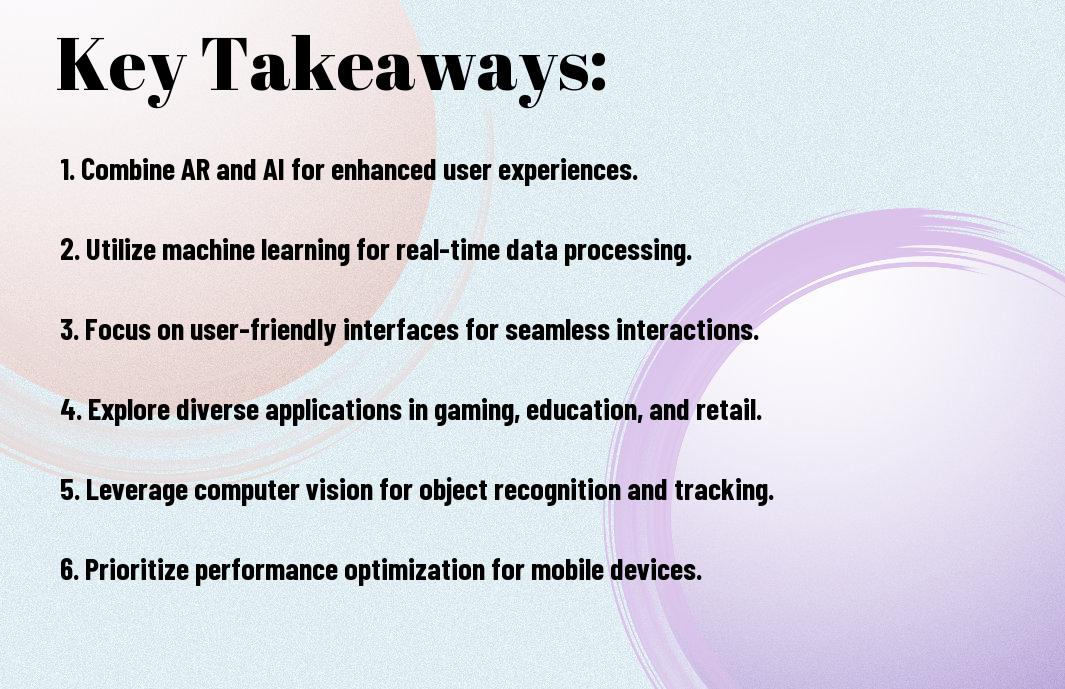
Key Takeaways:

  • Combining Augmented Reality (AR) and Artificial Intelligence (AI) enables the creation of immersive and interactive experiences that can revolutionize various industries such as education, healthcare, and entertainment.
  • AR-powered AI apps can analyze user interactions and adapt to their behavior, providing personalized experiences and enhancing user engagement.
  • AI-driven computer vision can be used to detect and track objects, allowing for more precise and accurate AR experiences, such as object recognition and tracking.
  • Building AR apps powered by AI requires a deep understanding of machine learning algorithms, computer vision, and software development, making it vital to have a skilled team with expertise in these areas.
  • The integration of AR and AI can also raise concerns about data privacy and security, making it vital to implement robust security measures to protect user data and ensure a safe and trustworthy experience.

    Foundations of AR-AI Integration

    A strong understanding of the foundations of AR-AI integration is imperative for building effective augmented reality apps. You will need to consider how artificial intelligence can enhance your app’s functionality and user experience. As you explore into the world of AR-AI integration, you will discover the various technologies and tools available to support your development process.

    Core AI Technologies for AR

    Beneath the surface of AR-AI integration lies a range of core AI technologies that enable the creation of immersive experiences. You will need to explore technologies such as machine learning, computer vision, and natural language processing to determine which ones are best suited to your app’s requirements.

    Hardware Requirements and Specifications

    Harmonizing your app’s hardware and software components is vital for seamless AR-AI integration. You should consider the processing power, memory, and display requirements of your app to ensure optimal performance on various devices.

    Also, as you consider the hardware requirements and specifications for your AR app, you will need to think about the trade-offs between device capabilities, power consumption, and cost. You should evaluate your options carefully to ensure that your app’s hardware and software components work together in harmony, providing your users with a compelling and engaging experience.

    Computer Vision and Object Recognition

    Even as you investigate into the world of augmented reality, you’ll find that computer vision and object recognition are imperative components, which you can learn more about in Augmented Reality App Development: The Complete Guide. This technology enables your apps to interpret and understand visual data from the environment.

    Real-time Image Processing

    Object detection is a key aspect of computer vision, allowing your app to identify and track objects in real-time, enabling seamless interactions and experiences.

    Spatial Mapping and Environment Analysis

    Spatial awareness is vital for creating immersive AR experiences, as it enables your app to understand the user’s surroundings and overlay virtual objects accordingly.

    Consequently, as you develop your AR app, you’ll need to consider how spatial mapping and environment analysis will impact your user’s experience, taking into account factors such as lighting, texture, and geometry to create a realistic and engaging interaction. You’ll need to ensure that your app can accurately map the environment and analyze the spatial relationships between objects to provide a seamless and intuitive experience.

    Machine Learning Models in AR

    Keep in mind that machine learning models are the backbone of augmented reality apps, enabling them to understand and interact with their environment. You will use these models to develop intelligent AR experiences that can learn and adapt to user behavior.

    Training Data Requirements

    Mechanically, you will need to collect and preprocess large amounts of data to train your machine learning models, ensuring they can accurately recognize patterns and make predictions in your AR app.

    Model Optimization for Mobile Devices

    Mechanistically, you will need to optimize your machine learning models for mobile devices, taking into account factors such as computational power, memory, and battery life to ensure seamless AR experiences.

    Considering the limited resources of mobile devices, you will need to carefully evaluate and optimize your model’s architecture, using techniques such as model pruning, quantization, and knowledge distillation to reduce computational complexity and memory usage, while maintaining your model’s accuracy and performance in your AR app.

    Natural Language Processing in AR

    Your augmented reality (AR) app can greatly benefit from natural language processing (NLP), enabling users to interact with virtual objects using voice commands or text input, making the experience more intuitive and engaging.

    Voice Commands and User Interaction

    After implementing NLP, you can use voice commands to control your AR app, allowing users to give instructions or ask questions, and the app will respond accordingly, creating a more immersive experience.

    Multilingual Support Systems

    Processing multiple languages can be a challenge, but with NLP, you can develop an AR app that supports various languages, making it accessible to a broader audience and enhancing user experience.

    Natural language understanding is key to creating a seamless multilingual support system, allowing your AR app to comprehend and respond to user input in different languages, and you can achieve this by integrating machine learning algorithms and NLP techniques into your app’s development.

    Development Frameworks and Tools

    To build augmented reality apps powered by artificial intelligence, you will need to choose the right development frameworks and tools. You can select from a variety of options, including ARKit, ARCore, and Unity, to create immersive and interactive experiences.

    Popular AR-AI Development Platforms

    Around the globe, developers like you are using platforms like Vuforia, Wikitude, and EasyAR to create innovative AR-AI apps. These platforms provide you with the necessary tools and resources to build engaging and interactive experiences.

    SDK Integration Methods

    For seamless integration of AR-AI functionality into your app, you will need to choose the right SDK integration method. You can use native SDKs, cross-platform SDKs, or third-party libraries to integrate AR-AI features into your app, depending on your development needs.

    At this stage, you will need to consider factors such as platform compatibility, development time, and cost when selecting an SDK integration method. You should evaluate your options carefully to ensure that you choose the method that best fits your project requirements and helps you achieve your goals.

    Performance Optimization

    After developing your augmented reality app, you’ll want to ensure it runs smoothly, which is where performance optimization comes in. You can learn more about Integrating AR/VR with AI: Enhancing Interactivity and User Experience to improve your app’s overall performance.

    Resource Management

    One of the key aspects of performance optimization is managing your app’s resources efficiently, allowing you to allocate processing power where it’s needed most, ensuring your app runs seamlessly on various devices.

    Latency Reduction Techniques

    Between optimizing your code and leveraging hardware capabilities, you can significantly reduce latency in your app, providing a better user experience, and you can achieve this by implementing various techniques tailored to your app’s specific needs.

    Reduction of latency is vital for augmented reality apps, as it directly impacts the user experience, and you can achieve this by using techniques such as caching, content delivery networks, and optimizing your app’s rendering pipeline, allowing you to provide a seamless and immersive experience for your users.

    To wrap up

    As a reminder, you now have the foundation to build augmented reality apps powered by artificial intelligence. You can leverage your newfound knowledge to create immersive experiences, enhancing your users’ interactions. Your ability to integrate AI and AR will set your apps apart, driving engagement and innovation. You are equipped to push the boundaries of what is possible in this exciting field, and your creations will shape the future of interactive technology.

    FAQ

    Q: What are the key components required to build augmented reality (AR) apps powered by artificial intelligence (AI)?

    A: To build AR apps powered by AI, several key components are necessary. First, a robust AR platform such as ARKit or ARCore is needed to handle the augmented reality functionality. Additionally, a deep learning framework like TensorFlow or PyTorch is required to integrate AI capabilities. A device with a high-quality camera and sufficient processing power is also imperative. Furthermore, a user-friendly interface and experience design are vital to ensure seamless interaction between the user and the virtual objects. Lastly, a significant amount of data is needed to train the AI models, which can be obtained through various sources such as datasets or real-time user input.

    Q: How can AI enhance the user experience in augmented reality apps?

    A: AI can significantly enhance the user experience in AR apps by enabling more accurate and dynamic object recognition, tracking, and interaction. For instance, AI-powered computer vision can detect and identify real-world objects, allowing for more precise placement and manipulation of virtual objects. AI-driven machine learning algorithms can also learn user behavior and preferences, enabling personalized experiences and recommendations. Moreover, AI-powered natural language processing can facilitate voice commands and voice interactions, making the app more intuitive and user-friendly. Overall, the integration of AI can create a more immersive, interactive, and engaging experience for users.

    Q: What are some potential applications and industries that can benefit from building AR apps powered by AI?

    A: The potential applications and industries that can benefit from building AR apps powered by AI are vast and diverse. For example, in the field of education, AR apps can create interactive and immersive learning experiences, making complex concepts more engaging and accessible. In the retail industry, AR apps can enable customers to try out virtual products, enhancing the shopping experience and reducing returns. In healthcare, AR apps can assist medical professionals in training, diagnosis, and treatment, improving patient outcomes. Additionally, AR apps powered by AI can also be applied in fields such as gaming, tourism, and architecture, among others, to create innovative and interactive experiences that blur the line between the physical and digital worlds.

AI-Driven App Analytics – Tools and Techniques for Success

As you navigate the complex world of mobile app development, you need to make data-driven decisions to optimize your app’s performance. Your goal is to deliver a seamless user experience, driving engagement and revenue. With AI-driven app analytics, you can uncover valuable insights into your users’ behavior, identifying trends and patterns that inform your strategy. By leveraging these tools and techniques, you can refine your app, enhance user satisfaction, and ultimately achieve success in a competitive market.

Key Takeaways:

  • Effective use of AI-driven app analytics tools enables businesses to gain deeper insights into user behavior, preferences, and pain points, leading to data-driven decision making and improved app performance.
  • AI-powered analytics tools can automatically track and analyze large amounts of data, providing real-time feedback and allowing developers to identify trends, patterns, and areas for improvement.
  • Techniques such as machine learning and predictive analytics can be applied to app data to forecast user behavior, detect anomalies, and optimize app functionality, resulting in enhanced user experience and increased engagement.
  • Integrating AI-driven app analytics with other tools and platforms, such as marketing automation and customer relationship management systems, can help businesses create a unified view of their users and develop targeted marketing strategies.
  • By leveraging AI-driven app analytics, businesses can measure the effectiveness of their app updates, feature releases, and marketing campaigns, and make informed decisions to drive growth, retention, and revenue.

Core Analytics Tools

A comprehensive set of analytics tools is vital for your app’s success. You can leverage these tools to gain insights into user behavior, track key performance indicators, and make data-driven decisions to optimize your app.

Machine Learning Platforms

Analytically, you can utilize machine learning platforms to uncover hidden patterns and trends in your app’s data, enabling you to create personalized experiences for your users and drive engagement.

Predictive Analytics Solutions

Mechanically, you can apply predictive analytics solutions to forecast user behavior, identify potential issues, and develop proactive strategies to improve your app’s overall performance and user satisfaction.

Another significant advantage of predictive analytics solutions is that they allow you to analyze large datasets, identify correlations, and make accurate predictions about future trends, enabling you to make informed decisions and stay ahead of the competition, ultimately driving your app’s success and growth.

Data Collection Methods

Any effective app analytics strategy begins with collecting the right data, and you have several methods at your disposal to gather insights about your users and their behavior.

User Behavior Tracking

Above all, tracking user behavior is important to understanding how users interact with your app, and you can use various tools to monitor their actions, such as clicks, swipes, and navigation patterns.

Performance Metrics

Beside user behavior, performance metrics provide valuable insights into your app’s technical performance, allowing you to identify areas for improvement and optimize your app for better user experience, and you can track metrics such as load times, crash rates, and battery usage.

Behavior patterns and performance metrics are closely related, and by analyzing them together, you can gain a deeper understanding of your app’s strengths and weaknesses, and make data-driven decisions to improve your app’s overall performance, which will help you to increase user engagement and retention, and ultimately drive your business forward, as you will be able to identify and address issues that may be affecting your users’ experience.

AI Pattern Recognition

After implementing AI-driven app analytics, you can uncover hidden trends and patterns in your data, enabling you to make informed decisions about your app’s development and marketing strategy. This technology helps you identify areas of improvement and optimize your app’s performance.

User Journey Analysis

Beneath the surface of your app’s user interface, you can analyze the user journey to identify pain points and areas of improvement, allowing you to refine your app’s user experience and increase engagement.

Anomaly Detection

Discovering unusual patterns in your data can be a game-changer, as you can identify and address issues before they impact your app’s performance, and with AI-driven analytics, you can detect anomalies in real-time.

Also, by leveraging machine learning algorithms, you can set up custom alerts and notifications to inform you of any anomalies, enabling you to take swift action and minimize potential damage to your app’s reputation and user base, and you can use this insight to refine your app’s security and performance.

Real-time Monitoring

All aspects of your app’s performance can be tracked with AI-driven analytics, allowing you to make data-driven decisions. You can monitor user behavior, identify trends, and optimize your app for better engagement and retention.

Live Performance Tracking

Across various platforms and devices, you can track your app’s performance in real-time, giving you insights into user interactions and app functionality. You can analyze this data to identify areas for improvement and optimize your app for better user experience.

Automated Alert Systems

Performing at optimal levels is key to your app’s success, and automated alert systems can notify you of any issues or anomalies in real-time. You can set up custom alerts to inform you of changes in user behavior or app performance, allowing you to take prompt action.

Realtime alert systems enable you to respond quickly to changes in your app’s performance, minimizing downtime and ensuring a seamless user experience. You can configure these systems to notify you of specific events, such as spikes in traffic or errors, and take corrective action to prevent issues from escalating, thereby protecting your app’s reputation and your business.

Actionable Insights

Keep in mind that actionable insights are the key to driving business growth with AI-driven app analytics. You need to analyze your data to identify trends and patterns that inform your decisions.

Data Visualization

Actual insights are derived from data visualization, which enables you to see your data in a clear and concise manner, allowing you to make informed decisions about your app’s performance and user behavior.

Decision Support Systems

The ability to make data-driven decisions is enhanced by decision support systems, which provide you with recommendations based on your app’s data and analytics, helping you to optimize your app’s performance and improve user engagement.

Support for your decision-making process is further enhanced by the ability to simulate different scenarios and predict outcomes, allowing you to test different strategies and identify the most effective approaches for your app, and you can use this information to refine your app and improve your overall business strategy.

Privacy and Security

Not all AI-driven app analytics tools are created equal when it comes to protecting your data. You need to consider the potential risks and take steps to mitigate them.

Data Protection Measures

Around the clock, your app’s data is being collected and analyzed, so you must implement robust security measures to safeguard it. You can start by encrypting your data and using secure protocols for transmission.

Compliance Framework

Measures such as GDPR and CCPA regulate how your app’s data is handled, and you must ensure your analytics tools comply with these regulations. You can achieve this by implementing data anonymization and access controls.

Also, as you research deeper into the compliance framework, you will need to consider factors such as data subject access requests, data breaches, and cross-border data transfers, ensuring that your app analytics tools can handle these complexities and provide you with the necessary support to maintain compliance.

Final Words

On the whole, you now have a comprehensive understanding of AI-driven app analytics. You can leverage these tools and techniques to optimize your app’s performance. To further enhance your skills, you can learn How To Make AI Features Work Better In Data Analysis and take your app to the next level. With this knowledge, you can make informed decisions to drive your app’s success and improve your overall user experience.

FAQ

Q: What is AI-Driven App Analytics and how does it help in optimizing app performance?

A: AI-Driven App Analytics is the use of artificial intelligence and machine learning algorithms to analyze data from mobile and web applications. This technology helps in optimizing app performance by providing insights into user behavior, identifying areas of improvement, and predicting future trends. With AI-Driven App Analytics, developers can make data-driven decisions to enhance user experience, increase engagement, and ultimately drive business growth. By leveraging AI-powered tools and techniques, app developers can automate the analysis process, gain real-time insights, and stay ahead of the competition.

Q: What are some of the key tools and techniques used in AI-Driven App Analytics for success?

A: Some of the key tools and techniques used in AI-Driven App Analytics include machine learning algorithms, predictive modeling, data visualization, and A/B testing. These tools help in analyzing user behavior, identifying patterns, and making predictions about future trends. Additionally, techniques such as funnel analysis, cohort analysis, and retention analysis are used to gain a deeper understanding of user engagement and retention. By leveraging these tools and techniques, app developers can gain a competitive edge and make informed decisions to drive business success.

Q: How can AI-Driven App Analytics help in improving user experience and driving business growth?

A: AI-Driven App Analytics can help in improving user experience by providing insights into user behavior, preferences, and pain points. By analyzing this data, app developers can identify areas of improvement and make targeted changes to enhance user experience. Additionally, AI-Driven App Analytics can help in driving business growth by providing predictive insights into user behavior, allowing app developers to make data-driven decisions to increase engagement, conversion rates, and revenue. By leveraging AI-Driven App Analytics, businesses can stay ahead of the competition, drive user acquisition and retention, and ultimately achieve long-term success.

Predicting User Behavior in Apps Using AI Models

As you develop and refine your mobile app, you’re likely wondering how to better understand your users’ actions and preferences. You can leverage artificial intelligence (AI) models to forecast your users’ behavior, enabling you to create a more personalized and engaging experience. By analyzing user data and patterns, you can use AI to anticipate your users’ needs and make informed decisions to drive your app’s success. This approach allows you to stay ahead of the curve and optimize your app for maximum impact.

Key Takeaways:

  • Predicting user behavior in apps using AI models can significantly enhance the overall user experience by providing personalized recommendations and improving engagement.
  • AI-powered predictive models can analyze vast amounts of user data, including demographics, behavior, and preferences, to forecast future actions and preferences.
  • By leveraging machine learning algorithms, developers can identify patterns and trends in user behavior, enabling them to optimize app design, content, and features to meet user needs.
  • AI-driven predictive analytics can also help app developers to detect and prevent potential issues, such as user churn or abandonment, by identifying early warning signs and taking proactive measures.
  • Effective implementation of AI models for predicting user behavior requires careful consideration of data quality, model selection, and ongoing evaluation to ensure accurate and reliable predictions that drive business value.

AI Model Fundamentals

A key aspect of predicting user behavior in apps is understanding the basics of AI models, which you can learn more about in AI for Predictive Analytics in Mobile Apps: Anticipating User Behaviour, to improve your app’s performance.

Machine Learning Algorithms in User Behavior

For instance, you will be using machine learning algorithms to analyze user behavior, which enables your app to make informed decisions and provide personalized experiences, making it more engaging for your users.

Neural Networks for Pattern Recognition

Above all, neural networks play a significant role in recognizing patterns in user behavior, allowing you to identify trends and preferences, which can be used to enhance your app’s overall user experience.

At the heart of neural networks for pattern recognition is the ability to learn from large datasets, enabling you to make accurate predictions about your users’ behavior, and as you examine deeper into this topic, you will discover how neural networks can be applied to various aspects of your app to improve user engagement and retention, ultimately driving business growth and increasing your app’s success.

Data Collection Methods

It is necessary to gather relevant data to predict user behavior in apps using AI models. You can learn more about AI-Powered Product Analytics: Predicting User Behavior with Data to improve your understanding of user interactions.

User Interaction Metrics

After collecting data, you will have access to user interaction metrics, such as click-through rates and session duration, which provide valuable insights into user behavior.

Behavioral Timestamps and Sequences

Around the time you start analyzing user behavior, you will notice patterns in timestamps and sequences of actions, helping you understand user journeys.

In addition, as you investigate deeper into behavioral timestamps and sequences, you will be able to identify specific events that trigger certain actions, allowing you to refine your AI models and make more accurate predictions about your users’ behavior, enabling you to create a more personalized experience for them.

Predictive Analytics Framework

After establishing the foundation of your AI model, you can develop a predictive analytics framework to forecast user behavior in your app. This framework will enable you to analyze user interactions and make informed decisions to enhance your app’s overall performance.

Real-time Behavior Tracking

Beneath the surface of your app’s interface, you can implement real-time behavior tracking to monitor user activities and identify patterns, allowing you to respond promptly to changes in user behavior and optimize your app’s user experience.

Historical Data Analysis

Prior to making predictions, you will need to analyze your app’s historical data to identify trends and correlations that can inform your predictive model, enabling you to make more accurate forecasts about your users’ future behavior.

Consequently, as you explore deeper into historical data analysis, you will uncover valuable insights into your users’ past behavior, such as usage patterns, preferences, and pain points, which you can then use to refine your predictive model and make data-driven decisions to improve your app’s overall user experience and increase user engagement.

App Usage Patterns

Not all users interact with your app in the same way, and understanding these differences is key to predicting their behavior. You can analyze usage patterns to identify trends and areas for improvement, helping you refine your app to meet your users’ needs.

User Journey Mapping

Across various stages of app usage, you can map out the user journey to identify pain points and areas of engagement. You will be able to see how users navigate your app, where they spend most of their time, and where they tend to drop off.

Interaction Hotspots

Juxtaposing different user behaviors, you can identify interaction hotspots, which are areas of your app where users engage the most. You can use this information to optimize these areas and create a more seamless user experience.

Considering the interaction hotspots in your app, you can explore deeper into the specific features and functionalities that drive user engagement. You will be able to analyze the types of interactions that occur in these hotspots, such as clicks, swipes, or taps, and use this information to inform design and development decisions, ultimately enhancing your app’s overall user experience and encouraging users to continue interacting with your app.

Model Implementation

Now that you have chosen your AI model, it’s time to implement it in your app. You will need to integrate the model with your existing infrastructure and ensure it can handle the volume of user data.

Training Procedures

Proceeding with the training process, you will need to prepare your data, select the appropriate algorithms, and tune the model’s parameters to achieve optimal performance. You can then train the model using your dataset and evaluate its accuracy.

Validation Methods

By verifying the model’s performance, you can ensure it is making accurate predictions about user behavior. You will need to test the model using various validation methods to determine its effectiveness.

With a well-designed validation process, you can identify areas where the model needs improvement and make adjustments to increase its accuracy. You can use techniques such as cross-validation and walk-forward optimization to evaluate your model’s performance and make data-driven decisions to refine it. As you validate your model, you will be able to trust its predictions and make informed decisions about your app’s development.

Performance Optimization

Keep in mind that optimizing your app’s performance is important for predicting user behavior effectively. You need to ensure your AI models are running smoothly and efficiently to provide accurate predictions.

Response Time Enhancement

Performing regular checks on your app’s response time helps you identify areas for improvement, allowing you to make data-driven decisions to enhance your user experience, and you can do this by analyzing your app’s performance metrics.

Accuracy Refinement

At the heart of your AI models lies the need for precise predictions, and you can achieve this by continually refining your models with new data, enabling you to make more accurate predictions about your users’ behavior.

Indeed, refining the accuracy of your AI models is an ongoing process that requires your attention and dedication. You will need to continuously collect and analyze new data, updating your models to ensure they remain effective in predicting user behavior, and by doing so, you will be able to provide your users with a more personalized experience, increasing their engagement and loyalty to your app.

Conclusion

Presently, you can leverage AI models to predict user behavior in apps, enhancing your understanding of their needs. By utilizing these models, you can analyze user interactions and make informed decisions to improve your app’s overall performance. As you continue to develop and refine your app, you will be able to provide your users with a more personalized experience, increasing engagement and driving success. Your ability to predict user behavior will be a key factor in setting your app apart from others.

FAQ

Q: What are the benefits of using AI models to predict user behavior in apps?

A: The benefits of using AI models to predict user behavior in apps are numerous. By analyzing user interactions, AI models can identify patterns and trends, allowing developers to personalize the user experience, improve engagement, and increase conversions. Additionally, AI-powered predictive analytics can help identify potential issues, such as user frustration or churn, and enable developers to take proactive measures to address them. This can lead to increased user satisfaction, loyalty, and ultimately, revenue growth.

Q: How do AI models learn to predict user behavior in apps, and what data do they require?

A: AI models learn to predict user behavior in apps by analyzing large amounts of data, including user demographics, behavior, and interactions. This data can come from various sources, such as user profiles, app usage logs, and feedback mechanisms. The AI model uses machine learning algorithms to identify patterns and relationships within the data, and then makes predictions about future user behavior. The data required to train AI models can include clickstream data, session duration, screen navigation, and other relevant metrics. By analyzing these data points, AI models can develop a comprehensive understanding of user behavior and make accurate predictions about future interactions.

Q: Can AI models predict user behavior in real-time, and how can developers integrate them into their apps?

A: Yes, AI models can predict user behavior in real-time, enabling developers to respond quickly to changing user needs and preferences. To integrate AI models into their apps, developers can use various techniques, such as API integration, SDKs, or cloud-based services. These solutions provide pre-trained AI models that can be easily integrated into existing app infrastructure, allowing developers to leverage the power of predictive analytics without requiring extensive machine learning expertise. Additionally, many AI platforms offer real-time data processing and analytics, enabling developers to respond promptly to user behavior and make data-driven decisions to improve the user experience.

From Prototype to Product – Launching AI-Enhanced Applications

As you commence on the journey of developing AI-enhanced applications, you’ll need to navigate the process of transforming your prototype into a fully-fledged product. You can learn more about Revolutionizing Product Development With AI to understand the complexities involved. Your goal is to create a seamless user experience, and with the right strategy, you can successfully launch your AI-enhanced application and take your business to the next level.

Key Takeaways:

  • Developing AI-enhanced applications requires a structured approach, starting from the prototype phase to ensure a successful product launch, focusing on integrating AI technologies effectively into the application’s core functionality.
  • A thorough understanding of the target audience and their needs is vital for designing AI-enhanced applications that provide meaningful value and user experience, driving adoption and engagement.
  • Continuous testing and iteration are vital during the development process to refine the AI algorithms, improve performance, and address potential biases or errors, ensuring the application meets the desired standards.
  • Collaboration between cross-functional teams, including data scientists, engineers, and designers, is necessary for effectively integrating AI capabilities into the application, ensuring a cohesive and user-friendly experience.
  • Post-launch monitoring and evaluation of the AI-enhanced application are necessary to assess its impact, gather user feedback, and inform future updates and improvements, driving ongoing innovation and optimization.

Market Research and Validation

To develop a successful AI-enhanced application, you need to conduct thorough market research and validation. This involves gathering data about your potential users, their needs, and the competitive landscape.

Identifying Target Users and Pain Points

On the path to creating a viable product, you will uncover your target audience and the challenges they face. By doing so, you can tailor your application to meet their specific needs and expectations.

Competitive Analysis and Market Positioning

About your competitors, you should assess their strengths, weaknesses, and market strategies to differentiate your product and identify opportunities for growth.

Consequently, as you investigate deeper into competitive analysis and market positioning, you will gain a better understanding of how your AI-enhanced application fits into the market and how you can effectively position it to attract your target users, ultimately informing your product development and marketing strategies to ensure a successful launch.

Technical Planning

There’s a need to carefully consider the technical aspects of your AI-enhanced application to ensure a successful launch. You must evaluate your resources, timeline, and budget to determine the best approach for your project.

Core AI Components Selection

Any assessment of your application’s requirements will help you choose the most suitable AI components, such as machine learning algorithms or natural language processing tools, to integrate into your project, allowing you to create a more efficient and effective solution for your users.

Infrastructure Requirements and Scalability

Components such as data storage, processing power, and network bandwidth will play a significant role in determining your application’s performance, and you should select them based on your specific needs and expected user base.

Hence, as you plan your infrastructure, you should consider factors such as scalability, reliability, and security to ensure that your application can handle increased traffic and user demand, and that your users’ data is protected, allowing you to build trust and maintain a positive user experience.

Development Process

All stages of the development process are interconnected, and you can learn more about AI-Driven Product Development: From Idea to Launch by visiting Building a Product with AI. This will help you understand how to successfully launch your AI-enhanced application.

Minimum Viable Product Creation

With a clear plan in place, you can start building your minimum viable product, focusing on the core features that will provide value to your users, and then iterate based on feedback to improve your application.

Integration of AI Features

The integration of AI features into your application is a key step in the development process, and you should consider how these features will enhance the user experience and provide a competitive edge in the market.

Minimum requirements for integrating AI features include a robust data infrastructure and a talented team of developers who can implement and fine-tune the AI algorithms to meet your application’s specific needs, allowing you to launch a successful AI-enhanced product that meets your users’ expectations.

Testing and Refinement

After developing your AI-enhanced application, you will need to test and refine it to ensure it meets your requirements and functions as expected. This stage involves identifying and fixing bugs, optimizing performance, and making any necessary adjustments to improve the overall user experience.

Performance Metrics and Benchmarking

Against a set of predefined standards, you will evaluate your application’s performance, comparing it to industry benchmarks to identify areas for improvement. This process helps you fine-tune your application, ensuring it operates efficiently and effectively.

User Feedback Implementation

To gather valuable insights, you will collect user feedback, analyzing it to identify trends and patterns that inform your refinement process. This feedback loop enables you to make data-driven decisions, enhancing your application’s overall quality and user satisfaction.

Due to the importance of user feedback in shaping your application’s development, you should prioritize its collection and implementation. As you analyze user feedback, you will uncover opportunities to address pain points, improve usability, and add features that meet the evolving needs of your target audience, ultimately driving the success of your AI-enhanced application.

Deployment Strategy

Unlike other development phases, deploying an AI-enhanced application requires careful planning to ensure seamless integration and scalability. You need to consider various factors, including infrastructure, security, and maintenance, to guarantee a successful launch.

Cloud Infrastructure Setup

On the basis of your application’s requirements, you will need to set up a cloud infrastructure that can handle the anticipated traffic and data storage. You should choose a cloud provider that offers flexible pricing plans and reliable services to support your application’s growth.

Security and Compliance Measures

Measures to ensure the security and compliance of your AI-enhanced application are crucial to protect your users’ data and maintain their trust. You should implement robust security protocols and comply with relevant regulations to avoid any potential risks or penalties.

Due to the sensitive nature of user data, you must prioritize security and compliance when deploying your AI-enhanced application. You should conduct thorough risk assessments, implement encryption and access controls, and ensure that your application complies with relevant laws and regulations, such as GDPR or HIPAA, to maintain the trust of your users and protect your reputation.

Launch and Marketing

Not only is launching your AI-enhanced application a significant milestone, but it also marks the beginning of your marketing efforts. You will need to develop a comprehensive strategy to reach your target audience and showcase your product’s capabilities.

Go-to-Market Strategy

Around the time of launch, you should have a clear plan in place, outlining your marketing objectives, target audience, and key messaging. You will need to consider factors such as pricing, distribution, and promotion to ensure a successful launch.

User Acquisition Channels

Among the various channels available, you will need to select the most effective ones to reach your target audience, such as social media, content marketing, or paid advertising. You should consider your budget, target audience, and product offerings when selecting your user acquisition channels.

Due to the competitive nature of the market, you will need to continuously monitor and optimize your user acquisition channels to ensure maximum ROI. You should track key metrics such as user engagement, conversion rates, and customer retention to refine your strategy and improve your overall marketing efforts, allowing you to make data-driven decisions to drive your business forward.

Final Words

Conclusively, you have now gained insights into launching AI-enhanced applications, from prototype to product. You understand the process and its significance in your development journey. Your ability to integrate AI will enhance your applications, making them more efficient and user-friendly. You are now equipped to successfully launch your AI-enhanced applications, transforming your ideas into reality and setting your business up for success.

FAQ

Q: What are the key steps involved in transitioning an AI-enhanced application from a prototype to a fully-fledged product?

A: The key steps involved in transitioning an AI-enhanced application from a prototype to a fully-fledged product include refining the application’s core functionality, testing and validating its performance with real-world data, ensuring scalability and reliability, integrating user feedback, and finally, deploying the application on a suitable platform. Additionally, it’s imperative to consider factors such as data privacy, security, and compliance with regulatory standards to guarantee a smooth and successful launch.

Q: How can developers and product managers effectively collaborate to ensure the successful launch of an AI-enhanced application?

A: Effective collaboration between developers and product managers is vital for the successful launch of an AI-enhanced application. This can be achieved by maintaining open lines of communication, setting clear goals and expectations, and establishing a shared understanding of the application’s requirements and limitations. Regular meetings and progress updates can help identify potential issues early on, allowing for timely adjustments and ensuring that the final product meets both technical and business requirements. Utilizing agile development methodologies can also facilitate this collaborative process.

Q: What strategies can be employed to mitigate potential risks and challenges associated with launching AI-enhanced applications, such as data bias or model drift?

A: To mitigate potential risks and challenges associated with launching AI-enhanced applications, such as data bias or model drift, several strategies can be employed. Firstly, implementing robust testing and validation procedures can help identify biases in the data or the AI model. Secondly, incorporating diverse and representative data sets during the training phase can minimize the risk of bias. Regularly updating and retraining the AI models with new data can also help mitigate model drift. Furthermore, establishing a monitoring system to track the application’s performance post-launch and being prepared to make adjustments as needed can ensure the long-term reliability and accuracy of the AI-enhanced application.

Skip to content