AGI

From Keywords To Context – How AGI Is Transforming Search Engine Algorithms

As you navigate the ever-evolving digital landscape, you’re likely aware that search engine algorithms are becoming increasingly sophisticated. Your online searches are now being influenced by Artificial General Intelligence (AGI), which is shifting the focus from keywords to context. You’ll notice that search results are becoming more personalized and relevant, taking into account your previous searches and preferences. This transformation is revolutionizing the way you interact with search engines, and understanding its implications is imperative for maximizing your online experience.

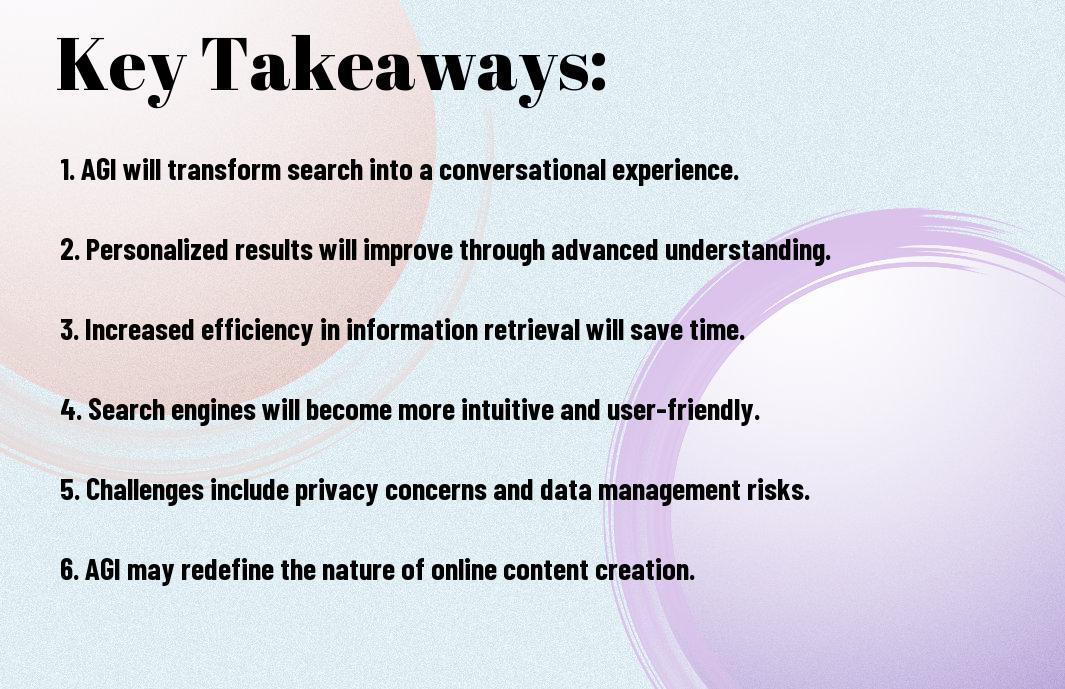
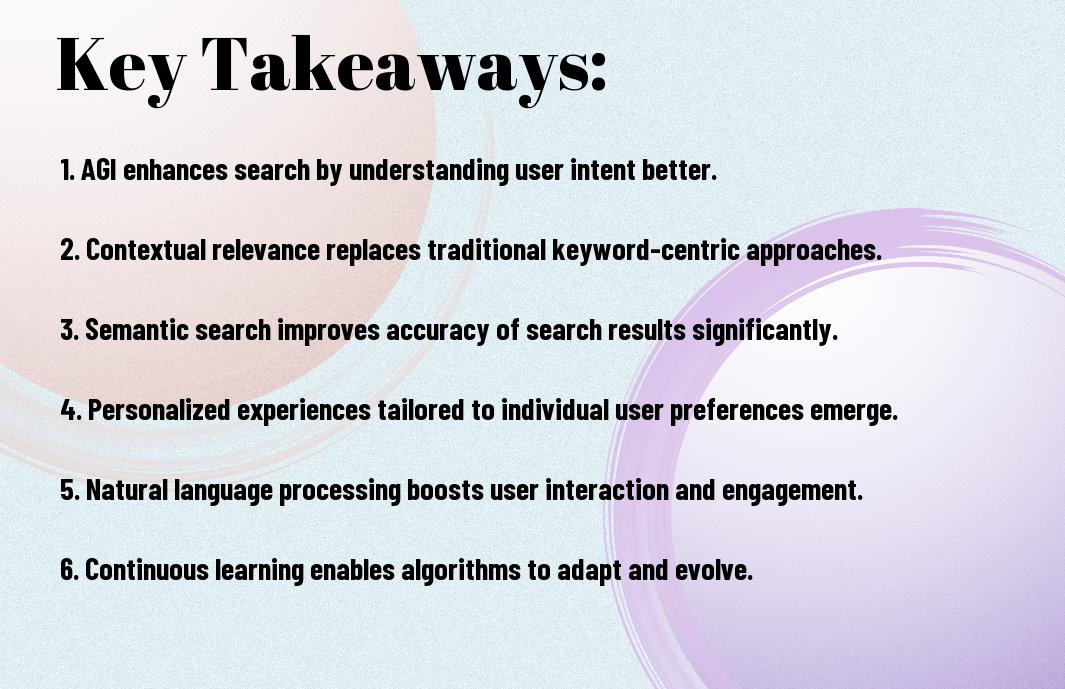
Key Takeaways:

  • The development of Artificial General Intelligence (AGI) is revolutionizing search engine algorithms by shifting the focus from keyword-based searches to context-based searches, allowing for more accurate and relevant results.
  • AGI-enabled search engines can now understand the nuances of human language, including intent, tone, and semantics, enabling them to provide more personalized and informative search results.
  • The integration of AGI in search engine algorithms is expected to significantly improve the overall search experience, enabling users to find relevant information more efficiently and effectively, and opening up new possibilities for applications such as voice search and natural language processing.
Evolution of Search Algorithms

Your search engine experience has undergone significant changes over the years, driven by advancements in artificial intelligence and natural language processing.

Keyword-Based Legacy Systems

Across the early days of search, you relied on keyword-based systems that matched your queries to relevant web pages, often yielding irrelevant results.

Semantic Search Emergence

For instance, you may have noticed that search engines now understand the context and intent behind your searches, providing more accurate results.

Legacy systems are being replaced by semantic search, which enables search engines to comprehend the nuances of your search queries, taking into account factors like synonyms, related concepts, and entity disambiguation, allowing you to find more relevant information with ease.

AGI’s Role in Modern Search

Assuming you’re familiar with the basics of search engine algorithms, you’ll notice that Artificial General Intelligence (AGI) is revolutionizing the way search engines operate, enabling them to understand your queries more accurately.

Neural Networks and Pattern Recognition

Artificially intelligent systems, akin to AGIs, are being used to improve search results by recognizing patterns in your search history and behavior, allowing for more personalized results.

Contextual Understanding Mechanisms

Contextually, you’ll find that AGI-powered search engines are able to comprehend the nuances of your search queries, taking into account the context in which you’re searching, to provide more relevant results.

Pattern recognition plays a significant role in contextual understanding mechanisms, as you’ll notice that AGI-powered search engines can identify relationships between your search queries and the content you engage with, allowing them to refine your search results and provide more accurate answers to your questions.

Natural Language Processing Revolution

Unlike traditional search methods, natural language processing (NLP) enables you to interact with search engines in a more human-like way, allowing your queries to be more nuanced and complex.

Conversational Search Queries

Along with the rise of voice assistants, you’re now able to ask search engines questions in a conversational tone, and receive relevant results that take into account your previous queries and context.

Intent Recognition Systems

For instance, intent recognition systems are being developed to better understand your search intent, enabling search engines to provide more accurate and personalized results that cater to your specific needs.

Processing your search queries in real-time, these systems analyze your language patterns, behavior, and preferences to identify your intent, and then use this information to retrieve the most relevant results, making your search experience more efficient and effective, and allowing you to find what you’re looking for quickly and easily.

Context-Aware Search Architecture

Not surprisingly, the development of context-aware search architecture is a key aspect of AGI’s transformation of search engine algorithms, enabling you to receive more accurate and relevant search results.

User Behavior Analysis

Behaving in a way that is intuitive to your search habits, user behavior analysis allows search engines to understand your preferences and tailor results accordingly, making your search experience more personalized.

Adaptive Learning Components

The ability of search engines to adapt to your behavior is made possible by adaptive learning components, which enable them to learn from your interactions and improve their performance over time, providing you with better results.

For instance, as you continue to use a search engine, its adaptive learning components can identify patterns in your search queries and adjust its algorithms to provide you with more relevant results, taking into account your location, search history, and other factors that influence your search behavior, allowing you to find what you’re looking for more efficiently.

Machine Learning Integration

Many search engine algorithms are now incorporating machine learning to improve their accuracy and efficiency, allowing you to receive more relevant search results. This integration enables your search queries to be understood in a more nuanced way, taking into account context and intent.

Deep Learning Models

One of the key technologies driving this shift is deep learning models, which you can leverage to analyze complex patterns in your search data, enabling more accurate predictions and personalized results.

Predictive Search Capabilities

Models like these are being used to develop predictive search capabilities, allowing you to see potential search results before you even finish typing, saving you time and effort in your search process.

Further, as you use predictive search capabilities, you’ll notice that the algorithms are able to learn your preferences and adapt to your behavior, providing you with an increasingly personalized experience that streamlines your search process and helps you find what you’re looking for more efficiently.

Search Personalization

Now, as you research into the world of search personalization, you’ll find that AI is revolutionizing the way search engines cater to your needs, and you can learn more about How AI Is Transforming the SEO Landscape to improve your online presence.

User Profile Analysis

Assessing your search history and behavior, search engines create a unique profile to provide tailored results, allowing you to find what you’re looking for more efficiently.

Dynamic Result Generation

About the time you start searching, algorithms kick in to generate results based on your profile, ensuring a more personalized experience.

But as you explore dynamic result generation further, you’ll discover that it’s not just about providing relevant results, it’s also about anticipating your needs and adapting to your search patterns over time, making your search experience more intuitive and effective.

Final Words

To wrap up, you now understand how AGI is transforming search engine algorithms, enabling more accurate results. As you optimize your online presence, consider the shift from keywords to context. For more insights, visit The Impact of AI on Search Engine Algorithms & Optimization to enhance your understanding of the evolving search landscape and improve your website’s visibility, ultimately boosting your online success.

FAQ

Q: What is the main difference between traditional search engine algorithms and those powered by Artificial General Intelligence (AGI)?

A: The primary distinction lies in their approach to understanding and processing user queries. Traditional algorithms rely heavily on keyword matching, whereas AGI-powered algorithms focus on comprehending the context and intent behind the search query, providing more accurate and relevant results. This shift from keyword-centric to context-centric search enables a more human-like understanding of the query, leading to improved search outcomes.

Q: How does AGI enhance the search engine’s ability to handle natural language queries?

A: AGI integrates advanced natural language processing (NLP) capabilities, allowing search engines to better understand the nuances of human language, including idioms, colloquialisms, and context-dependent expressions. This enables the search engine to accurately interpret the user’s intent, even when the query is phrased in a complex or ambiguous manner, and provide results that are more relevant to the user’s needs.

Q: What role does machine learning play in the development of AGI-powered search engine algorithms?

A: Machine learning is a fundamental component in the development of AGI-powered search algorithms, as it enables the system to learn from vast amounts of data and improve its performance over time. By analyzing user behavior, search patterns, and feedback, the algorithm can refine its understanding of context and intent, leading to more accurate and personalized search results. This continuous learning process allows the search engine to adapt to evolving user needs and preferences.

Q: How will the transformation to AGI-powered search engine algorithms impact the way content is created and optimized for search engines?

A: The shift towards AGI-powered search algorithms will likely lead to a greater emphasis on creating high-quality, contextually relevant content that provides value to users. Content creators will need to focus on producing well-structured, engaging, and informative content that addresses the user’s intent and needs, rather than simply optimizing for specific keywords. This change will promote a more user-centric approach to content creation, ultimately leading to a better search experience.

Q: What are the potential benefits of AGI-powered search engine algorithms for users and businesses alike?

A: The benefits of AGI-powered search algorithms are numerous. For users, these algorithms provide more accurate and relevant search results, saving time and effort. For businesses, they offer increased visibility and opportunities to connect with their target audience, as the search engine can better understand the context and intent behind user queries. Additionally, AGI-powered search algorithms can help reduce the noise and spam that often accompany traditional keyword-based search results, leading to a more trustworthy and efficient search experience for all parties involved.


The Future Of Search Engines In An AGI World – Opportunities And Challenges

As you explore the evolving landscape of search engines, you’ll discover how Artificial General Intelligence (AGI) is poised to revolutionize the way you find information. Your search experience is about to become more intuitive and personalized. To understand the impact of AGI on search engines, you can learn more about AI in Search Engines: The Future of Finding Information, and how it will change your interaction with search engines forever.

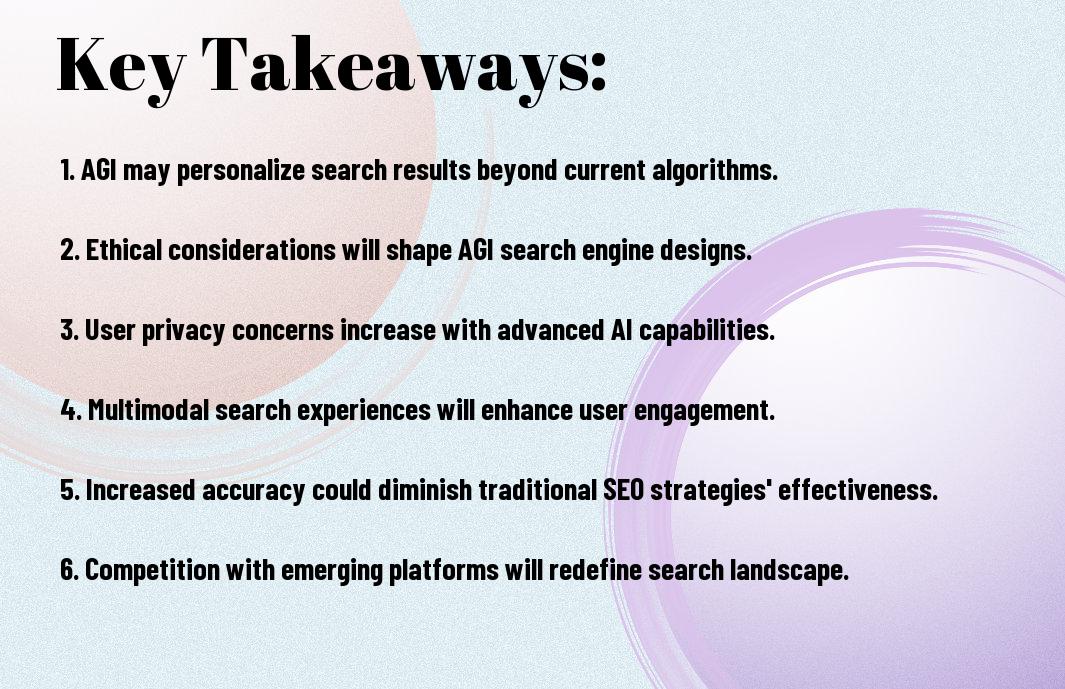
Key Takeaways:

  • The integration of Artificial General Intelligence (AGI) into search engines is expected to revolutionize the way information is retrieved and presented, offering more personalized and accurate results based on complex user queries and preferences.
  • AGI-powered search engines will face significant challenges, including ensuring the transparency and explainability of their decision-making processes, as well as addressing potential biases and ethical concerns that may arise from their autonomous operations.
  • The development of AGI-driven search engines will also create new opportunities for innovation, such as enhanced natural language understanding, improved handling of ambiguous queries, and the ability to provide more comprehensive and relevant search results, ultimately changing the landscape of information retrieval and access.

Current Search Engine Landscape

While exploring the current search engine landscape, you’ll notice a mix of traditional and modern approaches. You can see how search engines have evolved over time, incorporating new technologies to improve user experience.

Traditional Search Architecture

Among the various components, you’ll find that traditional search architecture relies on keyword-based indexing and retrieval methods. You can observe how this approach has been the foundation of search engines for years, providing a basic framework for information retrieval.

Machine Learning Integration

About the latest advancements, you’ll discover that machine learning integration has become a key aspect of modern search engines. You can learn how this technology enhances search results, providing more accurate and personalized responses to your queries.

Architecture of machine learning-integrated search engines involves complex algorithms and natural language processing techniques, allowing you to receive more relevant results. You can explore how this integration enables search engines to better understand your search intent, providing a more efficient and effective search experience.

AGI’s Impact on Search Technology

Clearly, the emergence of Artificial General Intelligence (AGI) will significantly alter the search technology landscape, enabling you to access more accurate and personalized results, and you will witness a paradigm shift in how you interact with search engines.

Neural Processing Evolution

On the heels of AGI development, you will see significant advancements in neural processing, allowing your search queries to be processed at unprecedented speeds and enabling you to access complex information more efficiently.

Semantic Understanding Revolution

Evolution of semantic understanding will enable search engines to comprehend the context and intent behind your search queries, providing you with more relevant results and enhancing your overall search experience.

And as you examine deeper into the possibilities of semantic understanding, you will discover that AGI-powered search engines can analyze complex patterns and relationships, allowing you to uncover new insights and connections that were previously unknown, thereby revolutionizing the way you approach search and discovery.

Personalization and Context Awareness

All search engines will need to adapt to your individual needs in an AGI world, providing personalized results based on your behavior, preferences, and search history.

Individual User Modeling

By analyzing your search patterns, search engines will create detailed models of your interests, allowing them to provide more accurate and relevant results tailored to your needs.

Adaptive Search Responses

Contextually aware search engines will adjust their responses based on your current situation, taking into account your location, device, and other environmental factors to deliver the most useful information.

Due to the advanced capabilities of AGI, you can expect search engines to learn from your interactions and adapt their responses over time, providing an increasingly personalized and intuitive search experience that meets your unique needs and preferences.

Privacy and Ethical Considerations

Once again, you will face numerous challenges as AGI-powered search engines become more prevalent, and your personal data will be at the forefront of these concerns, prompting you to think about how your information is being used and protected.

Data Protection Challenges

Challenging issues arise when considering how your data will be safeguarded in an AGI-driven search engine landscape, and you must consider the potential risks and consequences of relying on these advanced technologies to manage your personal information.

Ethical Framework Development

Below the surface of AGI-powered search engines lies a complex web of ethical considerations that you must navigate, and developing a robust framework to address these concerns will be imperative to ensuring that your rights and interests are protected.

Plus, as you examine deeper into the development of ethical frameworks for AGI-powered search engines, you will need to consider multiple stakeholders’ perspectives, including users, developers, and regulators, to create a comprehensive and effective set of guidelines that balance innovation with accountability and transparency, ultimately shaping the future of search engines in a way that aligns with your values and priorities.

Search Engine Business Models

Now, as you consider the impact of AGI on search engines, you can explore how business models will adapt, such as learning more about The Future of AI and Search to stay ahead.

Revenue Structure Evolution

About the changes in revenue structure, you will notice a shift towards more personalized and targeted advertising, allowing you to better understand your audience and tailor your content accordingly.

Market Competition Dynamics

Against the backdrop of AGI, you will face increased competition, as new players enter the market with innovative solutions, forcing you to rethink your strategies and stay competitive.

Also, as you navigate the evolving market competition dynamics, you will need to focus on developing unique value propositions and building strong relationships with your users to maintain your market share and stay ahead of the competition.

Human-AGI Search Interaction

Unlike traditional search engines, you will interact with AGI-powered search engines in a more intuitive way, as you can learn more about What is the Future of Search? to understand the evolving landscape.

Interface Transformation

Interacting with AGI search engines will transform your search experience, as you will have more visual and voice-based interfaces to choose from, making it easier for you to find what you need.

Natural Language Processing

Naturally, you will expect AGI search engines to understand your search queries better, using advanced natural language processing to provide more accurate results.

To take full advantage of AGI-powered search engines, you need to understand how natural language processing works, and how it can help you refine your search queries to get the most relevant results, allowing you to make the most of your search experience.

Conclusion

Upon reflecting on the future of search engines in an AGI world, you will encounter numerous opportunities and challenges. As you navigate this landscape, your ability to adapt to advancements in artificial general intelligence will be important. You can expect significant changes in how search engines operate, and your understanding of these shifts will be vital to harnessing their potential and addressing the challenges that arise, ultimately shaping your experience in this new era of search.

FAQ

Q: What impact will the emergence of Artificial General Intelligence (AGI) have on the future of search engines?

A: The emergence of AGI is expected to significantly impact the future of search engines, enabling them to understand and process natural language more effectively, and provide more accurate and personalized search results. AGI-powered search engines will be able to learn and adapt to user behavior, improving their performance over time. Additionally, AGI will enable search engines to move beyond traditional keyword-based search and provide more intuitive and conversational interfaces.

Q: How will AGI-powered search engines change the way we interact with information online?

A: AGI-powered search engines will revolutionize the way we interact with information online, enabling users to ask complex questions and receive detailed, context-specific answers. These search engines will be able to understand the nuances of human language, including idioms, sarcasm, and figurative language, and provide more accurate and relevant results. Furthermore, AGI-powered search engines will enable users to engage in multi-turn conversations, allowing for more in-depth and personalized interactions with information.

Q: What are some of the opportunities and challenges associated with the development of AGI-powered search engines?

A: The development of AGI-powered search engines presents several opportunities, including improved search accuracy, enhanced user experience, and increased accessibility. However, there are also several challenges, such as ensuring the transparency and explainability of AGI decision-making processes, addressing potential biases and errors, and protecting user privacy and security. Additionally, the development of AGI-powered search engines will require significant advances in areas such as natural language processing, machine learning, and human-computer interaction.

Q: How will AGI-powered search engines address issues of misinformation and disinformation online?

A: AGI-powered search engines will have the potential to significantly improve the detection and mitigation of misinformation and disinformation online. By analyzing patterns of language use and user behavior, AGI-powered search engines will be able to identify and flag potentially misleading or false information, and provide users with more accurate and trustworthy results. Additionally, AGI-powered search engines will be able to provide users with more context and background information, enabling them to make more informed decisions about the information they encounter online.

Q: What role will human evaluators and fact-checkers play in the development and maintenance of AGI-powered search engines?

A: Human evaluators and fact-checkers will play a vital role in the development and maintenance of AGI-powered search engines, ensuring that these systems are fair, accurate, and unbiased. Human evaluators will be necessary to provide training data, test and validate AGI-powered search engine performance, and identify areas for improvement. Additionally, human fact-checkers will be necessary to verify the accuracy of information provided by AGI-powered search engines, and to correct any errors or biases that may arise. By combining the strengths of human and artificial intelligence, AGI-powered search engines will be able to provide more accurate, reliable, and trustworthy results.

Unlocking The Potential – How AGI Enhances User Experience In Search Engines

As you navigate through the vast online landscape, your search engine experience is about to get a significant boost. With the integration of Artificial General Intelligence (AGI), your searches will become more efficient and personalized. You will enjoy more accurate results, tailored to your specific needs, making your online journey smoother and more productive. Your interaction with search engines is on the cusp of a revolution, and understanding how AGI enhances your user experience is key to unlocking its full potential.

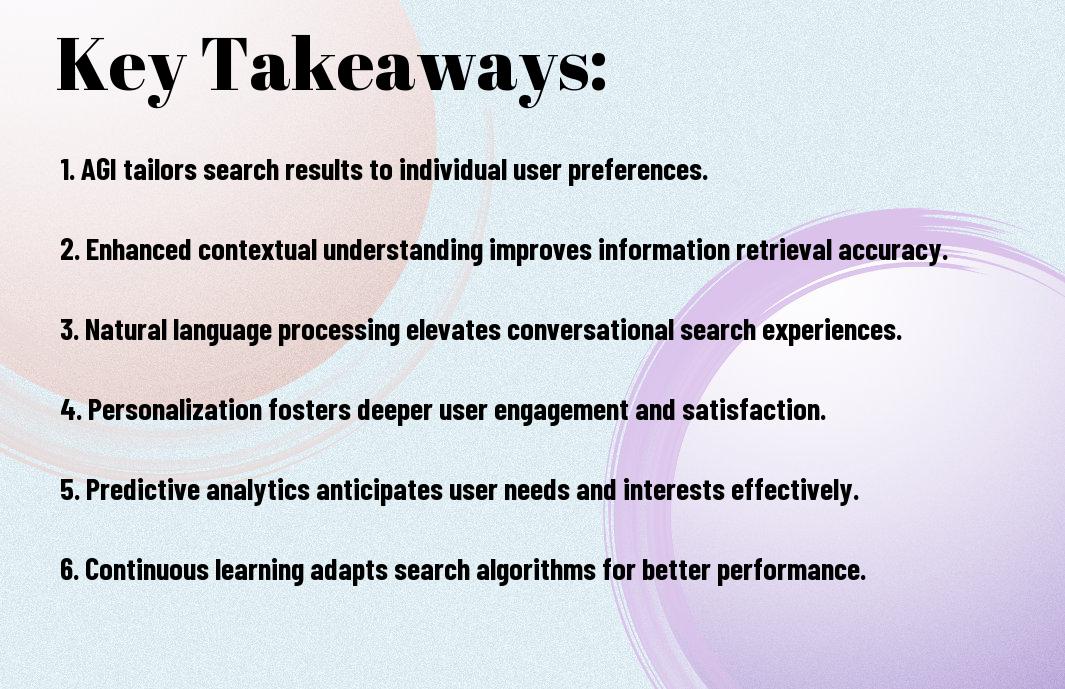
Key Takeaways:

  • Advanced search engines powered by Artificial General Intelligence (AGI) can significantly enhance user experience by providing more accurate and personalized search results, allowing users to find relevant information more efficiently.
  • AGI-driven search engines can also improve the overall search process by offering features such as natural language understanding, intent recognition, and context-aware searching, making it easier for users to express their search queries and receive relevant results.
  • The integration of AGI in search engines has the potential to revolutionize the way users interact with online information, enabling more intuitive and effective search experiences that can lead to increased user satisfaction and engagement.

The Evolution of Search Engine Intelligence

Before the advent of Artificial General Intelligence (AGI), search engines relied on basic algorithms to provide results, often yielding irrelevant or outdated information, which limited your ability to find what you were looking for.

Traditional Search Limitations

Along these lines, traditional search engines struggled to understand the nuances of your search queries, failing to capture the context and intent behind your words, leading to frustrating and unproductive search experiences.

AGI’s Revolutionary Approach

After the integration of AGI, search engines began to exhibit human-like intelligence, enabling them to comprehend your search queries with unprecedented accuracy and provide personalized results that cater to your specific needs and preferences.

A key aspect of AGI’s revolutionary approach is its ability to learn and adapt to your behavior, allowing it to refine its search results over time and provide you with an increasingly tailored experience, making it easier for you to find the information you need quickly and efficiently.

Core Components of AGI-Powered Search

Clearly, to unlock the full potential of AGI-powered search, you need to understand its core components. You can learn more about How Can We Enhance User Experience Through Generative AI and its applications in search engines.

Neural Processing Systems

Beside the development of algorithms, neural processing systems play a significant role in AGI-powered search, enabling you to process complex queries efficiently.

Contextual Understanding Mechanisms

Mechanisms such as natural language processing allow you to better understand the context of your search queries, providing more accurate results.

With contextual understanding mechanisms, you can expect more personalized and relevant search results, as the system can understand the nuances of your query and provide answers that are tailored to your needs, making your search experience more efficient and effective.

Personalization Through AGI

Not only does AGI enhance search engine user experience, but it also provides personalized results. You can expect tailored suggestions based on your search history and behavior.

User Behavior Analysis

Assessing your interactions with the search engine, AGI identifies patterns and preferences, allowing for more accurate results. You will notice improvements in the relevance of your search results.

Adaptive Learning Patterns

Tailoring the search experience to your needs, AGI adjusts its algorithms to fit your behavior. You will find that the search engine learns your habits and adapts to provide better results.

This adaptive learning enables the search engine to refine its understanding of your preferences over time, allowing it to make more informed decisions about the results it displays. As you continue to use the search engine, you will notice that the results become increasingly relevant to your interests and needs, providing a more efficient and effective search experience.

Natural Language Processing Advancement

After advancements in natural language processing, you can expect significant improvements in search engine user experience, as seen in Unlocking the Power of AI in SEO – by Anna Juhász, enabling you to find relevant results more efficiently.

Semantic Interpretation

Following the development of semantic interpretation, you will be able to search using natural language, and search engines will understand your intent, providing more accurate results.

Multilingual Capabilities

After the integration of multilingual capabilities, you will be able to search in your native language, breaking language barriers and enhancing your search experience.

With multilingual capabilities, you can access a broader range of information, and search engines will be able to provide you with results from diverse sources, giving you a more comprehensive understanding of your search query, and enabling you to make more informed decisions based on your search results.

Real-Time Learning and Adaptation

For enhanced user experience, AGI enables search engines to learn and adapt in real-time, allowing you to get more accurate results. You can learn more about How to Enhance Search Engine Rankings Using AI to improve your search engine rankings.

Dynamic Result Optimization

Contrary to traditional methods, AGI optimizes search results dynamically, ensuring you get the most relevant information. This leads to a more personalized experience, increasing your satisfaction with the search engine.

Feedback Integration Systems

Resulting from user interactions, feedback integration systems help AGI to refine its understanding of your preferences, enabling it to provide better results over time.

Hence, as you continue to use the search engine, you’ll notice improvements in the accuracy and relevance of the results, making your search experience more efficient and effective.

Privacy and Security Framework

All search engines must prioritize your privacy and security when integrating AGI, ensuring that your personal data is protected and used responsibly.

Data Protection Measures

Besides the benefits of AGI, you should also consider the data protection measures that are in place to safeguard your information, such as encryption and secure storage.

Ethical Implementation Guidelines

Behind every successful AGI implementation, you will find a set of guidelines that ensure ethical use of your data, prioritizing transparency and accountability in all interactions.

A key aspect of these guidelines is that they provide you with control over your personal data, allowing you to make informed decisions about how it is used and shared, and giving you the confidence to trust the search engine with your information, as you navigate and interact with the platform, you can be assured that your privacy and security are being protected.

Conclusion

Summing up, you now understand how AGI enhances your search engine experience. As you explore the capabilities of Artificial General Intelligence, you’ll discover how it tailors results to your needs, making your searches more efficient and effective. With AGI, your interactions with search engines become more intuitive, providing you with a personalized and seamless experience, ultimately transforming the way you find and process information.

FAQ

Q: What is AGI and how does it relate to search engines?

A: AGI, or Artificial General Intelligence, refers to a type of artificial intelligence that possesses the ability to understand, learn, and apply knowledge across a wide range of tasks, similar to human intelligence. In the context of search engines, AGI has the potential to revolutionize the user experience by enabling more accurate, personalized, and intuitive search results. By leveraging AGI, search engines can better comprehend the nuances of human language, intent, and behavior, ultimately providing users with more relevant and helpful information.

Q: How does AGI enhance the user experience in search engines?

A: AGI enhances the user experience in search engines in several ways. Firstly, it enables more accurate search results by better understanding the context and intent behind a user’s search query. Secondly, AGI-powered search engines can provide personalized results tailored to an individual’s preferences, search history, and behavior. Additionally, AGI can help to improve the overall search interface, making it more intuitive and user-friendly. This can include features such as natural language processing, voice search, and predictive suggestions, making it easier for users to find what they are looking for.

Q: What are the benefits of using AGI in search engines for users?

A: The benefits of using AGI in search engines for users are numerous. For instance, AGI-powered search engines can provide more relevant and accurate search results, saving users time and effort. Additionally, AGI can help to reduce the amount of irrelevant or misleading information that users are exposed to, improving the overall quality of their search experience. Furthermore, AGI can enable more personalized and interactive search experiences, such as virtual assistants and chatbots, which can help users to find what they are looking for more efficiently.

Q: How does AGI handle complex search queries and ambiguous keywords?

A: AGI-powered search engines are designed to handle complex search queries and ambiguous keywords with ease. By leveraging advanced natural language processing and machine learning algorithms, AGI can better understand the nuances of human language and intent. This enables AGI to disambiguate keywords, identify relevant context, and provide more accurate search results, even for complex or ambiguous search queries. Additionally, AGI can learn from user behavior and feedback, allowing it to improve its performance over time and provide more accurate results for complex searches.

Q: What is the future of AGI in search engines and how will it continue to evolve?

A: The future of AGI in search engines is exciting and rapidly evolving. As AGI technology continues to advance, we can expect to see even more sophisticated and personalized search experiences. This may include the integration of emerging technologies such as computer vision, augmented reality, and the Internet of Things (IoT). Additionally, AGI-powered search engines may begin to incorporate more human-like intelligence, such as common sense, reasoning, and decision-making abilities. As a result, the user experience in search engines will become increasingly intuitive, interactive, and helpful, revolutionizing the way we search for and interact with information online.

Rise Of The Machines – What AGI Means For The Future Of Online Search

As you navigate the ever-evolving digital landscape, you’re likely aware of the growing presence of Artificial General Intelligence (AGI) in your online interactions. You may wonder how AGI will impact your search experiences, and what this means for the future of online search. Your queries will soon be answered by more intelligent and human-like systems, changing the way you find and interact with information online. You will need to adapt to these changes to make the most of your online searches.

Key Takeaways:

  • The emergence of Artificial General Intelligence (AGI) is poised to revolutionize the future of online search by enabling more sophisticated and human-like interactions between users and search engines, potentially leading to more accurate and relevant search results.
  • AGI-powered search engines may be able to understand the context and intent behind a user’s search query, allowing for more personalized and informative responses, and potentially disrupting the traditional keyword-based search paradigm.
  • The integration of AGI into online search may also raise important questions about the role of human judgment and oversight in the search process, and the potential risks and benefits of relying on machine intelligence to curate and prioritize information online.

The Evolution of Search Technology

A significant transformation is underway in the world of online search, and you are about to witness a major shift in how you interact with search engines. As you explore the latest advancements, you’ll notice that search technology has come a long way, paving the way for more sophisticated and intelligent search capabilities.

From Keywords to Neural Networks

Approximately a decade ago, you were relying on basic keyword searches to find what you needed online. Now, with the advent of neural networks, you can expect more accurate and personalized results, making your search experience more efficient and effective.

The Current State of Search Engines

Essentially, engines like Google are continually updating their algorithms to improve your search experience, incorporating machine learning and natural language processing to provide more relevant results. You can see this in action when you notice how search engines can now understand the context and intent behind your searches.

Another aspect of the current state of search engines is the increasing use of artificial intelligence to enhance your search results. As you search for information online, you’ll notice that search engines are now able to provide more personalized and accurate results, taking into account your search history and preferences, making your overall search experience more tailored to your needs.

AGI’s Impact on Search Mechanics

While you navigate the evolving online landscape, AGI is poised to revolutionize search mechanics. As you explore the potential of AGI, consider how AI means the end of internet search as we’ve known it, transforming your online interactions.

Natural Language Processing Revolution

Influencing your search experience, natural language processing advances will enable more intuitive interactions, allowing you to communicate with machines in a more human-like way, making your searches more effective.

Contextual Understanding and Intent

Before you even initiate a search, AGI-powered systems will anticipate your needs, providing personalized results that cater to your unique context and intent, making your search experience more seamless and relevant to your needs.

Understanding the nuances of your search queries, AGI will be able to discern your intent, providing more accurate and relevant results, saving you time and effort in finding the information you need, and enabling you to make more informed decisions based on your search results.

Reshaping User Experience

Now, as you explore the potential of Artificial General Intelligence (AGI), you can learn more about What is Artificial General Intelligence (AGI)? and its impact on online search. This technology will revolutionize the way you interact with search engines, making your experience more intuitive and personalized.

Conversational Search Interfaces

Besides traditional text-based searches, you will soon be using conversational interfaces that mimic human-like discussions, allowing you to find information more naturally and efficiently.

Predictive Information Delivery

To enhance your search experience, AGI-powered systems will anticipate your needs, providing you with relevant information before you even ask for it, saving you time and effort.

It is likely that predictive information delivery will become a standard feature in online search, allowing you to access the information you need quickly and effortlessly, and enabling you to make informed decisions with your newfound knowledge, as you navigate the vast amounts of data available to you.

Privacy and Ethics in AGI Search

All aspects of online search will be impacted by the rise of Artificial General Intelligence (AGI), including your personal data and privacy. As you consider the implications, you’ll want to think about how AGI will change the way your information is collected and used.

Data Collection Concerns

Concerns about data collection will grow as AGI-powered search engines gather more of your personal information. You will need to consider how your data is being used and protected in this new landscape.

Algorithmic Transparency

The transparency of algorithms used in AGI search will be crucial for you to understand how your search results are generated. You will want to know how your queries are being interpreted and what factors influence the results.

Further, as you research deeper into the world of AGI search, you will realize that algorithmic transparency is key to trusting the results. You will need to understand the decision-making process behind the algorithms to ensure that your search results are unbiased and relevant, allowing you to make informed decisions based on the information provided.

Economic Implications

Not surprisingly, the rise of AGI will have significant economic implications for your business, and you can learn more about how to adapt at AGI Will Make You Irrelevant (How To Future-Proof Yourself).

Search Industry Disruption

Before the AGI revolution, you need to understand how it will disrupt the search industry and impact your online presence.

New Business Models

Behind the scenes, new business models are emerging that will change the way you interact with online search and AGI-powered services.

With the rise of AGI, you will have access to more personalized and efficient search results, and you can leverage this technology to create new revenue streams and business opportunities, allowing you to stay ahead of the curve and maintain a competitive edge in the market.

Human-AGI Collaboration

Once again, you will see a significant shift in how you interact with online search as AGI becomes more prevalent, enabling you to leverage the strengths of both human and artificial intelligence to achieve better results.

Role of Human Expertise

By combining your unique abilities with the capabilities of AGI, you can create a more effective and efficient search process, allowing you to focus on high-level tasks while AGI handles more mundane ones.

Adaptive Learning Systems

Similarly, human intuition and judgment will play a significant role in developing adaptive learning systems that can learn from your behavior and preferences, providing you with more personalized search results.

Collaboration between you and AGI will lead to the development of more sophisticated adaptive learning systems, enabling you to refine your search queries and receive more accurate results, as you work together to improve the overall search experience, and you will be able to see the benefits of this collaboration in your daily online activities.

Final Words

So, as you consider the rise of machines and the impact of AGI on online search, you’ll need to adapt your strategies to stay ahead. You’ll have to rethink your approach to searching and utilizing information, as AGI transforms the way you interact with technology. Your ability to navigate this new landscape will depend on your willingness to learn and evolve, ensuring you remain relevant in a future where machines play an increasingly dominant role in online search.

FAQ

Q: What is AGI and how will it impact the future of online search?

A: Artificial General Intelligence (AGI) refers to a type of artificial intelligence that possesses the ability to understand, learn, and apply its intelligence across a wide range of tasks, similar to human intelligence. The rise of AGI is expected to significantly impact the future of online search, enabling search engines to provide more accurate and personalized results, as well as improving their ability to understand natural language and context. This could lead to a more intuitive and effective search experience for users.

Q: How will AGI change the way search engines process and rank search results?

A: With the integration of AGI, search engines will be able to analyze and understand the context and intent behind a user’s search query, allowing them to provide more relevant and accurate results. AGI will also enable search engines to better evaluate the credibility and reliability of sources, reducing the visibility of low-quality or misleading content. Additionally, AGI-powered search engines may use machine learning algorithms to personalize search results based on individual users’ preferences and search history.

Q: Will AGI replace human search engine optimizers (SEOs) and content creators?

A: While AGI is expected to automate some aspects of search engine optimization (SEO) and content creation, it is unlikely to completely replace human SEOs and content creators. AGI will likely augment the work of humans, freeing them up to focus on higher-level tasks such as strategy and creativity. Human SEOs and content creators will still be needed to provide high-quality, engaging content and to ensure that AGI systems are aligned with human values and goals.

Q: How will AGI impact the user experience of online search, and what new features can we expect to see?

A: The integration of AGI into online search is expected to significantly improve the user experience, enabling users to ask more complex and nuanced questions and receive accurate and relevant results. New features that may emerge include voice-activated search, visual search, and predictive search, which anticipate and provide results based on a user’s likely intent. AGI-powered search engines may also provide more interactive and immersive experiences, such as virtual tours or interactive simulations.

Q: What are the potential risks and challenges associated with the rise of AGI in online search, and how can they be mitigated?

A: The rise of AGI in online search also raises several potential risks and challenges, including the potential for biased or misleading results, job displacement, and increased vulnerability to cyber attacks. To mitigate these risks, it is crucial to develop and implement robust safeguards, such as transparency and accountability mechanisms, to ensure that AGI systems are aligned with human values and goals. Additionally, ongoing investment in education and retraining programs will be necessary to support workers who may be displaced by automation, and to ensure that the benefits of AGI are shared equitably across society.

AGI Vs. Traditional Search Engines – A Comparative Analysis Of Impacts

As you navigate the digital landscape, you’re likely using search engines to find information. You may have noticed the emergence of Artificial General Intelligence (AGI) search engines, which claim to offer more accurate results. Your search experience is about to change, and understanding the differences between AGI and traditional search engines is important. You will learn how these two technologies impact your online searches and what this means for your daily life in this comparative analysis.

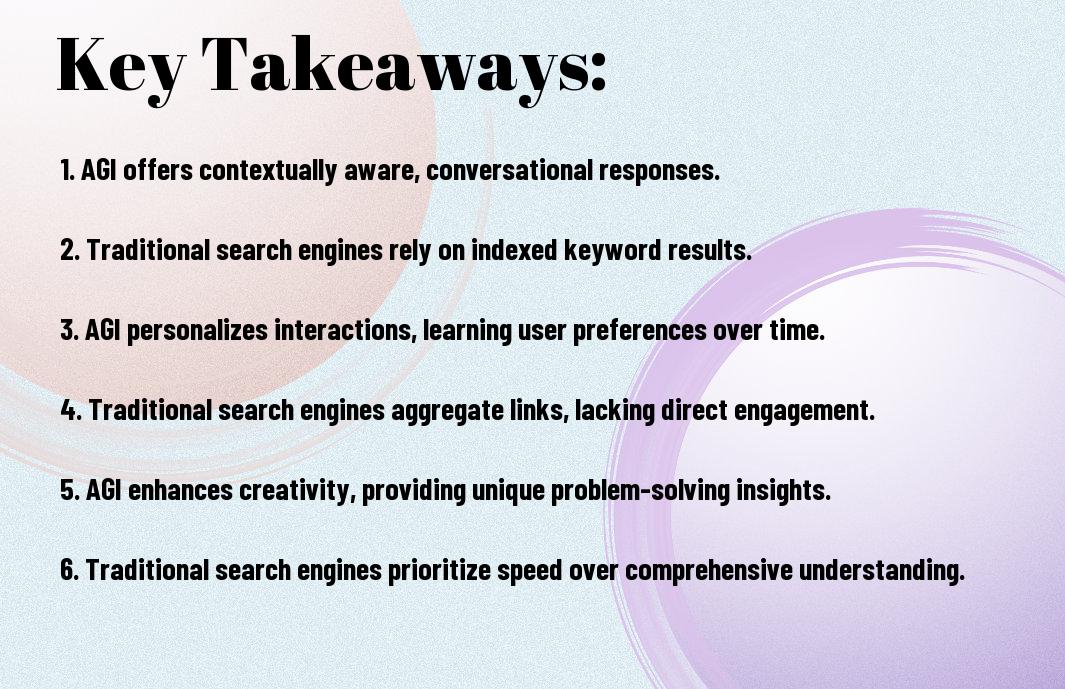
Key Takeaways:

  • AGI (Artificial General Intelligence) has the potential to revolutionize the way we interact with search engines, offering more personalized and accurate results compared to traditional search engines, which rely on algorithms and keyword matching.
  • The impact of AGI on search engines will likely lead to a shift from simple information retrieval to more complex tasks such as question answering, sentiment analysis, and decision-making, enabling users to gain deeper insights and make more informed decisions.
  • The integration of AGI with traditional search engines will also raise important questions about data privacy, bias, and accountability, highlighting the need for developers and policymakers to address these concerns and ensure that the benefits of AGI are realized while minimizing its risks.

Evolution of Search Technology

While exploring the landscape of search technology, you’ll notice significant advancements over the years, transforming the way you access and process information, with traditional search engines being the precursor to more advanced systems.

Traditional Search Engine Architecture

The traditional search engine architecture relies on complex algorithms and keyword indexing to retrieve relevant results, allowing you to find information based on your search queries, but with limitations in understanding context and intent.

AGI-Powered Search Systems

Architecturally, AGI-powered search systems are designed to mimic human-like intelligence, enabling you to interact with search engines in a more natural and intuitive way, using techniques such as natural language processing to understand your search intent.

Consequently, as you probe deeper into AGI-powered search systems, you’ll discover that they can learn and adapt to your search behavior, providing more personalized and accurate results, and even anticipating your information needs, thereby revolutionizing your search experience and redefining the way you interact with search engines.

Core Operational Differences

Any analysis of AGI and traditional search engines must consider their distinct operational frameworks. You will notice that AGI operates on a more complex, integrated level, while traditional search engines rely on indexed databases and algorithms.

Information Processing Methods

Processing information is the foundation of both AGI and traditional search engines, but you will find that AGI’s methods are more dynamic, incorporating various data sources and learning from interactions.

Learning and Adaptation Capabilities

Differences in learning and adaptation are significant, as AGI can evolve based on user behavior and new data, whereas traditional search engines rely on pre-defined algorithms and periodic updates, limiting your search experience.

At the heart of AGI’s learning and adaptation capabilities lies its ability to analyze your search patterns, understand context, and adjust its responses accordingly, providing you with more accurate and personalized results over time, which enhances your overall search experience.

Search Result Quality

All search engines aim to provide you with the most relevant results, but AGI and traditional search engines differ in their approach. You will notice a significant difference in the quality of search results when using these two types of search engines.

Accuracy and Relevance Metrics

By analyzing various metrics, you can evaluate the accuracy and relevance of search results. You will find that AGI-powered search engines often outperform traditional ones in terms of precision and recall, providing you with more accurate results.

Context Understanding

For instance, when you search for something, you expect the search engine to understand the context of your query. You want the search engine to provide results that are relevant to your specific needs, taking into account the nuances of your search query.

Hence, as you explore deeper into the capabilities of AGI-powered search engines, you will discover that they can understand the context of your search query much better than traditional search engines. You will be able to get more personalized and relevant results, making your search experience more efficient and effective, allowing you to find what you need quickly and easily.

User Experience Impact

Once again, you will notice a significant difference in the user experience when comparing AGI to traditional search engines, as AGI provides more intuitive and personalized results, allowing you to find what you’re looking for more efficiently.

Interface and Interaction Models

Around the time you start using AGI, you’ll realize that its interface is more conversational and interactive, enabling you to refine your search queries and receive more accurate results, making your search experience more engaging and effective.

Personalization Capabilities

Interacting with AGI, you’ll discover that its personalization capabilities are more advanced, allowing you to receive tailored results based on your search history and preferences, making your search experience more relevant and useful to you.

The personalization capabilities of AGI also enable you to have a more seamless and integrated search experience, as it can learn your habits and adapt to your needs over time, providing you with more accurate and relevant results, and ultimately saving you time and effort in finding what you’re looking for.

Economic Implications

Despite the potential benefits of AGI, you will need to consider its economic implications, as it may significantly impact your business and investments.

Market Disruption Potential

Around the time AGI is implemented, you can expect significant changes in the market, affecting your search engine usage and online interactions.

Business Model Transformation

About the time you start using AGI, you will notice a shift in business models, as companies adapt to the new technology and its capabilities.

Disruption in traditional business models will force you to rethink your strategies, as AGI changes the way you interact with customers and provide services, ultimately affecting your revenue streams and requiring you to innovate and adapt to stay competitive.

Societal Considerations

Not surprisingly, the rise of AGI and traditional search engines has significant implications for your daily life. You can learn more about Comparing AI Search Engines And Traditional Browsers to understand the differences.

Privacy and Data Handling

Before plunging into the specifics, you should consider how your personal data is handled by these search engines, and how it may impact your online security.

Information Access Equality

Considerations about equal access to information are imperative when evaluating AGI and traditional search engines, as you want to ensure that everyone has a fair chance to access the information they need.

Consequently, you will find that AGI search engines can provide more personalized results, but may also perpetuate existing biases, whereas traditional search engines offer a more standardized experience, but may not account for individual differences, affecting your ability to access relevant information.

Final Words

Taking this into account, you now have a deeper understanding of the impacts of AGI and traditional search engines. Your analysis has shown that AGI offers more personalized and efficient results, while traditional search engines provide a broader scope of information. As you consider your options, you can see that AGI is revolutionizing the way you search and interact with information, making it an crucial tool for your future inquiries. Your choice between AGI and traditional search engines will depend on your specific needs and preferences.

FAQ

Q: What is the primary difference between AGI and traditional search engines in terms of their approach to information retrieval?

A: The primary difference between AGI (Artificial General Intelligence) and traditional search engines lies in their approach to information retrieval. Traditional search engines rely on keyword-based searches, using algorithms to match search queries with relevant web pages. In contrast, AGI-powered search engines use natural language processing and machine learning to understand the context and intent behind a search query, providing more accurate and personalized results.

Q: How do AGI and traditional search engines differ in their ability to handle complex search queries?

A: AGI-powered search engines have the ability to handle complex search queries more effectively than traditional search engines. AGI can understand the nuances of human language, including idioms, metaphors, and context-dependent expressions, allowing it to provide more accurate results for complex queries. Traditional search engines, on the other hand, may struggle with complex queries, relying on keyword matching rather than true understanding.

Q: What are the implications of AGI on the user experience compared to traditional search engines?

A: The implications of AGI on the user experience are significant. AGI-powered search engines can provide users with more relevant and personalized results, reducing the need for multiple searches and clicks. Additionally, AGI can learn a user’s preferences and adapt to their behavior over time, providing a more tailored experience. Traditional search engines, while improving, still often require users to sift through numerous results to find what they are looking for.

Q: How do AGI and traditional search engines impact the way businesses and organizations approach search engine optimization (SEO)?

A: The impact of AGI on SEO is substantial. With AGI-powered search engines, businesses and organizations will need to focus on creating high-quality, contextually relevant content that resonates with their target audience. Traditional SEO tactics, such as keyword stuffing and link schemes, may become less effective as AGI-powered search engines prioritize user experience and relevance over technical optimization. Traditional search engines, while still requiring some level of optimization, are more forgiving of these tactics.

Q: What are the potential long-term consequences of widespread adoption of AGI-powered search engines compared to traditional search engines?

A: The potential long-term consequences of widespread adoption of AGI-powered search engines are far-reaching. AGI could fundamentally change the way we interact with information, enabling more efficient and effective discovery of knowledge. Additionally, AGI-powered search engines could lead to new opportunities for businesses and organizations to connect with their audiences, driving innovation and growth. However, there are also concerns about the potential for AGI to exacerbate existing biases and inequalities, highlighting the need for careful consideration and regulation as these technologies continue to evolve.

Skip to content