
As you launch on developing your next application, you’re likely considering the role of artificial intelligence in enhancing user experience. You want your app to be intelligent, intuitive, and innovative. Your goal is to create an app that not only leverages AI capabilities but also provides a seamless and personalized experience for your users. You will learn how to harness the power of AI to drive your app’s development and success, and this post will guide you through the process with expert tips and strategies.
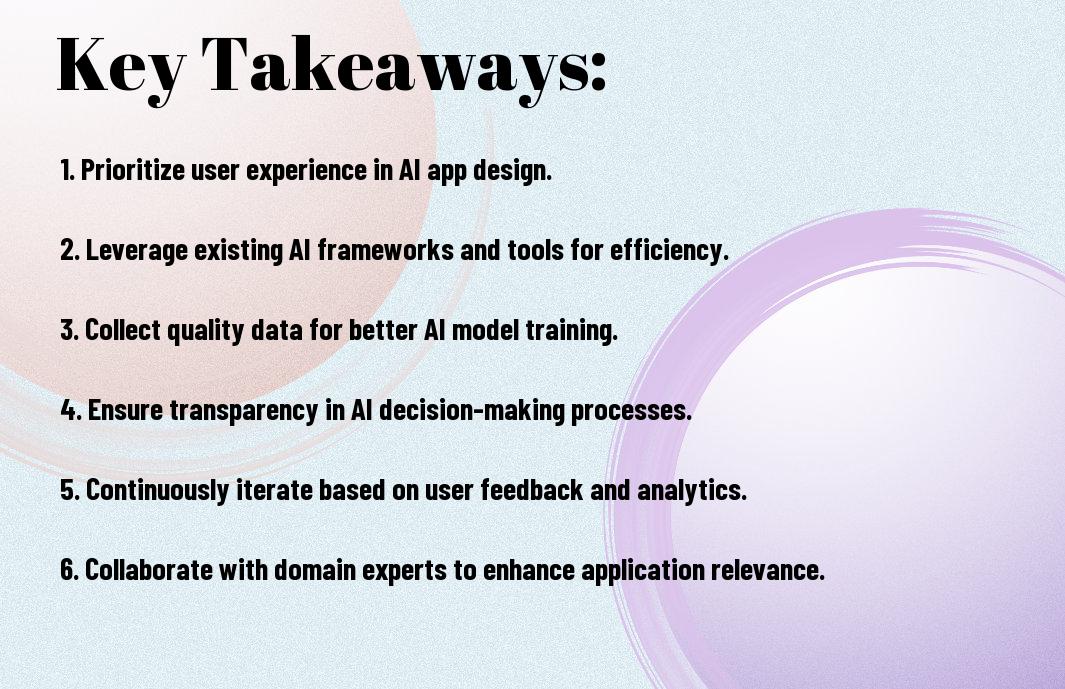
Key Takeaways:
- Define a clear AI strategy that aligns with your business goals and objectives, ensuring that AI is integrated into the core of your application from the outset.
- Focus on developing a robust data infrastructure to support AI capabilities, including data collection, processing, and analysis.
- Design intuitive user interfaces that seamlessly integrate AI-driven features, providing a seamless and engaging user experience.
- Leverage cloud-based services and platforms to streamline AI development, deployment, and maintenance, reducing costs and increasing scalability.
- Continuously monitor and evaluate AI performance, using metrics and feedback to refine and improve AI-driven features and capabilities over time.
Core AI Components for Modern Applications
To build AI-first apps, you need to understand the core components that drive their functionality. Your application’s success relies on the effective integration of these components, which include machine learning, natural language processing, and computer vision.
Machine Learning Integration Points
Points to consider when integrating machine learning into your app include data quality, model selection, and training methods. You should carefully evaluate your data and choose the most suitable model to achieve your desired outcomes, ensuring your app provides accurate and reliable results.
Natural Language Processing Elements
Around the concept of natural language processing, you’ll find various elements that enable your app to understand and generate human-like language. You can leverage these elements to create chatbots, sentiment analysis tools, and language translation features that enhance your app’s user experience.
Modern natural language processing techniques allow you to analyze and generate text, speech, and dialogue, enabling your app to interact with users in a more intuitive and personalized way. You can use these techniques to build conversational interfaces, such as voice assistants or chatbots, that understand and respond to user input, making your app more engaging and user-friendly.
Data Architecture Fundamentals
There’s no denying that a well-designed data architecture is important for building AI-first apps, as it enables you to efficiently process and analyze large amounts of data, which is necessary for training AI models.
Data Collection and Processing
Gathering data from various sources is key to building a robust AI model, and you should consider how to integrate and process your data in a way that supports your app’s functionality.
Model Training Infrastructure
At the heart of your AI-first app is the model training infrastructure, which you will use to train and deploy your AI models, and you should design it to be scalable and flexible.
Considering your model training infrastructure, you will want to ensure that it can handle large amounts of data and scale to meet the needs of your app, and you should also consider using cloud-based services to reduce costs and improve efficiency, allowing you to focus on developing and improving your AI models.
AI Development Best Practices
After laying the foundation for your AI-first app, you’ll want to focus on best practices that ensure its success. You’ll need to consider several factors, including model selection, optimization, and scalability, to create a robust and efficient application.
Model Selection and Optimization
Alongside your development process, you should evaluate various models to determine which one best suits your app’s requirements, considering factors such as accuracy, complexity, and computational resources, to optimize your AI’s performance.
Scalability Considerations
Before deploying your app, you should think about scalability, ensuring your AI system can handle increased traffic and data, and that your infrastructure can adapt to growing demands without compromising performance or user experience.
With scalability in mind, you can design your app to handle large volumes of data and user requests, allowing you to expand your user base without worrying about your AI’s ability to keep up, and you should plan for potential bottlenecks and develop strategies to mitigate them, ensuring your app’s continued success.

User Experience in AI Applications
Keep in mind that a well-designed user experience is imperative for AI-first apps, as it directly impacts user engagement and adoption. You need to consider how your users will interact with your AI-powered app and ensure that it is intuitive and easy to use.
Intuitive AI Interfaces
Interacting with AI systems requires careful consideration of the interface design, as you want your users to be able to easily understand and navigate your app. You should focus on creating simple and consistent interfaces that make it easy for users to access the AI-powered features.
Feedback Loop Implementation
One key aspect of AI-first apps is the implementation of a feedback loop, which allows your app to learn and improve over time based on user interactions. You should design your app to collect and incorporate user feedback, enabling your AI system to refine its performance and provide better results.
A well-implemented feedback loop can significantly enhance the user experience, as it enables your app to adapt to the user’s needs and preferences. As you design your feedback loop, you should consider how you will collect, process, and incorporate user feedback, and ensure that it is seamless and transparent to the user.
Performance Optimization
All AI-first apps require careful performance optimization to ensure seamless user experience. You need to consider factors like latency, throughput, and resource utilization to build a high-performing app.
Resource Management
The key to efficient resource management is allocating resources effectively, allowing your app to scale as needed. You should monitor your app’s resource usage and adjust accordingly to prevent bottlenecks.
Response Time Enhancement
Above all, optimizing response time is vital for your app’s success. You can achieve this by minimizing latency, optimizing database queries, and leveraging caching mechanisms to reduce load times.
Understanding how your app’s architecture impacts response time is necessary for making informed optimization decisions. You should analyze your app’s workflow, identify bottlenecks, and apply techniques like parallel processing, content delivery networks, and edge computing to enhance response times, ultimately improving your users’ experience.
Security and Ethics
Now that you’re building AI-first apps, considering security and ethics is vital to protect your users’ trust and maintain a positive reputation. You must prioritize these aspects to ensure the long-term success of your application.
Data Privacy Measures
To safeguard your users’ sensitive information, you should implement robust data privacy measures, such as encryption and secure data storage, to prevent unauthorized access and potential data breaches.
Ethical AI Implementation
Between developing and deploying AI models, you need to ensure that your implementation is fair, transparent, and unbiased, avoiding any potential harm to your users or society as a whole.
Privacy is a fundamental right, and as you implement ethical AI, you should consider the potential impact of your app on your users’ personal lives, taking steps to mitigate any negative consequences and maintain their trust in your application, which is important for your success in the long run, and you should be aware of the potential risks and take proactive measures to address them.
Summing up
Conclusively, you now have the knowledge to build AI-first apps that transform your business. You can leverage these tips and strategies to create innovative solutions, enhancing your users’ experience. By prioritizing AI in your development process, you will unlock new opportunities, driving growth and success for your organization. Your ability to adapt and innovate will set you apart, allowing you to stay ahead in a competitive market.
FAQ
Q: What are the key considerations when designing an AI-first app, and how can I ensure a seamless user experience?
A: When designing an AI-first app, it’s imperative to prioritize a user-centered approach, focusing on simplicity, intuitiveness, and transparency. To achieve a seamless user experience, consider the following strategies: implement intuitive navigation, provide clear explanations of AI-driven decisions, and offer personalized feedback mechanisms. Additionally, ensure that your app’s AI components are explainable, fair, and unbiased, and that you have a robust testing and validation process in place to identify and address potential issues.
Q: How can I effectively integrate machine learning models into my AI-first app, and what are some best practices for model training and deployment?
A: To integrate machine learning models into your AI-first app, start by selecting the most suitable model for your specific use case, considering factors such as data quality, complexity, and scalability. Best practices for model training include using high-quality, diverse datasets, monitoring performance metrics, and continuously updating and refining your models. When deploying models, ensure that you have a robust infrastructure in place, leveraging cloud-based services or containerization to enable efficient scaling and management. Furthermore, implement model interpretability techniques, such as feature attribution or model explainability, to provide insights into AI-driven decisions.
Q: What are some strategies for ensuring the security and reliability of AI-first apps, and how can I mitigate potential risks associated with AI-driven decision-making?
A: To ensure the security and reliability of AI-first apps, implement robust data validation and sanitization mechanisms, encrypt sensitive data, and use secure communication protocols. Additionally, consider implementing techniques such as adversarial training, anomaly detection, and redundancy to mitigate potential risks associated with AI-driven decision-making. Regularly monitor your app’s performance, and have a plan in place for addressing potential errors or biases. It’s also imperative to establish clear guidelines and regulations for AI development, deployment, and maintenance, and to invest in ongoing education and training for your development team to stay up-to-date with the latest AI security best practices and standards.


